



FNC-TP
Based on 1 publication(s) in Google Scholar
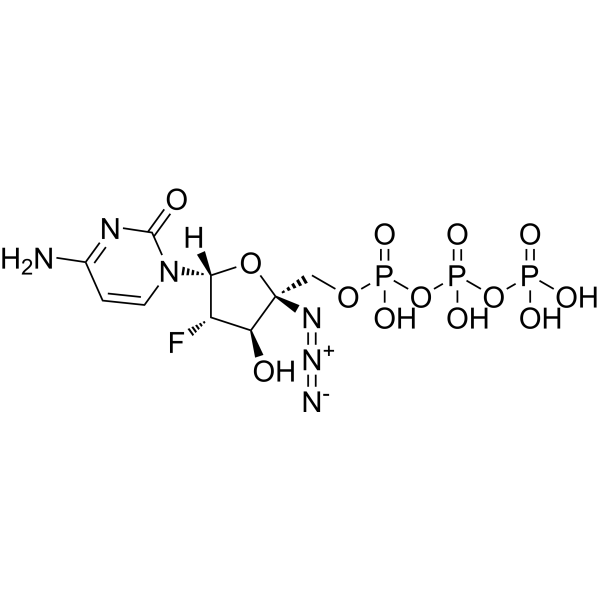
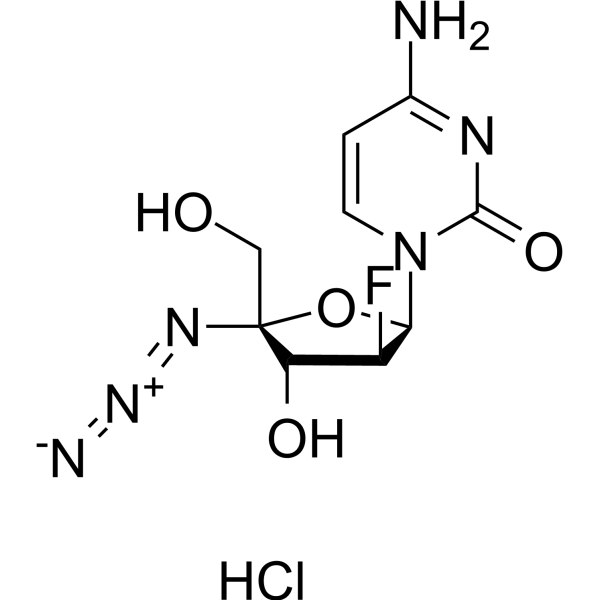
FNC-TP is the intracellular active form of FNC. FNC is a potent nucleoside reverse transcriptase inhibitor (NRTI), with antiviral activity on HIV, HBV and HCV. FNC-TP is a click chemistry reagent, it contains an Azide group and can undergo copper-catalyzed azide-alkyne cycloaddition reaction (CuAAc) with molecules containing Alkyne groups. It can also undergo strain-promoted alkyne-azide cycloaddition (SPAAC) reactions with molecules containing DBCO or BCN groups.
For research use only. We do not sell to patients.
- Purity : 95.0%
- CAS No.: 2457357-99-0
- Formula: C9H14FN6O13P3
- Molecular Weight:526.16
-
Storage:
-20°C, protect from light
* In solvent : -80°C, 6 months; -20°C, 1 month (protect from light)

To place orders, for customer services and technical support, please contact: MedChemExpress USA
Tel: 609-228-6898 E-mail: [email protected] [email protected]


-
 Biological Activity
-
Chemical Information
-
Solvent & Solubility
- Protocols
- Purity & Documentation
- References
-
 Help & FAQs



Publications Citing Use of MedChemExpress (MCE) FNC-TP
More

Biological Activity
Description
IC50 & Target
|
HIV-1 |
Cellular Effect
|
Cell Line

|
Type | Value | Description | References |
|---|---|---|---|---|
| PBMC | EC50 |
0.018 nM
Compound: FNC-TP
|
Antiviral activity against HIV-2 D194 infected in PBMC assessed as inhibition of viral growth
Antiviral activity against HIV-2 D194 infected in PBMC assessed as inhibition of viral growth
|
[PMID: 37229831] |
In Vitro
In Vivo
MedChemExpress (MCE) has not independently confirmed the accuracy of these methods. They are for reference only.


Chemical Information
-
CAS No. 2457357-99-0
-
Appearance Solid
-
Molecular Weight 526.16
-
Formula C9H14FN6O13P3
-
Color White to off-white
-
SMILES
O=P(O)(O)OP(OP(OC[C@]1(O[C@](N2C(N=C(C=C2)N)=O)([H])[C@H]([C@@H]1O)F)N=[N+]=[N-])(O)=O)(O)=O
-
Shipping
Room temperature in continental US; may vary elsewhere.
-
Storage
-20°C, protect from light
* In solvent : -80°C, 6 months; -20°C, 1 month (protect from light)


Publications (1)
-
Journal Impact Factor
-
Most Recent
-
NAR Mol Med
Mechanism and spectrum of inhibition of viral polymerases by 2'-deoxy-2'-β-fluoro-4'-azidocytidine or azvudine. [Abstract]2025 Aug 11;2(3):ugaf029. PMID: 40900943


Solvent & Solubility
In Vitro:
H2O : 10 mg/mL (19.01 mM; Need ultrasonic)
Please refer to the solubility information to select the appropriate solvent. Once prepared, please aliquot and store the solution to prevent product inactivation from repeated freeze-thaw cycles.
Storage method and period of stock solution: -80°C, 6 months; -20°C, 1 month (protect from light). When stored at -80°C, please use it within 6 months. When stored at -20°C, please use it within 1 month.
* Note: If you choose water as the stock solution, please dilute it to the working solution, then filter and sterilize it with a 0.22 μm filter before use.
Please refer to the solubility information to select the appropriate solvent. Once prepared, please aliquot and store the solution to prevent product inactivation from repeated freeze-thaw cycles.
Storage method and period of stock solution: -80°C, 6 months; -20°C, 1 month (protect from light). When stored at -80°C, please use it within 6 months. When stored at -20°C, please use it within 1 month.
* Note: If you choose water as the stock solution, please dilute it to the working solution, then filter and sterilize it with a 0.22 μm filter before use.
Concentration (start) × Volume (start) = Concentration (final) × Volume (final)


Purity & Documentation
-
Data Sheet (274 KB)
-
SDS (252 KB)
- English - EN (252 KB)
- Français - FR (252 KB)
- Deutsch - DE (252 KB)
- Norwegian - NO (252 KB)
- Español - ES (252 KB)
- Swedish - SV (252 KB)
- Italian - IT (252 KB)
- Korean - KR (252 KB)
- Portuguese - PT (252 KB)
-
Handling Instructions (2659 KB)
References


Complete Stock Solution Preparation Table
Please refer to the solubility information to select the appropriate solvent. Once prepared, please aliquot and store the solution to prevent product inactivation from repeated freeze-thaw cycles.
Storage method and period of stock solution: -80°C, 6 months; -20°C, 1 month (protect from light). When stored at -80°C, please use it within 6 months. When stored at -20°C, please use it within 1 month.
| Optional Solvent | Concentration Solvent Mass | 1 mg | 5 mg | 10 mg | 25 mg |
|---|---|---|---|---|---|
| H2O | 1 mM | 1.9006 mL | 9.5028 mL | 19.0056 mL | 47.5141 mL |
| 5 mM | 0.3801 mL | 1.9006 mL | 3.8011 mL | 9.5028 mL | |
| 10 mM | 0.1901 mL | 0.9503 mL | 1.9006 mL | 4.7514 mL | |
| 15 mM | 0.1267 mL | 0.6335 mL | 1.2670 mL | 3.1676 mL |
* Note: If you choose water as the stock solution, please dilute it to the working solution, then filter and sterilize it with a 0.22 μm filter before use.


FNC-TP Related Classifications
HY-139262 Related Classifications
 Powered by Bioz