



Linzagolix

Based on 1 Customer Validation
Linzagolix (KLH-2109) is an orally active GnRH receptor antagonist with Ki values of 27.4 nM and 274.0 nM for the human and rat GnRH receptors, respectively. Linzagolix binds to GnRH1R, blocks GnRH signaling, and inhibits the hypothalamic-pituitary-gonadal axis. Linzagolix can be used in research on endometriosis, uterine fibroids, benign prostatic hyperplasia, and polycystic ovary syndrome.
Para uso exclusivo en investigación. No vendemos a pacientes.
- Pureza : 99.68%
- No. CAS: 935283-04-8
- Fòrmula: C22H15F3N2O7S
- Peso molecular:508.42
-
Almacenamiento:Powder -20°C, 3 years , 4°C, 2 years ; In solvent -80°C, 6 months , -20°C, 1 month

To place orders, for customer services and technical support, please contact: MedChemExpress USA
Tel: 609-228-6898 E-mail: [email protected] [email protected]


-
 Actividad biológica
-
Chemical Information
-
Solvente y solubilidad
- Pureza y Documentación
- Referencias
-
 Help & FAQs


-
HY-16474
RelugolixGnRH Antagonist -
HY-P0009A
Cetrorelix acetateGnRH Receptor Antagonist -
HY-14789
(R)-ElagolixGnRH Receptor Antagonist -
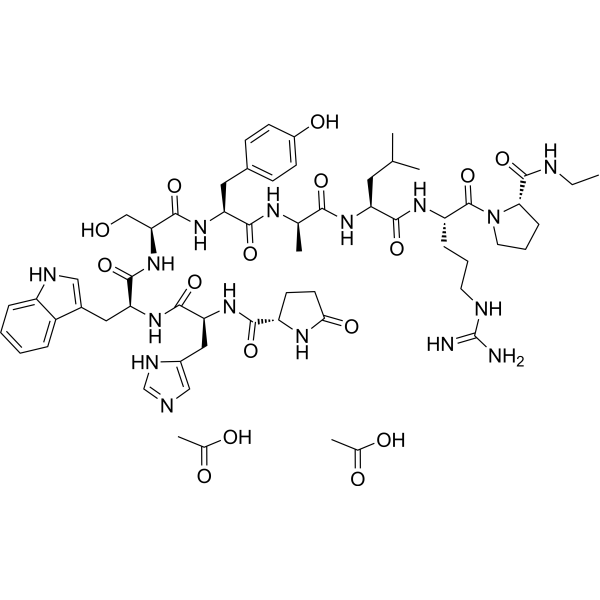
HY-17405
Alarelin AcetateGnRH Receptor Agonist -
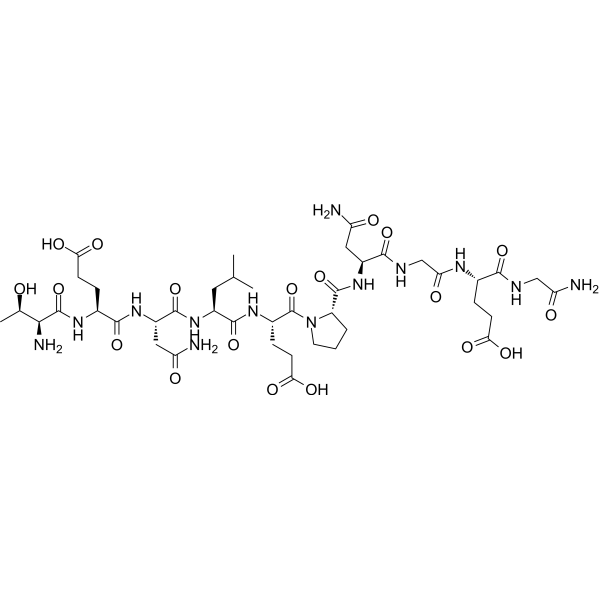
HY-P4190
Fsh receptor-binding inhibitor fragment(bi-10)FSH Antagonist -
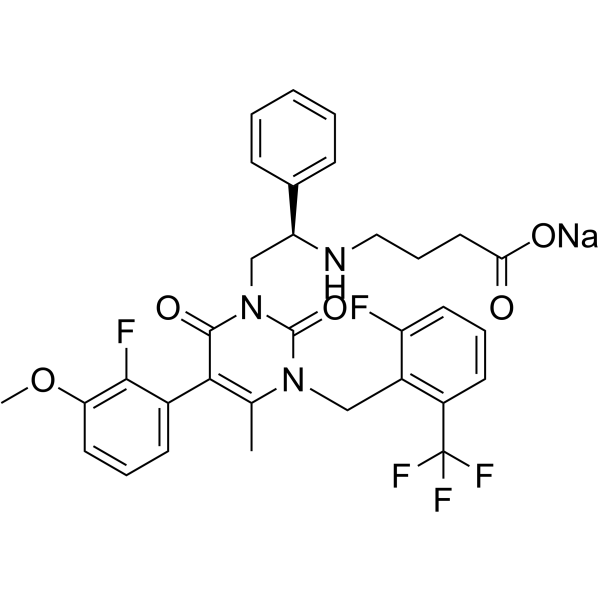
HY-14369
Elagolix sodiumGnRH Receptor Antagonist -
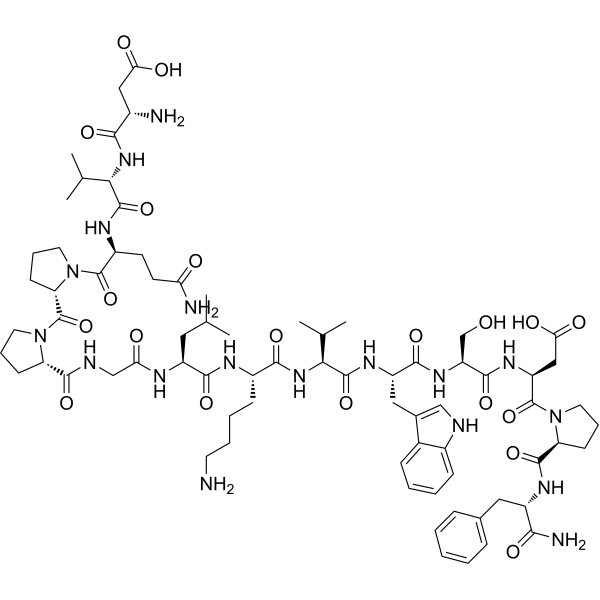
HY-P5762
Phoenixin-14Hormone-like Actions Peptide -
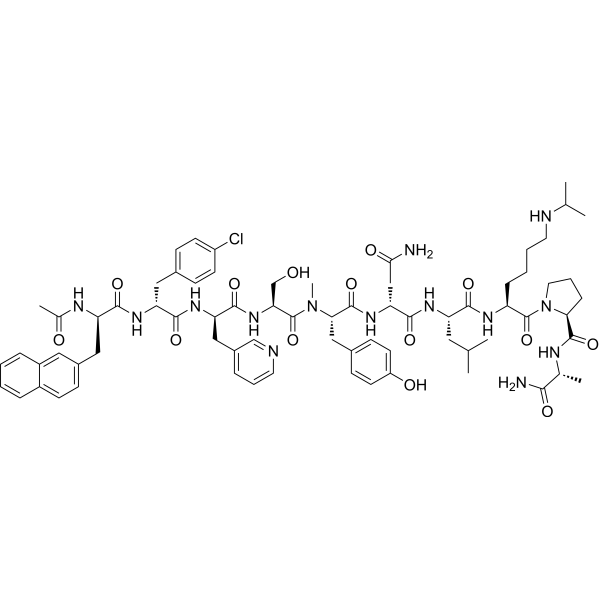
HY-13534
AbarelixGnRH Antagonist -
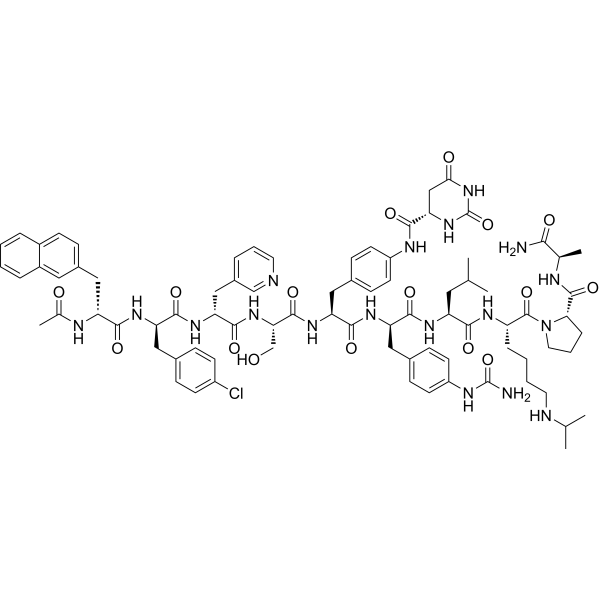
HY-16168A
DegarelixGnRHR Antagonist -

HY-16474R
Relugolix (Standard)GnRH Antagonist -
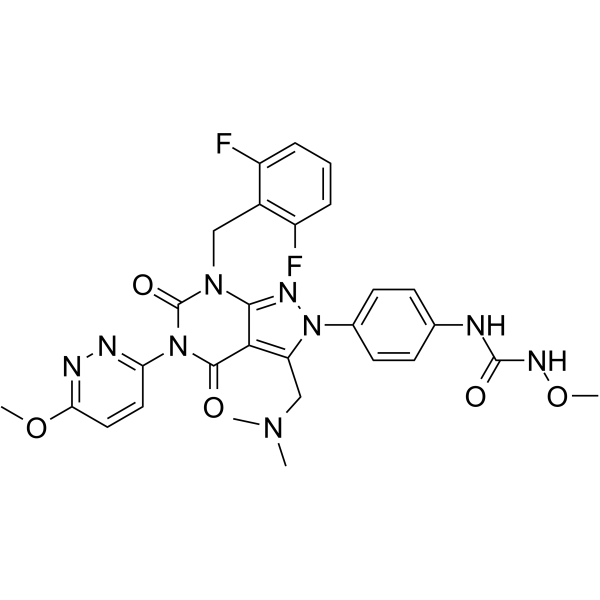
HY-134864
LumigolixGnRH Receptor Antagonist -

HY-P1174
GnRH Associated Peptide (GAP) (1-13), humanGnRH Associated Peptide


Actividad biológica
Descripciòn
IC50 & Target
[3]|
Human GnRH 27.4 nM (Ki) |
Rat GnRH 274 nM (Ki) |
In Vitro
Linzagolix is a potent antagonist of the canine GnRH receptor in transfected 293 cells, with an IC50 of 79.5 nM[4].
Linzagolix exhibits potent concentration-dependent antagonism of human and cynomolgus monkey GnRH receptors at multiple concentrations in the HEK293 Ca2+ flux assay, with an IC50 value of 36.7 nM for the human GnRH receptor and an IC50 value of 441.9 nM for the monkey GnRH receptor[5].
MedChemExpress (MCE) has not independently confirmed the accuracy of these methods. They are for reference only.
In Vivo
Linzagolix (25-100 mg/kg; p.o.; single administration) inhibits serum estradiol concentrations in female rats after oral administration[3].
Linzagolix (10-100 mg/kg; p.o.; single dose) dose-dependently inhibits GnRH agonist-stimulated LH secretion in male rats, and the duration of inhibition is prolonged with increasing dose[4].
Linzagolix (1.25-5 mg/kg; p.o.; single dose) produces dose-dependent suppression of serum testosterone in healthy male dogs, with the 5 mg/kg dose maintaining testosterone below the lower limit of quantification within 24 h[4].
Linzagolix (5 mg/kg; p.o.; once daily; 28 days) maintains testosterone suppression and significantly reduces prostate weight in dogs with benign prostatic hyperplasia[4].
MedChemExpress (MCE) has not independently confirmed the accuracy of these methods. They are for reference only.
-
Animal Model:Sprague-Dawley (female, 10 weeks old at model preparation; Charles River Japan)[3]
-
Dosage:50 mg/kg; 100 mg/kg; 200 mg/kg
-
Administration:p.o.; twice daily; 14 days
-
Result:Cyst volumes were decreased compared with the control group at 50, 100, and 200 mg/kg.
The lowest dose showing decreased cyst volume was 50 mg/kg.
-
Animal Model:Sprague-Dawley (female, 11 weeks old)[3]
-
Dosage:25 mg/kg; 50 mg/kg; 100 mg/kg
-
Administration:p.o.; single administration
-
Result:Serum E2 concentrations were suppressed dose-dependently at 25, 50, and 100 mg/kg compared with vehicle up to 24 h after oral administration.
At 24 h, E2 concentrations in the 25 mg/kg group had recovered to 80% of the vehicle group.
A recovery trend was observed at 50 mg/kg at 24 h.
-
Animal Model:Sprague-Dawley (male)[4]
-
Dosage:10, 30 and 100 mg/kg
-
Administration:p.o.; single dose
-
Result:Inhibited leuprolide-induced LH secretion in a dose-dependent manner; the significant effect persisted up to 12 h after administration in the 10 mg/kg group and up to 16 h after administration in the 30 and 100 mg/kg groups compared with the vehicle control group.
-
Animal Model:Beagle (male; 12 months old)[4]
-
Dosage:1.25, 2.5 and 5 mg/kg
-
Administration:p.o.; single dose
-
Result:Serum testosterone levels showed a circadian rhythm in the vehicle control group, with the lowest levels at approximately noon.
Suppressed serum testosterone concentrations in a dose-dependent manner; serum testosterone levels were below the limit of quantitation up to 12 h after administration of 1.25 and 2.5 mg/kg and up to 24 h after 5 mg/kg.
-
Animal Model:Beagle (male; 44-90 months old at start of administration)[4]
-
Dosage:5 mg/kg
-
Administration:p.o.; once daily; 28 days
-
Result:Serum testosterone levels were constantly reduced throughout the 28-day dosing period (measured on days 1 and 28).
After 4 weeks of repeated administration, prostate weight per body weight was decreased by 41% compared with the control group.
Testis weight showed a downward trend (decreased by 24%) compared with the control group.
-
Animal Model:Sprague-Dawley (female; 10 weeks old at PCOS model preparation)[4]
-
Dosage:200 mg/kg (200×2 mg/kg/day)
-
Administration:p.o.; twice daily; 14 days
-
Result:In Letrozole-exposed control rats, polycystic formation was significantly increased and corpora lutea decreased.
Significantly decreased the number of follicular cysts (9.8 vs control 20.7; normal 1.1) and increased the number of corpora lutea (33.9 vs control 25.3; normal 40.6).
In the insulin tolerance test, the change in blood glucose levels (0-1 h) was 39.8 mg/dL versus 26.4 mg/dL in the control group, indicating significantly reduced insulin resistance.
Serum FSH was significantly decreased (8.96 ng/mL vs control 11.74; normal 6.65), whereas LH (1.40 vs control 2.35; normal 1.03 ng/mL), LH/FSH ratio (0.15 vs control 0.21; normal 0.16) and testosterone (210.99 vs control 146.12; normal 4.00 ng/dL) were not significantly decreased.
Ensayo clínico
| NCT Number | Sponsor | Condition | Start Date |
Phase

|
|---|---|---|---|---|
| NCT01329991 | 2011-05 | PHASE1 |


Chemical Information
-
No. CAS 935283-04-8
-
Appearance Solid
-
Peso molecular 508.42
-
Fòrmula C22H15F3N2O7S
-
Color White to light brown
-
SMILES
O=C(C(SC=C1NC(N2C3=C(F)C=C(OC)C(OCC4=C(C(F)=CC=C4OC)F)=C3)=O)=C1C2=O)O
-
Synonyms
KLH-2109; OBE-2109
-
Envío
Room temperature in continental US; may vary elsewhere.
-
Almacenamiento
Powder -20°C 3 years 4°C 2 years In solvent -80°C 6 months -20°C 1 month


Solvente y solubilidad
In Vitro:
DMSO : 125 mg/mL (245.86 mM; Need ultrasonic; Hygroscopic DMSO has a significant impact on the solubility of product, please use newly opened DMSO)
Please refer to the solubility information to select the appropriate solvent. Once prepared, please aliquot and store the solution to prevent product inactivation from repeated freeze-thaw cycles.
Storage method and period of stock solution: -80°C, 6 months; -20°C, 1 month. When stored at -80°C, please use it within 6 months. When stored at -20°C, please use it within 1 month.
Concentration (start) × Volume (start) = Concentration (final) × Volume (final)
In Vivo Dissolution Calculator
Please enter the basic information of animal experiments:
-
-
-
-
Recommended: Prepare an additional quantity of animals to account for potential losses during experiments.
Working solution concentration: 0.22 mg/mL


Pureza y Documentación


Referencias
[2]. Kobayashi K, et al. Non-clinical studies indicating lack of interactions between iron/calcium ions and linzagolix, an orally available GnRH antagonist. Xenobiotica. 2022 May;52(5):488-497. [Content Brief]
[3]. Tezuka M, et al. Suppressive effects of linzagolix, a novel non-peptide antagonist of gonadotropin-releasing hormone receptors, in experimental endometriosis model rats. Clinical and experimental pharmacology & physiology. 2023 Jul;50(7):610-617. [Content Brief]
[4]. Tezuka M, et al. Suppression of hypothalamic-pituitary-gonadal function by linzagolix in benign prostatic hyperplasia and polycystic ovary syndrome animal models. Clinical and experimental pharmacology & physiology. 2023 Nov;50(11):914-923. [Content Brief]

Complete Stock Solution Preparation Table
Please refer to the solubility information to select the appropriate solvent. Once prepared, please aliquot and store the solution to prevent product inactivation from repeated freeze-thaw cycles.
Storage method and period of stock solution: -80°C, 6 months; -20°C, 1 month. When stored at -80°C, please use it within 6 months. When stored at -20°C, please use it within 1 month.
| Optional Solvent | Concentration Solvent Mass | 1 mg | 5 mg | 10 mg | 25 mg |
|---|---|---|---|---|---|
| DMSO | 1 mM | 1.9669 mL | 9.8344 mL | 19.6688 mL | 49.1719 mL |
| 5 mM | 0.3934 mL | 1.9669 mL | 3.9338 mL | 9.8344 mL | |
| 10 mM | 0.1967 mL | 0.9834 mL | 1.9669 mL | 4.9172 mL | |
| 15 mM | 0.1311 mL | 0.6556 mL | 1.3113 mL | 3.2781 mL | |
| 20 mM | 0.0983 mL | 0.4917 mL | 0.9834 mL | 2.4586 mL | |
| 25 mM | 0.0787 mL | 0.3934 mL | 0.7868 mL | 1.9669 mL | |
| 30 mM | 0.0656 mL | 0.3278 mL | 0.6556 mL | 1.6391 mL | |
| 40 mM | 0.0492 mL | 0.2459 mL | 0.4917 mL | 1.2293 mL | |
| 50 mM | 0.0393 mL | 0.1967 mL | 0.3934 mL | 0.9834 mL | |
| 60 mM | 0.0328 mL | 0.1639 mL | 0.3278 mL | 0.8195 mL | |
| 80 mM | 0.0246 mL | 0.1229 mL | 0.2459 mL | 0.6146 mL | |
| 100 mM | 0.0197 mL | 0.0983 mL | 0.1967 mL | 0.4917 mL |


Linzagolix Related Classifications
HY-109093 Related Classifications
 Powered by Bioz
Keywords
- Linzagolix
- 935283-04-8
- KLH-2109
- OBE-2109
- KLH2109
- KLH 2109
- OBE2109
- OBE 2109
- OBE-2109
- GnRH Receptor
- Gonadotropin releasing hormone receptor
- GNRHR
- GnRH receptor antagonist
- endometriosis
- follicle-stimulating hormone
- gonadotropin secretion
- hypothalamic-pituitary-gonadal axis
- luteinizing hormone
- oestradiol
- polycystic ovary syndrome
- testosterone
- uterine fibroids
- Inhibitor
- inhibitor
- inhibit