



Glatiramer acetate
Based on 2 publication(s) in Google Scholar
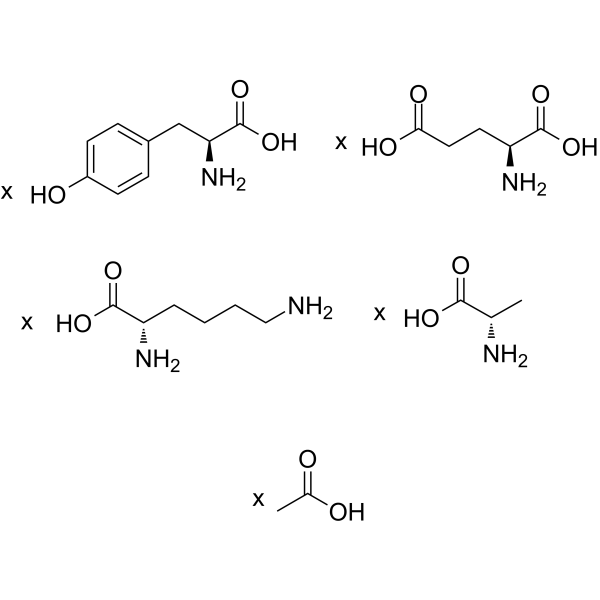
Glatiramer acetate, a synthetic analogue of myelin basic protein and an immunomodulating agent, inhibits Experimental autoimmune encephalomyelitis (EAE), and can be used for the research of multiple sclerosis. Glatiramer acetate exhibits strong and promiscuous binding to MHC molecules and consequent competition with various myelin antigens for their presentation to T cells. A further aspect of its action is potent induction of specific suppressor cells of the T helper 2 (Th2) type that migrate to the brain and lead to in situ bystander suppression.
For research use only. We do not sell to patients.
- Purity : 98%
- CAS No.: 147245-92-9
- Formula: (C9H11NO3.C6H14N2O2.C5H9NO4.C3H7NO2)x.xC2H4O2
-
Storage:
4°C, sealed storage, away from moisture
* In solvent : -80°C, 6 months; -20°C, 1 month (sealed storage, away from moisture)

To place orders, for customer services and technical support, please contact: MedChemExpress USA
Tel: 609-228-6898 E-mail: [email protected] [email protected]


-
 Biological Activity
-
Chemical Information
-
Solvent & Solubility
- Protocols
- Purity & Documentation
- References
-
 Help & FAQs


Publications Citing Use of MedChemExpress (MCE) Glatiramer acetate
More

Biological Activity
Description
In Vitro
Glatiramer acetate (25-100 mg/kg; S.c; 5 days) increase BDNF levels[3].
In huntington’s disease (HD) mouse model, the N171-82Q transgenic mouse line, which exhibits a more rapidly progressing disease course. Glatiramer acetate (1 mg/mouse; s.c.; 5×week) beginning at 8 weeks of age and continuing until 20 weeks of age, which is near the age of death due to the disease. Glatiramer acetate elicited improves performance on several motor function measures. Glatiramer acetate significantly improves the performance of N171-82Q transgenic mice at 15 weeks of age in the rotarod test measured over the course of 4 days[3].
MedChemExpress (MCE) has not independently confirmed the accuracy of these methods. They are for reference only.


Chemical Information
-
CAS No. 147245-92-9
-
Appearance Solid
-
Formula (C9H11NO3.C6H14N2O2.C5H9NO4.C3H7NO2)x.xC2H4O2
-
Color Off-white to light yellow
-
SMILES
OC(CC[C@H](N)C(O)=O)=O.OC([C@@H](N)CC1=CC=C(O)C=C1)=O.OC([C@@H](N)C)=O.NCCCC[C@H](N)C(O)=O.O=C(C)O.[x].[x].[x].[x].[x]
-
Shipping
Room temperature in continental US; may vary elsewhere.
-
Storage
4°C, sealed storage, away from moisture
* In solvent : -80°C, 6 months; -20°C, 1 month (sealed storage, away from moisture)


Publications (2)
-
Journal Impact Factor
-
Most Recent
-
Cell Rep
Activation status of astrocytes drives the MS/NMOSD therapeutic paradox: Insights from IFNAR1 signaling. [Abstract]2026 Feb 2;45(2):116913. PMID: 41632569 -
Pharmaceutics
LPX-TI641, a Tim3/4 Agonist, Induces Long-Term Immune Tolerance in Multiple Sclerosis Models. [Abstract]2025 Oct 30;17(11):1402. PMID: 41304740


Solvent & Solubility
In Vitro:
H2O : 50 mg/mL (Need ultrasonic)


Purity & Documentation
-
Data Sheet (274 KB)
-
SDS (558 KB)
- English - EN (558 KB)
- Français - FR (558 KB)
- Deutsch - DE (558 KB)
- Norwegian - NO (558 KB)
- Español - ES (558 KB)
- Swedish - SV (558 KB)
- Italian - IT (558 KB)
- Korean - KR (558 KB)
- Portuguese - PT (558 KB)
-
Handling Instructions (2659 KB)
References
[1]. Lalive PH, et al. Glatiramer acetate in the treatment of multiple sclerosis: emerging concepts regarding its mechanism of action. CNS Drugs. 2011 May;25(5):401-14. [Content Brief]
[2]. McKeage K. Glatiramer Acetate 40 mg/mL in Relapsing-Remitting Multiple Sclerosis: A Review. CNS Drugs. 2015;29(5):425-432. [Content Brief]
[3]. Arnon R, et al. Mechanism of action of glatiramer acetate in multiple sclerosis and its potential for the development of new applications. Proc Natl Acad Sci U S A. 2004;101 Suppl 2(Suppl 2):14593-14598. [Content Brief]
[4]. Corey-Bloom J, et al. Beneficial effects of glatiramer acetate in Huntington's disease mouse models: Evidence for BDNF-elevating and immunomodulatory mechanisms. Brain Res. 2017;1673:102-110. [Content Brief]
[5]. Aharoni R, et al. Glatiramer acetate-specific T cells in the brain express T helper 2/3 cytokines and brain-derived neurotrophic factor in situ [published correction appears in Proc Natl Acad Sci U S A. 2005 Aug 23;102(34):12288]. Proc Natl Acad Sci U S A. 2003;100(24):14157-14162. [Content Brief]

Calculators
Concentration (start) × Volume (start) = Concentration (final) × Volume (final)


Glatiramer acetate Related Classifications
HY-109520 Related Classifications
 Powered by Bioz