



HPPE
Based on 3 publication(s) in Google Scholar
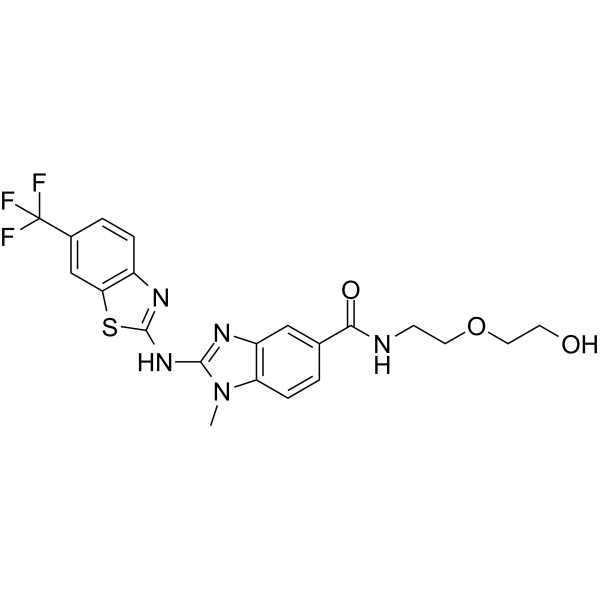
HPPE (compound 236) is an orally active, potential Bach1 inhibitor. Bach1 is a transcription factor of the cap'n'collar type alkaline region leucine zipper factor family (CNC-bZip) that regulates mitochondrial metabolism and reduces glucose utilization. HPPE can be used for research in psoriasis, multiple sclerosis, and COPD.
For research use only. We do not sell to patients.
- Purity : 99.71%
- CAS No.: 1325721-55-8
- Formula: C21H20F3N5O3S
- Molecular Weight:479.48
-
Storage:
4°C, sealed storage, away from moisture
* In solvent : -80°C, 6 months; -20°C, 1 month (sealed storage, away from moisture)

To place orders, for customer services and technical support, please contact: MedChemExpress USA
Tel: 609-228-6898 E-mail: [email protected] [email protected]


-
 Biological Activity
-
Chemical Information
-
Solvent & Solubility
- Protocols
- Purity & Documentation
- References
-
 Help & FAQs



Publications Citing Use of MedChemExpress (MCE) HPPE
More Customer Validation & Images

-
Cell Proliferation/Viability Assay

-
Bio/Physico-chemical Assay

-
Flow Cytometry

-
WB

-
ELISA


Biological Activity
Description
IC50 & Target
Bach1[1]
In Vitro
HPPE (0-20 μM, 18 h) is competitively inhibited by the overexpressed WT Bach1 in HepG2 cells[3].
HPPE (3 μM, 1 h)-induced Bach1 derepression requires nuclear export of Bach1 and exhibited Nrf2 stabilization activity in M17-5 neuroblastoma cells[3].
HPPE (10 μM, 8 h) activates NRF2 driven transcription independently of BACH1 in HEK293T cells[4].
HPPE (10 μM, 1 h) liberates cellular zinc and increases cellular ROS levels in HEK293T cells[4].
MedChemExpress (MCE) has not independently confirmed the accuracy of these methods. They are for reference only. Further protocols information, click here.
-
Cell Line:M17-5 neuroblastoma cells
-
Concentration:3 μM
-
Incubation Time:1 h
-
Result:Significantly up-regulated Hmox1 (a Bach1 target) protein levels and showed accumulation of Nrf2 protein in the cytosol and especially in the nucleus in M17-5 neuroblastoma cells.
-
Cell Line:HEK293T cells
-
Concentration:10 μM
-
Incubation Time:8 h
-
Result:Robustly stabilized NRF2 protein levels within 8 hours of treatment in HEK293T cells.
In Vivo
MedChemExpress (MCE) has not independently confirmed the accuracy of these methods. They are for reference only.
-
Animal Model:The acute MPTP mouse model[2]
-
Dosage:5 and 10 mg/kg
-
Administration:oral gavage, twice a day for 6 days
-
Result:Significantly protected SNpc dopaminergic neurons against MPTP neurotoxicity.


Chemical Information
-
CAS No. 1325721-55-8
-
Appearance Solid
-
Molecular Weight 479.48
-
Formula C21H20F3N5O3S
-
Color White to off-white
-
SMILES
O=C(C1=CC(N=C(N2C)NC3=NC4=C(S3)C=C(C(F)(F)F)C=C4)=C2C=C1)NCCOCCO
-
Synonyms
Bach1-IN-1
-
Shipping
Room temperature in continental US; may vary elsewhere.
-
Storage
4°C, sealed storage, away from moisture
* In solvent : -80°C, 6 months; -20°C, 1 month (sealed storage, away from moisture)


Publications (3)
-
Journal Impact Factor
-
Most Recent
-
J Nanobiotechnology
Ferrocene-derived magnetic fiber-particles from diesel exhaust: enhanced pulmonary toxicity via Bach1-SAT1-polyamine depletion. [Abstract]2025 Apr 29;23(1):324. PMID: 40301891
HPPE purchased from MedChemExpress. Usage Cited in: J Nanobiotechnology. 2025 Apr 29;23(1):324. [Abstract]
Viability of 16HBE cells following 48 h exposure to FMP (20 µg/ml) with or without pretreatment with 0.6 µM HPPE for 2 h. A 1 mM hydrogen peroxide treatment for 4 h was used as a positive control. (N = 5).
HPPE purchased from MedChemExpress. Usage Cited in: J Nanobiotechnology. 2025 Apr 29;23(1):324. [Abstract]
Quantification of intracellular Fe2 + levels in 16HBE cells following 48 h exposure to FMP (20 µg/ml) with or without pretreatment with 0.6 µM HPPE for 2 h (N = 3).
HPPE purchased from MedChemExpress. Usage Cited in: J Nanobiotechnology. 2025 Apr 29;23(1):324. [Abstract]
HPPE (0.6 µM, 4 h). Quantification of ROS levels in 16HBE cells. Cells were treated with 50 µg/ml ROSUP for 2 h as a positive control. (N = 5).
HPPE purchased from MedChemExpress. Usage Cited in: J Nanobiotechnology. 2025 Apr 29;23(1):324. [Abstract]
Representative Western blot images showing key molecular proteins (Bach1, ALOX15, SLC7A11, SAT1, GPX4) in 16HBE cells following 48 h exposure to FMP (20 µg/ml) with or without pretreatment with 0.6 µM HPPE for 2 h.
HPPE purchased from MedChemExpress. Usage Cited in: J Nanobiotechnology. 2025 Apr 29;23(1):324. [Abstract]
ELISA quantifications of spermine (SP) and spermidine (SPD) levels in 16HBE cells following 48 h exposure to FMP (20 µg/ml) with or without pretreatment with 0.6 µM HPPE for 2 h (N = 5).

HPPE purchased from MedChemExpress. Usage Cited in: J Nanobiotechnology. 2025 Apr 29;23(1):324. [Abstract]
Representative IHC images showing Bach1 and SAT1 protein expression in chicken lung tissues exposed to 0.6 mg/kg FMP, with or without pretreatment of 4 mg/kg HPPE (air cell injection, single dose). Each image was captured under a 400 × optical microscope, with the scale bar in the lower-right corner representing 100 μm. The lower-left corner of the image indicates a 200 × magnification of the field of view, with the scale bar representing 100 μm.

HPPE purchased from MedChemExpress. Usage Cited in: J Nanobiotechnology. 2025 Apr 29;23(1):324. [Abstract]
Representative pathological pictures of chicken lung tissue sections from animals exposed to 0.6 mg/kg FMP, with or without pretreatment of 4 mg/kg HPPE (air cell injection, single dose), Yellow arrows represent positive areas.
-
J Exp Clin Cancer Res
CCNY-mediated phosphorylation and TET2-BACH1-driven DNA demethylation activate PRC1 to augment NSCLC progression. [Abstract]2025 Jul 15;44(1):206. PMID: 40665337
HPPE purchased from MedChemExpress. Usage Cited in: J Exp Clin Cancer Res. 2025 Jul 15;44(1):206. [Abstract]
H1299 cells were subcutaneously injected into nude mice to construct xenografts, followed by intratumoral injections (10 mg/kg; Bobcat339, HPPE, or PLK1-IN-10) starting from day 7. Volume of xenograft tumors by week.
-
Br J Pharmacol
The neuronal ALAS2/5-ala axis mitigates chemotherapy-induced neurotoxicity via the BACH1/NRF2 pathway. [Abstract]2026 Jun;183(11):2695-2719. PMID: 41652971


Solvent & Solubility
In Vitro:
DMSO : 100 mg/mL (208.56 mM; Need ultrasonic; Hygroscopic DMSO has a significant impact on the solubility of product, please use newly opened DMSO)
Please refer to the solubility information to select the appropriate solvent. Once prepared, please aliquot and store the solution to prevent product inactivation from repeated freeze-thaw cycles.
Storage method and period of stock solution: -80°C, 6 months; -20°C, 1 month (sealed storage, away from moisture). When stored at -80°C, please use it within 6 months. When stored at -20°C, please use it within 1 month.
Please refer to the solubility information to select the appropriate solvent. Once prepared, please aliquot and store the solution to prevent product inactivation from repeated freeze-thaw cycles.
Storage method and period of stock solution: -80°C, 6 months; -20°C, 1 month (sealed storage, away from moisture). When stored at -80°C, please use it within 6 months. When stored at -20°C, please use it within 1 month.
Concentration (start) × Volume (start) = Concentration (final) × Volume (final)
In Vivo:
Select the appropriate dissolution method based on your experimental animal and administration route.
- For the following dissolution methods, please ensure to first prepare a clear stock solution using an In Vitro approach and then sequentially add co-solvents:
- To ensure reliable experimental results, the clarified stock solution can be appropriately stored based on storage conditions. As for the working solution for In Vivo experiments, it is recommended to prepare freshly and use it on the same day.
- The percentages shown for the solvents indicate their volumetric ratio in the final prepared solution. If precipitation or phase separation occurs during preparation, heat and/or sonication can be used to aid dissolution.
Add each solvent one by one: 10% DMSO 40% PEG300 5% Tween-80 45% Saline
Solubility: ≥ 2.5 mg/mL (5.21 mM); Clear solution
This protocol yields a clear solution of ≥ 2.5 mg/mL (saturation unknown).
Taking 1 mL working solution as an example, add 100 μL DMSO stock solution (25.0 mg/mL) to 400 μL PEG300, and mix evenly; then add 50 μL Tween-80 and mix evenly; then add 450 μL Saline to adjust the volume to 1 mL.
Preparation of Saline: Dissolve 0.9 g sodium chloride in ddH₂O and dilute to 100 mL to obtain a clear Saline solution.
Add each solvent one by one: 10% DMSO 90% (20% SBE-β-CD in Saline)
Solubility: ≥ 2.5 mg/mL (5.21 mM); Clear solution
This protocol yields a clear solution of ≥ 2.5 mg/mL (saturation unknown).
Taking 1 mL working solution as an example, add 100 μL DMSO stock solution (25.0 mg/mL) to 900 μL 20% SBE-β-CD in Saline, and mix evenly.
Preparation of 20% SBE-β-CD in Saline (4°C, storage for one week): 2 g SBE-β-CD powder is dissolved in 10 mL Saline, completely dissolve until clear.
In Vivo Dissolution Calculator
Please enter the basic information of animal experiments:
-
-
-
-
Recommended: Prepare an additional quantity of animals to account for potential losses during experiments.
Please enter your animal formula composition:
-
%DMSO +
Recommended: Keep the proportion of DMSO in working solution below 2% if your animal is weak.
-
%+
-
+%Tween-80 + +
-
%Saline +
The co-solvents required include: DMSO, . All of co-solvents are available by MedChemExpress (MCE). , Tween 80. All of co-solvents are available by MedChemExpress (MCE).
Working solution concentration: 0.22 mg/mL
Method for preparing stock solution: mg drug dissolved in μL DMSO. Stock solution concentration: mg/mL. * In solvent : -80°C, 6 months; -20°C, 1 month (sealed storage, away from moisture)
1. Take μL DMSO stock solution;
2. Add μL .
μL , mix evenly;
3. Then add μL Tween 80, mix evenly;
4. Then add μL
Please ensure that the stock solution in the first step is dissolved to a clear state, and add co-solvents in sequence. You can use ultrasonic heating (ultrasonic cleaner, recommended frequency 20-40 kHz), vortexing, etc. to assist dissolution.

Protocols
-
Nuclear Protein Extraction (High-Salt/Hypotonic Fractionation)
The high-salt/hypotonic fractionation method for nuclear protein extraction is based on the differential solubility of cellular components. Cytoplasmic proteins are extracted first using a hypotonic buffer that causes cell swelling and membrane rupture, followed by centrifugation to separate the cytoplasmic supernatant from the nuclear pellet. The nuclear pellet is then subjected to high-salt extraction (e. g. , 0. 4 M (NH4)2SO4 or 1 M NaCl) to solubilize tightly bound nuclear matrix proteins, including transcription factors, histones, and structural proteins associated with chromatin and the nuclear scaffold. This approach allows for the isolation of both soluble cytoplasmic proteins and salt-resistant nuclear proteins while minimizing cross-contamination.
-
Imiquimod-Induced Psoriasiform Dermatitis
Imiquimod (IMQ)-induced psoriasiform dermatitis is a widely used murine model in which topical application of IMQ, a Toll-like receptor 7 (TLR7) agonist, triggers innate immune activation in the skin and induces a psoriasis-like inflammatory cascade characterized by epidermal hyperplasia, immune cell infiltration, and cytokine production dominated by the IL-23/IL-17 axis. This inflammatory response is mediated through activation of dendritic cells and downstream induction of IL-23, IL-17A, IL-22, and related pro-inflammatory mediators, recapitulating key features of human plaque psoriasis and enabling mechanistic and therapeutic studies. The model is commonly induced using Aldara (5% IMQ cream) applied topically to murine skin, resulting in rapid onset of erythema, scaling, and thickening that can be quantified as disease severity indices and validated histologically.


Purity & Documentation
-
Data Sheet (276 KB)
-
SDS (252 KB)
- English - EN (252 KB)
- Français - FR (252 KB)
- Deutsch - DE (252 KB)
- Norwegian - NO (252 KB)
- Español - ES (252 KB)
- Swedish - SV (252 KB)
- Italian - IT (252 KB)
- Korean - KR (252 KB)
- Portuguese - PT (252 KB)
-
Handling Instructions (2659 KB)
References
[2]. Zhang X, et al. Bach1: Function, Regulation, and Involvement in Disease. Oxid Med Cell Longev. 2018 Oct 2;2018:1347969. [Content Brief]
[3]. Ahuja M, et al. Bach1 derepression is neuroprotective in a mouse model of Parkinson's disease. Proc Natl Acad Sci U S A. 2021 Nov 9;118(45):e2111643118. [Content Brief]
[4]. Freeman R, et al. HPPE Activates NRF2 Signaling by Liberating Heavy Metal Stores. Chembiochem. 2024 Sep 6:e202400529. [Content Brief]


Complete Stock Solution Preparation Table
Please refer to the solubility information to select the appropriate solvent. Once prepared, please aliquot and store the solution to prevent product inactivation from repeated freeze-thaw cycles.
Storage method and period of stock solution: -80°C, 6 months; -20°C, 1 month (sealed storage, away from moisture). When stored at -80°C, please use it within 6 months. When stored at -20°C, please use it within 1 month.
| Optional Solvent | Concentration Solvent Mass | 1 mg | 5 mg | 10 mg | 25 mg |
|---|---|---|---|---|---|
| DMSO | 1 mM | 2.0856 mL | 10.4280 mL | 20.8559 mL | 52.1398 mL |
| 5 mM | 0.4171 mL | 2.0856 mL | 4.1712 mL | 10.4280 mL | |
| 10 mM | 0.2086 mL | 1.0428 mL | 2.0856 mL | 5.2140 mL | |
| 15 mM | 0.1390 mL | 0.6952 mL | 1.3904 mL | 3.4760 mL | |
| 20 mM | 0.1043 mL | 0.5214 mL | 1.0428 mL | 2.6070 mL | |
| 25 mM | 0.0834 mL | 0.4171 mL | 0.8342 mL | 2.0856 mL | |
| 30 mM | 0.0695 mL | 0.3476 mL | 0.6952 mL | 1.7380 mL | |
| 40 mM | 0.0521 mL | 0.2607 mL | 0.5214 mL | 1.3035 mL | |
| 50 mM | 0.0417 mL | 0.2086 mL | 0.4171 mL | 1.0428 mL | |
| 60 mM | 0.0348 mL | 0.1738 mL | 0.3476 mL | 0.8690 mL | |
| 80 mM | 0.0261 mL | 0.1303 mL | 0.2607 mL | 0.6517 mL | |
| 100 mM | 0.0209 mL | 0.1043 mL | 0.2086 mL | 0.5214 mL |


HPPE Related Classifications
HY-153040 Related Classifications
 Powered by Bioz