



Cephradine monohydrate
Based on 5 publication(s) in Google Scholar
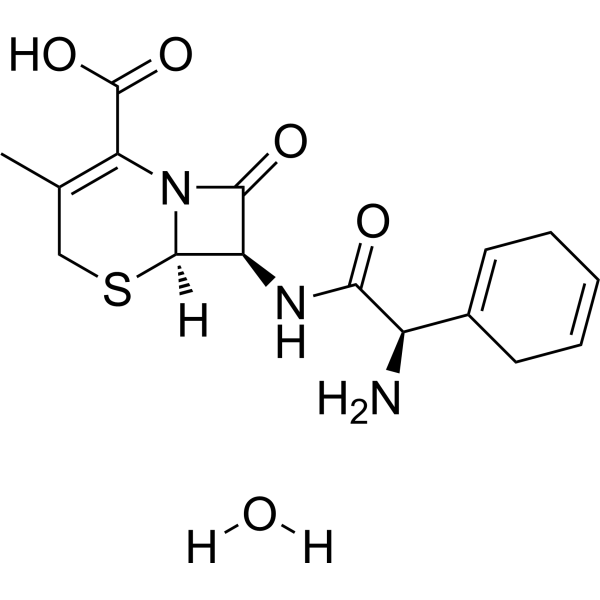
Cephradine (Cefradine) monohydrate is a broad-spectrum and orally active cephalosporin. Cephradine monohydrate is active against both grampositive and gram-negative pathogens and effective in eradicating most penicillinase-producing organisms known to be resistant to penicillin G, penicillin V, and ampicillin. Cephradine monohydrate has been used in the research of genitourinary, gastrointestinal and respiratory tract infections, and in infections of the skin and soft tissues. Cephradine monohydrate blocks solar-ultraviolet induced skin inflammation through direct inhibition of TOPK.
商品は「研究用試薬」です。人や動物の医療用・臨床診断用・食品用の製品ではありません。
研究用途以外に使用した場合、当社は一切の責任を負いかねます。
- 純度 : 91.02%
- CAS 番号: 75975-70-1
- 分子式: C16H21N3O5S
- 分子量:367.42
-
保管条件:
Store at room temperature, keep dry and cool.
In solvent -80°C, 1 year , -20°C, 6 months

To place orders, for customer services and technical support, please contact: MedChemExpress USA
Tel: 609-228-6898 E-mail: [email protected] [email protected]


-
 生物活性
生物活性
-
化学情報
- プロトコル
- 純度とドキュメンテーション
- 参考文献
-
 Help & FAQs


-
HY-12467
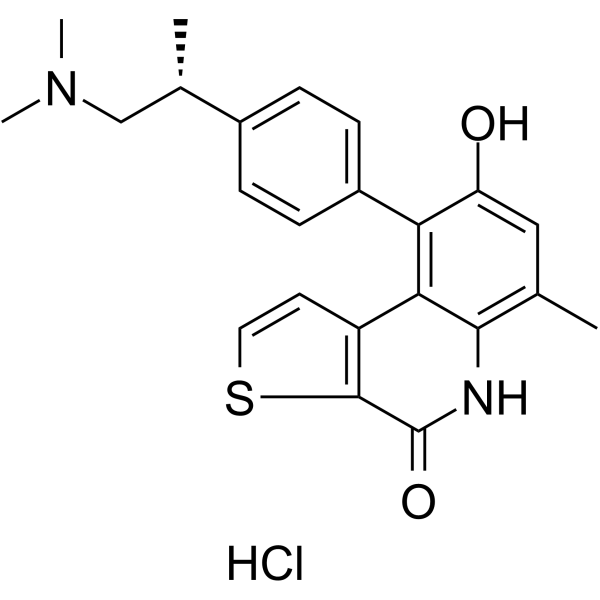
OTS964 hydrochlorideTOPK Inhibitor -
HY-B2145
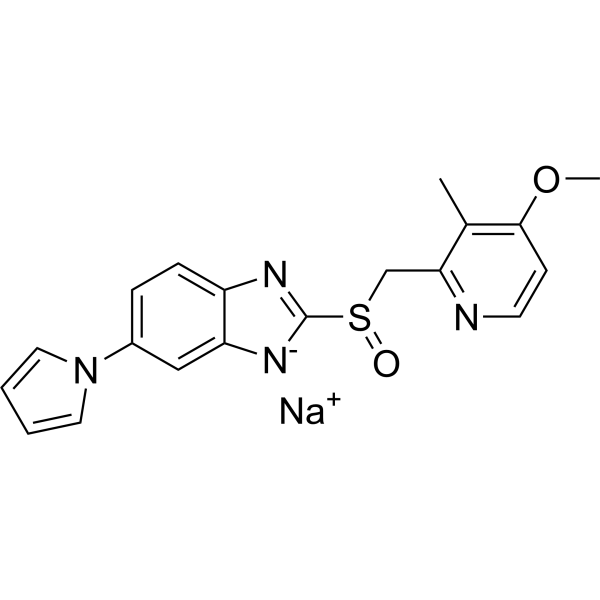
Ilaprazole sodiumProton Pump Inhibitor -
HY-19718
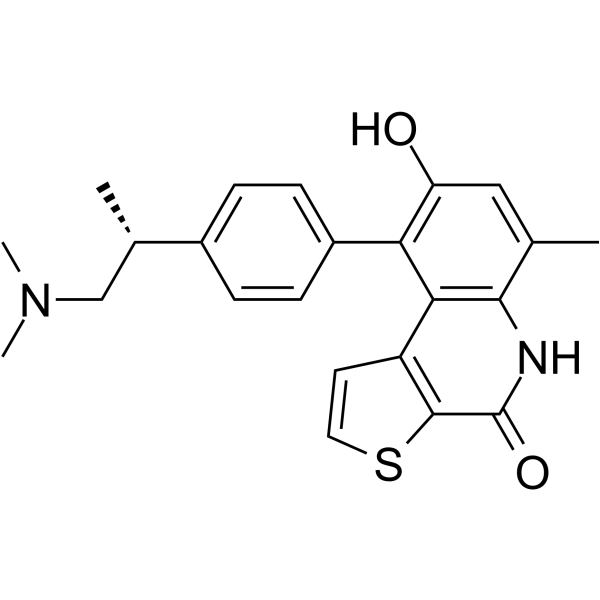
OTS964TOPK Inhibitor -
HY-B0441A
Tobramycin sulfateAminoglycoside Antibiotic -
HY-B0798
Cefpiramide sodiumAntibacterial Agent -

HY-B2145R
Ilaprazole sodium (Standard)Proton Pump Inhibitor -

HY-B0441AR
Tobramycin sulfate (Standard)Bacterial Inhibitor
MedChemExpress(MCE)の使用を引用している文献 Cephradine monohydrate
MoreAntibiotic アイソフォーム固有の製品をすべて表示
More

生物活性
製品説明
IC50 & Target
|
β-lactam |
体外実験
Cephradine (0~8 μg/mL; 12 hours) makes bacterial viability rapidly increased at antibiotic concentrations below the MIC (minimum inhibitory concentration) of 0.70 µg/mL at both pH 7.4 and pH 5.5[4].
MedChemExpress (MCE) has not independently confirmed the accuracy of these methods. They are for reference only.
体内実験
MedChemExpress (MCE) has not independently confirmed the accuracy of these methods. They are for reference only.
-
Animal Model:Nondiabetic mice
-
Dosage:25 mg/kg
-
Administration:S.c.; 11 days
-
Result:Reduced the bacterial density and counts in the abscesses.
臨床実験
| NCT Number | Sponsor | Condition | Start Date |
Phase

|
|---|---|---|---|---|
| NCT01329991 | Plexxikon| | 2011-05 | PHASE1 |


化学情報
-
CAS 番号 75975-70-1
-
性状 Solid
-
分子量 367.42
-
分子式 C16H21N3O5S
-
Color Off-white to light yellow
-
SMILES
O=C(C(N12)=C(C)CS[C@]2([H])[C@H](NC([C@H](N)C3=CCC=CC3)=O)C1=O)O.[H]O[H]
-
別名
Cefradine monohydrate
-
輸送条件
Room temperature in continental US; may vary elsewhere.
-
保管条件
Store at room temperature, keep dry and cool
In solvent -80°C 1 year -20°C 6 months


Publications (5)
-
Journal Impact Factor
-
Most Recent
-
ACS Environ Au
Machine Learning-Assisted Recognition of Environmental Sulfur-Containing Chemicals in Nontargeted Mass Spectrometry Analysis of Inadequate Mass Resolution. [Abstract]2025 Aug 5;5(6):573-582. PMID: 41277996 -
Anal Chem
Exposome-Scale Investigation of Cl-/Br-Containing Chemicals Using High-Resolution Mass Spectrometry, Multistage Machine Learning, and Cloud Computing. [Abstract]2025 Jun 3;97(21):11099-11109. PMID: 40401576 -
Molecules
Seeking Correlation Among Porin Permeabilities and Minimum Inhibitory Concentrations Through Machine Learning: A Promising Route to the Essential Molecular Descriptors. [Abstract]2025 Mar 9;30(6):1224. PMID: 40142001 -
Microbiol Spectr
2025 Aug 29:e0059025. PMID: 40879403 -
Chemosphere
Mass-balance-model-based evaluation of sewage treatment plant contribution to residual pharmaceuticals in environmental waters. [Abstract]2019 Jun:225:378-387. PMID: 30884299


純度とドキュメンテーション
-
データシート (277 KB)
-
SDS (252 KB)
- English - EN (252 KB)
- Français - FR (252 KB)
- Deutsch - DE (252 KB)
- Norwegian - NO (252 KB)
- Español - ES (252 KB)
- Swedish - SV (252 KB)
- Italian - IT (252 KB)
- Korean - KR (252 KB)
- Portuguese - PT (252 KB)
-
取扱説明書 (2659 KB)
参考文献
[1]. Schwinghammer TL, et al. Pharmacokinetics of cephradine administered intravenously and orally to young and elderly subjects. J Clin Pharmacol. 1990;30(10):893-899 [Content Brief]
[2]. Caloza DL Jr, et al. Intravenous use of cephradine and cefazolin against serious infections. Antimicrob Agents Chemother. 1979;15(1):119-122. [Content Brief]
[3]. Fan X, et al. Cefradine blocks solar-ultraviolet induced skin inflammation through direct inhibition of T-LAK cell-originated protein kinase. Oncotarget. 2016;7(17):24633-24645. [Content Brief]
[4]. Kang S, et al. In Vitro and In Vivo Antimicrobial Activity of Antibiotic-Conjugated Carriers with Rapid pH-Responsive Release Kinetics. Adv Healthc Mater. 2019;8(14):e1900247. [Content Brief]

Calculators
濃度 (開始) × 体積 (開始) = 濃度 (終了) × 体積 (終了)


Cephradine monohydrate 関連分類
HY-128449 関連分類
 Powered by Bioz