



Curcumin (Standard)
Based on 3 publication(s) in Google Scholar
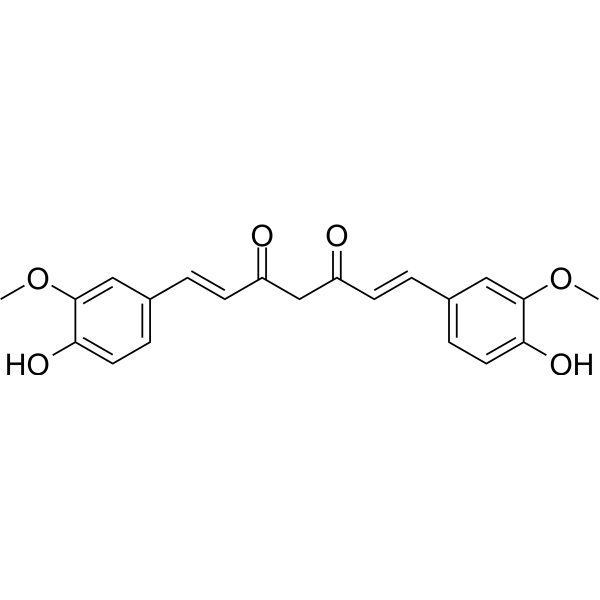
Curcumin (Standard) is the analytical standard of Curcumin (HY-N0005). This product is intended for research and analytical applications. Curcumin (Diferuloylmethane), a natural phenolic compound, is a p300/CREB-binding protein-specific inhibitor of acetyltransferase, represses the acetylation of histone/nonhistone proteins and histone acetyltransferase-dependent chromatin transcription. Curcumin is a photosensitizer against microorganisms. Curcumin shows inhibitory effects on NF-κB and MAPKs, and has diverse pharmacologic effects including anti-inflammatory, antioxidant, antiproliferative and antiangiogenic activities. Curcumin induces stabilization of Nrf2 protein through Keap1 cysteine modification.
商品は「研究用試薬」です。人や動物の医療用・臨床診断用・食品用の製品ではありません。
研究用途以外に使用した場合、当社は一切の責任を負いかねます。
- 純度 : 98.01%
- CAS 番号: 458-37-7
- 分子式: C21H20O6
- 分子量:368.38
-
保管条件:
Please store the product under the recommended conditions in the Certificate of Analysis.


To place orders, for customer services and technical support, please contact: MedChemExpress USA
Tel: 609-228-6898 E-mail: [email protected] [email protected]


-
 Product Information
-
化学情報
- 純度とドキュメンテーション
-
 Help & FAQs


-
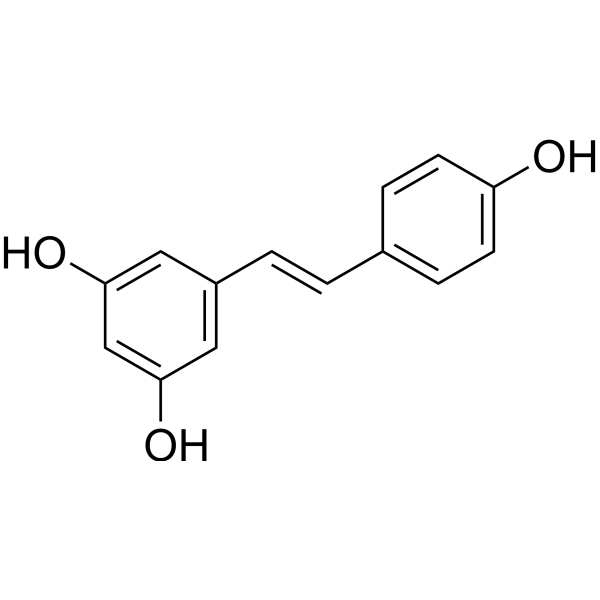
HY-16561R
Resveratrol (Standard) -
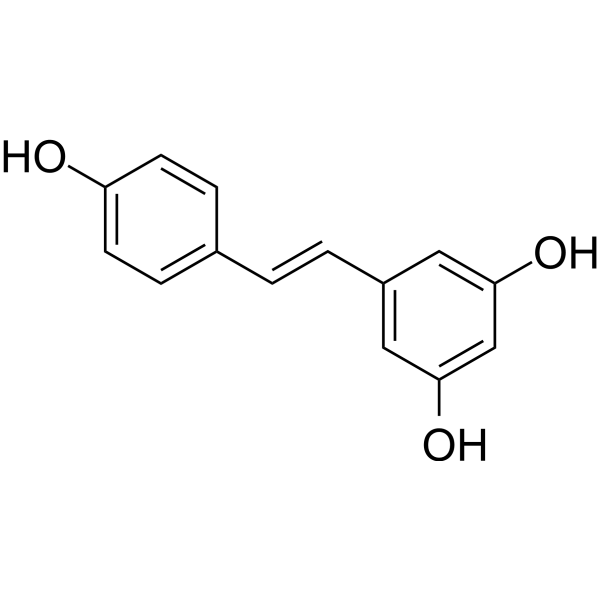
HY-16561
ResveratrolPolyphenolic Phytoalexin -
HY-N0005
Curcuminp300 Histone Acetylatransferase Inhibitor -
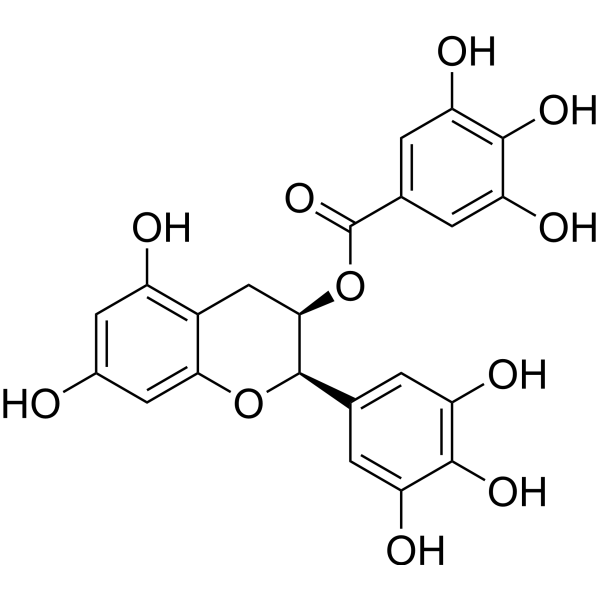
HY-13653
(-)-Epigallocatechin GallateAnticancer Agent -
HY-116673
TTK21CBP/p300 Activator -
HY-B0627
MetforminAntihyperglycemic Agent -
HY-17589A
ChloroquineAntimalarial Agent -
HY-N0105
RheinAntioxidant -

HY-N0009R
Geniposide (Standard)Influenza Virus Inhibitor -

HY-18085R
Quercetin (Standard)Flavonoid Antioxidant -

HY-N0007R
(E,E)-Bisdemethoxycurcumin (Standard)Autophagy Inducer -
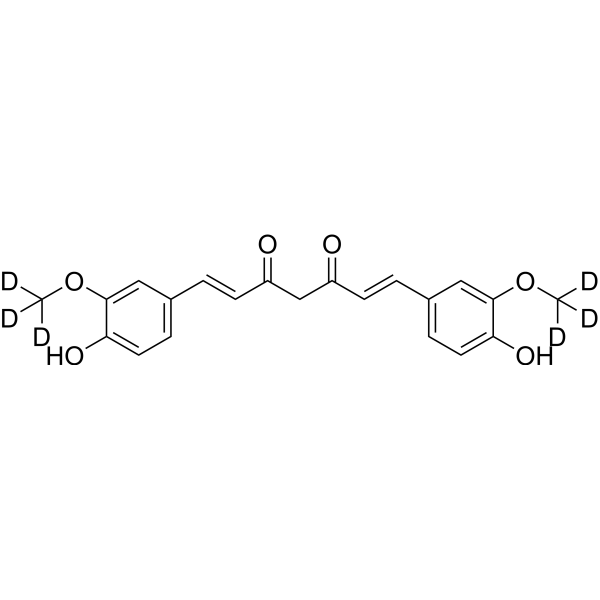
HY-N0005S
Curcumin-d6Stable Isotope
MedChemExpress(MCE)の使用を引用している文献 Curcumin (Standard)
More

Product Information
説明
アプリケーション
The compound is the grade of analytical standard, which is the reference standard supplied assay. It is commonly used in qualitative, quantitative and methodological research experiments in HPLC, GC and MS.


化学情報
-
CAS 番号 458-37-7
-
性状 Solid
-
分子量 368.38
-
分子式 C21H20O6
-
Color Orange to red
-
SMILES
O=C(CC(/C=C/C1=CC=C(O)C(OC)=C1)=O)/C=C/C2=CC=C(O)C(OC)=C2
-
別名
Diferuloylmethane (Standard); Natural Yellow 3 (Standard); Turmeric yellow (Standard)
-
Structure Classification
-
Initial Source
-
輸送条件
Room temperature in continental US; may vary elsewhere.
-
保管条件
Please store the product under the recommended conditions in the Certificate of Analysis.


Publications (3)
-
Journal Impact Factor
-
Most Recent
-
-
Pharmaceutics
Quality by Design-Based Scale-Up and Industrial Development of Turmeric Extract-Loaded Nanostructured Lipid Carriers. [Abstract]2026 Apr 16;18(4):492. PMID: 42076142 -


純度とドキュメンテーション
-
SDS (393 KB)
- English - EN (393 KB)
- Français - FR (393 KB)
- Deutsch - DE (393 KB)
- Norwegian - NO (393 KB)
- Español - ES (393 KB)
- Swedish - SV (393 KB)
- Italian - IT (393 KB)
- Korean - KR (393 KB)
- Portuguese - PT (393 KB)
-
取扱説明書 (2659 KB)
参考文献
[1]. Gao S, et al. Curcumin attenuates arsenic-induced hepatic injuries and oxidative stress in experimental mice through activation of Nrf2 pathway, promotion of arsenic methylation and urinary excretion. Food Chem Toxicol. 2013 Jul 18. pii: S0278-6915(13)004 [Content Brief]
[2]. Nasiri M, et al. Curcumin and Silibinin Inhibit Telomerase Expression in T47D Human Breast Cancer Cells. Asian Pac J Cancer Prev. 2013;14(6):3449-53. [Content Brief]
[3]. Cao A, et all. Curcumin induces apoptosis in human gastric carcinoma AGS cells and colon carcinoma HT-29 cells through mitochondrial dysfunction and endoplasmic reticulum stress. Apoptosis. 2013 Jul 24. [Epub ahead of print] [Content Brief]
[4]. Jiang H, et al. Antidepressant-like effects of curcumin in chronic mild stress of rats: Involvement of its anti-inflammatory action. Prog Neuropsychopharmacol Biol Psychiatry. 2013 Jul 20. pii: S0278-5846(13)00150-4. [Content Brief]
[5]. Guo H, et al. Curcumin induces cell cycle arrest and apoptosis of prostate cancer cells by regulating the expression of IkappaBalpha, c-Jun and androgen receptor. Pharmazie. 2013 Jun;68(6):431-4. [Content Brief]
[6]. Zhu X, et al. Curcumin alleviates neuropathic pain by inhibiting p300/CBP histone acetyltransferase activity-regulated expression of BDNF and cox-2 in a rat model. PLoS One. 2014 Mar 6;9(3):e91303. [Content Brief]
[7]. Balasubramanyam K, et al. Curcumin, a novel p300/CREB-binding protein-specific inhibitor of acetyltransferase, represses the acetylation of histone/nonhistone proteins and histone acetyltransferase-dependent chromatin transcription. J Biol Chem. 2004 Dec 3;279(49):51163-71. [Content Brief]
[8]. Jun Wan Shin, et al. Curcumin induces stabilization of Nrf2 protein through Keap1 cysteine modification. Biochem Pharmacol. 2020 Mar;173:113820. [Content Brief]

Calculators
濃度 (開始) × 体積 (開始) = 濃度 (終了) × 体積 (終了)


Curcumin (Standard) 関連分類
HY-N0005R 関連分類
 Powered by Bioz