



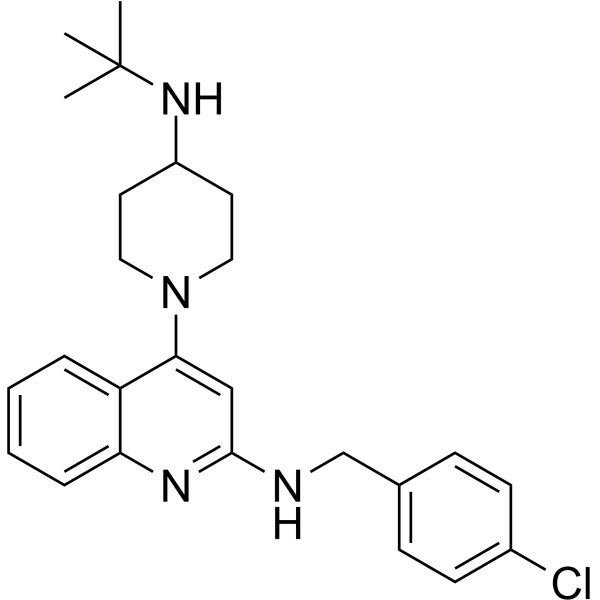
Ezurpimtrostat
Based on 3 publication(s) in Google Scholar
Ezurpimtrostat (GNS561) is an orally active PPT1 inhibitor, autophagy inhibitor, immunomodulator, anti-inflammatory agent, and anticancer agent. Ezurpimtrostat inhibits PPT1, dysregulates lysosomal function, redistributes mTOR, and induces apoptosis. Ezurpimtrostat reduces IFN‑α, CRP, immune complex deposition, and SARS‑CoV‑2 viral load. Ezurpimtrostat can be used for the study of systemic lupus erythematosus, SARS‑CoV‑2, hepatocellular carcinoma, fibrosis, and related disorders.
商品は「研究用試薬」です。人や動物の医療用・臨床診断用・食品用の製品ではありません。
研究用途以外に使用した場合、当社は一切の責任を負いかねます。
- 純度 : 99.37%
- CAS 番号: 1914148-72-3
- 分子式: C25H31ClN4
- 分子量:422.99
-
保管条件:Powder -20°C, 3 years , 4°C, 2 years ; In solvent -80°C, 6 months , -20°C, 1 month

To place orders, for customer services and technical support, please contact: MedChemExpress USA
Tel: 609-228-6898 E-mail: [email protected] [email protected]


-
 生物活性
生物活性
-
化学情報
-
溶剤 & 溶解度
- プロトコル
- 純度とドキュメンテーション
- 参考文献
-
 Help & FAQs


MedChemExpress(MCE)の使用を引用している文献 Ezurpimtrostat
More

生物活性
製品説明
IC50 & Target
[1]|
IFNAR1 |
Cellular Effect
|
Cell Line

|
Type | Value | Description | References |
|---|---|---|---|---|
| LN-18 | IC50 |
0.22 μM
Compound: 79; GNS561
|
Antitumor activity against human LN-18 cells assessed as reduction in cell growth incubated for 72 hrs in presence of sirtuins inhibitor by crystal violet staining based analysis
Antitumor activity against human LN-18 cells assessed as reduction in cell growth incubated for 72 hrs in presence of sirtuins inhibitor by crystal violet staining based analysis
|
[PMID: 38621327] |
体外実験
Ezurpimtrostat (2-6 μM; 24 h) blocks late-stage autophagic flux in uninfected Vero E6 cells, with a dose-dependent increase in LC3-II and p62 accumulation[2].
Ezurpimtrostat (2 h pre-treatment, 24 h infection incubation) Ezurpimtrostat potently inhibits SARS-CoV-2 replication in Vero E6 and Calu-3 cells, with EC50 values of 0.04 μM, 0.006 μM, and 1.1 μM, and CC50 values of 8.19 μM, 2 μM, and 4.6 μM against the IHUMI-6 and USA-WA1/2020 strains[2].
Ezurpimtrostat (1 μM; 2 h pre-treatment, 48 h infection incubation) enhances LC3B cluster formation and signal in SARS-CoV-2-infected Vero E6 cells at 1 μM, and colocalizes with SARS-CoV-2 in LAMP2-positive lysosomes, indicating modulation of the autophagy pathway during viral infection[2].
Ezurpimtrostat (4 μM; 2 h pre-treatment, 24 h infection incubation) treatment at 4 μM increases autophagic vacuole volume and induces multilamellar body formation in SARS-CoV-2-infected Vero E6 cells, indicating disruption of autophagosome-lysosome fusion[2].
Ezurpimtrostat (72 h) potently inhibits the viability of a broad panel of human cancer cell lines and primary HCC cells[3].
Ezurpimtrostat (0-4 μM; 6-48 h) induces caspase-dependent apoptotic cell death in HepG2 cells in vitro in a dose- and time-dependent manner, with significant caspase activation observed after 24 hours of treatment[3].
Ezurpimtrostat (10 μM GNS561D; 90 min) is a lysosomotropic agent that accumulates in HepG2 cell lysosomes, and its antitumor activity in these cells is dependent on this lysosomal localization[3].
Ezurpimtrostat (0.5-10 μM; 1-24 h) modulates lysosomal function in HepG2 cells by inducing lysosomal enlargement, lysosomal unbound Zn2+ accumulation, impaired cathepsin maturation and activity, and blockage of autophagic flux[3].
Ezurpimtrostat (0.5-100 μM; 3-24 h) binds to and inhibits PPT1 in HepG2 cells, leading to MTOR displacement from the lysosomal membrane and autophagic flux inhibition; its antitumor activity is partially mediated by PPT1 inhibition, with additional contributing mechanisms[3].
Ezurpimtrostat (1-3 μM; 24-48 h) induces lysosomal membrane permeabilization in HepG2 cells, leading to cathepsin release and partially CTSB- and CTSD-dependent apoptotic cell death[3].
MedChemExpress (MCE) has not independently confirmed the accuracy of these methods. They are for reference only.
-
Cell Line:uninfected Vero E6 (African green monkey kidney) cells
-
Concentration:2, 4, 6 μM; 200 nM bafilomycin A1 (final 4 h)
-
Incubation Time:24 h; 4 h (bafilomycin A1)
-
Result:Increased normalized LC3-II and p62 protein levels in a dose-dependent manner.
Decreased the LC3-II (+ bafilomycin A1/− bafilomycin A1) ratio from 2.3 (untreated) to 1.7 at 2 μM and 4 μM, and 1.1 at 6 μM.
-
Cell Line:wild-type Vero E6 and Vero E6-TMPRSS2 cells infected with SARS-CoV-2 hCoV-19_IPL_France strain
-
Concentration:0.01, 0.1, 0.5, 1 μM
-
Incubation Time:16 h infection incubation
-
Result:Did not alter SARS-CoV-2 N protein levels compared to untreated controls in either wild-type Vero E6 or Vero E6-TMPRSS2 cells at all tested concentrations.
-
Cell Line:Vero E6 cells infected with SARS-CoV-2 IHUMI-6 strain
-
Concentration:1 μM
-
Incubation Time:2 h pre-treatment, followed by 48 h infection incubation
-
Result:Further enhanced LC3B signal in infected cells, with increased LC3B cluster formation, compared to SARS-CoV-2 infection alone which increased intracellular LC3B expression.
Colocalized with SARS-CoV-2 in LAMP2-positive lysosomes.
-
Cell Line:HepG2 human HCC cells
-
Concentration:0.2, 0.4, 1, 2, 4 μM (ANXA5/PI staining; 48 h); 5 μM Z-VAD-FMK (HY-16658B) (pre-treatment)
-
Incubation Time:48 h (ANXA5/PI staining); 6, 24, 30 h (caspase activity/luminescence assays); 1 h (Z-VAD-FMK pre-treatment, then 48 h co-treatment)
-
Result:Induced dose-dependent increases in early (ANXA5+/PI-) and late (ANXA5+/PI+) apoptosis after 48 hours of treatment.
Pre-treatment with Z-VAD-FMK significantly restored cell viability, confirming caspase-dependent apoptosis.
-
Cell Line:HepG2 human HCC cells
-
Concentration:0, 1, 2 μM
-
Incubation Time:24 h
-
Result:Caused dose-dependent cleavage of PARP and CASP3 after 24 hours of treatment via immunoblotting.
体内実験
Ezurpimtrostat (50 mg/kg; p.o.; once daily; 24 hours pre-infection to 7 days post-infection) disrupts the autophagy pathway in SARS-CoV-2-infected K18-hACE2 mice and reduces lung viral load[2].
Ezurpimtrostat (50 mg/kg; p.o.) reduces hepatocellular carcinoma tumor volume by 37.1% and tumor weight by 34.4%, and decreases serum AFP levels significantly at days 21 and 28 post inoculation in a BALB/c nude mouse orthotopic xenograft model[3].
Ezurpimtrostat (15 mg/kg/day; p.o.; daily; 6 weeks) reduces hepatocellular carcinoma tumor progression by 33%, decreases mean tumor size and tumor nodule count, and lowers CCND1 and MKI67 staining in a DEN-induced cirrhotic Fischer 344 rat HCC model[3].
Ezurpimtrostat (15-50 mg/kg/day; p.o.; daily; 21-28 days) shows high liver tropism in rats, with the highest accumulation in liver, stomach, and lung, and limited crossing of the blood-brain and blood-testis barriers[3].
MedChemExpress (MCE) has not independently confirmed the accuracy of these methods. They are for reference only.
-
Animal Model:BALB/cByJ (female, 2 months old, pristane-induced lupus model)[1]
-
Dosage:15 mg/kg (preventive group); 15 mg/kg (therapeutic group)
-
Administration:p.o.; daily; 6 months (preventive group); p.o.; daily; 3 months (therapeutic group)
-
Result:Reduced body weight persistently from 1 to 6 months and significantly at 2 months during preventive treatment, while increasing body weight significantly at 3 months during therapeutic treatment; lowered arthritis incidence to 57% under preventive dosing and 71.4% under therapeutic dosing at 6 months, with a trend toward decreased arthritis severity under both regimens.
Alleviated renal injury by decreasing proteinuria, urinary soluble CD163, and renal IgG/C3 deposits under preventive treatment, and reducing proteinuria and renal IgG deposits under therapeutic treatment.
Attenuated lung damage by lowering the lung histological score during therapeutic treatment.
Dampened autoimmunity via decreasing ANA and anti-dsDNA levels under both preventive and therapeutic treatment schedules.
Diminished inflammatory responses by reducing lipogranuloma formation, CRP, IFNα, and TNFα levels under both dosing regimens.
-
Animal Model:2B6.Cg-Tg (K18-ACE2)2Prlmn/J (female, 8-9 weeks old, intranasally infected with SARS-CoV-2)[2]
-
Dosage:50 mg/kg
-
Administration:p.o.; once daily; 24 hours pre-infection to 7 days post-infection
-
Result:Induced accumulation of autophagic vacuoles and multilamellar bodies in lung tissue, and trended toward reduced lung SARS-CoV-2 viral load versus controls.
-
Animal Model:BALB/c nude mice[3]
-
Dosage:50 mg/kg
-
Administration:p.o.
-
Result:Reduced tumor volume and weight by 37.1% and 34.4% versus controls, respectively, and dose-dependently decreased serum AFP levels significantly at days 21 and 28 post tumor inoculation.
-
Animal Model:Fischer 344 male rats (6 weeks old at study start; DEN-induced cirrhotic HCC model)[3]
-
Dosage:15 mg/kg/day
-
Administration:p.o.; daily; 6 weeks
-
Result:Reduced tumor progression by 33% and mean tumor size to 5.48 mm (vs. 9.97 mm in controls), significantly decreased tumor nodule count, and suppressed CCND1 and MKI67 expression in tumor tissues.
- Fibrosis/Collagen Morphometry
- Collagen: Sirius Red Staining
- Detection of Apoptosis
- TUNEL staining for apoptotic DNA fragmentation
- Annexin V plus membrane-impermeant dye apoptosis staining
- Connective Tissue: Masson's Trichrome/Collagen Trichrome Staining
- Autophagy
- Apoptosis Solutions
- Lysosome and acidic-vesicle live-cell staining
- Research Protocol for Inflammation-related Diseases
- Liver Cancer Modeling
- Macroautophagy Solutions


化学情報
-
CAS 番号 1914148-72-3
-
性状 Solid
-
分子量 422.99
-
分子式 C25H31ClN4
-
Color White to off-white
-
SMILES
CC(NC1CCN(C2=CC(NCC3=CC=C(Cl)C=C3)=NC4=CC=CC=C24)CC1)(C)C
-
別名
GNS561
-
輸送条件
Room temperature in continental US; may vary elsewhere.
-
保管条件
Powder -20°C 3 years 4°C 2 years In solvent -80°C 6 months -20°C 1 month


Publications (3)
-
Journal Impact Factor
-
Most Recent
-
Research (Wash D C)
Dual Regulation of Sprouty 4 Palmitoylation by ZDHHC7 and Palmitoyl-Protein Thioesterase 1: A Potential Therapeutic Strategy for Cisplatin-Resistant Osteosarcoma. [Abstract]2025 May 23:8:0708. PMID: 40416361 -
Cell Signal
2026 Jul:143:112502. PMID: 41865945 -
Virus Res
Novel quinoline substituted autophagy inhibitors attenuate Zika virus replication in ocular cells. [Abstract]2024 Jun 18:347:199419. PMID: 38880335


溶剤 & 溶解度
体外:
DMSO : 50 mg/mL (118.21 mM; Need ultrasonic; Hygroscopic DMSO has a significant impact on the solubility of product, please use newly opened DMSO)
Please refer to the solubility information to select the appropriate solvent. Once prepared, please aliquot and store the solution to prevent product inactivation from repeated freeze-thaw cycles.
Storage method and period of stock solution: -80°C, 6 months; -20°C, 1 month. When stored at -80°C, please use it within 6 months. When stored at -20°C, please use it within 1 month.
Please refer to the solubility information to select the appropriate solvent. Once prepared, please aliquot and store the solution to prevent product inactivation from repeated freeze-thaw cycles.
Storage method and period of stock solution: -80°C, 6 months; -20°C, 1 month. When stored at -80°C, please use it within 6 months. When stored at -20°C, please use it within 1 month.
濃度 (開始) × 体積 (開始) = 濃度 (終了) × 体積 (終了)
体内:
Select the appropriate dissolution method based on your experimental animal and administration route.
- For the following dissolution methods, please ensure to first prepare a clear stock solution using an In Vitro approach and then sequentially add co-solvents:
- To ensure reliable experimental results, the clarified stock solution can be appropriately stored based on storage conditions. As for the working solution for In Vivo experiments, it is recommended to prepare freshly and use it on the same day.
- The percentages shown for the solvents indicate their volumetric ratio in the final prepared solution. If precipitation or phase separation occurs during preparation, heat and/or sonication can be used to aid dissolution.
Add each solvent one by one: 10% DMSO 40% PEG300 5% Tween-80 45% Saline
Solubility: ≥ 2.5 mg/mL (5.91 mM); Clear solution
This protocol yields a clear solution of ≥ 2.5 mg/mL (saturation unknown).
Taking 1 mL working solution as an example, add 100 μL DMSO stock solution (25.0 mg/mL) to 400 μL PEG300, and mix evenly; then add 50 μL Tween-80 and mix evenly; then add 450 μL Saline to adjust the volume to 1 mL.
Preparation of Saline: Dissolve 0.9 g sodium chloride in ddH₂O and dilute to 100 mL to obtain a clear Saline solution.
In Vivo Dissolution Calculator
Please enter the basic information of animal experiments:
-
-
-
-
Recommended: Prepare an additional quantity of animals to account for potential losses during experiments.
Please enter your animal formula composition:
-
%DMSO +
Recommended: Keep the proportion of DMSO in working solution below 2% if your animal is weak.
-
%+
-
+%Tween-80 + +
-
%Saline +
The co-solvents required include: DMSO, . All of co-solvents are available by MedChemExpress (MCE). , Tween 80. All of co-solvents are available by MedChemExpress (MCE).
Working solution concentration: 0.22 mg/mL
Method for preparing stock solution: mg drug dissolved in μL DMSO. Stock solution concentration: mg/mL.
1. Take μL DMSO stock solution;
2. Add μL .
μL , mix evenly;
3. Then add μL Tween 80, mix evenly;
4. Then add μL
Please ensure that the stock solution in the first step is dissolved to a clear state, and add co-solvents in sequence. You can use ultrasonic heating (ultrasonic cleaner, recommended frequency 20-40 kHz), vortexing, etc. to assist dissolution.


純度とドキュメンテーション
-
データシート (291 KB)
-
SDS (254 KB)
- English - EN (254 KB)
- Français - FR (254 KB)
- Deutsch - DE (254 KB)
- Norwegian - NO (254 KB)
- Español - ES (254 KB)
- Swedish - SV (254 KB)
- Italian - IT (254 KB)
- Korean - KR (254 KB)
- Portuguese - PT (254 KB)
-
取扱説明書 (2659 KB)
参考文献
[1]. Toumi E, et al. GNS561 (ezurpimtrostat), a small basic lipophilic molecule, prevents lupus phenotype in a pristane-induced lupus mouse model. Br J Pharmacol. 2025;182(16):3786-3799. [Content Brief]
[2]. Bestion E, et al. GNS561 Exhibits Potent Antiviral Activity against SARS-CoV-2 through Autophagy Inhibition. Viruses. 2022;14(1):132. Published 2022 Jan 12. [Content Brief]
[3]. Brun S, et al. GNS561, a clinical-stage PPT1 inhibitor, is efficient against hepatocellular carcinoma via modulation of lysosomal functions. Autophagy. 2022;18(3):678-694. [Content Brief]


Complete Stock Solution Preparation Table
Please refer to the solubility information to select the appropriate solvent. Once prepared, please aliquot and store the solution to prevent product inactivation from repeated freeze-thaw cycles.
Storage method and period of stock solution: -80°C, 6 months; -20°C, 1 month. When stored at -80°C, please use it within 6 months. When stored at -20°C, please use it within 1 month.
| Optional Solvent | Concentration Solvent Mass | 1 mg | 5 mg | 10 mg | 25 mg |
|---|---|---|---|---|---|
| DMSO | 1 mM | 2.3641 mL | 11.8206 mL | 23.6412 mL | 59.1031 mL |
| 5 mM | 0.4728 mL | 2.3641 mL | 4.7282 mL | 11.8206 mL | |
| 10 mM | 0.2364 mL | 1.1821 mL | 2.3641 mL | 5.9103 mL | |
| 15 mM | 0.1576 mL | 0.7880 mL | 1.5761 mL | 3.9402 mL | |
| 20 mM | 0.1182 mL | 0.5910 mL | 1.1821 mL | 2.9552 mL | |
| 25 mM | 0.0946 mL | 0.4728 mL | 0.9456 mL | 2.3641 mL | |
| 30 mM | 0.0788 mL | 0.3940 mL | 0.7880 mL | 1.9701 mL | |
| 40 mM | 0.0591 mL | 0.2955 mL | 0.5910 mL | 1.4776 mL | |
| 50 mM | 0.0473 mL | 0.2364 mL | 0.4728 mL | 1.1821 mL | |
| 60 mM | 0.0394 mL | 0.1970 mL | 0.3940 mL | 0.9851 mL | |
| 80 mM | 0.0296 mL | 0.1478 mL | 0.2955 mL | 0.7388 mL | |
| 100 mM | 0.0236 mL | 0.1182 mL | 0.2364 mL | 0.5910 mL |


Ezurpimtrostat 関連分類
HY-137978 関連分類
 Powered by Bioz