



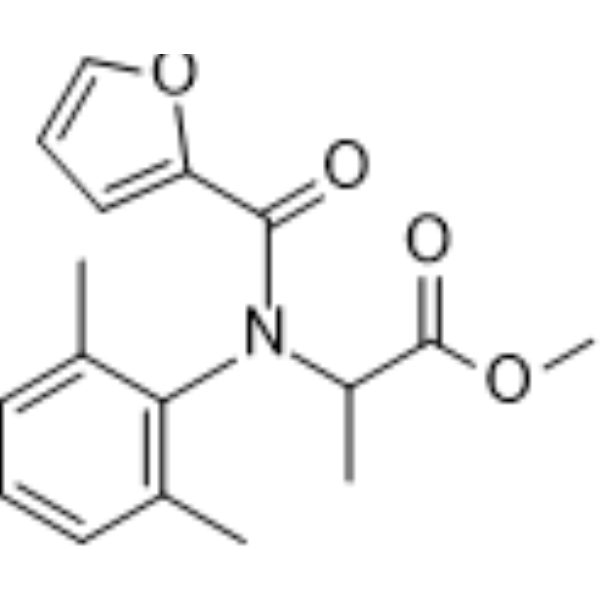
Furalaxyl
Furalaxyl (CGA 38140) is an acylalanine fungicide with high selectivity against the order Peronosporales. Furalaxyl inhibits mycelial growth of Pythium ultimum. Furalaxyl inhibits fungal protein and nucleic acid synthesis, with RNA synthesis being more strongly inhibited than DNA synthesis. The primary mode of action of Furalaxyl is considered to involve impairment of fungal RNA biosynthesis and associated effects on mitosis. Furalaxyl is applicable for studies on oomycete growth inhibition, fungal RNA biosynthesis, and pesticide photodegradation.
商品は「研究用試薬」です。人や動物の医療用・臨床診断用・食品用の製品ではありません。
研究用途以外に使用した場合、当社は一切の責任を負いかねます。
- CAS 番号: 57646-30-7
- 分子式: C17H19NO4
- 分子量:301.34
-
保管条件:Powder -20°C, 3 years , 4°C, 2 years ; In solvent -80°C, 6 months , -20°C, 1 month

To place orders, for customer services and technical support, please contact: MedChemExpress USA
Tel: 609-228-6898 E-mail: [email protected] [email protected]


-
 生物活性
-
化学情報
- プロトコル
- 純度とドキュメンテーション
- 参考文献
-
 Help & FAQs


DNA/RNA Synthesis アイソフォーム固有の製品をすべて表示
More

生物活性
製品説明
体外実験
Furalaxyl (1 × 10⁻³ M; sunlight; CH3CN) reaches 100% conversion within 1 d in the presence of rose bengal, whereas without the photosensitizer, the conversion is <5% after 1 d. In water containing 1% CH3CN, the conversion is <2% after 8 d of irradiation without the photosensitizer, and reaches 10% after 1 d of irradiation with rose bengal added[1].
Furalaxyl (3 d) inhibits the growth of Pseudokirchneriella subcapitata algae, with an IC50 of 23.98 mg/L[1].
Furalaxyl inhibits sporangium formation in Phytophthora palmivora with an ED50 of 0.05 μM, whereas the ED50 values for sporangium germination and zoospore germination are both >10 μM[2].
Furalaxyl (1, 5, or 10 μM; 1 h) does not inhibit oxygen uptake in Pythium ultimum, Phytophthora nicotianae, and Phytophthora palmivora; at 10 μM, oxygen uptake is 132%, 141%, and 196% of the untreated control, respectively[2].
Furalaxyl (0.03-3 μg/mL; 4 h) does not inhibit glucose-dependent oxygen consumption in Pythium splendens[3].
Furalaxyl inhibits mycelial growth of Phytophthora nicotianae, with ED50 values of 1.44 μM and 2.9 μM in potato dextrose agar and potato dextrose broth, respectively[2].
Furalaxyl inhibits mycelial growth of Phytophthora palmivora, with ED50 values of <0.5 μM and 0.35 μM in potato dextrose agar and potato dextrose broth, respectively[2].
Furalaxyl (0.1-1 μM; 4 h) inhibits the incorporation of [14C]-labeled amino acids into proteins in Pythium ultimum, Phytophthora palmivora, and Phytophthora nicotianae; at 1 μM, the inhibition rates are 19.1%, 23.2%, and 37.8%, respectively[2].
Furalaxyl (up to 12 h) inhibits Phytophthora palmivora DNA and RNA synthesis, with RNA synthesis being more strongly inhibited; after 12 h of treatment, the degree of RNA synthesis inhibition is at least twice that of DNA synthesis[2].
Furalaxyl causes germ tubes of Phytophthora palmivora to twist and increases hyphal branching, whereas sporangia and zoospores still germinate normally at the ED50 concentration[2].
Furalaxyl results in 21 nuclei per 100 μm at the growing hyphal tips of Phytophthora palmivora, compared with 25 nuclei per 100 μm in the control, suggesting that nuclear division may be inhibited[2].
Furalaxyl (24 °C; 1-3 weeks) exhibits selective antifungal activity against the Peronosporales in oomycetes, with various Phytophthora and Pythium species being sensitive to Furalaxyl, while a large number of other fungi remain insensitive at concentrations up to 300 μg/mL[3].
The activity of Furalaxyl against Pythium splendens and Phytophthora cinnamomi increases with decreasing culture temperature; at 10, 15, and 30 °C, the EC50/MIC values for P. splendens are 0.01/0.03, 0.1/0.3, and 0.1/0.3 μg/mL, respectively, while those for P. cinnamomi are 0.03/0.3, 0.3/10, and 3/30 μg/mL[3].
Furalaxyl (10 μg/mL; 1 d) prevents Pythium splendens from resuming growth after transfer to Furalaxyl-free medium; at the MIC concentration, Furalaxyl primarily exhibits growth inhibition during the initial 24 h, and shows fungicidal activity after continuous exposure for 7 d[3].
Furalaxyl (0.03-10 μg/mL; 1-7 d) has a minor effect on the germination of swollen hyphal bodies of Pythium splendens, but exposure to 0.03 μg/mL for 1 d reduces hyphal growth and branching; treatment with 0.3-1 μg/mL and higher concentrations for 3 d induces marked hyphal morphological changes, and after 7 d of treatment, no new swollen hyphal body formation is observed even at the lowest tested concentration[3].
MedChemExpress (MCE) has not independently confirmed the accuracy of these methods. They are for reference only.
体内実験
MedChemExpress (MCE) has not independently confirmed the accuracy of these methods. They are for reference only.


化学情報
-
CAS 番号 57646-30-7
-
性状 Solid
-
分子量 301.34
-
分子式 C17H19NO4
-
Color White to off-white
-
SMILES
O=C(C(C)N(C1=C(C)C=CC=C1C)C(C2=CC=CO2)=O)OC
-
別名
CGA 38140
-
輸送条件
Room temperature in continental US; may vary elsewhere.
-
保管条件
Powder -20°C 3 years 4°C 2 years In solvent -80°C 6 months -20°C 1 month


純度とドキュメンテーション
-
データシート (294 KB)
-
SDS (393 KB)
- English - EN (393 KB)
- Français - FR (393 KB)
- Deutsch - DE (393 KB)
- Norwegian - NO (393 KB)
- Español - ES (393 KB)
- Swedish - SV (393 KB)
- Italian - IT (393 KB)
- Korean - KR (393 KB)
- Portuguese - PT (393 KB)
-
取扱説明書 (2659 KB)
参考文献

Calculators
濃度 (開始) × 体積 (開始) = 濃度 (終了) × 体積 (終了)


Furalaxyl 関連分類
HY-118578 関連分類
 Powered by Bioz