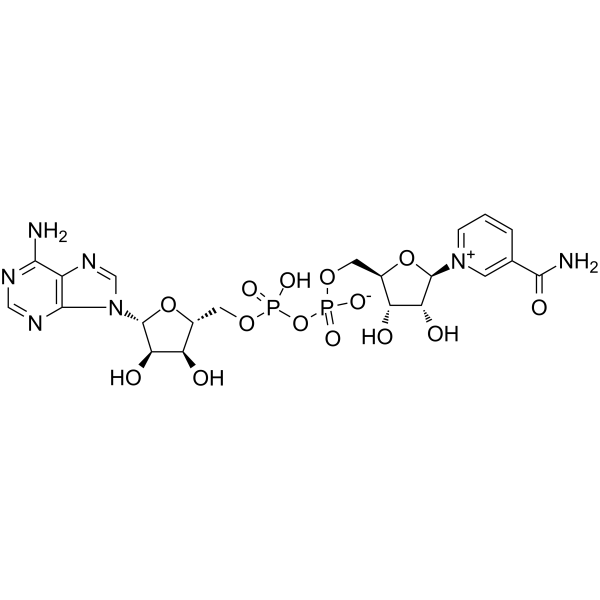
NADH
Based on 11 publication(s) in Google Scholar
NADH is an orally active dehydrogenase coenzyme that acts as a crucial electron carrier in cellular respiration and participates in ATP production. NADH promotes metabolism, supports brain function, and counteracts oxidative stress by transferring electrons to the electron transport chain. As a signaling molecule, NADH regulates multiple biological processes, including anti-apoptosis, synaptic plasticity, gene expression, and calcium homeostasis. Redox imbalance of NADH/NAD⁺ is one of the key pathological mechanisms of various diseases, such as diabetic nephropathy, neurodegenerative diseases, and ischemia-reperfusion injury.
商品は「研究用試薬」です。人や動物の医療用・臨床診断用・食品用の製品ではありません。
研究用途以外に使用した場合、当社は一切の責任を負いかねます。
- CAS 番号: 58-68-4
- 分子式: C21H29N7O14P2
- 分子量:665.44
-
保管条件:
Please store the product under the recommended conditions in the Certificate of Analysis.
MedChemExpress(MCE)の使用を引用している文献 NADH
More- Cell Mol Immunol. 2024 Jun;21(6):561-574. [Abstract]
- Food Chem. 2023 Oct 15:423:136274. [Abstract]
- Biomater Res. 2026 Apr 29.
- Free Radic Biol Med. 2025 Jan:226:56-69. [Abstract]
- J Ginseng Res. 2025 Sep;49(5):541-552. [Abstract]
- Mol Plant Pathol. 2025 Dec;26(12):e70196. [Abstract]
- Microorganisms. 2026 May 9;14(5):1070. [Abstract]
- ACS Chem Biol. 2026 Jul 2.
- Biochemistry. 2023 Dec 5;62(23):3396-3410. [Abstract]
- Chemrxiv. 2025 Aug 28.
- Research Square Preprint. 2023 Sep 15.
Endogenous Metabolite アイソフォーム固有の製品をすべて表示
More
生物活性
製品説明
IC50 & Target
|
Human Endogenous Metabolite |
体外実験
臨床実験
| NCT Number | Sponsor | Condition | Start Date |
Phase
|
|---|---|---|---|---|
| NCT01329991 | Plexxikon| | 2011-05 | PHASE1 |
化学情報
-
CAS 番号 58-68-4
-
分子量 665.44
-
分子式 C21H29N7O14P2
-
SMILES
O[C@H]1[C@@H](O)[C@H](N2C=CCC(C(N)=O)=C2)O[C@@H]1COP(O)(OP(OC[C@@H]3[C@@H](O)[C@@H](O)[C@H](N4C5=NC=NC(N)=C5N=C4)O3)(O)=O)=O
-
Structure Classification
-
Initial Source
-
輸送条件
Room temperature in continental US; may vary elsewhere.
-
保管条件
Please store the product under the recommended conditions in the Certificate of Analysis.
Publications (11)
-
Journal Impact Factor
-
Most Recent
-
Cell Mol Immunol
2024 Jun;21(6):561-574. PMID: 38570588 -
Food Chem
Improvement of catalytic activity of sorbose dehydrogenase for deoxynivalenol degradation by rational design. [Abstract]2023 Oct 15:423:136274. PMID: 37159968 -
-
Free Radic Biol Med
TSPO exacerbates sepsis-induced cardiac dysfunction by inhibiting p62-Mediated autophagic flux via the ROS-RIP1/RIP3-exosome axis. [Abstract]2025 Jan:226:56-69. PMID: 39542185 -
J Ginseng Res
Total ginsenosides and ginsenoside Rb2 delay hepatocyte senescence by regulating NAD+ metabolism and promoting IDO2/QPRT expression. [Abstract]2025 Sep;49(5):541-552. PMID: 40843012 -
Mol Plant Pathol
Negative Immune Regulator CAD7 Functions as a Small-Molecule Aldehyde Reductase and Increases Histamine Accumulation in Arabidopsis. [Abstract]2025 Dec;26(12):e70196. PMID: 41456913 -
Microorganisms
Characterization of RmlABCD Enzymes from Marine Bacteria and Efficient Synthesis of dTDP-L-Rhamnose. [Abstract]2026 May 9;14(5):1070. PMID: 42197457 -
-
Biochemistry
Full-Length NAD+-I Riboswitches Bind a Single Cofactor but Cannot Discriminate against Adenosine Triphosphate. [Abstract]2023 Dec 5;62(23):3396-3410. PMID: 37947391 -
-
プロトコル
-
RT-PCR
Reverse transcription technology uses RNA as a template to synthesize DNA. RT-PCR is simple, specific and sensitive, and can be used to detect gene expression levels and expression differences in cells; detect RNA virus content; clone cDNA sequences of specific genes.
-
RNA extraction experimental
By lysing cells, releasing RNA, and removing impurities such as proteins and DNA, high-purity RNA products are finally obtained. The commonly used traditional method is the guanidine isothiocyanate/phenol/chloroform method (Trizol), which is suitable for a variety of animal materials including animal tissues, microorganisms, cultured cells, etc., and most plant materials.
-
Detection of Apoptosis
Apoptosis, also called programmed cell death, is generally characterized by distinct morphological characteristics.
-
TUNEL staining for apoptotic DNA fragmentation
TUNEL staining detects DNA strand breaks by using terminal deoxynucleotidyl transferase to add labeled nucleotides to exposed 3′-OH DNA termini, generating either microscopic staining in fixed cells or tissue sections, or fluorescence/cytometric signal in cell suspensions. TUNEL positivity reflects DNA fragmentation but should not be interpreted alone as definitive apoptosis, because TUNEL can also label necrotic, autolytic, mechanically damaged, or DNA-repair-associated DNA breaks.
-
Annexin V plus membrane-impermeant dye apoptosis staining
Annexin V-based apoptosis assays rely on the detection of phosphatidylserine (PS) externalization from the inner leaflet of the plasma membrane to the outer leaflet, an early biochemical hallmark of apoptosis. Fluorescently labeled Annexin V binds PS in a calcium-dependent manner, enabling identification of early apoptotic cells by flow cytometry or fluorescence microscopy. When combined with a membrane-impermeant DNA-binding dye (e. g. , propidium iodide), this approach allows discrimination between viable (Annexin V−/dye−), early apoptotic (Annexin V+/dye−), and late apoptotic or necrotic (Annexin V+/dye+) cell populations by assessing membrane integrity and PS exposure.
-
ROS/oxidative-stress fluorescent staining
ROS/oxidative-stress fluorescent staining uses cell-permeant fluorogenic probes that become fluorescent after oxidation inside cells or tissues; commonly used examples include DCFH-DA/DCFDA for broad cellular oxidant detection, DHE for superoxide-related signal detection, MitoSOX for mitochondrial superoxide-related signal detection, and CellROX probes for oxidative-stress-associated fluorescence readouts. The assay detects probe oxidation rather than a single ROS species unless the probe and analysis method have been chemically validated for that species. DCFH-DA enters cells, is deacetylated by intracellular esterases to DCFH, and produces fluorescent DCF after oxidation, so the readout is used as an operational measure of total cellular oxidative stress rather than a species-specific ROS measurement. DHE and MitoSOX can report superoxide-related oxidation, but red fluorescence alone can include non-specific ethidium-like oxidation products; HPLC or optimized spectral approaches are
-
Apoptosis Solutions
Apoptosis is a regulated, generally non-lytic cell-death pathway that removes unwanted, damaged, infected, or abnormal cells through coordinated morphological changes, caspase activation, DNA fragmentation, and membrane remodeling. The intrinsic apoptosis pathway is controlled mainly by mitochondrial outer membrane permeabilization, BCL-2 family proteins, cytochrome c release, apoptosome formation, caspase-9 activation, and downstream executioner caspase-3/7 activation. The extrinsic apoptosis pathway is initiated by death receptors such as Fas, TNFR, and TRAIL receptors, which recruit adaptor proteins and activate caspase-8 before engaging executioner caspases or mitochondrial amplification through BID cleavage. Apoptosis is linked to many phenotypes, including cancer cell killing, tissue homeostasis, immune regulation, neurodegeneration, infection response, and treatment-induced cytotoxicity; unresolved questions include how apoptosis interacts with necroptosis, pyroptosis, ferroptos
-
Real Time qPCR (Q-PCR)
Real-time quantitative PCR (qPCR) quantifies an amplifiable nucleic-acid target by monitoring fluorescence during PCR cycling rather than measuring product only after amplification. The increase in fluorescence tracks accumulation of PCR product, and the quantification cycle (Cq; historically also Ct/CP) is related to the initial amount of target: samples containing more starting target generally reach the defined fluorescence threshold in fewer cycles.
純度とドキュメンテーション
参考文献
[1].
Ying W. NAD+ and NADH in cellular functions and cell death. Front Biosci. 2006 Sep 1;11:3129-48.
[Content Brief]
[2].
Chen Z, et al. Therapeutic potential of NADH: in neurodegenerative diseases characterizde by mitochondrial dysfunction. Lin Chuang Er Bi Yan Hou Tou Jing Wai Ke Za Zhi. 2024 Jan;38(1):57-62.
[Content Brief]
[3]. Yan LJ, et al. NADH/NAD+ Redox Imbalance and Diabetic Kidney Disease. Biomolecules. 2021;11(5):730. Published 2021 May 14. [Content Brief]
Calculators
濃度 (開始) × 体積 (開始) = 濃度 (終了) × 体積 (終了)