



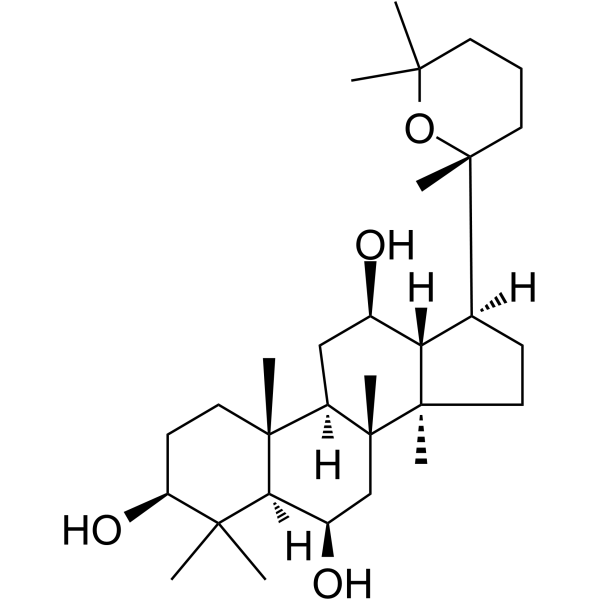
Panaxatriol
Based on 3 publication(s) in Google Scholar
Panaxatriol is an orally active dammarane-type tetracyclic triterpene sapogenin. Panaxatriol enhances the phosphorylation levels of Akt, insulin receptor and p70S6K in skeletal muscle. Panaxatriol reduces the mRNA expression level of Atrogin1 in skeletal muscle. Panaxatriol induces apoptosis, pre-G1 cell cycle arrest and increased intracellular ROS levels in prostate cancer cells, decreases mitochondrial membrane potential, inhibits cell migration and reduces colony formation. Panaxatriol can be used in research related to insulin resistance, myocardial ischemia/reperfusion injury and prostate cancer[1][2][3].
연구목적의 판매만을 진행합니다. 환자를 대상으로 한 판매는 하지 않습니다.
- Purity : 99.93%
- CAS No.: 32791-84-7
- 화학식: C30H52O4
- 분자량:476.73
-
보관:Powder -20°C, 3 years , 4°C, 2 years ; In solvent -80°C, 2 years , -20°C, 1 year

To place orders, for customer services and technical support, please contact: MedChemExpress USA
Tel: 609-228-6898 E-mail: [email protected] [email protected]


-
 Biological Activity
-
Chemical Information
-
용액&용해도
- Protocol
- 순도&문서
- References
-
 Help & FAQs



Publications Citing Use of MedChemExpress (MCE) Panaxatriol
More Customer Validation & Images

-
RT-PCR

-
WB

-
Histological Imaging/Staining

-
Cell Imaging/Staining

-
In Vivo Efficacy Study


Biological Activity
제품 설명
In Vitro
Panaxatriol (15-60 μM; 48-72 h) exhibits concentration-dependent cytotoxicity against DU-15 human prostate cancer cells, with an IC50 of 30 μM[3].
Panaxatriol (15-60 μM; 6 days) concentration-dependently suppresses colony formation by DU-15 human prostate cancer cells[3].
Panaxatriol (15-60 μM; 48 h) concentration-dependently induces apoptosis in DU-15 human prostate cancer cells, as detected by DAPI staining[3].
Panaxatriol (15-60 μM; 72 h) concentration-dependently increases intracellular ROS production in DU-15 human prostate cancer cells[3].
Panaxatriol (15-60 μM; 72 h) concentration-dependently reduces mitochondrial membrane potential in DU-15 human prostate cancer cells[3].
Panaxatriol (15-60 μM; 24 h) concentration-dependently induces sub-G1 cell cycle arrest in DU-15 human prostate cancer cells, with 24.8% of cells arrested at 60 μM[3].
Panaxatriol (30 μM; 48 h) inhibits the migration of DU-15 human prostate cancer cells in an in vitro wound healing assay[3].
MedChemExpress (MCE) has not independently confirmed the accuracy of these methods. They are for reference only.
-
Cell Line:DU-15 human prostate cancer cells
-
Concentration:10 μM; 15 μM; 30 μM; 50 μM; 100 μM
-
Incubation Time:48 h; 72 h
-
Result:Exerted concentration-dependent cytotoxic effects on DU-15 cells, with an IC50 of 30 μM.
-
Cell Line:DU-15 human prostate cancer cells
-
Concentration:15 μM; 30 μM; 60 μM
-
Incubation Time:24 h
-
Result:Induced sub-G1 cell cycle arrest in a concentration-dependent manner, with sub-G1 cell fractions reaching 10.4% at 15 μM, 17.3% at 30 μM, and 24.8% at 60 μM.
-
Cell Line:DU-15 human prostate cancer cells
-
Concentration:30 μM
-
Incubation Time:48 h
-
Result:Suppressed the migratory capability of DU-15 cells.
In Vivo
Pretreatment with panaxatriol (5 mg/kg; p.o.; daily; 7 days) markedly ameliorates ischemia/reperfusion-induced myocardial damage in isolated rat hearts, as demonstrated by preserved cardiac contractile function, reduced myocardial enzyme leakage, attenuated oxidative stress, and delayed time to contracture[2].
MedChemExpress (MCE) has not independently confirmed the accuracy of these methods. They are for reference only.
-
Animal Model:KK-Ay/Ta Jcl (KKAy) (6-week-old male, spontaneous insulin-resistant model)[1]
-
Dosage:0.2% (in standard diet)
-
Administration:p.o.; daily; 6 weeks
-
Result:Significantly reduced blood glucose.
Increased soleus muscle Akt phosphorylation to 1.5 arbitrary units (AU), normalized to GAPDH.
Increased p70S6K phosphorylation to 1.5 AU, normalized to GAPDH.
Reduced Atrogin1 mRNA expression levels.
Reduced HOMA-R to 10.3 when combined with aerobic exercise.
Increased soleus muscle mass to 16.3 mg.
Increased soleus myofiber cross-sectional area (CSA) significantly higher than exercise alone when combined with aerobic exercise.
Increased Akt phosphorylation to 2.3 AU when combined with aerobic exercise.
-
Animal Model:Sprague-Dawley (male, 250-300 g, myocardial ischemia/reperfusion injury model via 30 min global ischemia + 30 min reperfusion after 7-day pretreatment)[2]
-
Dosage:5 mg/kg
-
Administration:p.o.; once daily; 7 consecutive days
-
Result:Increased post-reperfusion left ventricular developed pressure to 68.1 mmHg.
Reached a post-reperfusion double product of 12.8.
Significantly increased time to contracture compared with the vehicle-treated group.
Significantly lowered malondialdehyde (MDA) levels compared with the vehicle-treated group.
Significantly elevated reduced glutathione (GSH) levels compared with the vehicle-treated group.
- RNA extraction experimental
- Cell migration
- Detection of Apoptosis
- TUNEL staining for apoptotic DNA fragmentation
- Flow cytometric DNA-content cell-cycle staining
- Zigmond Chamber Chemotaxis Assay
- Research Protocol for Endocrine Diseases
- Under-Agarose Cell Migration Assay
- Fluorescent plasma-membrane potential dye assay
- Transwell/Boyden Chamber Migration Assay
- Mitochondrial membrane-potential and mitochondrial mass staining
- Apoptosis Solutions
- 3D Collagen/Hydrogel Matrix Migration Assay
- Soft Agar Colony Formation Assay
- Cell-Exclusion Zone Migration Assay
- Dunn/Insall Chamber Chemotaxis Assay
- RT-PCR
- Western Blot
- Scratch/Wound-Healing Migration Assay
- Mitochondrial membrane-potential fluorescent assay
- Annexin V plus membrane-impermeant dye apoptosis staining
- BrdU Incorporation Assay
- ROS/oxidative-stress fluorescent staining
- Neural Crest/Neuronal Cell Migration Explant Assay
- Protocol for Cell Cycle
- Colony Formation (Clonogenic) Assay
- Research Protocol for Metabolic Diseases
- Real Time qPCR (Q-PCR)
- Kinase activity and phosphorylation assays
- Protocol for Kinase activity and phosphorylation assays


Chemical Information
-
CAS No. 32791-84-7
-
Appearance Solid
-
분자량 476.73
-
화학식 C30H52O4
-
Color White to off-white
-
SMILES
C[C@@]1(CC[C@@H]2O)[C@](C[C@H]3O)([H])[C@](C[C@@H](O)[C@@]1([H])C2(C)C)(C)[C@@]4(C)[C@@]3([H])[C@]([C@](CCC5)(C)OC5(C)C)([H])CC4
-
Structure Classification
-
Initial Source
-
선적
Room temperature in continental US; may vary elsewhere.
-
보관
Powder -20°C 3 years 4°C 2 years In solvent -80°C 2 years -20°C 1 year


Publications (3)
-
Journal Impact Factor
-
Most Recent
-
J Adv Res
Panaxatriol exerts anti-senescence effects and alleviates osteoarthritis and cartilage repair fibrosis by targeting UFL1. [Abstract]2025 Aug:74:493-511. PMID: 39442872
Panaxatriol purchased from MedChemExpress. Usage Cited in: J Adv Res. 2025 Aug:74:493-511. [Abstract]
qRT-PCR was used to detect the mRNA level of anabolism markers (SOX9, COL2, ACAN) and catabolism markers (MMP13, ADAMTS-4, COL10) treated with Panaxatriol (1, 5, 10 μM) for 7 days.
Panaxatriol purchased from MedChemExpress. Usage Cited in: J Adv Res. 2025 Aug:74:493-511. [Abstract]
Western blot was used to detect the protein level of COL2, ACAN and MMP13 treated with Panaxatriol (1, 5, 10 μM) for 7 days.
Panaxatriol purchased from MedChemExpress. Usage Cited in: J Adv Res. 2025 Aug:74:493-511. [Abstract]
Representative images of H&E stained, safranin O/Fast green stained and immunofluorescence stained sections of human cartilage explants treated with Panaxatriol (1, 5, 10 μM) for 7 days.
Panaxatriol purchased from MedChemExpress. Usage Cited in: J Adv Res. 2025 Aug:74:493-511. [Abstract]
Representative images of SA-beta-gal staining C28/I2 cells treated with 10 ng/mL IL-1β or a series concentration of Panaxatriol (1, 5, 10 μM) for 2 days.
Panaxatriol purchased from MedChemExpress. Usage Cited in: J Adv Res. 2025 Aug:74:493-511. [Abstract]
Three-dimensional micro-CT images of subchondral bone in the groups treated with Panaxatriol (20 μM, intraarticular injection).
-
Acta Pharmacol Sin
Ginsenoside (20)S-APPT induces ferroptosis in hepatocellular carcinoma and cholangiocarcinoma by targeting FSP1. [Abstract]2025 Jun 23. PMID: 40550962 -
Planta Med
Discovery and characterization of panaxatriol as a novel thrombin inhibitor from Panax notoginseng using combination of computational and experimental approach. [Abstract]2024 Aug;90(10):801-809. PMID: 38838717


용액&용해도
In Vitro:
DMSO : 25 mg/mL (52.44 mM; Need ultrasonic; Hygroscopic DMSO has a significant impact on the solubility of product, please use newly opened DMSO)
Please refer to the solubility information to select the appropriate solvent. Once prepared, please aliquot and store the solution to prevent product inactivation from repeated freeze-thaw cycles.
Storage method and period of stock solution: -80°C, 2 years; -20°C, 1 year. When stored at -80°C, please use it within 2 years. When stored at -20°C, please use it within 1 year.
Please refer to the solubility information to select the appropriate solvent. Once prepared, please aliquot and store the solution to prevent product inactivation from repeated freeze-thaw cycles.
Storage method and period of stock solution: -80°C, 2 years; -20°C, 1 year. When stored at -80°C, please use it within 2 years. When stored at -20°C, please use it within 1 year.
Concentration (start) × Volume (start) = Concentration (final) × Volume (final)
In Vivo:
Select the appropriate dissolution method based on your experimental animal and administration route.
- For the following dissolution methods, please ensure to first prepare a clear stock solution using an In Vitro approach and then sequentially add co-solvents:
- To ensure reliable experimental results, the clarified stock solution can be appropriately stored based on storage conditions. As for the working solution for In Vivo experiments, it is recommended to prepare freshly and use it on the same day.
- The percentages shown for the solvents indicate their volumetric ratio in the final prepared solution. If precipitation or phase separation occurs during preparation, heat and/or sonication can be used to aid dissolution.
Add each solvent one by one: 10% DMSO 40% PEG300 5% Tween-80 45% Saline
Solubility: ≥ 2.5 mg/mL (5.24 mM); Clear solution
This protocol yields a clear solution of ≥ 2.5 mg/mL (saturation unknown).
Taking 1 mL working solution as an example, add 100 μL DMSO stock solution (25.0 mg/mL) to 400 μL PEG300, and mix evenly; then add 50 μL Tween-80 and mix evenly; then add 450 μL Saline to adjust the volume to 1 mL.
Preparation of Saline: Dissolve 0.9 g sodium chloride in ddH₂O and dilute to 100 mL to obtain a clear Saline solution.
Add each solvent one by one: 10% DMSO 90% (20% SBE-β-CD in Saline)
Solubility: ≥ 2.5 mg/mL (5.24 mM); Clear solution
This protocol yields a clear solution of ≥ 2.5 mg/mL (saturation unknown).
Taking 1 mL working solution as an example, add 100 μL DMSO stock solution (25.0 mg/mL) to 900 μL 20% SBE-β-CD in Saline, and mix evenly.
Preparation of 20% SBE-β-CD in Saline (4°C, storage for one week): 2 g SBE-β-CD powder is dissolved in 10 mL Saline, completely dissolve until clear.
In Vivo Dissolution Calculator
Please enter the basic information of animal experiments:
-
-
-
-
Recommended: Prepare an additional quantity of animals to account for potential losses during experiments.
Please enter your animal formula composition:
-
%DMSO +
Recommended: Keep the proportion of DMSO in working solution below 2% if your animal is weak.
-
%+
-
+%Tween-80 + +
-
%Saline +
The co-solvents required include: DMSO, . All of co-solvents are available by MedChemExpress (MCE). , Tween 80. All of co-solvents are available by MedChemExpress (MCE).
Working solution concentration: 0.22 mg/mL
Method for preparing stock solution: mg drug dissolved in μL DMSO. Stock solution concentration: mg/mL.
1. Take μL DMSO stock solution;
2. Add μL .
μL , mix evenly;
3. Then add μL Tween 80, mix evenly;
4. Then add μL
Please ensure that the stock solution in the first step is dissolved to a clear state, and add co-solvents in sequence. You can use ultrasonic heating (ultrasonic cleaner, recommended frequency 20-40 kHz), vortexing, etc. to assist dissolution.


순도&문서
-
Data Sheet (288 KB)
-
SDS (396 KB)
- English - EN (396 KB)
- Français - FR (396 KB)
- Deutsch - DE (396 KB)
- Norwegian - NO (396 KB)
- Español - ES (396 KB)
- Swedish - SV (396 KB)
- Italian - IT (396 KB)
- Korean - KR (396 KB)
- Portuguese - PT (396 KB)
-
Handling Instructions (2659 KB)
References
[1]. Takamura Y, et al. Effects of Aerobic Exercise Combined with Panaxatriol Derived from Ginseng on Insulin Resistance and Skeletal Muscle Mass in Type 2 Diabetic Mice. J Nutr Sci Vitaminol (Tokyo). 2017;63(5):339-348. [Content Brief]
[2]. Kim TH, et al. The effects of ginseng total saponin, panaxadiol and panaxatriol on ischemia/reperfusion injury in isolated rat heart. Food Chem Toxicol. 2010;48(6):1516-1520. [Content Brief]
[3]. Yu R, et al. Potential antitumor effects of panaxatriol against DU-15 human prostate cancer cells is mediated via mitochondrial mediated apoptosis, inhibition of cell migration and sub-G1 cell cycle arrest. J BUON. 2018;23(1):200-204. [Content Brief]


Complete Stock Solution Preparation Table
Please refer to the solubility information to select the appropriate solvent. Once prepared, please aliquot and store the solution to prevent product inactivation from repeated freeze-thaw cycles.
Storage method and period of stock solution: -80°C, 2 years; -20°C, 1 year. When stored at -80°C, please use it within 2 years. When stored at -20°C, please use it within 1 year.
| Optional Solvent | Concentration Solvent Mass | 1 mg | 5 mg | 10 mg | 25 mg |
|---|---|---|---|---|---|
| DMSO | 1 mM | 2.0976 mL | 10.4881 mL | 20.9762 mL | 52.4406 mL |
| 5 mM | 0.4195 mL | 2.0976 mL | 4.1952 mL | 10.4881 mL | |
| 10 mM | 0.2098 mL | 1.0488 mL | 2.0976 mL | 5.2441 mL | |
| 15 mM | 0.1398 mL | 0.6992 mL | 1.3984 mL | 3.4960 mL | |
| 20 mM | 0.1049 mL | 0.5244 mL | 1.0488 mL | 2.6220 mL | |
| 25 mM | 0.0839 mL | 0.4195 mL | 0.8390 mL | 2.0976 mL | |
| 30 mM | 0.0699 mL | 0.3496 mL | 0.6992 mL | 1.7480 mL | |
| 40 mM | 0.0524 mL | 0.2622 mL | 0.5244 mL | 1.3110 mL | |
| 50 mM | 0.0420 mL | 0.2098 mL | 0.4195 mL | 1.0488 mL |


Panaxatriol Related Classifications
HY-N0597 Related Classifications
 Powered by Bioz