



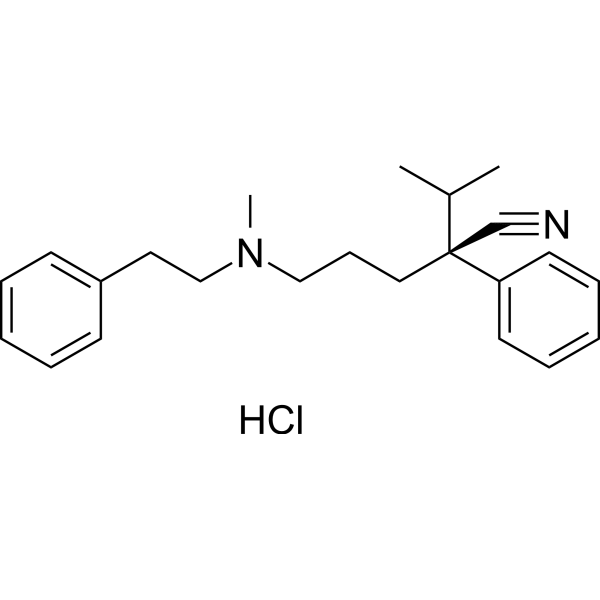
Levemopamil hydrochloride
Levemopamil hydrochloride is a blood-brain barrier penetrable calcium channel blocker and a 5-HT2 antagonist. Levemopamil hydrochloride can be used for temporary occlusion and neurological disease research.
For research use only. We do not sell to patients.
- CAS No.: 101238-54-4
- Formula: C23H31ClN2
- Molecular Weight:370.96
-
Storage:
Please store the product under the recommended conditions in the Certificate of Analysis.

To place orders, for customer services and technical support, please contact: MedChemExpress USA
Tel: 609-228-6898 E-mail: [email protected] [email protected]


-
 Biological Activity
-
Chemical Information
- Protocols
- Purity & Documentation
- References
-
 Help & FAQs




Biological Activity
Description
In Vivo
MedChemExpress (MCE) has not independently confirmed the accuracy of these methods. They are for reference only.
-
Animal Model:Male Han-Wistar rats with bilateral damping of carotid arteries (BCCA)[1]
-
Dosage:30 mg/kg
-
Administration:Intraperitoneal injection; 30 mg/kg, once
-
Result:Showed no effect on GABA or ACh content in either BCCA or sham-operated control rats. Significantly increased swimming speed of BCCA rats in swimming test. Prevented the increasing of escape latency to reach the hidden platform.


Chemical Information
-
CAS No. 101238-54-4
-
Molecular Weight 370.96
-
Formula C23H31ClN2
-
SMILES
CN(CCC1=CC=CC=C1)CCC[C@@](C#N)(C2=CC=CC=C2)C(C)C.Cl
-
Shipping
Room temperature in continental US; may vary elsewhere.
-
Storage
Please store the product under the recommended conditions in the Certificate of Analysis.

Protocols
-
Research Protocol for Neurological Diseases
PINK1/Parkin-mediated mitophagy pathway is a mitochondrial quality-control signaling axis in which mitochondrial depolarization stabilizes PINK1 on damaged mitochondria, activates Parkin recruitment and E3 ubiquitin ligase activity, promotes ubiquitination of outer mitochondrial membrane proteins, recruits selective autophagy adaptors, and drives lysosomal degradation of damaged mitochondria. In neurological disease research, this pathway is experimentally important because neurons, especially dopaminergic neurons, are highly dependent on mitochondrial integrity, and defective mitochondrial turnover can lead to mitochondrial dysfunction, oxidative stress, impaired neuronal survival, α-synuclein accumulation, and neuroinflammatory damage-associated signals. The genetic disease link is strongest in Parkinson’s disease because mutations in PRKN/parkin cause autosomal recessive juvenile parkinsonism, mutations in PINK1 cause hereditary early-onset Parkinson’s disease, and Drosophila studie


Purity & Documentation
References

Calculators
Concentration (start) × Volume (start) = Concentration (final) × Volume (final)


Levemopamil hydrochloride Related Classifications
HY-113643 Related Classifications
 Powered by Bioz