



Metazachlor

Based on 1 Customer Validation
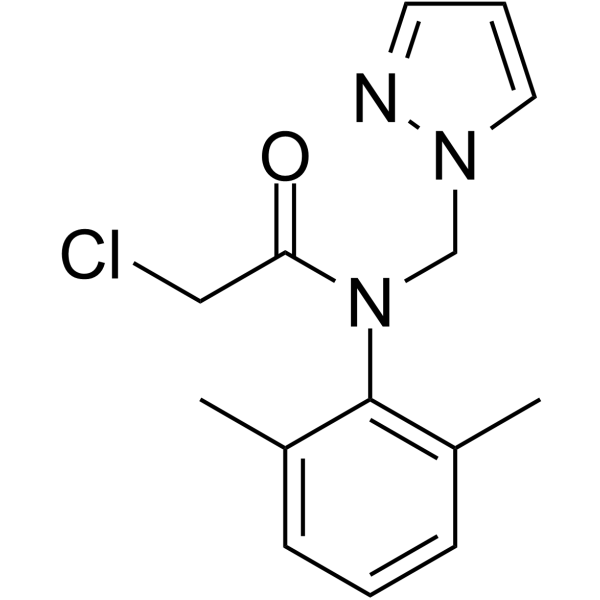
Metazachlor (BAS 479H) is a herbicide belonging to the chloroacetamides class. Metazachlor can inhibit the synthesis of very long chain fatty acids during the germination and emergence of weed seeds, thereby interfering with cell division and tissue differentiation, and thus hindering the normal growth and development of weeds.
Para uso exclusivo en investigación. No vendemos a pacientes.
- Pureza : 99.75%
- No. CAS: 67129-08-2
- Fòrmula: C14H16ClN3O
- Peso molecular:277.75
-
Almacenamiento:
4°C, protect from light
* In solvent : -80°C, 6 months; -20°C, 1 month (protect from light)

To place orders, for customer services and technical support, please contact: MedChemExpress USA
Tel: 609-228-6898 E-mail: [email protected] [email protected]


-
 Actividad biológica
-
Chemical Information
-
Solvente y solubilidad
- Protocolo
- Pureza y Documentación
- Referencias
-
 Help & FAQs


Ver todos los productos específicos de isoformas DNA/RNA Synthesis
More

Actividad biológica
Descripciòn
In Vitro
Metazachlor (0.5-50 μM; 4 days) can increase CYP2B enzyme activity, mRNA levels, and hepatocyte replicative DNA synthesis in hepatocytes of male Sprague-Dawley wild-type rats, but has little effect on these parameters in hepatocytes of CAR knockout rats[1].
MedChemExpress (MCE) has not independently confirmed the accuracy of these methods. They are for reference only.
In Vivo
MedChemExpress (MCE) has not independently confirmed the accuracy of these methods. They are for reference only.


Chemical Information
-
No. CAS 67129-08-2
-
Appearance Solid
-
Peso molecular 277.75
-
Fòrmula C14H16ClN3O
-
Color Off-white to light yellow
-
SMILES
O=C(N(C1=C(C)C=CC=C1C)CN2N=CC=C2)CCl
-
Synonyms
BAS 479H
-
Envío
Room temperature in continental US; may vary elsewhere.
-
Almacenamiento
4°C, protect from light
* In solvent : -80°C, 6 months; -20°C, 1 month (protect from light)


Solvente y solubilidad
In Vitro:
DMSO : 100 mg/mL (360.04 mM; Need ultrasonic; Hygroscopic DMSO has a significant impact on the solubility of product, please use newly opened DMSO)
Please refer to the solubility information to select the appropriate solvent. Once prepared, please aliquot and store the solution to prevent product inactivation from repeated freeze-thaw cycles.
Storage method and period of stock solution: -80°C, 6 months; -20°C, 1 month (protect from light). When stored at -80°C, please use it within 6 months. When stored at -20°C, please use it within 1 month.
Please refer to the solubility information to select the appropriate solvent. Once prepared, please aliquot and store the solution to prevent product inactivation from repeated freeze-thaw cycles.
Storage method and period of stock solution: -80°C, 6 months; -20°C, 1 month (protect from light). When stored at -80°C, please use it within 6 months. When stored at -20°C, please use it within 1 month.
Concentration (start) × Volume (start) = Concentration (final) × Volume (final)


Pureza y Documentación
-
Ficha de datos (274 KB)
-
SDS (761 KB)
- English - EN (761 KB)
- Français - FR (761 KB)
- Deutsch - DE (761 KB)
- Norwegian - NO (761 KB)
- Español - ES (761 KB)
- Swedish - SV (761 KB)
- Italian - IT (761 KB)
- Korean - KR (761 KB)
- Portuguese - PT (761 KB)
-
Instrucciones de manejo (2659 KB)
Referencias


Complete Stock Solution Preparation Table
Please refer to the solubility information to select the appropriate solvent. Once prepared, please aliquot and store the solution to prevent product inactivation from repeated freeze-thaw cycles.
Storage method and period of stock solution: -80°C, 6 months; -20°C, 1 month (protect from light). When stored at -80°C, please use it within 6 months. When stored at -20°C, please use it within 1 month.
| Optional Solvent | Concentration Solvent Mass | 1 mg | 5 mg | 10 mg | 25 mg |
|---|---|---|---|---|---|
| DMSO | 1 mM | 3.6004 mL | 18.0018 mL | 36.0036 mL | 90.0090 mL |
| 5 mM | 0.7201 mL | 3.6004 mL | 7.2007 mL | 18.0018 mL | |
| 10 mM | 0.3600 mL | 1.8002 mL | 3.6004 mL | 9.0009 mL | |
| 15 mM | 0.2400 mL | 1.2001 mL | 2.4002 mL | 6.0006 mL | |
| 20 mM | 0.1800 mL | 0.9001 mL | 1.8002 mL | 4.5005 mL | |
| 25 mM | 0.1440 mL | 0.7201 mL | 1.4401 mL | 3.6004 mL | |
| 30 mM | 0.1200 mL | 0.6001 mL | 1.2001 mL | 3.0003 mL | |
| 40 mM | 0.0900 mL | 0.4500 mL | 0.9001 mL | 2.2502 mL | |
| 50 mM | 0.0720 mL | 0.3600 mL | 0.7201 mL | 1.8002 mL | |
| 60 mM | 0.0600 mL | 0.3000 mL | 0.6001 mL | 1.5002 mL | |
| 80 mM | 0.0450 mL | 0.2250 mL | 0.4500 mL | 1.1251 mL | |
| 100 mM | 0.0360 mL | 0.1800 mL | 0.3600 mL | 0.9001 mL |


Metazachlor Related Classifications
HY-136373 Related Classifications
 Powered by Bioz