



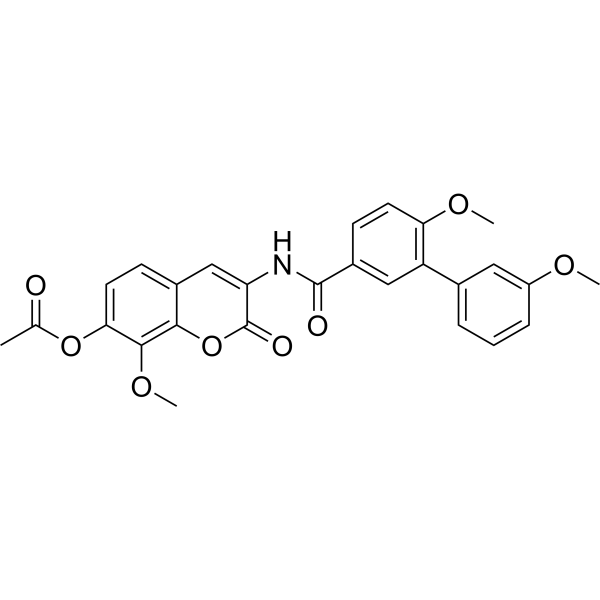
KU-177
KU-177 is a potent inhibitor of Hsp90 ATPase homologue 1 (Aha1), ablates Aha1-driven enhancement of Hsp90-dependent tau aggregation. KU-177 also disrupts Aha1/Hsp90 interactions (IC50=4.08 μM) without inhibition of Hsp90’s ATPase activity. KU-177 can be used for tauopathies research.
For research use only. We do not sell to patients.
- CAS No.: 1160952-43-1
- Formula: C27H23NO8
- Molecular Weight:489.47
-
Storage:Powder -20°C, 3 years ; In solvent -80°C, 6 months , -20°C, 1 month

To place orders, for customer services and technical support, please contact: MedChemExpress USA
Tel: 609-228-6898 E-mail: [email protected] [email protected]


-
 Biological Activity
-
Chemical Information
- Purity & Documentation
- References
-
 Help & FAQs




Biological Activity
Description
IC50 & Target
|
HSP90 |
Cellular Effect
|
Cell Line

|
Type | Value | Description | References |
|---|---|---|---|---|
| MCF7 | IC50 |
8.62 μM
Compound: 12c
|
Antiproliferative activity against human MCF7 cells expressing estrogen receptor after 72 hrs by MTS/PMS assay
Antiproliferative activity against human MCF7 cells expressing estrogen receptor after 72 hrs by MTS/PMS assay
|
[PMID: 21553822] |
| SK-BR-3 | IC50 |
20.5 μM
Compound: 12c
|
Antiproliferative activity against human SKBR3 cells expressing HER2 after 72 hrs by MTS/PMS assay
Antiproliferative activity against human SKBR3 cells expressing HER2 after 72 hrs by MTS/PMS assay
|
[PMID: 21553822] |
In Vitro
KU-177 (50 μM; 48 h) hampers the proliferation of flow MRD-positive cells in both primary multiple myeloma (MM) and recurrent MM patient samples[1].
KU-177 (30 μM; 48 h) inhibits proteasome activity in AHSA1 WT/OE cells, PSMD2 WT/OE cells and ANBL6 WT/DR cells[1].
KU-177 abrogates the cellular proliferation and PI resistance induced by elevated AHSA1, and decreases the expression of CDK6 and PSMD2[1].
KU-177 (25 μM; 30 min; 37 °C) inhibits recombinant P301L tau aggregation without inhibiting Hsp90 to refold luciferase[2].
KU-177 (10 μM; 24 h) exhibits the ability to disrupt interactions between Aha1 and Hsp90 in SH-SY5Y neuroblastoma cells and SK-BR-3 breast cancer cells, without significantly inhibition on Hsp90 client protein (Her2)[2].
MedChemExpress (MCE) has not independently confirmed the accuracy of these methods. They are for reference only.
-
Cell Line:ARP1 and H929 WT and AHSA1-OE cells
-
Concentration:1 nM-100 μM
-
Incubation Time:24, 48, 72 hours
-
Result:Decreased multiple myeloma (MM) cell proliferation and PI resistance induced by AHSA1/HSP90 in vitro.
-
Cell Line:SH-SY5Y neuroblastoma cells and Her2 overexpressing SK-BR-3 breast cancer cells
-
Concentration:10 μM
-
Incubation Time:24 hours
-
Result:Didn’t induce the degradation of Hsp90 client proteins Her2 (in SK-BR-3 cells), Cdk6, or pAktS473 (in SHSY5Y cells), nor induced the expression of Hsp70, a marker of the heat shock response.
In Vivo
MedChemExpress (MCE) has not independently confirmed the accuracy of these methods. They are for reference only.
-
Animal Model:5TMM3VT mouse model (6-8 weeks old, C57BL/KaLwrij mice)[1]
-
Dosage:1 mg/kg
-
Administration:Intraperitoneal injection; twice a week; sacrificed mice with hindlimb weakness immediately, about 4-5 weeks
-
Result:Inhibited the xenograft tumor growth of both ANBL6 WT/BTZ-DR cells.
Didn’t induce histopathological abnormities or lesions in main organs including heart, liver, spleen, lung and kidney.


Chemical Information
-
CAS No. 1160952-43-1
-
Appearance Solid
-
Molecular Weight 489.47
-
Formula C27H23NO8
-
Color White to off-white
-
SMILES
COC1=CC(C2=C(C=CC(C(NC3=CC4=CC=C(C(OC)=C4OC3=O)OC(C)=O)=O)=C2)OC)=CC=C1
-
Shipping
Room temperature in continental US; may vary elsewhere.
-
Storage
Powder -20°C 3 years In solvent -80°C 6 months -20°C 1 month


Purity & Documentation
-
Data Sheet (273 KB)
-
SDS (252 KB)
- English - EN (252 KB)
- Français - FR (252 KB)
- Deutsch - DE (252 KB)
- Norwegian - NO (252 KB)
- Español - ES (252 KB)
- Swedish - SV (252 KB)
- Italian - IT (252 KB)
- Korean - KR (252 KB)
- Portuguese - PT (252 KB)
-
Handling Instructions (2659 KB)
References
[1]. Gu C, et al. AHSA1 is a promising therapeutic target for cellular proliferation and proteasome inhibitor resistance in multiple myeloma. J Exp Clin Cancer Res. 2022 Jan 6;41(1):11. [Content Brief]
[2]. Keegan BM, et al. Synthesis and Evaluation of Small Molecule Disruptors of the Aha1/Hsp90 Complex for the Reduction of Tau Aggregation. ACS Med Chem Lett. 2022 Apr 15;13(5):827-832. [Content Brief]

Calculators
Concentration (start) × Volume (start) = Concentration (final) × Volume (final)


KU-177 Related Classifications
HY-151335 Related Classifications
 Powered by Bioz