



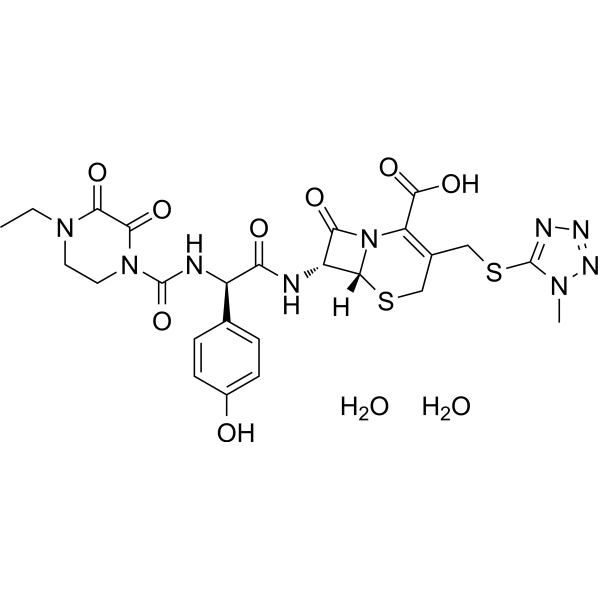
Cefoperazone dihydrate
Based on 7 publication(s) in Google Scholar
Cefoperazone dihydrate, a semisynthetic cephalosporin, has a broad spectrum of antibacterial activity.
For research use only. We do not sell to patients.
- CAS No.: 113826-44-1
- Formula: C25H31N9O10S2
- Molecular Weight:681.70
-
Storage:
Please store the product under the recommended conditions in the Certificate of Analysis.

To place orders, for customer services and technical support, please contact: MedChemExpress USA
Tel: 609-228-6898 E-mail: [email protected] [email protected]


-
 Biological Activity
-
Chemical Information
- Protocols
- Purity & Documentation
- References
-
 Help & FAQs


Publications Citing Use of MedChemExpress (MCE) Cefoperazone dihydrate
More- Signal Transduct Target Ther. 2025 Dec 15;10(1):406. [Abstract]
- Carbohydr Polym. 2024 Jan 1:323:121379. [Abstract]
- Mol Med. 2024 Nov 6;30(1):203. [Abstract]
- Virulence. 2026 Dec 31;17(1):2646808. [Abstract]
- Ther Adv Med Oncol. 2026 Jan 2:18:17588359251409010. [Abstract]
- Toxicol Appl Pharmacol. 2023 Apr 1:464:116447. [Abstract]
- J Antibiot (Tokyo). 2023 Apr;76(4):225-235. [Abstract]
 Customer Validation & Images

-
Bio/Physico-chemical Assay

-
Bio/Physico-chemical Assay

-
Microbiological Assay

-
Microbiological Assay

All Antibiotic Isoforms
More

Biological Activity
Description
IC50 & Target
|
β-lactam |
In Vitro
Cefoperazone (Aerosol treatment, 60 μg/mL final concentration in lung homogenate) protects granulocytopenic mice from acute Pseudomonas aeruginosa pneumonia[2].
MedChemExpress (MCE) has not independently confirmed the accuracy of these methods. They are for reference only. Further protocols information, click here.


Chemical Information
-
CAS No. 113826-44-1
-
Molecular Weight 681.70
-
Formula C25H31N9O10S2
-
SMILES
O=C(C(N12)=C(CSC3=NN=NN3C)CS[C@]2([H])[C@H](NC([C@H](NC(N4C(C(N(CC)CC4)=O)=O)=O)C5=CC=C(O)C=C5)=O)C1=O)O.O.O
-
Shipping
Room temperature in continental US; may vary elsewhere.
-
Storage
Please store the product under the recommended conditions in the Certificate of Analysis.


Publications (7)
-
Journal Impact Factor
-
Most Recent
-
Signal Transduct Target Ther
Selective depletion of tumor-associated SAMHD1 enhances chemotherapeutic efficacy and antitumor immune responses. [Abstract]2025 Dec 15;10(1):406. PMID: 41392286 -
Carbohydr Polym
Preparation of bacterial cellulose-based antibacterial membranes with prolonged release of drugs: Emphasis on the chemical structure of drugs. [Abstract]2024 Jan 1:323:121379. PMID: 37940275
Cefoperazone dihydrate purchased from MedChemExpress. Usage Cited in: Carbohydr Polym. 2024 Jan 1:323:121379. [Abstract]
According to the results, BC-CEF (Cefoperazone) had a loading quantity that was much higher than BC-CEF/Na.
Cefoperazone dihydrate purchased from MedChemExpress. Usage Cited in: Carbohydr Polym. 2024 Jan 1:323:121379. [Abstract]
The drug release profiles of CEF (Cefoperazone) and CEF/Na from membranes in PBS.
Cefoperazone dihydrate purchased from MedChemExpress. Usage Cited in: Carbohydr Polym. 2024 Jan 1:323:121379. [Abstract]
The antibacterial effectiveness of the BC-CEF (Cefoperazone) and BC-CEF/Na membranes against S. aureus and E. coli was very high.
-
Mol Med
Dexmedetomidine alleviates intestinal ischemia/reperfusion injury by modulating intestinal neuron autophagy and mitochondrial homeostasis via Nupr1 regulation. [Abstract]2024 Nov 6;30(1):203. PMID: 39508252 -
Virulence
Antibacterial efficacy and mechanism of the novel antimicrobial peptide lachnospirin-1 against Acinetobacter baumannii. [Abstract]2026 Dec 31;17(1):2646808. PMID: 41838520 -
Ther Adv Med Oncol
Repurposing of ivacaftor shows potential to treat ROR1 expressing high-grade serous ovarian cancer. [Abstract]2026 Jan 2:18:17588359251409010. PMID: 41487693 -
Toxicol Appl Pharmacol
2023 Apr 1:464:116447. PMID: 36889513 -
J Antibiot (Tokyo)
Impact of short chain fatty acids (SCFAs) on antimicrobial activity of new β-lactam/β-lactamase inhibitor combinations and on virulence of Escherichia coli isolates. [Abstract]2023 Apr;76(4):225-235. PMID: 36726014
Cefoperazone dihydrate purchased from MedChemExpress. Usage Cited in: J Antibiot (Tokyo). 2023 Apr;76(4):225-235. [Abstract]
Susceptibility patterns of E. coli isolates (n = 140) towards different β-Lactams singly and in combination with β-Lactamase inhibitors (CFP Cefoperazone, CAZ Ceftazidime, FEP Cefepime).

Protocols
-
Research Protocol for Infectious Diseases
Infectious-disease experiments test how pathogens interact with host barriers, innate immune receptors, inflammatory signaling, pathogen replication, and tissue injury; pattern-recognition receptors such as TLRs, RIG-I-like receptors, NOD-like receptors, and inflammasomes detect microbial molecules and activate NF-κB, interferon, and cytokine responses. The central hypothesis is that infection severity reflects the balance between pathogen burden and host response: protective inflammation restricts pathogen growth, whereas excessive or mislocalized inflammation contributes to tissue damage and disease phenotype. Unresolved questions include which host pathways are protective versus pathogenic, why some infection models fail to translate to human disease, and which combined readouts best predict clinically relevant infection outcomes.
-
Bacterial live/dead nucleic-acid viability staining
The LIVE/DEAD bacterial viability staining method is based on differential permeability of nucleic-acid-binding fluorescent dyes, most commonly SYTO 9 and propidium iodide (PI), which enables discrimination of bacterial populations with intact versus compromised cytoplasmic membranes. SYTO 9 penetrates both intact and damaged bacterial membranes and binds nucleic acids to produce green fluorescence, whereas propidium iodide penetrates only cells with compromised membranes and fluoresces red while also reducing SYTO 9 signal through competitive binding and fluorescence interactions. The resulting fluorescence pattern is interpreted as a proxy for membrane integrity, which is widely used as an indicator of bacterial viability in microscopy, flow cytometry, and spectroscopic platforms. However, mechanistic studies show that SYTO 9 and PI interactions involve displacement and fluorescence resonance energy transfer effects, which can influence signal interpretation depending on dye ratios a


Purity & Documentation
References

Calculators
Concentration (start) × Volume (start) = Concentration (final) × Volume (final)


Cefoperazone dihydrate Related Classifications
HY-B0210C Related Classifications
 Powered by Bioz