285 Results for "

Fluorescent Substrate

" in MedChemExpress (MCE) Product Catalog:
Products (285)

285 Results for "Fluorescent Substrate" in MCE Product Catalog:

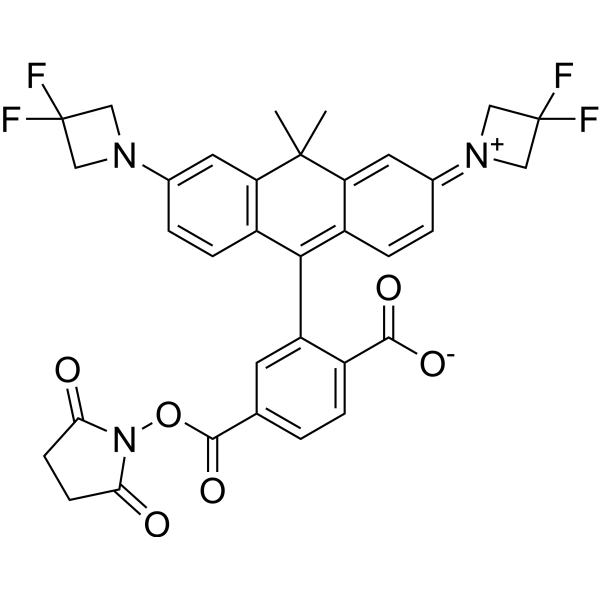
Cat. No.: HY-131025
CAS No.: 1811539-88-4
Synonyms: JF585, SE; JF585, NHS
Janelia Fluor 585, SE (JF585, SE) is an orange fluorescent dye containing an NHS ester that can be conjugated with primary amine groups. Janelia Fluor 585, SE can be used immediately for structured illumination (SIM) and stimulated emission depletion (STED) imaging and could be converted to photoactivatable derivative for single-molecule localization microscopy (SMLM) experiments . Janelia Fluor fluorescent dyes can be chemically conjugated to the specific HaloTag substrate (a chloroalkane ligand) to form a fluorescent ligand, rather than binding directly to the HaloTag protein itself. Janelia Fluor products are licensed under U.S. Pat. Nos. 9,933,417, 10,018,624 and 10,161,932 and other patents from Howard Hughes Medical Institute (Ex/Em = 585/609 nm).
loading...
    loading...
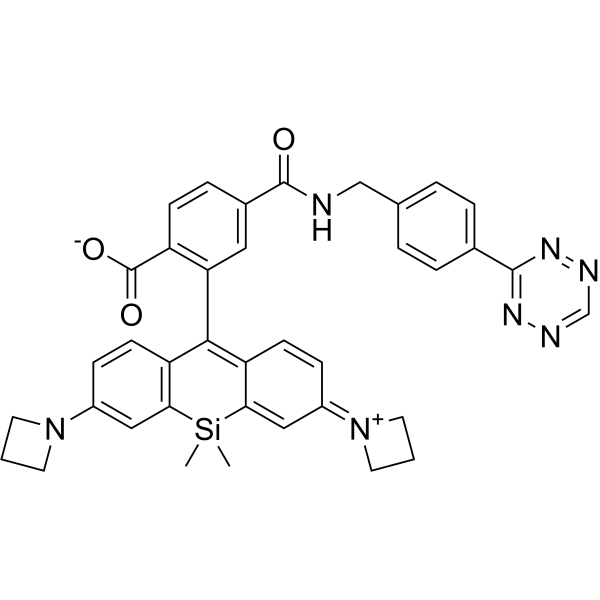
Cat. No.: HY-138659
CAS No.: 2042192-00-5
Purity:  95.29%
Synonyms: JF646, Tetrazine
Janelia Fluor 646, Tetrazine (JF646, Tetrazine) a red fluorescent dye that contains a tetrazine group. JF646, Tetrazine can be used in cellular imaging . Janelia Fluor fluorescent dyes can be chemically conjugated to the specific HaloTag substrate (a chloroalkane ligand) to form a fluorescent ligand, rather than binding directly to the HaloTag protein itself. Janelia Fluor products are licensed under U.S. Pat. Nos. 9,933,417, 10,018,624 and 10,161,932 and other patents from Howard Hughes Medical Institute. Janelia Fluor 646, Tetrazine is a click chemistry reagent, it contains a Tetrazine group that can undergo an inverse electron demand Diels-Alder reaction (iEDDA) with molecules containing TCO groups (Ex/Em = 646/664 nm).
loading...
    loading...
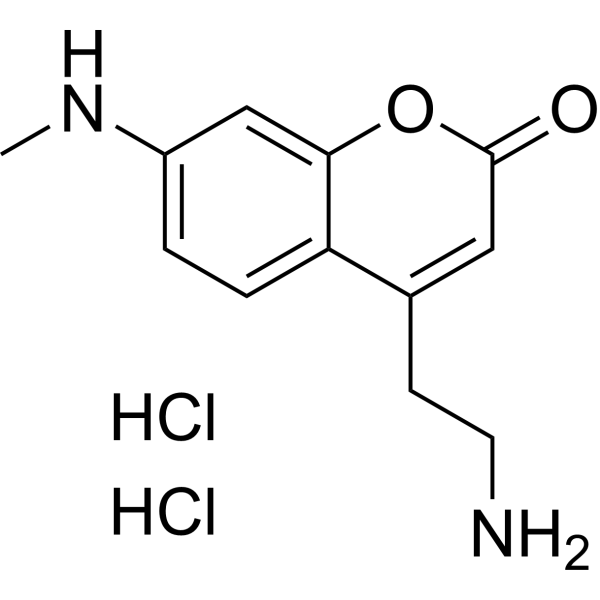
Cat. No.: HY-110334
CAS No.: 1883548-88-6
Target:  

Fluorescent Dye

Research Areas:  

Others

FFN 206 dihydrochloride, a fluorescent probe, is used as an excellent Vesicular Monoamine Transporter 2 (VMAT2) substrate with an apparent Km of 1.16 μM. FFN 206 dihydrochloride is capable of detecting VMAT2 activity in intact cells using fluorescence microscopy, with subcellular localization to VMAT2-expressing acidic compartments without apparent labeling of other organelles .
loading...
    loading...
Cat. No.: HY-124324
CAS No.: 106927-48-4
Synonyms: p-Nitopheyl β-D-cellotioside
4-Nitrophenyl β-D-cellotrioside (p-Nitopheyl β-D-cellotioside) is a chromogenic substrate for endoglucanases and cellulose biohydrolases. As a fluorescent dye, nitrophenyl β-D-Cellotrioside can be hydrolyzed by enzymes to release 4-nitrophenol, producing a yellow color. The activity of the enzyme can be quantitatively analyzed by monitoring the change in absorbance at 405 nm .
loading...
    loading...
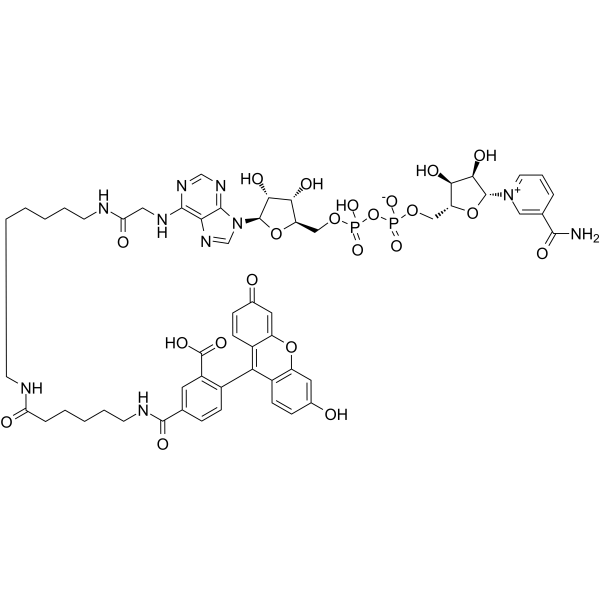
Cat. No.: HY-131009
Purity:  66.20%
Research Areas:  

Others

Fluorescein-NAD + is a fluorescent NAD + analog that can be used in studies related to the detection of ADP-ribosylation reactions. Fluorescein-NAD + enables visualization of ADP-ribose groups, thereby facilitating the detection of ADP-ribosylation reactions. Fluorescein-NAD + serves as a substrate for detecting the auto-ribosylation activity of SIRT6 and the ADP-ribosylation of RhoA by C3larvin toxin .
loading...
    loading...
Cat. No.: HY-131009A
Research Areas:  

Others

Fluorescein-NAD + sodium is a fluorescent NAD + analog that can be used in studies related to the detection of ADP-ribosylation reactions. Fluorescein-NAD + sodium enables visualization of ADP-ribose groups, thereby facilitating the detection of ADP-ribosylation reactions. Fluorescein-NAD + sodium serves as a substrate for detecting the auto-ribosylation activity of SIRT6 and the ADP-ribosylation of RhoA by C3larvin toxin .
loading...
    loading...
Cat. No.: HY-138241
CAS No.: 148185-52-8
Target:  

Fluorescent Dye

Research Areas:  

Others

PBD-BODIPY is a probe for the spectrophotometric measurement of autoxidation reactions. Co-autoxidation of the PBD-BODIPY signal carrier and a hydrocarbon co-substrate can be quantified by monitoring loss of absorbance at 591 nm. PBD-BODIPY has been used to measure the activity of radical-trapping antioxidants in cell-free assays. It has also been used as a fluorescent probe for the detection of epoxidation activity.
loading...
    loading...
Cat. No.: HY-139814
CAS No.: 1979130-73-8
Research Areas:  

Others

d-Phe-Pro-Arg-PABA-Resorufin is a selective Thrombin substrate. d-Phe-Pro-Arg-PABA-Resorufin can be cleaved by thrombin to release fluorescent and chromogenic products. d-Phe-Pro-Arg-PABA-Resorufin enables sensitive detection of the thrombin inhibitor Dabigatran (HY-10163) via thrombin-mediated cleavage attenuation .
loading...
    loading...
Cat. No.: HY-187021
CAS No.: 81017-23-4
Target:  

Fluorescent Dye

Research Areas:  

Infection

3-Carboxyumbelliferyl acetate (compound ACC) is a fluorescent substrate that can be used to detect the activity of the Escherichia coli polysaccharide deacetylase PgaB, with a Km of 1.2 mM. 3-Carboxyumbelliferyl acetate undergoes acetate hydrolysis under the catalysis of E. coli PgaB. 3-Carboxyumbelliferyl acetate can be used in studies related to PgaB enzymatic activity and the mechanism of bacterial biofilm formation .
loading...
    loading...
Cat. No.: HY-W344383A
Research Areas:  

Others

Boc-Phe-Ser-Arg-AMC TFA is a fluorescence peptide substrate with specificity. Boc-Phe-Ser-Arg-AMC TFA can be cleaved by tryptase-like serine proteases (TLSPs) to generate fluorescent products, thereby enabling the detection of TLSPs activity. Boc-Phe-Ser-Arg-AMC TFA can be used in studies related to rosacea .
loading...
    loading...
Cat. No.: HY-137744
CAS No.: 148821-01-6
MANT-GppNHp is a competitive adenyl cyclase (AC) inhibitor. MANT-GppNHp is a fluorescently labeled GTP (HY-113225) analogue. MANT-GppNHp interacts with the hydrophobic pocket near the AC catalytic site through its MANT group, thereby directly blocking the binding of the substrate ATP. MANT-GppNHp can be used to study diseases related to the increased activity of AC (such as cholera) .
loading...
    loading...
Cat. No.: HY-158800
CAS No.: 2309189-98-6
Research Areas:  

Others

1-NBD-decanoyl-2-decanoyl-sn-glycerol is a diacylglycerol (DAG) derivative, which is labeled with a fluorescent group NBD. 1-NBD-decanoyl-2-decanoyl-sn-glycerol is the substrate for diacylglycerol kinase (DGK), and can be used for quantitative detection of the DGF enzyme kinetics in vitro, and the changes in DAG and PA during cell signaling .
loading...
    loading...
Cat. No.: HY-P3106
CAS No.: 149695-85-2
Synonyms: (Z-Ala-Ala-Ala-Ala)2Rhodamine110; bis-CBZ-L-alanyl-L-arginine amide Rhodamine 110
Target:  

Fluorescent Dye

Research Areas:  

Others

(Z-Ala-Ala-Ala-Ala)2Rh110 is a sensitive fluorogenic elastase substrate. The colorless and nonfluorescent (Z-Ala-Ala-Ala-Ala)2Rh110 is selectively cleaved by elastase to yield the highly fluorescent compound rhodamine 110, which can be analyzed with an excitation wavelength of 485 nm and emission wavelength of 525 nm.
loading...
    loading...
Cat. No.: HY-D2477
CAS No.: 1974271-78-7
Target:  

Fluorescent Dye

Research Areas:  

Cancer

Sulfo-QSY21-NHS is an N-hydroxysuccinimide ester derivative fluorescent quencher that reduces the fluorescence intensity of paired fluorophores via proximity effect and relieves quenching after linker extension induced by mechanical force. Sulfo-QSY21-NHS can label streptavidin through NHS ester bioconjugation and be integrated into fluorescence-based molecular tension sensors to map the mechanical forces of cell surface receptors. Sulfo-QSY21-NHS also serves as a quencher for cysteine cathepsin-targeted quenched fluorescent substrate probes, and is widely used in studies related to breast cancer, colorectal cancer and lung adenocarcinoma .
loading...
    loading...
Cat. No.: HY-D2919
CAS No.: 2177287-88-4
DMN-Tre is a conjugate of a solvatochromic fluorescent dye and trehalose. DMN-Tre takes advantage of the substrate promiscuity of the endogenous antigen 85 protein complex in mycobacteria to be metabolically integrated into the hydrophobic mycobacterial membrane. Once entering this hydrophobic environment, the linked DMN dye fluorescence is "turned on", enabling specific labeling . DMN-Tre can be used to reflect bacterial metabolic activity and support physiological studies of Mycobacterium tuberculosis .
loading...
    loading...
Cat. No.: HY-P3123
CAS No.: 172666-82-9
Target:  

Fluorescent Dye

Research Areas:  

Others

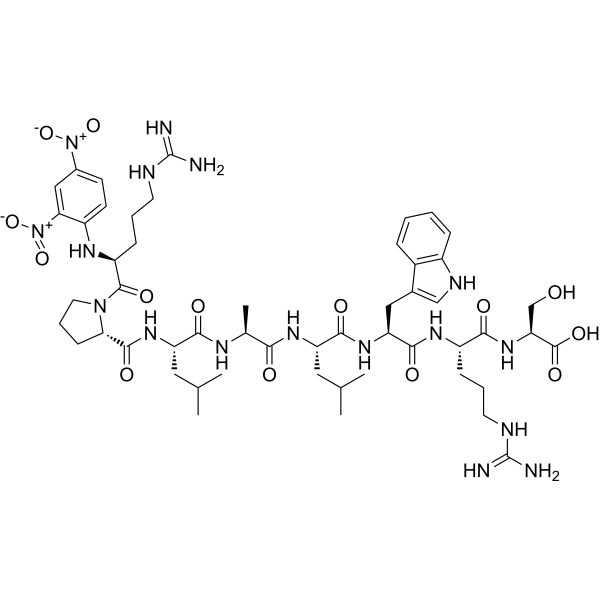
Dnp-RPLALWRS is a fluorescent peptide substrate designed for human matrilysin (MMP-7). After enzymatic cleavage of Dnp-RPLALWRS at the alanine-leucine bond, the release of the Dnp group alleviates fluorescence quenching, thereby enabling real-time quantitative analysis of MMP-7 activity by increasing tryptophan emission. Dnp-RPLALWRS provides a sensitive and efficient detection method for kinetic studies and inhibitor screenin .
loading...
    loading...
Cat. No.: HY-W027544S
Synonyms: 7-Methoxycoumarin-4-acetic acid-d3
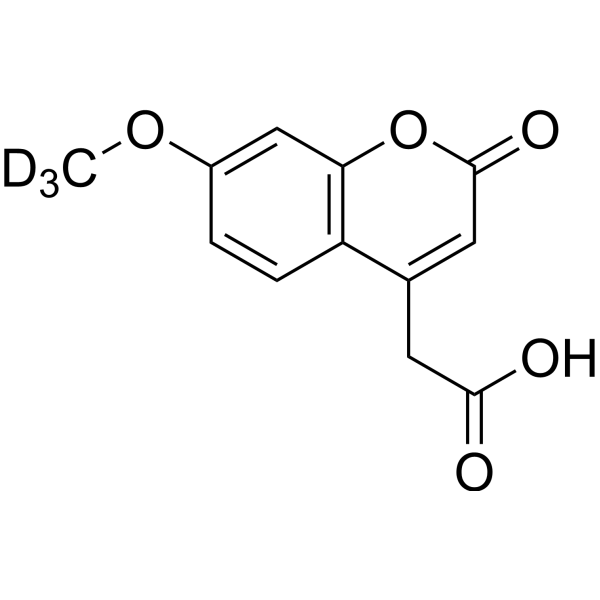
MCA-d3 (7-Methoxycoumarin-4-acetic acid3) is the deuterium labeled MCA (HY-W027544) . MCA is a Coumarin (HY-N0709) derivative. MCA quantitates platelet-activating factor (PAF) by high-performance liquid chromatography with fluorescent detection. MCA can modify FRET peptide substrates for analyzing protease activities .
loading...
    loading...
Cat. No.: HY-D3442
CAS No.: 3121565-89-4
ALDH2 probe 5 is a ALDH2 isoform-selective fluorescent probe with an emission wavelength centered at 494 nm. ALDH2 probe 5 is a turn-on fluorescent substrate for ALDH2; in its unreacted aldehyde form, twisted intramolecular charge transfer (TICT) occurs, resulting in fluorescence quenching. After ALDH2 probe 5 is catalytically oxidized to carboxylate by ALDH2, TICT is inhibited and fluorescence is significantly enhanced. ALDH2 probe 5 enables highly sensitive quantitative imaging of ALDH2 activity in recombinant enzymes, live cells, blood, tissue homogenates, and the brains of living mice. ALDH2 probe 5 can be used for studies related to neuroinflammation .
loading...
    loading...
Cat. No.: HY-203233
CAS No.: 126111-99-7
Rhodamine-DHPE is a fluorescently labeled phosphatidylethanolamine lipid that labels phospholipid bilayers. Rhodamine-DHPE serves as a fluorescence quenching substrate and membrane stain. The fluorescence lifetime of Rhodamine-DHPE decreases significantly in the presence of Cu 2+-PS complexes. Rhodamine-DHPE effectively stains the membranes of human red blood cells and mouse fibroblasts, and supports lifetime-resolved imaging via pump-probe fluorescence microscopy .
loading...
    loading...
Cat. No.: HY-D3166
CAS No.: 2413816-64-3
CEMT is a carboxylesterase (CES) substrate and a ratiometric two-photon fluorescent reporter probe. CEMT can be hydrolyzed by CES to generate HMT, which is used for mitochondrial pH sensing. After activation by CES, CEMT exhibits ratiometric fluorescence changes in response to pH variations. CEMT targets and covalently binds to mitochondria, and can avoid leakage during acidification, thus enabling in situ imaging (Ex/Em = 410 nm/550 nm) .
loading...
    loading...

