88 Results for "

DNA damage response

" in MedChemExpress (MCE) Product Catalog:
Products (88)

88 Results for "DNA damage response" in MCE Product Catalog:

Cat. No.: HY-112347
CAS No.: 244148-46-7
Research Areas:  

Cancer

Isogranulatimide is a selective checkpoint kinase 1 (Chk1) inhibitor with an IC50 value of 0.1 μM. Isogranulatimide inhibits the G2/M checkpoint and inhibits the growth of p53-mutant tumor cells. Isogranulatimide is promising for research of tumors associated with DNA damage response .
loading...
    loading...
Cat. No.: HY-144435
Target:  

ATM/ATR

Research Areas:  

Cancer

ATR-IN-11 (Compound Hit01) is a potent inhibitor of ataxia telangiectasia and Rad3-related (ATR) kinase. ATR kinase is a key regulating protein within the DNA damage response (DDR), responsible for sensing replication stress (RS). ATR-IN-11 is a promising lead compound for subsequent agent discovery targeting ATR kinase. ATR-IN-11 has the potential for the research of cancer disease .
loading...
    loading...
Cat. No.: HY-E70830
Target:  

DYRK

Research Areas:  

Cancer

Homeodomain interacting protein kinase 2 (HIPK2) is an evolutionary conserved serine/threonine kinase that regulates gene expression by phosphorylation of transcription factors and accessory components of the transcription machinery. HIPK2 is activated in response to DNA-damaging agents or morphogenic signals. HIPK2 Recombinant Human Active Protein Kinase is a recombinant HIPK2 protein that can be used to study HIPK2-related functions .
loading...
    loading...
Cat. No.: HY-169225A
CAS No.: 3040919-39-6
Synonyms: PDIC-NS
PDIC-NN dimethanesulfonate (PDIC-NS) is a STING activator with anticancer activity. PDIC-NN dimethanesulfonate promotes the content and biostability of endogenous cyclic dinucleotides (CDNs). PDIC-NN dimethanesulfonate triggers ROS burst and causes serious damage to mitochondria. PDIC-NN dimethanesulfonate induces cell apoptosis and inhibits DNA replication. PDIC-NN dimethanesulfonate activates cGAS-STING signaling pathway, enhances the immunogenicity of tumor cells and activates a robust innate immune response .
loading...
    loading...
Cat. No.: HY-171785
CAS No.: 2871056-82-3
Research Areas:  

Cancer

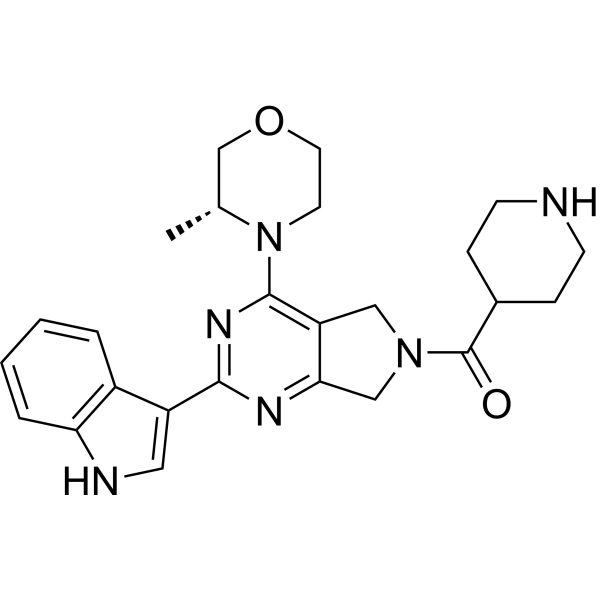
CHK1-IN-12 (Compound example 1-5) is an orally active and highly selective checkpoint kinase 1 (CHK1) inhibitor with in vitro enzyme IC50≤10 nM and cellular IC50≤50 nM. CHK1-IN-12 inhibits the phosphorylation activity of CHK1 kinase to block the DNA damage response pathway, inducing tumor cell cycle arrest and apoptosis. CHK1-IN-12 is promising for research of cancers .
loading...
    loading...
Cat. No.: HY-179418
Target:  

Apoptosis

Research Areas:  

Cancer

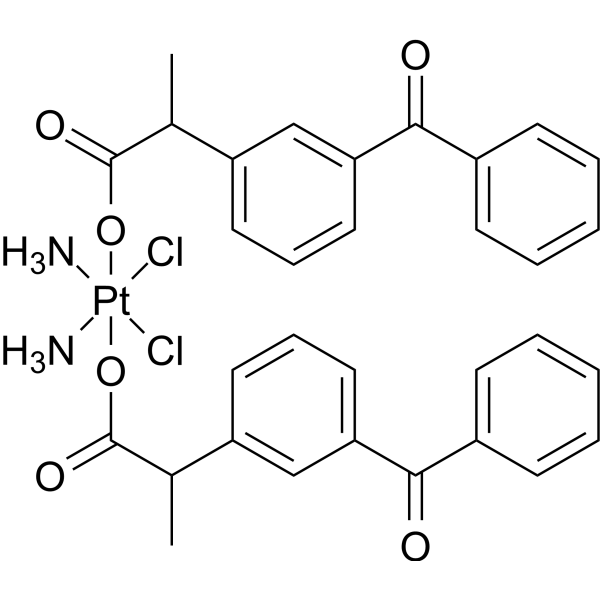
Ceritinib-platinum(IV)-4-phenylbutyrate (complex 7) is a Ceritinib (HY-15656)-conjugated Platinum(IV) prodrug with anticancer activity. Ceritinib-platinum(IV)-4-phenylbutyrate induces S-phase arrest, DNA damage responses, and apoptosis. Ceritinib-platinum(IV)-4-phenylbutyrate combines cytotoxicity with immune and anti-invasive activation in cancer cell models. Ceritinib-platinum(IV)-4-phenylbutyrate can be used for cancer research, such as non-small cell lung cancer (NSCLC) .
loading...
    loading...
Cat. No.: HY-123401
CAS No.: 4402-18-0
Target:  

DNA/RNA Synthesis

Research Areas:  

Cancer

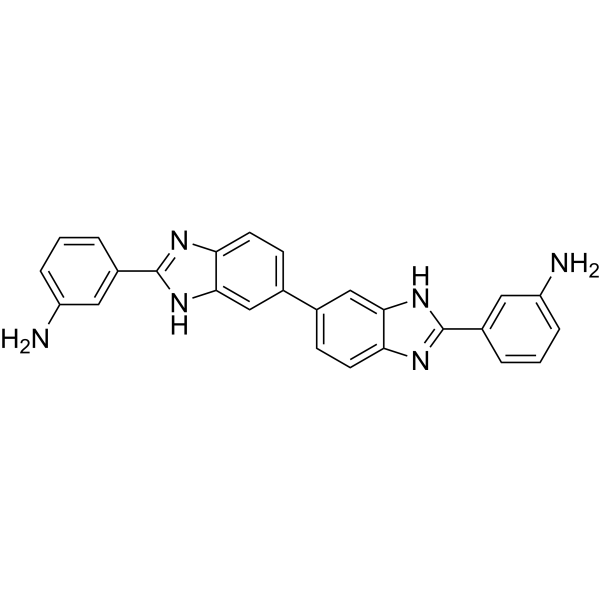
DDRI-18 is a DNA damage response inhibitor that inhibits the non-homologous end-joining (NHEJ) DNA repair process. DDRI-18 is an effective chemosensitizing agent .
loading...
    loading...
Cat. No.: HY-B0077S1
CAS No.: 1185068-23-8
Synonyms: SDX-105-d8
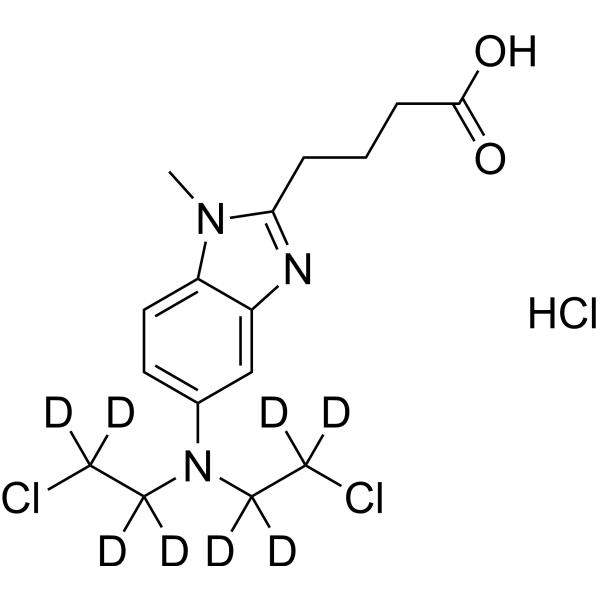
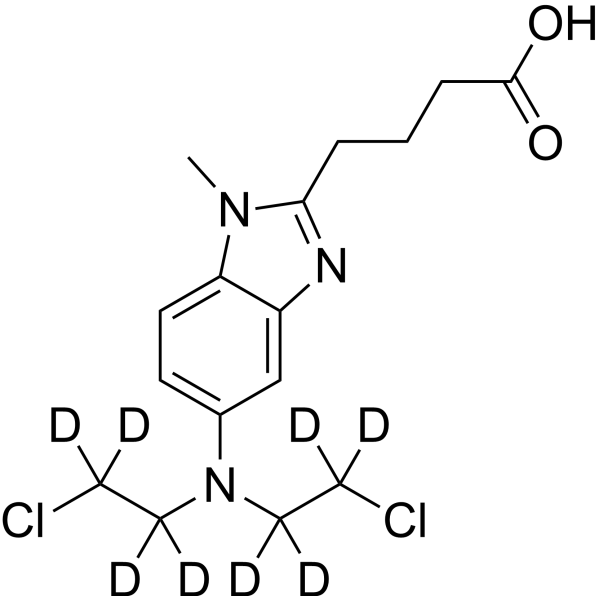
Bendamustine-d8 (hydrochloride) is deuterium labeled Bendamustine (hydrochloride). Bendamustine hydrochloride (SDX-105), a purine analogue, is a DNA cross-linking agent. Bendamustine hydrochloride activats DNA-damage stress response and apoptosis. Bendamustine hydrochloride has potent alkylating, anticancer and antimetabolite properties .
loading...
    loading...
Cat. No.: HY-13567S1
CAS No.: 1134803-33-0
Synonyms: SDX-105-d8 free base
Bendamustine-d8 is the deuterium labeled Bendamustine . Bendamustine (SDX-105 free base), a purine analogue, is a DNA cross-linking agent. Bendamustine activates DNA-damage stress response and apoptosis. Bendamustine has potent alkylating, anticancer and antimetabolite properties .
loading...
    loading...
Cat. No.: HY-B0077R
CAS No.: 3543-75-7
Synonyms: SDX-105 (Standard)
Bendamustine (hydrochloride) (Standard) is the analytical standard of Bendamustine (hydrochloride). This product is intended for research and analytical applications. Bendamustine hydrochloride (SDX-105), a purine analogue, is a DNA cross-linking agent. Bendamustine hydrochloride activats DNA-damage stress response and apoptosis. Bendamustine hydrochloride has potent alkylating, anticancer and antimetabolite properties .
loading...
    loading...
Cat. No.: HY-13567R
CAS No.: 16506-27-7
Synonyms: SDX-105 free base (Standard)
Bendamustine (Standard) is the analytical standard of Bendamustine. This product is intended for research and analytical applications. Bendamustine (SDX-105 free base), a purine analogue, is a DNA cross-linking agent. Bendamustine activates DNA-damage stress response and apoptosis. Bendamustine has potent alkylating, anticancer and antimetabolite properties .
loading...
    loading...
Cat. No.: HY-W738282
Synonyms: SDX-105-d7
Bendamustine-d7 hydrochloride (SDX-105-d7) is the deuterium labeled Bendamustine hydrochloride (HY-B0077). Bendamustine hydrochloride (SDX-105), a purine analogue, is a DNA cross-linking agent. Bendamustine hydrochloride activats DNA-damage stress response and apoptosis. Bendamustine hydrochloride has potent alkylating, anticancer and antimetabolite properties .
loading...
    loading...
Cat. No.: HY-168636
Research Areas:  

Cancer

p53 Activator 13 (compound 11) is a 6mA methyltransferase CamA inhibitor and a p53 activator. p53 Activator 13 intercalates into CamA-bound DNA via the minor groove, causing a conformational shift that moves the catalytic domain away from the DNA and elicits DNA damage response via p53 activation. p53 Activator 13 can be utilized in cancer research .
loading...
    loading...
Cat. No.: HY-W013053R
CAS No.: 53-70-3
Synonyms: DBA (Standard); 1,2,5,6-Dibenzanthracene (Standard); Benzo[k]tetraphene (Standard)
Dibenz[a,h]anthracene (Standard) is the analytical standard of Dibenz[a,h]anthracene. This product is intended for research and analytical applications. Dibenz[a,h]anthracene (DBA) is a polycyclic aromatic hydrocarbon (PAH) of considerable tumorigenicity. Dibenz[a,h]anthracene results in DNA adduct formation leading to the activation of a DNA damage response. Dibenz[a,h]anthracene induces cell cycle arrest and apoptosis via both Tp53-dependent and Tp53-independent mechanisms .
loading...
    loading...
Cat. No.: HY-169225
CAS No.: 932740-48-2
Synonyms: PDIC-NS free base
PDIC-NN (PDIC-NS free base) is a STING activator with anticancer activity. PDIC-NN promotes the content and biostability of endogenous cyclic dinucleotides (CDNs). PDIC-NN triggers ROS burst and causes serious damage to mitochondria. PDIC-NN induces cell apoptosis and inhibits DNA replication. PDIC-NN activates cGAS-STING signaling pathway, enhances the immunogenicity of tumor cells and activates a robust innate immune response .
loading...
    loading...
Cat. No.: HY-W749442
CAS No.: 105578-87-8
7a-Hydroxyfrullanolide has anticancer properties. 7a-Hydroxyfrullanolide reduces polymerization of α-, β-tubulin. 7a-Hydroxyfrullanolide preferrs to bind to β-tubulin over α-tubulin. 7a-Hydroxyfrullanolide also triggers DNA damage response arrests cells in the G2/M-phase. 7a-Hydroxyfrullanolide is an eudesmanolide sesquiterpene lactone (SL) and can be isolated from the flowering plants of the Asteraceae family .
loading...
    loading...
Cat. No.: HY-116217R
CAS No.: 10356-76-0
Synonyms: FdCyd (Standard); NSC-48006 (Standard)
Research Areas:  

Cancer

5-Fluoro-2'-deoxycytidine (Standard) is the analytical standard of 5-Fluoro-2'-deoxycytidine. This product is intended for research and analytical applications. 5-Fluoro-2'-deoxycytidine (FdCyd), a fluoropyrimidine nucleoside analogue, is a DNA methyltransferase (DNMT) inhibitor. 5-Fluoro-2'-deoxycytidine is a tumor-selective proagent of thymidylate synthase inhibitor 5-fluoro-2′-dUMP. 5-Fluoro-2'-deoxycytidine can induce cell cycle arrest in tumor cells through the DNA damage response, and it has anti-tumor activity .
loading...
    loading...
Cat. No.: HY-171334A
Research Areas:  

Cancer

P1D-34 is a potent PIN1 PROTAC degrader with a DC50 of 177 nM. P1D-34 induces PIN1 degradation in a proteasome- and ubiquitination-like modification-dependent manner, thereby increasing intracellular ROS levels, downregulating the unfolded protein response pathway, and inducing DNA damage, cell cycle arrest and apoptosis. P1D-34 can be used in studies related to acute myeloid leukemia .
loading...
    loading...
Cat. No.: HY-N1461R
CAS No.: 17238-05-0
Synonyms: (±)-Dihydrodaidzein (Standard)
Dihydrodaidzein (Standard) ((±)-Dihydrodaidzein (Standard)) is the analytical standard of Dihydrodaidzein (HY-N1461). This product is intended for research and analytical applications. Dihydrodaidzein is a dietary phytoestrogen. Dihydrodaidzein possesses functions including antioxidation, inhibition of DNA oxidative damage, regulation of lipid metabolism and maintenance of intestinal flora stability. Dihydrodaidzein induces apoptosis, regulates immune responses, modulates tumor-related factors, activates the Bmp-2 signaling pathway, inhibits NF-κB and MAPK, and exhibits anti-inflammatory activity. Dihydrodaidzein can be used in research related to cancer, cardiovascular diseases, osteoporosis and inflammatory diseases .
loading...
    loading...
Cat. No.: HY-145288
CAS No.: 3005986-81-9
Target:  

Apoptosis

Research Areas:  

Cancer

Antitumor agent-36 possesses potent anti-proliferative and anti-metastasis activities. Antitumor agent-36 induces serious DNA damage and further leads to high expression of γ-H2AX and p53. Antitumor agent-36 promotes apoptosis of tumor cells through mitochondrial apoptotic pathway Bcl-2/Bax/caspase3. Antitumor agent-36 significantly improves immune response through restraining the expression of PD-L1 to increase CD3+ and CD8+ T infiltrating cells in tumor tissues .
loading...
    loading...