139 Results for "

Genotoxicity

" in MedChemExpress (MCE) Product Catalog:
Products (139)

139 Results for "Genotoxicity" in MCE Product Catalog:

Cat. No.: HY-126841
CAS No.: 22897-08-1
5-Methoxysterigmatocystin is a mycotoxin with cytotoxic and genotoxic properties. 5-Methoxysterigmatocystin exhibits cytotoxicity against cancer cells A549 and HepG2 (IC50 of 5.5 and 0.7 μM), and induces DNA damage. 5-Methoxysterigmatocystin is a photosensitizer, which utilizes the visible to generate singlet oxygen ( 1O2) .
loading...
    loading...
Cat. No.: HY-152187
CAS No.: 3037545-23-3
Target:  

Topoisomerase Apoptosis

Research Areas:  

Others

Topoisomerase IIα-IN-5 is a topoisomerase II (topo II) α catalytic inhibitor. Topoisomerase IIα-IN-5 intercalates into DNA and binds to the DNA minor groove. Topoisomerase IIα-IN-5 exhibits better efficacy and less genotoxicity than Etoposide (HY-13629) .
loading...
    loading...
Cat. No.: HY-121267S1
CAS No.: 349553-95-3
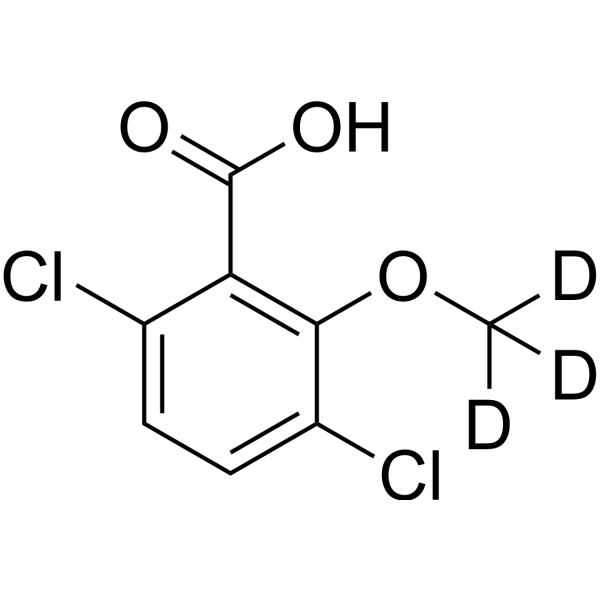
Dicamba-d3 is the deuterium labeled Dicamba (HY-121267 ) . Dicamba is a herbicide. Dicamba is currently used in agriculture and gardening to control the growth of different unwanted vegetable species, mainly in cereal grain crops, but also on sugar cane and soybeans, among others. Dicambais induces significant DNA damage. Dicambais induces genotoxicity and cytotoxicity .
loading...
    loading...
Cat. No.: HY-121267S
CAS No.: 1173023-06-7
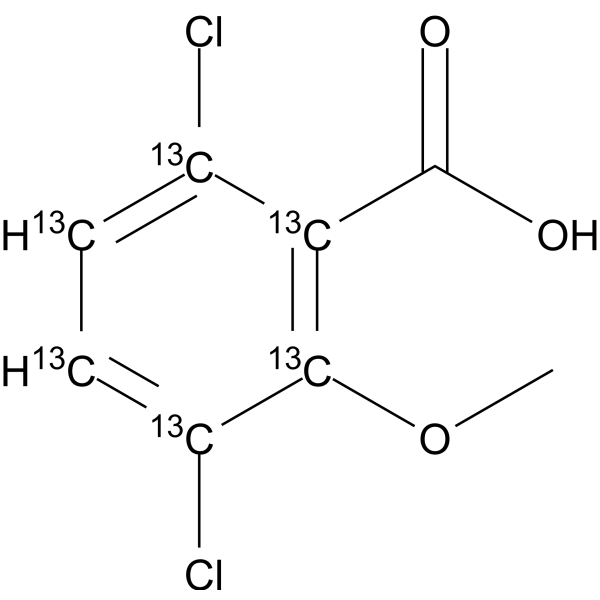
Dicamba- 13C6 is the 13C labeled Dicamba (HY-121267). Dicamba is a herbicide. Dicamba is currently used in agriculture and gardening to control the growth of different unwanted vegetable species, mainly in cereal grain crops, but also on sugar cane and soybeans, among others. Dicambais induces significant DNA damage. Dicambais induces genotoxicity and cytotoxicity .
loading...
    loading...
Cat. No.: HY-123870
CAS No.: 2170102-50-6
Target:  

Survivin IAP NF-κB

Research Areas:  

Inflammation/Immunology Cancer

MX107 is a selective and potent survivin inhibitor that suppresses triple-negative breast cancer (TNBC) cell proliferation. MX107 induces degradation of survivin and inhibitor-of-apoptosis proteins (IAPs), which inhibits nuclear factor κB (NF-κB) activation induced by DNA damage. MX107 enhances tumoricidal efficacy of genotoxic treatments synergized with chemotherapeutic drugs .
loading...
    loading...
Cat. No.: HY-133787R
CAS No.: 117678-38-3
Research Areas:  

Infection

Levofloxacin N-oxide (Standard) is the analytical standard of Levofloxacin N-oxide. This product is intended for research and analytical applications. Levofloxacin N-oxide is a minor metabolite of Levofloxacin (HY-B0330). Levofloxacin N-oxide does not exhibit significantly genotoxic risks. Levofloxacin is an orally active antibiotic and is active against both Gram-positive and Gram-negative bacteria .
loading...
    loading...
Cat. No.: HY-B1072R
CAS No.: 26002-80-2
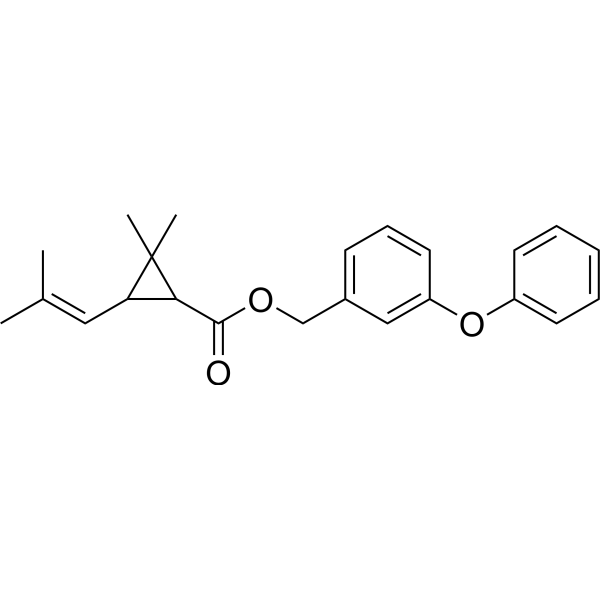
Phenothrin (Standard) is the analytical standard of Phenothrin (HY-B1072). This product is intended for research and analytical applications. Phenothrin is a Type I pyrethroid insecticide. Phenothrin induces dose-dependent DNA damage in human peripheral blood lymphocytes and hepatocytes, and exhibits definite genotoxic potential. Phenothrin acts as an insecticide for pest control in agriculture, households and public health, as well as for the elimination of human head lice infestations.
loading...
    loading...
Cat. No.: HY-W142432R
CAS No.: 2058-94-8
Target:  

Reference Standards

Research Areas:  

Others

Perfluoroundecanoic acid (Standard) is the analytical standard of Perfluoroundecanoic acid. This product is intended for research and analytical applications. Perfluoroundecanoic acid is an orally active inducer of oxidative stress and DNA damage. Perfluoroundecanoic acid exhibits genotoxicity and reproductive toxicity in swiss mice. Perfluoroundecanoic acid is utilized as a processing aid in the manufacture of fluoropolymer for its thermal and pressure stability, and properties of having both water-repellent and oil-repellent groups and hydrophilic groups on the same molecule .
loading...
    loading...
Cat. No.: HY-121261
CAS No.: 738-99-8
Target:  

Necroptosis Apoptosis

Research Areas:  

Cancer

Antineoplastic agent-1 is an alkylating agent and a genotoxic agent that can induce DNA damage. Antineoplastic agent-1 can lead to irreversible damage and progressive death of liver cells due to necroptosis and apoptosis. Antineoplastic agent-1 can cause alkylation damage to hematopoietic cells and stromal cells in the bone marrow. Antineoplastic agent-1 can be used in tumor research .
loading...
    loading...
Cat. No.: HY-W007577R
CAS No.: 555-16-8
4-Nitrobenzaldehyde (Standard) is the analytical standard of 4-Nitrobenzaldehyde (HY-W007577). This product is intended for research and analytical applications. 4-Nitrobenzaldehyde is a widely used industrial chemical intermediate and also the main photodegradation product of the broad-spectrum antibiotic Chloramphenicol (HY-B0239). 4-Nitrobenzaldehyde has genotoxic and mutagenic effects and poses a certain threat to human health and ecosystems .
loading...
    loading...
Cat. No.: HY-W756607
CAS No.: 2714413-99-5
6-Acetyl-1,1,2,4,4,7-hexamethyltetraline-d11 is the deuterium labeled 6-Acetyl-1,1,2,4,4,7-hexamethyltetraline (HY-W011817). 6-Acetyl-1,1,2,4,4,7-hexamethyltetraline (AHTN) is a synthetic fragrance ingredient that is not significantly genotoxic in mammalian systems .
loading...
    loading...
Cat. No.: HY-B0869AR
CAS No.: 125401-92-5
Bispyribac (sodium) (Standard) is the analytical standard of Bispyribac sodium (HY-B0869A). This product is intended for research and analytical applications. Bispyribac sodium is a selective, orally active, systemic and post-emergence herbicide. Bispyribac sodium reduces SOD levels and inhibits ALS activity. Bispyribac sodium blocks the biosynthesis of branched-chain amino acids, resulting in growth retardation, chlorosis and necrosis of weeds. Bispyribac sodium exerts herbicidal activity against grass, sedge and broadleaf weeds in rice fields. Bispyribac sodium is hepatotoxic and genotoxic .
loading...
    loading...
Cat. No.: HY-W012657R
CAS No.: 4748-78-1
4-Ethylbenzaldehyde (Standard) is the analytical standard of 4-Ethylbenzaldehyde (HY-W012657). This product is intended for research and analytical applications. 4-Ethylbenzaldehyde is an aldehyde type organic compound with an almond-like odor. 4-Ethylbenzaldehyde is naturally present in various foods such as grilled meat, black tea, peanuts, etc. 4-Ethylbenzaldehyde has significant effects in controlling plant parasitic nematodes. 4-Ethylbenzaldehyde has genotoxicity and potential for liver damage in zebrafish models.
loading...
    loading...
Cat. No.: HY-107835R
CAS No.: 69770-45-2
Synonyms: FCR 2769 (Standard)
Flumethrin (Standard) (FCR 2769 (Standard)) is the analytical standard of Flumethrin (HY-107835). This product is intended for research and analytical applications. Flumethrin (FCR 2769) is a pyrethroid insecticide and acaricide. Flumethrin targets voltage-gated sodium channels and estrogen receptor α (ERα). Flumethrin induces cytotoxicity, apoptosis, genotoxicity and DNA damage in breast cancer cells by regulating the expression of BCL2, BAX, TP53 and P21 genes. Flumethrin is applicable to relevant studies on ectoparasite infections (tick and flea burdens) in dogs and cats, as well as breast cancer.
loading...
    loading...
Cat. No.: HY-N6714R
CAS No.: 641-38-3
Alternariol (Standard) is the analytical standard of Alternariol. This product is intended for research and analytical applications. Alternariol is an orally ingested mycotoxin produced by Alternaria, capable of inhibiting the activity of topoisomerase I and II (topoisomerase I, topoisomerase II). Alternariol has weak estrogenic (Estrogen Receptor/ERR) and androgen/antiandrogen (Androgen Receptor) effects. Alternariol can induce apoptosis, trigger cell cycle arrest, suppress innate immune responses, and exhibit anti-tumor activity. Alternariol has genotoxic, mutagenic, and endocrine-disrupting effects .
loading...
    loading...
Cat. No.: HY-185173
CAS No.: 1309389-73-8
Target:  

TRP Channel

Research Areas:  

Others

(E)-3-Benzodioxol-5-yl-N,N-diphenyl-2-propenamide is a chemically synthesized flavoring substance and can be found in toothpaste products. (E)-3-Benzodioxol-5-yl-N,N-diphenyl-2-propenamide is non-genotoxic, shows no genotoxic activity in bacterial reverse mutation and in vitro mammalian cell micronucleus assays. (E)-3-Benzodioxol-5-yl-N,N-diphenyl-2-propenamide does not induce prenatal developmental toxicity in rats .
loading...
    loading...
Cat. No.: HY-185917
Research Areas:  

Metabolic Disease Cancer

N2-MIE-dG is the major DNA adduct formed after the activation of methyleugenol (ME) by SULT. N2-MIE-dG serves as a key biomarker for genotoxicity, metabolic activation, and potential carcinogenic risk .
loading...
    loading...
Cat. No.: HY-W415042
CAS No.: 103-52-6
Synonyms: Phenylethyl butyrate; 2-Phenylethyl butanoate
Phenethyl butyrate (Phenylethyl butyrate; 2-Phenylethyl butanoate) is a spice component isolated from the flowers of Mimusops elengi. Phenethyl butyrate exhibits rose, floral and fruity aromas. Phenethyl butyrate shows no genotoxicity or cytotoxicity. Phenethyl butyrate can be used in research related to fragrances and cosmetics .
loading...
    loading...
Cat. No.: HY-122145
CAS No.: 6860-12-4
Target:  

DNA/RNA Synthesis

Research Areas:  

Cancer

Ypenyl hydrochloride is a cytostatic. Ypenyl hydrochloride, belonging to the alkylating agent class, exhibits clear genotoxicity and cell cycle disruption properties. Ypenyl hydrochloride induces chromosomal aberrations in broad bean root tip meristem cells and leads to a decrease in the mitotic index. Ypenyl hydrochloride may be used in cancer research .
loading...
    loading...
Cat. No.: HY-24366
CAS No.: 2423-66-7
Research Areas:  

Infection

Quindoxin is an antibacterial and growth promoter, commonly used in the livestock industry. Quindoxin exhibits clear dose-dependent mutagenic activity against Salmonella typhimurium TA98 and TA100 strains. Quindoxin can cause DNA damage and has potential genotoxicity and carcinogenic risks .
loading...
    loading...

