10031 Results for "

Label

" in MedChemExpress (MCE) Product Catalog:
Products (10031)

10031 Results for "Label" in MCE Product Catalog:

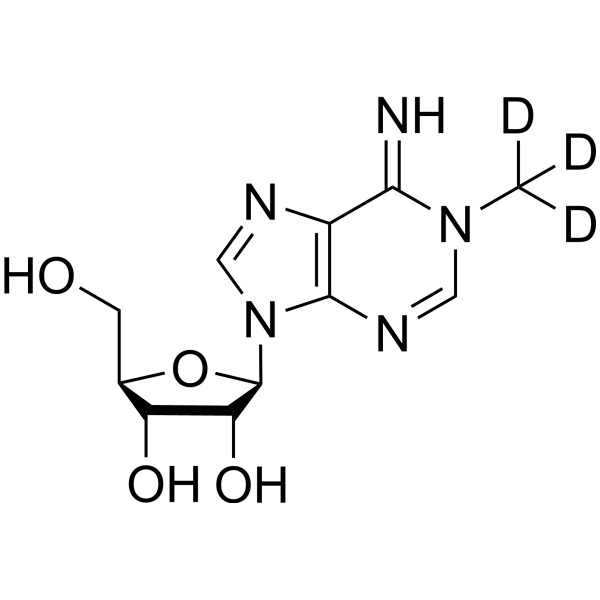
Cat. No.: HY-113081S
1-Methyl Adenosine-d3 is the deuterium labeled 1-Methyladenosine. 1-Methyladenosine is an RNA modification that can serve as a tumor marker, with elevated levels in the body associated with cancer development. Following 1-methyladenosine methylation, upregulation of PPARδ expression regulates cholesterol metabolism and activates Hedgehog signaling pathway, driving liver tumorigenesis .
loading...
    loading...
Cat. No.: HY-KD1114
The NOTA Rapid Labelling Kit enables NOTA labelling of proteins. Based on NHS ester chemistry, NHS ester-activated fluorescent dyes react with primary amines on the antibody/protein to be labelled in a pH 7-9 solution, forming stable amide bonds to achieve conjugation with the antibody/protein. Typically, a single IgG molecule can bind 2–8 NOTA molecules. The entire procedure can be completed within two hours.
loading...
    loading...
Cat. No.: HY-K0361

MCE Mouse Pan B Cell Negative Selection Kit enables the efficient isolation of total B cells from mouse spleen, lymph nodes, bone marrow, or peritoneal lavage fluid. The principle involves using biotin-labeled monoclonal antibodies to label non-target cells (non-B cells), followed by the removal of these non-target cells through streptavidin-labeled magnetic beads, achieving the selective isolation of mouse B Cells.

loading...
    loading...
Cat. No.: HY-KD1106
Red Fluorescent Rapid Labelling Kit (AF647) enables red fluorescent labelling of proteins. Maximum excitation/ Emission Wavelength: 647/665 nm. Based on NHS ester chemistry, the NHS ester-activated fluorescent dye reacts with primary amines in the antibody/protein to be labelled at pH 7-9, forming stable amide bonds to achieve conjugation. Typically, one IgG molecule can bind 2-8 molecules of AF647. The entire procedure can be completed within two hours.
loading...
    loading...
Cat. No.: HY-KD1112
TheBlue Fluorescence Rapid Labelling Kit (AF350) enables red fluorescent labelling of proteins. Maximum excitation/ emission wavelengths: 346/442 nm. Based on NHS ester chemistry, the NHS ester-activated fluorescent dye reacts with primary amines in the antibody/protein to be labelled at pH 7-9, forming stable amide bonds to achieve conjugation. Typically, one IgG molecule can bind 2-8 molecules of AF350. The entire procedure can be completed within two hours.
loading...
    loading...
Cat. No.: HY-K0357

MCE Mouse Mature B Cell Negative Selection Kit enables the efficient isolation of mature B cells from single-cell suspensions prepared from mouse spleen, lymph nodes, or bone marrow. The principle involves using biotin-labeled monoclonal antibodies to label non-target cells (non-B cells), followed by the removal of these non-target cells through streptavidin-labeled magnetic beads, achieving the selective isolation of mouse mature B cells.

loading...
    loading...
Cat. No.: HY-KD1025

The kit uses the Halo-tag principle to specifically label living cell structures.

loading...
    loading...
Cat. No.: HY-KD1103
Red Fluorescent Rapid Labelling Kit (CY3) enables red fluorescent labelling of proteins. Maximum excitation/ Emission Wavelength: 550/570 nm. Based on NHS ester chemistry, the NHS ester-activated fluorescent dye reacts with primary amines in the antibody/protein to be labelled at pH 7-9, forming stable amide bonds to achieve conjugation with the antibody/protein. Typically, one IgG molecule can bind 2–8 molecules of CY3. The entire experiment can be completed within 2 hours.
loading...
    loading...
Cat. No.: HY-KD1107
Deep Red Fluorescent Rapid Labelling Kit (CY5) enables red fluorescent labelling of proteins. Maximum excitation/ emission wavelengths: 649/667 nm. Based on NHS ester chemistry, the NHS ester-activated fluorescent dye reacts with primary amines in the antibody/protein to be labelled at pH 7-9, forming stable amide bonds to achieve conjugation. Typically, one IgG molecule can bind 2–8 molecules of CY5. The entire experiment can be completed within 2 hours.
loading...
    loading...
Cat. No.: HY-KD1109
Near-infrared Fluorescent Rapid Labelling Kit (CY7) enables red fluorescent labelling of proteins. Maximum excitation/ emission wavelengths: 750/773 nm. Based on NHS ester chemistry, the NHS ester-activated fluorescent dye reacts with primary amines in the antibody/protein to be labelled at pH 7-9, forming stable amide bonds to achieve conjugation. Typically, one IgG molecule can bind 2–8 molecules of CY7. The entire experiment can be completed within 2 hours.
loading...
    loading...
Cat. No.: HY-KD1108
Deep Red Fluorescent Rapid Labelling Kit (CY5.5) enables red fluorescent labelling of proteins. Maximum excitation/ emission wavelengths: 678/695 nm. Based on NHS ester chemistry, the NHS ester-activated fluorescent dye reacts with primary amines in the antibody/protein to be labelled at pH 7-9, forming stable amide bonds to achieve conjugation. Typically, one IgG molecule can bind 2-8 molecules of CY5.5. The entire procedure can be completed within two hours.
loading...
    loading...
Cat. No.: HY-KD1110
The Near-Infrared Fluorescence Rapid Labelling Kit (CY7.5) enables red fluorescent labelling of proteins. Maximum excitation/ emission wavelengths: 788/814 nm. Based on NHS ester chemistry, the NHS ester-activated fluorescent dye reacts with primary amines in the antibody/protein to be labelled at pH 7-9, forming stable amide bonds to achieve conjugation. Typically, one IgG molecule can bind 2-8 molecules of CY7.5. The entire procedure can be completed within two hours.
loading...
    loading...
Cat. No.: HY-KD1029

Mito Red is a red-fluorescent fluorescent probe that specifically labels mitochondria in living mammalian cells.

loading...
    loading...
Cat. No.: HY-KD1030

Tubulin Deep Red is a fluorescent probe with red fluorescence that can specifically label microtubules in living mammalian cells.

loading...
    loading...
Cat. No.: HY-K0702

MCE Antibody Labeling Kit-VF 488 can efficiently and covalently attach the VF 488 dye to antibodies.

loading...
    loading...
Cat. No.: HY-KD1115
The DOTA rapid labelling kit enables DOTA labelling of proteins. Based on NHS ester chemistry, NHS ester-activated fluorescent dyes react with primary amines on the antibody/protein to form stable amide bonds at pH 7–9, thereby achieving conjugation with the antibody/protein. Typically, a single IgG molecule can bind 2–8 DOTA molecules. The entire procedure can be completed within 2 hours.
loading...
    loading...
Cat. No.: HY-KD1113
The Biotinylation Rapid Labelling Kit enables biotinylation of proteins. Based on NHS ester chemistry, the NHS ester-activated fluorescent dye reacts with primary amines in the antibody/protein to be labelled within a pH 7-9 solution, forming stable amide bonds to achieve conjugation with the antibody/protein. Typically, a single IgG molecule can bind 2-8 molecules of biotin. The entire procedure can be completed within two hours.
loading...
    loading...
Cat. No.: HY-KD1003

The MCE four-color immunohistochemical kit can label three indicators. The kit contains rabbit secondary antibodies and can be used in combination with rabbit primary antibodies.

loading...
    loading...
Cat. No.: HY-KD1101
Green Fluorescent Rapid Labelling Kit (FITC) enables green fluorescent labelling of proteins. Maximum excitation/ emission wavelengths: 488/515 nm. Based on NHS-ester chemistry, the NHS-ester-activated fluorescent dye reacts with primary amines in pH 7-9 solutions to form stable amide bonds, thereby achieving conjugation with antibodies/proteins. Typically, one IgG molecule can bind 2-8 molecules of FITC. The entire procedure can be completed within two hours.
loading...
    loading...
Cat. No.: HY-KD1104
Red Fluorescent Rapid Labelling Kit (AF555) enables red fluorescent labelling of proteins. Maximum excitation/ Emission Wavelength: 555/565 nm. Based on NHS ester chemistry, the NHS ester-activated fluorescent dye reacts with primary amines in pH 7-9 solutions to form stable amide bonds with the target antibody/protein, achieving conjugation. Typically, one IgG molecule can bind 2-8 molecules of AF555. The entire procedure can be completed within two hours.
loading...
    loading...

