
213 Results for "

STEP

" in MedChemExpress (MCE) Product Catalog:
Products (213)

213 Results for "STEP" in MCE Product Catalog:

Cat. No.: HY-161304
CAS No.: 2444302-23-0
Target:  

HDAC

Research Areas:  

Cancer

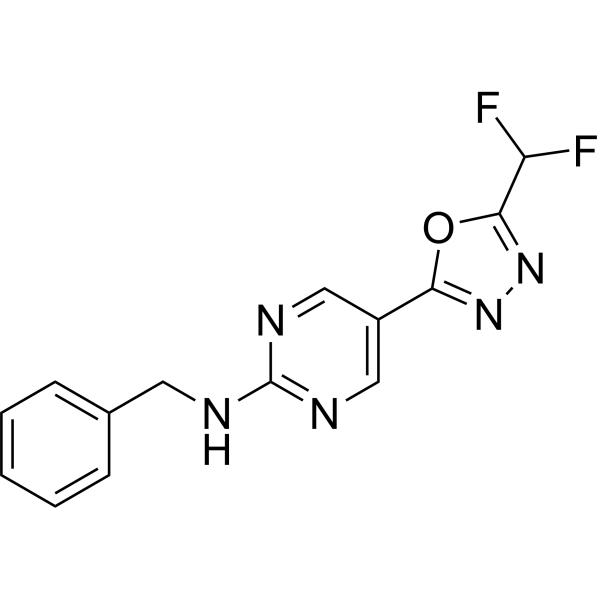
HDAC6-IN-33 (compound 6) is a selective and irreversible HDAC6 inhibitor with an IC50 of 193 nM. HDAC6-IN-33 shows no activity against HDAC1-4. HDAC6-IN-33 is a tight-binding HDAC6 inhibitor capable of inhibiting HDAC6 via a two-step slow-binding mechanism .
loading...
    loading...
Cat. No.: HY-P2917A
CAS No.: 9030-66-4
Synonyms: GyK, Cellulomonas sp.
Target:  

Endogenous Metabolite

Research Areas:  

Others

Glycerol kinase, Cellulomonas sp. (EC 2.7.1.30) is a bacterial sugar kinase, is often used in biochemical studies. Glycerol kinase, Cellulomonas sp. catalyzes the first step of glycerol metabolism by transforming the triol into glycerol-3-P (G3P). Glycerol kinase, Cellulomonas sp. is crucial for regulating channel/facilitator-independent uptake of glycerol into the cell .
loading...
    loading...
Cat. No.: HY-P3355
CAS No.: 2883747-74-6
Target:  

iGluR

Research Areas:  

Neurological Disease

p-fin4 is a peptide inhibitor of STEP Phosphatase-GluA2 AMPA receptor interaction with a Ki of 0.4 μM. p-fin4 restores the memory deficits and displays anxiolytic and antidepressant effects in a scopolamine-treated rat model. p-fin4 is a promising lead compound for novel cognitive enhancers and/or behavioral modulators .
loading...
    loading...
Cat. No.: HY-P2917B
CAS No.: 9030-66-4
Synonyms: GyK, Flavobacterium meningosepticum
Target:  

Endogenous Metabolite

Research Areas:  

Metabolic Disease

Glycerol kinase, Flavobacterium meningosepticum (GyK, Flavobacterium meningosepticum) is a thermostable glycerol kinase isolated from Flavobacterium meningosepticum. Glycerol kinase, Flavobacterium meningosepticum catalyzes the first step in glycerol metabolism by converting triol to glycerol-3-p (G3P). Glycerol kinase, Flavobacterium meningosepticum is essential for regulating glycerol uptake in cells that is independent of channels or facilitators and is useful for biochemical studies .
loading...
    loading...
Cat. No.: HY-132275
CAS No.: 1516489-83-0
Research Areas:  

Others

After the Long trebler phosphoramidite is condensed by the triple condensate, three DNA branches begin to grow simultaneously with each step of the synthesis. Deblock of this construct gives rise to DNA containing a branching point. One arm (stem) is attached to the branch point with its 5'-end, and other arms (branches) are attached with their 3'-ends. Reverse amidites can be used to prepare constructs with different branch orientations.
loading...
    loading...
Cat. No.: HY-169818
CAS No.: 96497-73-3
Synonyms: Monacolin X
Keto lovastatin (Monacolin X) is an impurity of Lovastatin (HY-N0504) and also a competitive inhibitor of HMG-CoA reductase. Keto lovastatin exerts its cholesterol-lowering effect by blocking the rate-limiting step of endogenous cholesterol synthesis. Keto lovastatin can be used in research on hypercholesterolemia and atherosclerosis, and can also serve as an impurity reference standard in the research on the production and quality control of Lovastatin .
loading...
    loading...
Cat. No.: HY-187472
Research Areas:  

Infection

SMA-245 is an inhibitor of Filovirus glycoproteins, acting on Ebola virus (EBOV) and Marburg virus (MARV). SMA-245 blocks the endosomal membrane fusion step of filoviruses by binding to the EBOV GP1/GP2 fusion loop. SMA-245 inhibits MARV viral entry. SMA-245 can be used in research related to filovirus infections .
loading...
    loading...
Cat. No.: HY-W007894R
CAS No.: 595-46-0
Synonyms: Dimethylpropanedioic acid (Standard)
Dimethylmalonic acid (Standard) (Dimethylpropanedioic acid (Standard)) is the analytical standard of Dimethylmalonic acid (HY-W007894). This product is intended for research and analytical applications. Dimethylmalonic acid (Dimethylpropanedioic acid) is a succinate dehydrogenase inhibitor. Dimethylmalonic acid competitively inhibits succinate dehydrogenase, reduces SDH-mediated succinate accumulation, blocks a key step in oxidative phosphorylation, and decreases anti-inflammatory cytokine secretion and ROS production. Dimethylmalonic acid can be used in research on autism spectrum disorders .
loading...
    loading...
Cat. No.: HY-W012185
CAS No.: 90-39-1
Synonyms: (-)-Lupinidine
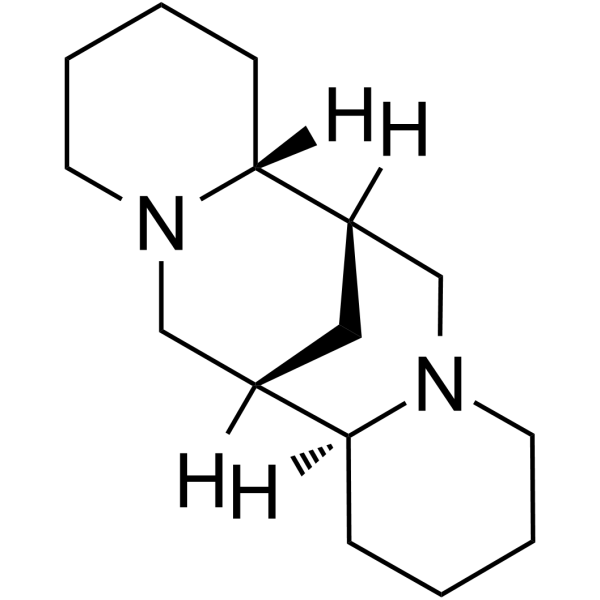
(-)-Sparteine ((-)-Lupinidine) is a chiral proton base and catalytic promoter. (-)-Sparteine promotes the enantioselective carbolithiation of cinnamyl derivatives with primary and secondary organolithium reagents. (-)-Sparteine forms mixed aggregates with lithium halides. As an exogenous chiral base, (-)-Sparteine deprotonates palladium-bound secondary alcohols, promotes the formation of palladium-alkoxide species, and alters the rate-limiting step of the catalytic cycle, thereby affecting reaction rate and enantioselectivity .
loading...
    loading...
Cat. No.: HY-W019938
CAS No.: 7785-84-4
Synonyms: Trisodium cyclo-triphosphate
Target:  

Others

Research Areas:  

Others

Sodium trimetaphosphate (Trisodium cyclo-triphosphate) is an orally active, multifunctional compound. Sodium trimetaphosphate serves as a buffer and chelating agent in cosmetics, a starch modifier in food, and can also act as a bone imaging agent. Sodium trimetaphosphate undergoes alkaline hydrolysis, with the rate-limiting first step producing sodium tripolyphosphate; the conversion rate is low when sodium carbonate or silicate is used. Sodium trimetaphosphate can be used in caries-related research .
loading...
    loading...
Cat. No.: HY-W1139983A
CAS No.: 17479-06-0
Target:  

Glycosyltransferase

Research Areas:  

Others

UDP-Galactosamine is a sugar nucleotide donor and enzyme substrate, exhibiting activity toward Galactosyltransferase, UDP-galactose 4'-epimerase, and hexose-1-phosphate uridylyltransferase. UDP-Galactosamine supports the transfer of galactosamine residues to acceptor molecules and participates in the biosynthesis of UDP-galactose. UDP-Galactosamine enables a two-step chemoenzymatic preparative-scale synthesis of GalNAc-glycosides and derivatives with unnatural glycosidic linkages .
loading...
    loading...
Cat. No.: HY-K0536

MCE Mouse Tissue Direct PCR Kit – Pro (with Dye) is specifically designed for direct PCR amplification from tissue samples. It enables rapid, one-step release of genomic DNA from various mouse tissues (such as tail, ear, toe, and muscle), which can be directly used for downstream PCR amplification and analysis without the need for conventional DNA extraction and purification steps, thereby significantly simplifying the experimental workflow.

loading...
    loading...
Cat. No.: HY-K0534

MCE Mouse Tissue Direct PCR Kit (with Dye) is specifically designed for direct PCR amplification from tissue samples. It enables rapid, one-step release of genomic DNA from various mouse tissues (such as tail, ear, toe, and muscle), which can be directly used for downstream PCR amplification and analysis without the need for conventional DNA extraction and purification steps, thereby significantly simplifying the experimental workflow.

loading...
    loading...
Cat. No.: HY-K0535

MCE Mouse Tissue Direct PCR Plus Kit is specifically designed for direct PCR amplification from tissue samples. It enables rapid, one-step release of genomic DNA from various mouse tissues (such as tail, ear, toe, and muscle), which can be directly used for downstream PCR amplification and analysis without the need for conventional DNA extraction and purification steps, thereby significantly simplifying the experimental workflow.

loading...
    loading...
Cat. No.: HY-K0539

MCE Plant Tissue Direct PCR Kit (with Dye) is specifically designed for direct amplification from various plant leaf samples. The kit enables rapid release of genomic DNA from plant tissues (such as rice, maize, tobacco, rapeseed, etc.) in a single step. The resulting lysate can be directly used for downstream PCR amplification without the need for conventional DNA extraction and purification, thereby significantly simplifying the experimental workflow.

loading...
    loading...
Cat. No.: HY-109045AR
CAS No.: 1075281-70-7
Synonyms: BTA074 hydrochloride (Standard); AP 611074 hydrochloride (Standard)
Research Areas:  

Infection

Teslexivir hydrochloride (Standard) is the analytical standard of Teslexivir (hydrochloride) (HY-109045A). This product is intended for research and analytical applications. Teslexivir (BTA074) hydrochloride is a potent antiviral agent. Teslexivir hydrochloride is a potent and selective inhibitor of the interaction between two essential viral proteins, E1 and E2, an association that is a necessary step in the DNA replication and thus viral production for Human Papilloma Virus (HPV) 6 and 11. Teslexivir hydrochloride can be used for condyloma research .
loading...
    loading...
Cat. No.: HY-125426
CAS No.: 1508303-85-2
Research Areas:  

Infection

ToP-DNJ is a selective endoplasmic reticulum α-glucosidase II (GluII) inhibitor with an IC50 value of 9.0 μM. ToP-DNJ selectively inhibits the two catalytic reactions of GluII, and exhibits stronger activity in the first step of converting di-glycosylated glycans to mono-glycosylated glycans. ToP-DNJ exhibits anti-DENV activity. ToP-DNJ can be used in studies related to dengue virus infection .
loading...
    loading...
Cat. No.: HY-N0093R
CAS No.: 10212-25-6
Synonyms: Cyclocytidine hydrochloride (Standard); Cyclo-CMP hydrochloride (Standard); Cyclo-C (Standard)
Ancitabine hydrochloride (Standard) is the analytical standard of Ancitabine hydrochloride. This product is intended for research and analytical applications. Ancitabine (Cyclocytidine) hydrochloride is a cytarabine derivative that inhibits viral replication. Ancitabine hydrochloride blocks vaccinia virus DNA replication, the progression of viral protein synthesis from early to late stages, and one-step growth of vaccinia virus. Ancitabine hydrochloride is applicable to research related to vaccinia virus infection, leukemia, human cytomegalovirus infection and colorectal cancer .
loading...
    loading...
Cat. No.: HY-N0240R
CAS No.: 527-95-7
Herbacetin (Standard) is the analytical standard of Herbacetin. This product is intended for research and analytical applications. Herbacetin is a natural flavonoid from flaxseed, exerts various pharmacological activities, including antioxidant, anti-inflammatory and anticancer effects . Herbacetin is an Ornithine decarboxylase (ODC) allosteric inhibitor, directly binds to Asp44, Asp243, and Glu384 on ODC. Ornithine decarboxylase (ODC) is a rate-limiting enzyme in the first step of polyamine biosynthesis .
loading...
    loading...
Cat. No.: HY-W075315
CAS No.: 4329-78-6
Research Areas:  

Metabolic Disease

Xanthine oxidoreductase-IN-6 (Compound 4) is an orally active xanthine oxidoreductase (XOR) inhibitor with an IC50 of 170 nM. Xanthine oxidoreductase-IN-6 can block the final step of uric acid biosynthesis and lower serum uric acid levels. Xanthine oxidoreductase-IN-6 also shows Cytochrome P450 3A4 (CYP3A4) inhibitory activity. Xanthine oxidoreductase-IN-6 can be used for the research of hyperuricemia .
loading...
    loading...

