7 Results for "

α-linolenic acids

" in MedChemExpress (MCE) Product Catalog:
Products (7)

7 Results for "α-linolenic acids" in MCE Product Catalog:

1
1 Cited Publications
Cat. No.: HY-139066
CAS No.: 544-72-9
Purity:  ≥98.0%
Synonyms: Trichosanic acid
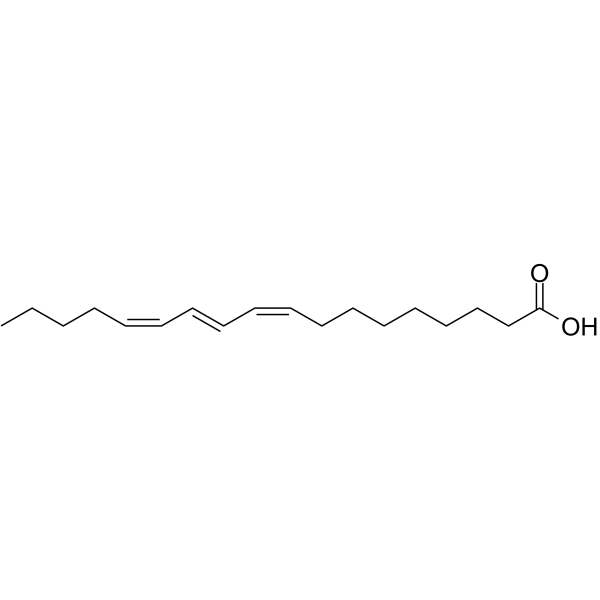
Punicic acid is a bioactive compound of pomegranate seed oil. Punicic acid is an isomer of conjugated α-linolenic acid and ω-5 polyunsaturated fatty acids. Punicic acid has anti-inflammatory and antioxidant activities and can inhibit the expression of inflammatory mediators such as tumor necrosis factor α (TNF-α). Punicic acid can also reduce the formation of β-amyloid deposits and hyperphosphorylation of tau by increasing the expression of GLUT4 protein and inhibiting the overactivation of calpain, and is used to prevent and treat neurodegenerative diseases. In addition, punicic acid also has breast cancer inhibitor properties that depend on lipid peroxidation and PKC pathways .
loading...
    loading...
Cat. No.: HY-W698249
CAS No.: 299-29-6
Target:  

Ferroptosis Bacterial

Research Areas:  

Cardiovascular Disease Infection

Ferrous gluconate is a highly water-soluble iron-containing agent with high bioavailability and bactericidal activity. As a non-heme iron, Ferrous gluconate is used for meat product fortification and improvement of iron deficiency anemia. Ferrous gluconate induces ferroptosis in E. coli through Fe 2+ infiltration, reactive oxygen species burst, lipid peroxidation and direct interaction with DNA. Ferrous gluconate also downregulates the SOS responsive transcriptional repressor LexA. In addition, Ferrous gluconate regulates multiple key pathways in E. coli such as fatty acid metabolism, iron-sulfur cluster assembly and pyruvate metabolism, and is applied in studies related to *E. coli* infection and iron deficiency anemia .
loading...
    loading...
Cat. No.: HY-145512
CAS No.: 259143-19-6
Synonyms: NLT
Target:  

Dopamine Receptor

Research Areas:  

Neurological Disease

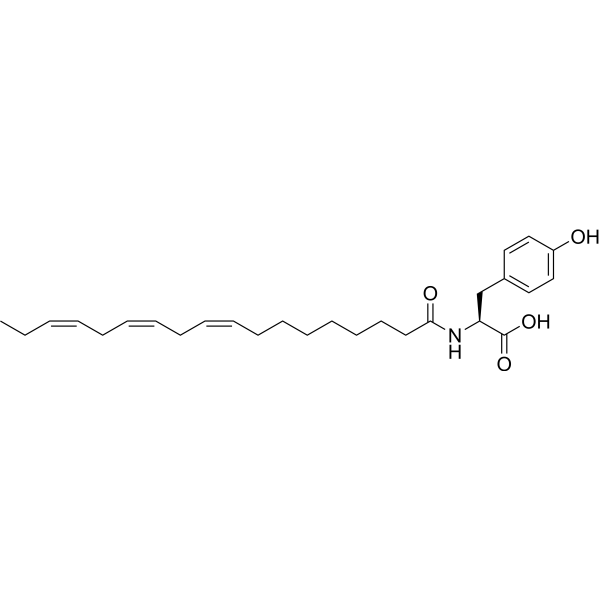
N-(α-Linolenoyl) tyrosine (NLT) is a dopaminergic agonist capable of crossing the blood-brain barrier. N-(α-Linolenoyl) tyrosine increases the level, turnover rate and release amount of dopamine in the striatum. N-(α-Linolenoyl) tyrosine modulates rotational behavior in a rat model with unilateral striatal injury and alleviates excessive blinking symptoms in models induced by dopamine-depleting agents. N-(α-Linolenoyl) tyrosine can be used for research on Parkinson's disease and idiopathic blepharospasm .
loading...
    loading...
Cat. No.: HY-113120
CAS No.: 20290-75-9
Purity:  ≥98.0%
Synonyms: 6Z,9Z,12Z,15Z-Octadecatetraenoic acid
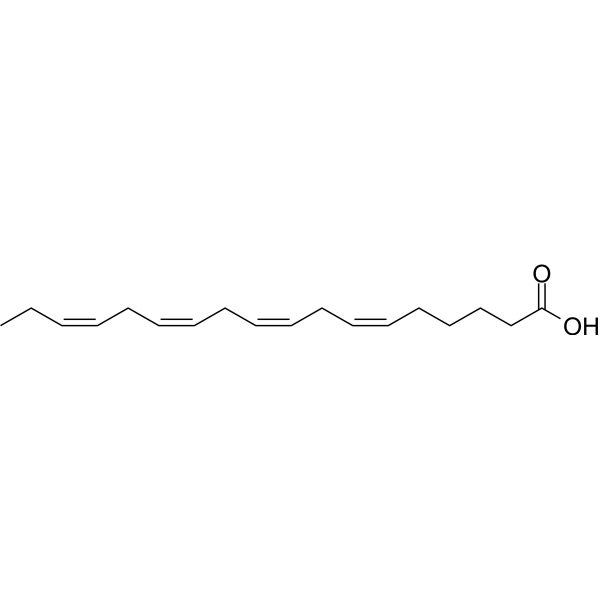
Stearidonic acid (6Z,9Z,12Z,15Z-Octadecatetraenoic acid) is an orally active polyunsaturated fatty acid found in blackcurrant seed oil. Stearidonic acid can inhibit 5-lipoxygenase and reduce leukotriene and 5-HETE synthesis. Stearidonic acid can increase the content of eicosapentaenoic acid (EPA) in red blood cells. Stearidonic acid can be used for the research of metabolic disease .
loading...
    loading...
Cat. No.: HY-N19627
CAS No.: 607357-35-7
Synonyms: 3′-M-ECG
3'-O-Methyl-(-)-epicatechin gallate (3′-M-ECG) is a methylated Catechin (HY-N0898) derivative and is an antioxidant agent. 3'-O-Methyl-(-)-epicatechin gallate reduces oxygen consumption and prevents decreases in linoleic and α-linolenic acids to protect canola oil from lipid oxidation when heated .
loading...
    loading...
Cat. No.: HY-N17745
CAS No.: 298700-56-8
(-)-EGCG-3'-O-Me is a catechin derivative (HY-N0898). (-)-EGCG-3'-O-Me inhibits lipid oxidation in rapeseed oil by reducing oxygen consumption and protecting linoleic acid and α-linolenic acid from degradation during heating. The antioxidant activity of (-)-EGCG-3'-O-Me in heated rapeseed oil is lower than that of its non-methylated precursor, (-)-epigallocatechin (EGCG) (HY-N0225) .
loading...
    loading...
Cat. No.: HY-184361
CAS No.: 143202-57-7
Synonyms: Ethyl 20:4BSO
Juniperonic acid ethyl ester (Ethyl 20:4BSO) is an orally active non-methylene-interrupted ω-3 polyunsaturated fatty acid ethyl ester. Juniperonic acid ethyl ester exists in Platycladus orientalis seed oil. Juniperonic acid ethyl ester reduces the ratio of 20:3n-9 to arachidonic acid in hepatic phosphatidylcholine of rats with essential fatty acid deficiency. Juniperonic acid ethyl ester is applicable to the research of hypertension and hepatic reperfusion injury .
loading...
    loading...

