Search Result
Results for "
Fluorescently labeled proteins
" in MedChemExpress (MCE) Product Catalog:
-
- HY-66022
-
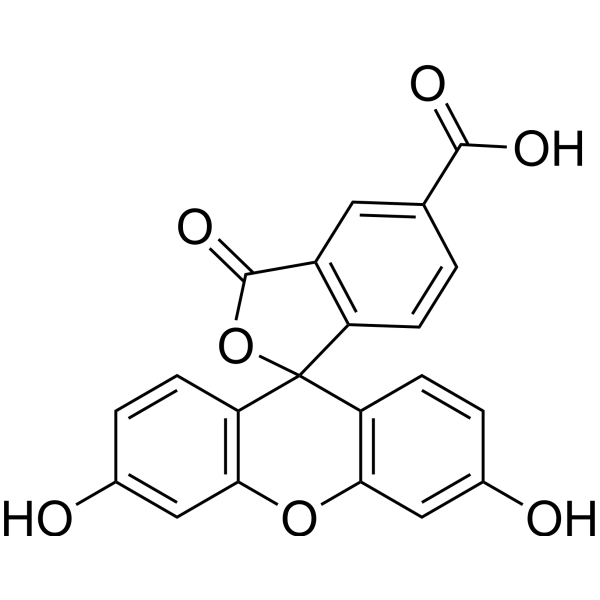
5-FAM
4 Publications Verification
5-Carboxyfluorescein
|
Fluorescent Dye
|
Others
|
|
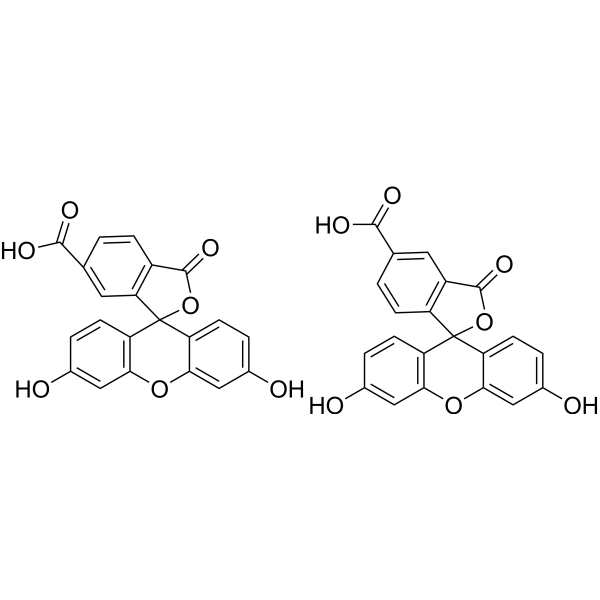
5-FAM (5-Carboxyfluorescein) is a green fluorescent reagent used for in situ labeling peptides, proteins and nucleotides. 5-FAM is a single isomer with Ex/Em of 490 nm/520 nm .
|
-
-
- HY-D0822
-
CY3
4 Publications Verification
Sulfo-Cyanine3
|
Fluorescent Dye
|
Others
|
|
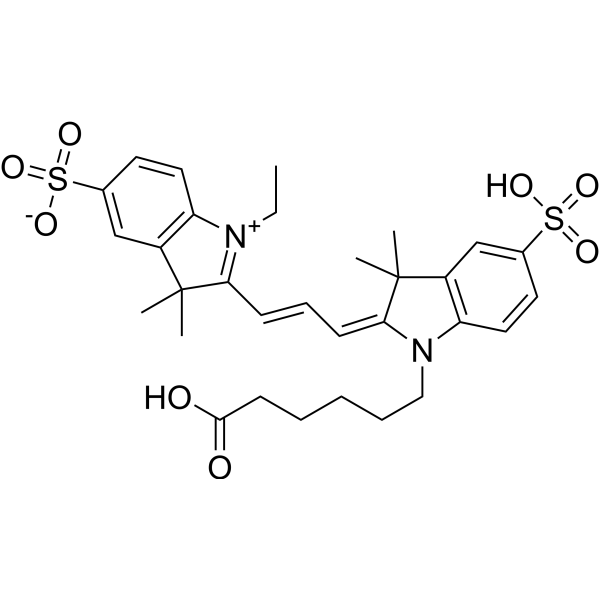
Cy3 (Sulfo-Cyanine3) is an orange-fluorescent label for protein and nucleic acid (λex=554, λem=568).
|
-
-
- HY-D2449
-
|
|
Fluorescent Dye
|
Others
|
|
DQ-BSA-Red is a bovine serum albumin labeled with a red fluorescent dye that can be used to detect lysosomal activity. The excitation wavelength and emission wavelength of DQ-BSA-Red are 590 nm and 620 nm, respectively. The BSA molecule in DQ-BSA-Red is labeled with high concentration of red fluorescent dye in multiple sites, which shows high fluorescence self-inhibition. Once DQ-BSA-RED enters the lysosome, DQ-BSA is cleaved by lysosomal proteases, resulting in unquenched and released fluorescent fragments, emitting bright fluorescence. Inactivated lysosomes are unable to degrade the BSA protein and thus have a lower or even no fluorescent signal .
|
-
-
- HY-15944
-
|
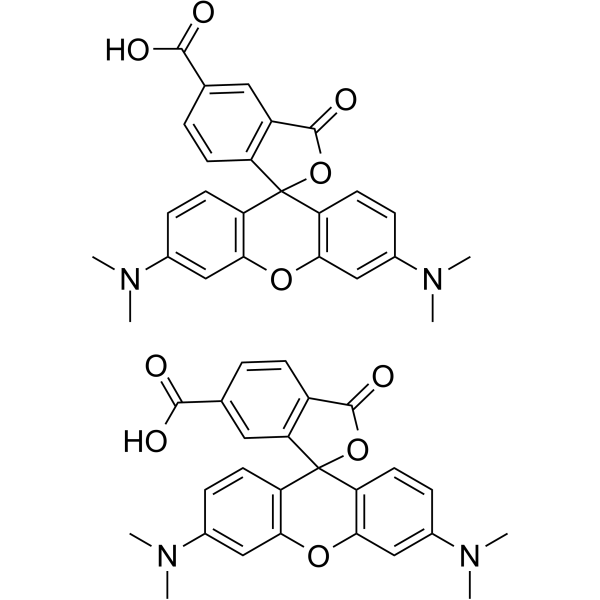
5(6)-Carboxytetramethylrhodamine
|
Fluorescent Dye
|
Others
|
|
5(6)-TAMRA (5(6)-Carboxytetramethylrhodamine) is a fluorescent dye molecule widely used as a label for peptides and proteins (Ex/Em = 520/600 nm).
|
-
-
- HY-15938
-
|
|
Fluorescent Dye
|
Others
|
|
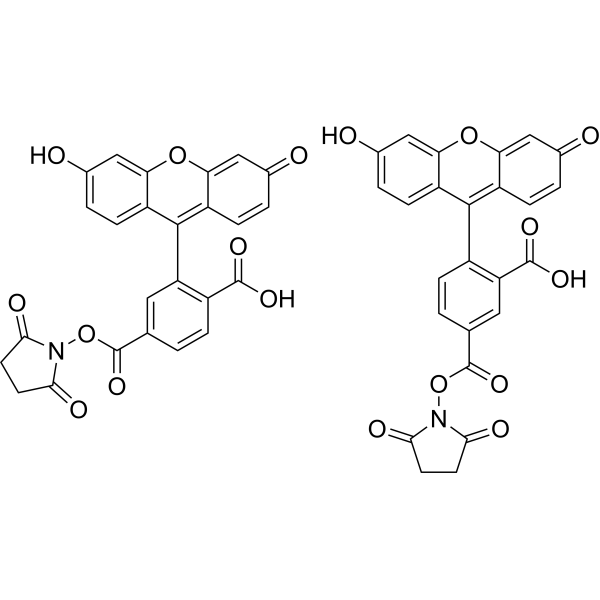
5-FAM SE is a single isomer, is a fluorescent labeling reagent used for labeling peptides, proteins and nucleotides. 5-FAM SE can react with amines and can yield stable amine conjugates .
|
-
-
- HY-135414
-
|
|
Fluorescent Dye
|
Others
|
|
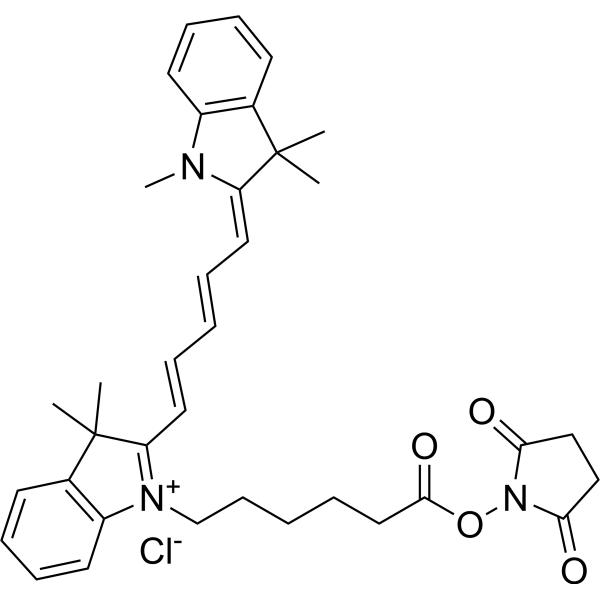
Cyanine5 NHS ester chloride is a red emitting fluorescent dye for labeling of amino-groups in peptides, proteins, and oligonucleotides .
|
-
-
- HY-D1817
-
|
|
Fluorescent Dye
|
Others
|
|
Vari Fluor 488-Phalloidin is a fluorescent derivative of Phalloidin that specifically labels myofilament proteins and exhibits green fluorescence when labeled, allowing for fluorescence imaging using FITC channels (Ex/Em=488 nm/513 nm) .
|
-
-
- HY-15937
-
|
5(6)-Carboxyfluorescein N-hydroxysuccinimide ester; 5(6)-Carboxyfluorescein succinimidyl ester mixed isomers
|
Fluorescent Dye
|
Others
|
|
5(6)-FAM SE is a green fluorescent dye widely used for protein labeling.
|
-
-
- HY-D1819
-
|
|
Fluorescent Dye
|
Others
|
|
Vari Fluor 633-Phalloidin is a fluorescent derivative of Phalloidin that specifically labels myofilament proteins and exhibits red fluorescence at 630/650 nm when labeled .
|
-
-
- HY-D0807
-
5-IAF
1 Publications Verification
5-Iodoacetamidofluorescein
|
Fluorescent Dye
|
Cancer
|
|
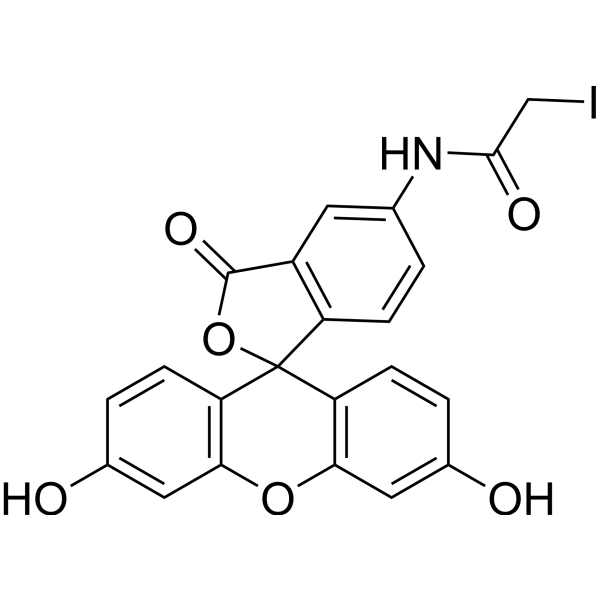
5-IAF (5-Iodoacetamidofluorescein) is an idoacetamide derivate of fluoresceine. 5-IAF can be used as fluorescent probe that labels proteins and other molecules having free thiols (cysteine side chains) .
|
-
-
- HY-D1849
-
|
|
Fluorescent Dye
|
Others
|
|
Cy3B NHS ester is a fluorescent dye compound that is commonly used in biomarking and fluorescent labeling experiments, especially for labeling biomolecules containing amino functional groups (amine groups), such as proteins, antibodies or peptides.
|
-
-
- HY-D1605
-
|
|
Fluorescent Dye
|
Others
|
|
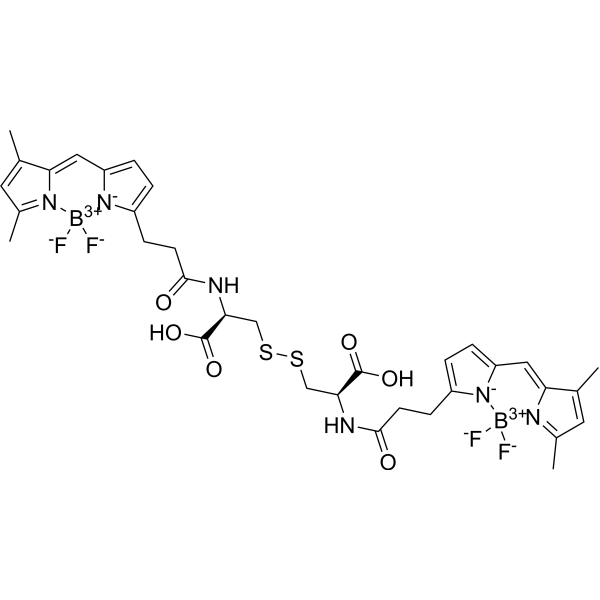
BODIPY FL L-Cystine is a thiol-reactive, green-fluorescent dye. BODIPY FL L-Cystine can be the labeling of membrane proteins, proteins with hydrophobic binding sites, or hydrophobic ligands. (λex=504 nm, λem=511 nm) .
|
-
-
- HY-D1816
-
|
|
Fluorescent Dye
|
Others
|
|
Vari Fluor 555-Phalloidin is a fluorescent derivative of Phalloidin that specifically labels myofilament proteins and exhibits red fluorescence when labeled, allowing for fluorescence imaging using the PE channel (Ex/Em=550 nm/561 nm) .
|
-
-
- HY-W998680
-
|
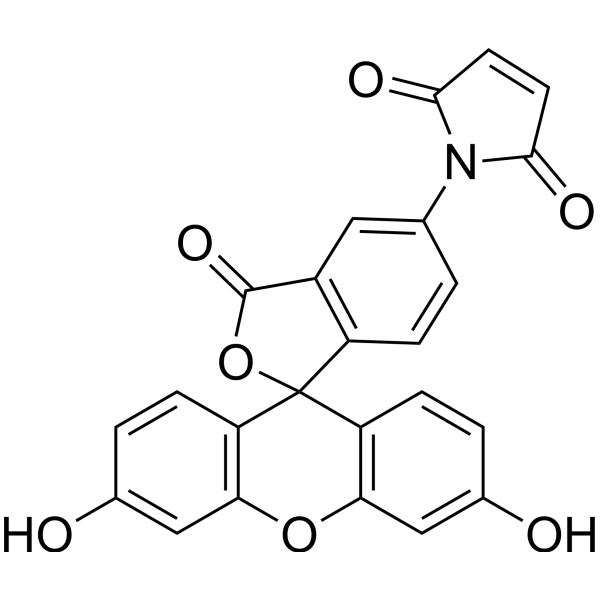
5-FITC-Maleimide
|
Fluorescent Dye
|
Others
|
|
Fluorescein-maleimide (5-FITC-Maleimide) is a thiol-reactive fluorescent derivatization reagent and non-specific protein labeling reagent. Fluorescein-maleimide covalently binds to protein thiol groups for protein labeling. Fluorescein-maleimide covalently binds to protein amino and imidazole groups under neutral pH conditions. Fluorescein-maleimide is used for fluorescent labeling of proteins, nucleic acids or other molecules containing one or more thiol groups (Ex/Em = 494/519 nm) .
|
-
-
- HY-D0077
-
|
Oregon green 488
|
Fluorescent Dye
|
Others
|
|
2',7'-Difluorofluorescein (Oregon green 488) is a fluorescein derivative and a pH-sensitive fluorescent probe (pKa ~4.7). Upon excitation at 488 nm, 2',7'-Difluorofluorescein exhibits pH-sensitive fluorescence intensity through the formation of dianions, while its pH sensitivity decreases under excitation at 450 nm, allowing its use in ratiometric pH analysis. 2',7'-Difluorofluorescein can be used for the quantitative analysis of pH values in the range of 2-7 in submicron aerosol particles. 2',7'-Difluorofluorescein undergoes buffer-mediated and buffer-free excited-state proton transfer between different protonated forms, and its cationic form undergoes rapid excited-state deprotonation. 2',7'-Difluorofluorescein is resistant to photodegradation, maintains stable absorption and fluorescence properties within the physiological pH range, and serves as a fluorescent protein label, a component of Ca 2+ indicators, a fluorescent imaging agent, and an anisotropy probe .
|
-
-
- HY-D1781
-
|
|
Fluorescent Dye
|
Others
|
|
NTPAN-MI is a fluorescent probe (excitation wavelength: 405 nm). NTPAN-MI is selectively activated after labeling unfolded proteins with exposed thiols, thereby reporting the degree of protein homeostasis .
|
-
-
- HY-W273413
-
|
NBD-H
|
Fluorescent Dye
|
Cancer
|
|
4-Hydrazino-7-nitro-benzofurazan hydrazine adduct (NBD-H) is a fluorescent reagent used for protein labeling .
|
-
-
- HY-143702
-
|
NBD-DOTAP
|
Fluorescent Dye
Liposome
|
Inflammation/Immunology
Cancer
|
|
Fluorescent DOTAP (NBD-DOTAP) is a cationic lipid which can be used for nucleic acid and protein delivery. Fluorescent DOTAP is labeled with a fluorophore NBD (maximum excitation/emission wavelength ∼463/536 nm). Fluorescent DOTAP can be used for gene delivery systems, drug delivery, as well as cell imaging and nanocarrier tracking. Fluorescent DOTAP is an ideal candidate for both biological and pharmaceutical formulation (e.g. co-delivery of vaccines) research .
|
-
-
- HY-D1820
-
|
|
Fluorescent Dye
|
Others
|
|
Vari Fluor 594-Phalloidin is a fluorescent derivative of Phalloidin that specifically labels myofilament proteins and exhibits red fluorescence at 585/609 nm when labeled .
|
-
-
- HY-D1365
-
|
|
Fluorescent Dye
|
Others
|
|
Sulfo-Cy3(Me)COOH is a sulfo-Cyanine3 derivative. Cyanine3 is an orange-fluorescent label dye for protein and nucleic acid (Ex=554 nm, Em=568 nm) .
|
-
-
- HY-155640
-
|
|
Fluorescent Dye
|
Others
|
|
Maleimide-5’FAM is a fluorescein. Maleimide-5’FAM can be used for labeling non-transduced cells .
|
-
-
- HY-D0099
-
|
|
Fluorescent Dye
|
Others
|
|
Fluorescein-5-thiosemicarbazide is a amine containing fluorescent probe that can be used for labeling saccharides and protein carbonyl derivatives .
|
-
-
- HY-124197
-
|
|
Fluorescent Dye
|
Others
|
|
Coumarin hydrazine is a fluorescent chemical probe (λex=420–450/λem=468nm) to label cellular protein- and lipid-bound carbonyls .
|
-
-
- HY-D1818
-
|
|
Fluorescent Dye
|
Others
|
|
Vari Fluor 680-Phalloidin is a fluorescent derivative of Phalloidin that specifically labels myofilament proteins and exhibits red fluorescence when labeled at 680/700 nm .
|
-
-
- HY-110211
-
|
|
Fluorescent Dye
|
Others
|
|
BODIPY TMR-X SE is a potent fluorescent dye. BODIPY TMR-X SE can be used to label the primary amines (R-NH2) of proteins, amine-modified oligonucleotides, and other amine-containing molecules. BODIPY TR-X binds to protein or antibody and has bright, orange fluorescent light. (λex=544 nm, λem=570 nm) .
|
-
-
- HY-D2498
-
|
|
Fluorescent Dye
|
Others
|
|
Cy7 maleimide is a fluorescent dye containing a Maleimide (HY-W007324) functional group. Maleimide can be used to label thiol groups on antibodies, proteins and peptides .
|
-
-
- HY-151759
-
|
|
Fluorescent Dye
|
Cancer
|
|
Sulfo-Cy5-TCO is a water-soluble sulfonated Cy5 fluorescent reagent containing trans-cyclooctene (TCO). Sulfo-Cy5-TCO undergoes an inverse electron demand Diels‑Alder reaction with tetrazine-labeled fixed breast cancer cells to achieve cell labeling. Sulfo-Cy5-TCO is used for fluorescent labeling and imaging of biological samples such as proteins and cells .
|
-
-
- HY-137098
-
|
|
Fluorescent Dye
|
Others
|
|
Sulfo-Cy3 maleimide potassium is a fluorescent dye with a maleimide functionality at the end a short alkyl linker. Sulfo-Cy3 maleimide potassium can be used for the labeling of antibodies and other labile proteins .
|
-
-
- HY-D2170
-
|
|
Fluorescent Dye
|
Others
|
|
AF488 streptavidin is a fluorescently labeled streptavidin. AF488 streptavidin is a streptavidin conjugated to Alexa Fluor 488, with 4 fluorophores per protein molecule, enabling stoichiometric fluorescent labeling of cell surface targets. AF488 streptavidin can form a complex with biotinylated E07 aptamer to stain cells expressing EGFR, and the staining is reversible after treatment with mA9 detoxifying oligonucleotides (Ex/Em = 470/520 nm) .
|
-
-
- HY-135414B
-
|
|
Fluorescent Dye
|
Others
|
|
Cyanine5 NHS ester iodide is a red emitting fluorescent dye for labeling of amino-groups in peptides, proteins, and oligonucleotides .
|
-
-
- HY-137100
-
|
Cyanine5 hydrazide
|
Fluorescent Dye
|
Others
|
|
Cy 5 hydrazide (Cyanine5 hydrazide) is a fluorescent dye for aldehydes and ketones. Cy 5 hydrazide can be used for labeling proteins .
|
-
-
- HY-D1830
-
|
VF 680 Carboxylic acid(free acid)
|
Fluorescent Dye
|
Others
|
|
Vari Fluor 680 Carboxylic acid (VF 680 Carboxylic acid) free acid is a carboxylic acid derivative of Vari Fluor. Vari Fluor carboxylic acid derivatives are unactivated labeled fluorescent dyes for protein, antibody, and polysaccharide labeling that require carboxylic acid activation for use .
|
-
-
- HY-D1692
-
|
|
Fluorescent Dye
|
Others
|
|
BODIPY 650/665 NHS ester is bright, far-red fluorescent dye that can be used to label the primary amines (R-NH2) of proteins, amine-modified oligonucleotides, and other amine-containing molecules . Ex / Em = 646 / 660 nm
|
-
-
- HY-D2444
-
|
|
Fluorescent Dye
|
Cancer
|
|
AF555 NHS is a red fluorescent dye with excellent fluorescence properties and light stability. The excitation wavelength is 556 nm and the emission wavelength is 571 nm, which can be used for protein labeling, antibody labeling, and cell imaging .
|
-
-
- HY-D0968
-
|
Cyanine3
|
Fluorescent Dye
|
Others
|
|
Cy 3 Non-Sulfonated (Cyanine3) is a fluorescent label for protein and nucleic acid.
|
-
-
- HY-D2956
-
|
CLIP-GLA-NHS
|
Biochemical Assay Reagents
|
Others
|
|
BC-GLA-NHS (CLIP-GLA-NHS) is a NHS-labeled CLIP tag, which is an amine-reactive crosslinker and can achieve site-specific protein labeling. The NHS ester of BC-GLA-NHS reacts with the primary amine of the target molecule (such as antibodies, quantum dots) in a pH 7.5-8.5 buffer solution to form a stable amide bond. After coupling, the BC molecule undergoes a nucleophilic substitution reaction with the active site (Cys) of the CLIP-tagged fusion protein, releasing benzylcytosine and forming an irreversible thioether bond, achieving covalent labeling. BC-GLA-NHS can be used for click chemistry labeling .
|
-
-
- HY-DY1066
-
|
|
Fluorescent Dye
|
Others
|
Cy3 (Sulfo-Cyanine3) (solution) is an orange-fluorescent label for protein and nucleic acid (λex=554, λem=568). Solvent and concentration: DMSO: 10 mM
|
-
-
- HY-N16309
-
|
|
Fluorescent Dye
|
Others
|
|
Cyanine 7 free acid bromide is a near-infrared fluorescent probe for labelling amine groups such as those on antibodies, nucleic acids, and proteins and can be detected using a variety of fluorescence detection techniques such as microscopy and flow cytometry.
|
-
-
- HY-D2488
-
|
|
Fluorescent Dye
|
Others
|
|
Sulfo Cy5.5-maleimide is a fluorescent dye containing a Maleimide (HY-W007324) functional group. Maleimide can be used to label thiol groups on antibodies, proteins and peptides.
|
-
-
- HY-148958
-
-
-
- HY-D1591
-
|
|
Fluorescent Dye
|
Others
|
|
BODIPY R6G methyl ester (compound 5′-1) is a BODIPY-like fluorescent dye with good light stability and insensitive to pH value. BODIPY R6G methyl ester shows good photostability, high sensitivity and insensitive to pH value. BODIPY R6G methyl ester can be used in research areas such as photodynamic research, PH probes, ion recognition, photocatalysis, protein labeling, cell imaging, and proteomic analysis .
|
-
-
- HY-D2931
-
|
|
Fluorescent Dye
|
Others
|
|
SNAP-FAM is a FAM-labeled SNAP tag fluorescent probe, specifically designed for live-cell protein labeling and real-time imaging applications .
|
-
-
- HY-D1109
-
|
|
Fluorescent Dye
|
Others
|
|
5(6)-SFX ,SE (Compound SFX-SE) is a fluorescent dye for labeling primary amines and nascent proteins .
|
-
-
- HY-110212
-
|
BODIPY TR-X NHS Ester
|
Fluorescent Dye
|
Others
|
|
BODIPY TR-X (BODIPY TR-X NHS Ester) is a potent fluorescent dye. BODIPY TR-X can be used to label the primary amines (R-NH2) of proteins, amine-modified oligonucleotides, and other amine-containing molecules. BODIPY TR-X binds to protein or antibody and has bright, red fluorescent light. (λex=545 nm, λem=560 nm) .
|
-
-
- HY-D2933
-
|
|
Fluorescent Dye
|
Others
|
|
SNAP-505 is a green fluorescent O6 benzylguanine derivative. SNAP-505 labels SNAP-tagged proteins covalently.
SNAP-505 can be used to label cells (green) .
|
-
-
- HY-D2949
-
|
|
Fluorescent Dye
|
Others
|
|
SNAP-549 is a DY-549P1-labeled SNAP tag fluorescent probe, specifically designed for single-molecule imaging and dynamic tracking of proteins in living cells. SNAP-549 only labels SNAP-tag fusion proteins, with low background signals and forming irreversible connections, making it suitable for long-term observation .
|
-
-
- HY-D2291
-
|
|
Fluorescent Dye
|
Others
|
|
BODIPY TMR NHS ester is bright, orange fluorescent dye with Ex/Em of 544/570 nm. The NHS ester (or succinimidyl ester) of BODIPY TMR NHS ester is a popular tool for conjugating the dye to a protein or antibody. NHS esters can be used to label the primary amines (R-NH2) of proteins, amine-modified oligonucleotides, and other amine-containing molecules .
|
-
-
- HY-D1890
-
|
|
Fluorescent Dye
|
Others
|
|
N-(2-Aminooxyethyl)-7-DCCAm (Compound 7) is a fluorescent dye, and can be used for protein labeling .
|
-
-
- HY-145800
-
|
pm-DAP TFA
|
Drug Intermediate
|
Others
|
|
Photocaged DAP (pm-DAP) TFA is a protected version of 2,3-Diaminopropionic acid (DAP) (HY-W013673). Photocaged DAP TFA can produce 2,3-Diaminopropionic acid after photodeprotection. Photocaged DAP TFA can be used as an intermediate to capture biosynthetic acylase .
|
-
-
- HY-D1496
-
|
|
Fluorescent Dye
|
Others
|
|
Fluorescent Red Mega 485 NHS-ester is an amine conjugating fluorescent biolabel that can be used to label proteins .
|
-
- HY-D2495
-
|
|
Fluorescent Dye
|
Others
|
|
Cy7 SE (nosulfo) is a fluorescent dye for the labeling of amino-groups in peptides, proteins, and oligonucleotides.
|
-
- HY-W879234
-
|
Sulfo Cy5.5-DBCO
|
Fluorescent Dye
|
Others
|
|
TriSulfo-Cy5.5 DBCO is a near infrared (NIR) fluorescent anthocyanin fluorescent dye.TriSulfo-Cy5.5 DBCO can be used to label proteins, antibodies, peptides, nucleic acid molecules.
|
-
- HY-D2290
-
|
|
Fluorescent Dye
|
Others
|
|
Demethoxy-BODIPY TMR NHS ester is an amine-reactive fluorescent probe, and can be used for the labeling of proteins, peptides, and other molecules .
|
-
- HY-D2960
-
|
CLIP-OG
|
Fluorescent Dye
|
Others
|
|
BC-OG is an oregon green labeled CLIP tag fluorescent probe. BC-OG can be used for labeling CLIP-tag fusion protein in cells .
|
-
- HY-141618
-
|
|
Fluorescent Dye
|
Others
|
|
5(6)-Carboxyrhodamine 110 is an amine-reactive fluorescent probe for labeling DNA, cells and proteins (Ex/Em = 498/530 nm) .
|
-
- HY-D0122
-
|
|
Fluorescent Dye
|
Others
|
|
6-Iodoacetamidofluorescein, a sulphhydryl-specific fluorescent dye, and can be used to selectively label the -SH groups of nuclear matrix polypeptides and proteins .
|
-
- HY-134308
-
|
|
Fluorescent Dye
|
Others
|
|
8-NBD-cAMP sodium is a fluorescently labeled cyclic adenosine phosphate (cAMP) analogue. 8-NBD-cAMP sodium retains a similar biological activity to cAMP, regulating their activity by binding to specific proteins such as EPACs or PKA. 8-NBD-cAMP sodium can be used in fluorescent competitive binding experiments to evaluate the binding affinity of newly synthesized EPAC1 agonists to EPAC1 proteins .
|
-
- HY-D1365B
-
|
|
Fluorescent Dye
|
Others
|
|
Sulfo-Cyanine 3 free acid potassium is a sulfo-Cyanine3 derivative. Cyanine3 is an orange-fluorescent label dye for protein and nucleic acid (Ex=554 nm, Em=568 nm) .
|
-
- HY-D1825
-
|
VF 532 Carboxylic acid(free acid)
|
Fluorescent Dye
|
Others
|
|
Vari Fluor 532 Carboxylic acid (VF 532 Carboxylic acid) free acid is a carboxylic acid derivative of Vari Fluor. Vari Fluor carboxylic acid derivatives are unactivated labeled fluorescent dyes for protein, antibody, and polysaccharide labeling that require carboxylic acid activation for use .
|
-
- HY-D1823
-
|
VF 647A Carboxylic acid(free acid)
|
Fluorescent Dye
|
Others
|
|
Vari Fluor 647A Carboxylic acid (VF 647A Carboxylic acid) free acid is a carboxylic acid derivative of Vari Fluor. Vari Fluor carboxylic acid derivatives are unactivated labeled fluorescent dyes for protein, antibody, and polysaccharide labeling that require carboxylic acid activation for use .
|
-
- HY-D1824
-
|
VF 488 Carboxylic acid(free acid)
|
Fluorescent Dye
|
Others
|
|
Vari Fluor 488 Carboxylic acid (VF 488 Carboxylic acid) free acid is a carboxylic acid derivative of Vari Fluor. Vari Fluor carboxylic acid derivatives are unactivated labeled fluorescent dyes for protein, antibody, and polysaccharide labeling that require carboxylic acid activation for use .
|
-
- HY-D1822
-
|
VF 555 Carboxylic acid(free acid)
|
Fluorescent Dye
|
Others
|
|
Vari Fluor 555 Carboxylic acid (VF 555 Carboxylic acid) free acid is a carboxylic acid derivative of Vari Fluor. Vari Fluor carboxylic acid derivatives are unactivated labeled fluorescent dyes for protein, antibody, and polysaccharide labeling that require carboxylic acid activation for use .
|
-
- HY-D1821
-
|
VF 750 Carboxylic acid(free acid)
|
Fluorescent Dye
|
Others
|
|
Vari Fluor 750 Carboxylic acid (VF 750 Carboxylic acid) free acid is a carboxylic acid derivative of Vari Fluor. Vari Fluor carboxylic acid derivatives are unactivated labeled fluorescent dyes for protein, antibody, and polysaccharide labeling that require carboxylic acid activation for use .
|
-
- HY-D1828
-
|
VF 640 Carboxylic acid(free acid)
|
Fluorescent Dye
|
Others
|
|
Vari Fluor 640 Carboxylic acid (VF 640 Carboxylic acid) free acid is a carboxylic acid derivative of Vari Fluor. Vari Fluor carboxylic acid derivatives are unactivated labeled fluorescent dyes for protein, antibody, and polysaccharide labeling that require carboxylic acid activation for use .
|
-
- HY-D1829
-
|
VF 568 Carboxylic acid(free acid)
|
Fluorescent Dye
|
Others
|
|
Vari Fluor 568 Carboxylic acid (VF 568 Carboxylic acid) free acid is a carboxylic acid derivative of Vari Fluor. Vari Fluor carboxylic acid derivatives are unactivated labeled fluorescent dyes for protein, antibody, and polysaccharide labeling that require carboxylic acid activation for use .
|
-
- HY-D1826
-
|
VF 594 Carboxylic acid(free acid)
|
Fluorescent Dye
|
Others
|
|
Vari Fluor 594 Carboxylic acid (VF 594 Carboxylic acid) free acid is a carboxylic acid derivative of Vari Fluor. Vari Fluor carboxylic acid derivatives are unactivated labeled fluorescent dyes for protein, antibody, and polysaccharide labeling that require carboxylic acid activation for use .
|
-
- HY-D1827
-
|
VF 660 Carboxylic acid(free acid)
|
Fluorescent Dye
|
Others
|
|
Vari Fluor 660 Carboxylic acid (VF 660 Carboxylic acid) free acid is a carboxylic acid derivative of Vari Fluor. Vari Fluor carboxylic acid derivatives are unactivated labeled fluorescent dyes for protein, antibody, and polysaccharide labeling that require carboxylic acid activation for use .
|
-
- HY-158531
-
|
A3 N-linked oligosaccharide, procainamide labelled
|
Fluorescent Dye
Biochemical Assay Reagents
|
Others
|
|
A3 glycan, procainamide labelled (A3 N-linked oligosaccharide, procainamide labelled) is a N-polysaccharide protein and a multifunctional fluorescent linker. The resulting conjugates exhibit high sensitivity and specificity by mimicking the antennal elements of N-glycans .
|
-
- HY-D2948
-
|
|
Fluorescent Dye
|
Others
|
|
SNAP-430 is a (diethylamino) coumarin-labeled SNAP tag fluorescent probe. SNAP-430 can be used for making SNAP-tag fusion proteins inside living cells, on cell surfaces, or in vitro.
|
-
- HY-D1885
-
|
|
Fluorescent Dye
|
Others
|
|
Vari Fluor 647 Carboxylic acid free acid is a carboxylic acid derivative of Vari Fluor. Vari Fluor carboxylic acid derivative is an inactive labeled fluorescent dye, which can be used to label proteins, antibodies, polysaccharides. The use of Vari Fluor carboxylic acid derivatives requires carboxylic acid activation.
|
-
- HY-D1365A
-
|
|
Fluorescent Dye
|
Others
|
|
Sulfo-Cy3(Me)COOH TEA is a sulfo-Cyanine3 derivative. Cyanine3 is an orange-fluorescent label dye for protein and nucleic acid (Ex=554 nm, Em=568 nm) .
|
-
- HY-D2943
-
|
SNAP-SS-SulfoCy3
|
Fluorescent Dye
|
Others
|
|
BG-SS-SulfoCy3 is a SulfoCy3-labeled SNAP tag fluorescent probe, which is linked by a disulfide bond to achieve selective labeling and controllable cleavage. BG-SS-SulfoCy3 can be used to study the endocytosis and trafficking of membrane proteins such as GPCRs .
|
-
- HY-158541
-
|
A4 N-linked oligosaccharide, 2-AB labelled
|
Fluorescent Dye
Biochemical Assay Reagents
|
Others
|
|
A4 glycan, 2-AB labelled (A4 N-linked oligosaccharide, 2-AB labelled) is a N-polysaccharide protein and a multifunctional fluorescent linker. The resulting conjugates exhibit high sensitivity and specificity by mimicking the antennal elements of N-glycans .
|
-
- HY-158540
-
|
A4 N-linked oligosaccharide, 2-AA labelled
|
Biochemical Assay Reagents
|
Others
|
|
A4 glycan, 2-AA labelled (A4 N-linked oligosaccharide, 2-AA labelled) is a N-polysaccharide protein and a multifunctional fluorescent linker. The resulting conjugates exhibit high sensitivity and specificity by mimicking the antennal elements of N-glycans .
|
-
- HY-D2946
-
|
BC-TMR
|
Fluorescent Dye
|
Infection
|
CLIP-TMR (BC-TMR) is a TMR-labeled CLIP tag fluorescent probe. CLIP-TMR combines the high specificity recognition ability of the CLIP-tag and the excellent optical performance of the TMR fluorophore, and can be used for the specific labeling and visualization of the HCV NS5A protein .
|
-
- HY-D2953
-
|
CLIP-CPY
|
Fluorescent Dye
|
Others
|
|
BC-CPY is a CLIP-tagged probe based on the pyridine-benzoanthrone (CPY) fluorophore (Ex/Em: 580 nm/610 nm). BC-CPY has excellent cell membrane permeability, enabling deep imaging, low phototoxicity and high signal-to-noise ratio. BC-CPY can be used for super-resolution microscopy imaging of living cells .
|
-
- HY-158507
-
|
Mannose-5 N-linked oligosaccharide, procainamide labelled; Oligomannose 5 glycan, procainamide labelled
|
Biochemical Assay Reagents
|
Others
|
|
M5 glycan (Man5), procainamide labelled (Mannose-5 N-linked oligosaccharide, procainamide labelled; Oligomannose 5 glycan, procainamide labelled) is a N-polysaccharide protein and a multifunctional fluorescent linker. The resulting conjugates exhibit high sensitivity and specificity by mimicking the antennal elements of N-glycans .
|
-
- HY-D1756
-
|
|
Fluorescent Dye
|
Others
|
|
ROX NHS ester, 6-isomer is a highly fluorescent, and photostable rhodamine dye for various applications. ROX labeled oligonucleotide probes are often used in qPCR, and qPCR instruments have ROX channel. This is reactive dye for the labeling of amino-groups in peptides, proteins, and amino-oligonucleotides. Pure single isomer.
|
-
- HY-158496
-
|
A2 N-linked oligosaccharide, 2-AB labelled
|
Biochemical Assay Reagents
|
Others
|
|
A2 glycan (G0), 2-AB labelled (A2 N-linked oligosaccharide, 2-AB labelled) is a N-polysaccharide protein and a multifunctional fluorescent linker. The resulting conjugates exhibit high sensitivity and specificity by mimicking the antennal elements of N-glycans .
|
-
- HY-158446
-
|
A2G2 N-linked oligosaccharide, APTS labelled
|
Biochemical Assay Reagents
|
Others
|
|
A2G2 glycan (G2), APTS labelled (A2G2 N-linked oligosaccharide, APTS labelled) is a N-polysaccharide protein and a multifunctional fluorescent linker. The resulting conjugates exhibit high sensitivity and specificity by mimicking the antennal elements of N-glycans .
|
-
- HY-D2941
-
|
SNAP-AF
|
Fluorescent Dye
|
Others
|
BGAF (SNAP-AF) is a fluorescent diacetyl fluorescein-labeled SNAP tag fluorescent probe, specifically designed for the covalent labeling of SNAP-tag fusion proteins in living cells. BGAF utilizes the specific reaction of the human DNA repair protein hAGT to achieve specific fluorescent labeling of the target protein in the living cell environment .
|
-
- HY-D2942
-
|
|
Fluorescent Dye
|
Others
|
|
BDP-V BG-BODIPY is a SNAP tag fluorescent probe labeled with a BODIPY molecular motor. BDP-V BG-BODIPY contains a BODIPY molecular rotor that functions as a viscosity-sensitive fluorophore, which is highly responsive to local viscosity changes and enables the specific monitoring of the local microviscosity of proteins. BDP-V BG-BODIPY supports one-photon and two-photon imaging, with an excitation wavelength (Ex) of 488 nm (for one-photon excitation) and 850 nm (for two-photon excitation), and an emission wavelength (Em) of 500-600 nm .
|
-
- HY-134392A
-
|
|
Nucleoside Antimetabolite/Analog
|
Others
|
|
6-Alkyne-NAD+ sodium is a nicotinamide adenine dinucleotide (NAD) analogue. 6-Alkyne-NAD+ sodium can be used as a fluorescent probe coupled with fluorescent labels for marking ADP-ribose polymerase substrate proteins .
|
-
- HY-D2939
-
|
|
Fluorescent Dye
|
Others
|
BGSBD is a SNAP-tag-based fluorescent probe (Ex/Em: 435 nm/516 nm) based on the environmentally sensitive fluorescent group SBD, specifically designed for protein labeling of live cells without washing. BGSBD achieves a 280-fold fluorescence enhancement after labeling by ingeniously utilizing the hydrophobic binding pocket of the SNAP-tag protein, providing an ideal tool for real-time monitoring of protein dynamics within cells .
|
-
- HY-D2959
-
|
CLIP-DF
|
Fluorescent Dye
|
Others
|
|
BC-DF is a diacetyl fluorescein labeled CLIP tag fluorescent probe. BC-DF can be used for labeling CLIP-tag fusion protein in cells .
|
-
- HY-P4878
-
-
- HY-D2945
-
|
|
Fluorescent Dye
|
Others
|
|
CLIP-Biotin is a Biotin-labeled CLIP tag fluorescent probe. CLIP-Biotin can be used for marking the CLIP-tag fusion proteins in cells.
|
-
- HY-D3272
-
|
|
Fluorescent Dye
|
Others
|
|
IR 680LT NHS ester is a fluorescent dye with an NHS ester moiety, which can be used to label antibodies, proteins, etc (Ex/Em = 675/694 nm) .
|
-
- HY-158542
-
|
A4 N-linked oligosaccharide, procainamide labelled
|
Biochemical Assay Reagents
|
Others
|
|
A4 glycan, procainamide labelled (A4 N-linked oligosaccharide, procainamide labelled) is a N-polysaccharide protein and a multifunctional fluorescent linker. The resulting conjugates exhibit high sensitivity and specificity by mimicking the antennal elements of N-glycans .
|
-
- HY-NP218
-
|
|
Fluorescent Dye
|
Others
|
|
NP-APC (Allophycocyanin) is a conjugate that links NP (a hapten) and APC (fluorescent protein) together. NP-APC (Allophycocyanin) is used in immunological research as a tool for specifically labeling cells and antibodies (Ex/Em = 650/660 nm).
|
-
- HY-158493
-
|
A2 N-linked oligosaccharide, procainamide labelled
|
Biochemical Assay Reagents
|
Others
|
|
A2 glycan (G0), procainamide labelled (A2 N-linked oligosaccharide, procainamide labelled) is a N-polysaccharide protein and a multifunctional fluorescent linker. The resulting conjugates exhibit high sensitivity and specificity by mimicking the antennal elements of N-glycans .
|
-
- HY-158497
-
|
A2 N-linked oligosaccharide, APTS labelled
|
Biochemical Assay Reagents
|
Others
|
|
A2 glycan (G0), APTS labelled (A2 N-linked oligosaccharide, APTS labelled) is a N-polysaccharide protein and a multifunctional fluorescent linker. The resulting conjugates exhibit high sensitivity and specificity by mimicking the antennal elements of N-glycans .
|
-
- HY-124197S
-
|
|
Isotope-Labeled Compounds
Fluorescent Dye
|
Others
|
|
Coumarin hydrazine-d7 is the deuterium labeled Coumarin hydrazine (HY-124197). Coumarin hydrazine is a fluorescent chemical probe (λex=420–450/λem=468nm) to label cellular protein- and lipid-bound carbonyls .
|
-
- HY-158516
-
|
Mannose-6 N-linked oligosaccharide, procainamide labelled; Oligomannose 6 glycan, procainamide labelled
|
Biochemical Assay Reagents
|
Others
|
|
M6 glycan (Man6), procainamide labelled (Mannose-6 N-linked oligosaccharide, procainamide labelled) is a N-polysaccharide protein and a multifunctional fluorescent linker. The resulting conjugates exhibit high sensitivity and specificity by mimicking the antennal elements of N-glycans .
|
-
- HY-158529
-
|
A3 N-linked oligosaccharide, 2-AA labelled
|
Biochemical Assay Reagents
|
Others
|
|
A3 glycan, 2-AA labelled (A3 N-linked oligosaccharide, 2-AA labelled) is a N-polysaccharide protein and a multifunctional fluorescent linker. The resulting conjugates exhibit high sensitivity and specificity by mimicking the antennal elements of N-glycans .
|
-
- HY-158530
-
|
A3 N-linked oligosaccharide, 2-AB labelled
|
Biochemical Assay Reagents
|
Others
|
|
A3 glycan, 2-AB labelled (A3 N-linked oligosaccharide, 2-AB labelled) is a N-polysaccharide protein and a multifunctional fluorescent linker. The resulting conjugates exhibit high sensitivity and specificity by mimicking the antennal elements of N-glycans .
|
-
- HY-158539
-
|
Mannose-8 N-linked oligosaccharide, procainamide labelled; Oligomannose 8 glycan, procainamide labelled
|
Biochemical Assay Reagents
|
Others
|
|
M8 glycan (Man8), procainamide labelled (Mannose-8 N-linked oligosaccharide, procainamide labelled; Oligomannose 8 glycan, procainamide labelled) is a N-polysaccharide protein and a multifunctional fluorescent linker. The resulting conjugates exhibit high sensitivity and specificity by mimicking the antennal elements of N-glycans .
|
-
- HY-158546
-
|
Mannose-9 N-linked oligosaccharide, procainamide labelled; Oligomannose 9 glycan, procainamide labelled
|
Biochemical Assay Reagents
|
Others
|
|
M9 glycan (Man9), procainamide labelled (Mannose-9 N-linked oligosaccharide, procainamide labelled; Oligomannose 9 glycan, procainamide labelled) is a N-polysaccharide protein and a multifunctional fluorescent linker. The resulting conjugates exhibit high sensitivity and specificity by mimicking the antennal elements of N-glycans .
|
-
- HY-158505
-
|
Mannose-5 N-linked oligosaccharide, APTS labelled; Oligomannose 5 glycan, APTS labelled
|
Biochemical Assay Reagents
|
Others
|
|
M5 glycan (Man5), APTS labelled (Mannose-5 N-linked oligosaccharide, APTS labelled; Oligomannose 5 glycan, APTS labelled) is a N-polysaccharide protein and a multifunctional fluorescent linker. The resulting conjugates exhibit high sensitivity and specificity by mimicking the antennal elements of N-glycans .
|
-
- HY-158526
-
|
Mannose-7 N-linked oligosaccharide, procainamide labelled; Oligomannose 7 glycan, procainamide labelled
|
Biochemical Assay Reagents
|
Others
|
|
M7 glycan (Man7), procainamide labelled (Mannose-7 N-linked oligosaccharide, procainamide labelled; Oligomannose 7 glycan, procainamide labelled) is a N-polysaccharide protein and a multifunctional fluorescent linker. The resulting conjugates exhibit high sensitivity and specificity by mimicking the antennal elements of N-glycans .
|
-
- HY-D2459
-
|
|
Fluorescent Dye
|
Cancer
|
|
Alexa Fluor 430 NHS ester is a compound that couples green fluorescent dye Alexa Fluor 430 to a protein or antibody. Alexa Fluor 430 is used for the generation of stable signals in imaging and flow cytometry. NHS ester can be used to label proteins, amine-modified oligonucleotides and other primary amines (R-NH2) containing amine molecules .
|
-
- HY-112697
-
|
|
Biochemical Assay Reagents
|
Others
|
|
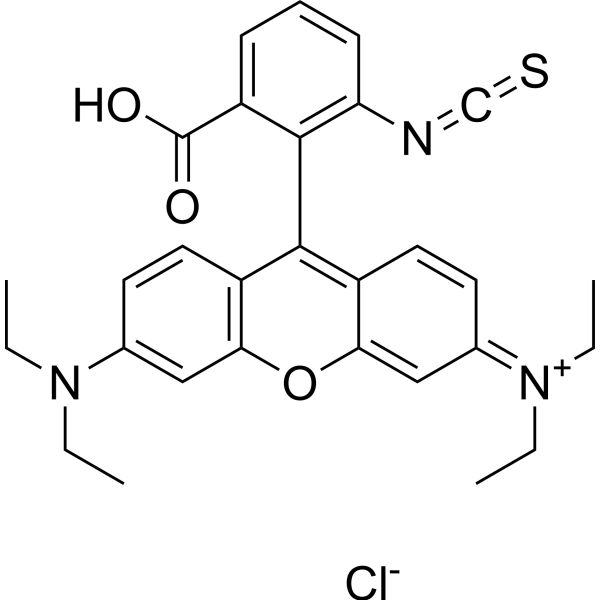
Rhodamine B isothiocyanate (RBITC) is a fluorescent dye commonly used in biological imaging and labeling applications. It has an isothiocyanate functional group that can be covalently attached to amino groups on proteins and other biomolecules, making it useful for fluorescent labeling of cells and tissues. RBITC fluoresces bright orange-red under green light excitation, which makes it easy to detect and track labeled molecules in complex samples. Due to its stability and sensitivity, RBITC has been widely used in various research fields, including cell biology, immunology, and neurobiology.
|
-
- HY-158461
-
|
Galactose-alpha-1,3-galactose, 2-AA labelled
|
Biochemical Assay Reagents
|
Others
|
|
Alpha-Gal standard, 2-AA labelled (Galactose-alpha-1,3-galactose, 2-AA labelled) is a N-polysaccharide protein and a multifunctional fluorescent linker. The resulting conjugates exhibit high sensitivity and specificity by mimicking the antennal elements of N-glycans .
|
-
- HY-158462
-
|
Galactose-alpha-1,3-galactose, 2-AB labelled
|
Biochemical Assay Reagents
|
Others
|
|
Alpha-Gal standard, 2-AB labelled (Galactose-alpha-1,3-galactose, 2-AB labelled) is a N-polysaccharide protein and a multifunctional fluorescent linker. The resulting conjugates exhibit high sensitivity and specificity by mimicking the antennal elements of N-glycans .
|
-
- HY-W749072
-
|
|
Fluorescent Dye
|
Others
|
|
BP Fluor 568 NHS ester is an amine-reactive, orange fluorescent dye routinely used to label proteins or antibodies through the primary amines (Lys), amine-modified oligonucleotides, and other amine-containing biomolecules (Ex/Em: 578 nm/602 nm) .
|
-
- HY-158492
-
|
A4G4 N-linked oligosaccharide, 2-AB labelled
|
Biochemical Assay Reagents
|
Others
|
|
A4G4 glycan, 2-AB labelled (A4G4 N-linked oligosaccharide, 2-AB labelled) is a N-polysaccharide protein and a multifunctional fluorescent linker. The resulting conjugates exhibit high sensitivity and specificity by mimicking the antennal elements of N-glycans .
|
-
- HY-158537
-
|
A3G3S3 N-linked oligosaccharide, procainamide labelled
|
Biochemical Assay Reagents
|
Others
|
|
A3G3S3 glycan, procainamide labelled (A3G3S3 N-linked oligosaccharide, procainamide labelled) is a N-polysaccharide protein and a multifunctional fluorescent linker. The resulting conjugates exhibit high sensitivity and specificity by mimicking the antennal elements of N-glycans .
|
-
- HY-158491
-
|
A4G4 N-linked oligosaccharide, 2-AA labelled
|
Biochemical Assay Reagents
|
Others
|
|
A4G4 glycan, 2-AA labelled (A4G4 N-linked oligosaccharide, 2-AA labelled) is a N-polysaccharide protein and a multifunctional fluorescent linker. The resulting conjugates exhibit high sensitivity and specificity by mimicking the antennal elements of N-glycans .
|
-
- HY-158527
-
|
FA2 N-linked oligosaccharide, APTS labelled; F(6)A2 glycan, APTS labelled
|
Biochemical Assay Reagents
|
Others
|
|
FA2 glycan (G0F), APTS labelled (FA2 N-linked oligosaccharide, APTS labelled; F(6)A2 glycan, APTS labelled) is a N-polysaccharide protein and a multifunctional fluorescent linker. The resulting conjugates exhibit high sensitivity and specificity by mimicking the antennal elements of N-glycans .
|
-
- HY-D3263
-
|
|
Fluorescent Dye
|
Others
|
|
IR 650 NHS ester is a far-red-fluorescent probe with NHS ester. NHS ester is the most popular amine-reactive group for labeling with the primary amines of proteins (Lys), amine-modified oligonucleotides, and other amine-containing molecules. (Ex=651nm, Em=668 nm)
|
-
- HY-149117
-
|
|
Fluorescent Dye
|
Others
|
|
AF430 NHS ester is an AF 430 maleimide is a derivative of the yellow fluorescent dye AF 430. AF430 has an excitation wavelength of 425 nm and an emission wavelength of 542 nm. AF430 NHS ester can be uesd for the labeling of amino-groups in peptides, proteins, and oligonucleotides. To achieve specific coupling of dye labels and biomolecules .
|
-
- HY-D1305
-
|
|
Fluorescent Dye
|
Others
|
|
ATTO 488 carboxylic acid is a new fluorescent label based on the Rhodamine structure. It has strong absorption, high fluorescence quantum yield, high thermal stability and photochemical stability, and is suitable for single molecule detection and high-resolution microscopy. ATTO 488 carboxylic acid is a carboxylic acid derivative of ATTO 488, which can be used to label proteins or antibodies.
|
-
- HY-172285
-
|
|
Fluorescent Dye
|
Others
|
|
Cy3 hydrazide is a cyanine dye linker containing hydrazide, which can be used to label aldehydes and ketones. This reagent allows to label various carbonyl-containing molecules such as antibodies and other glycoproteins after periodate oxidation, proteins after oxidative stress or deamination, or reducing saccarides. Cyanine3 is compatible with a number of fluorescent instruments.
|
-
- HY-158488
-
|
A3G3 N-linked oligosaccharide, 2-AB labelled
|
Biochemical Assay Reagents
|
Others
|
|
A3G3 glycan (G3), 2-AB labelled (A3G3 N-linked oligosaccharide, 2-AB labelled) is a N-polysaccharide protein and a multifunctional fluorescent linker. The resulting conjugates exhibit high sensitivity and specificity by mimicking the antennal elements of N-glycans .
|
-
- HY-158487
-
|
A3G3 N-linked oligosaccharide, 2-AA labelled
|
Biochemical Assay Reagents
|
Others
|
|
A3G3 glycan (G3), 2-AA labelled (A3G3 N-linked oligosaccharide, 2-AA labelled) is a N-polysaccharide protein and a multifunctional fluorescent linker. The resulting conjugates exhibit high sensitivity and specificity by mimicking the antennal elements of N-glycans .
|
-
- HY-158445
-
|
A2G2 N-linked oligosaccharide, 2-AB labelled
|
Biochemical Assay Reagents
|
Others
|
|
A2G2 glycan (G2), 2-AB labelled (A2G2 N-linked oligosaccharide, 2-AB labelled) is a N-polysaccharide protein and a multifunctional fluorescent linker. The resulting conjugates exhibit high sensitivity and specificity by mimicking the antennal elements of N-glycans .
|
-
- HY-158468
-
|
|
Biochemical Assay Reagents
|
Others
|
|
Sialylated Core 1 O-glycan (C1S(3)1), 2AB labelled () is a N-polysaccharide protein and a multifunctional fluorescent linker. The resulting conjugates exhibit high sensitivity and specificity by mimicking the antennal elements of N-glycans .
|
-
- HY-158514
-
|
Mannose-6 N-linked oligosaccharide, 2-AB labelled; Oligomannose 6 glycan, 2-AB labelled
|
Biochemical Assay Reagents
|
Others
|
|
M6 glycan (Man6), 2-AB labelled (Mannose-6 N-linked oligosaccharide, 2-AB labelled; Oligomannose 6 glycan, 2-AB labelled) is a N-polysaccharide protein and a multifunctional fluorescent linker. The resulting conjugates exhibit high sensitivity and specificity by mimicking the antennal elements of N-glycans .
|
-
- HY-158483
-
|
Mannose-3 N-linked oligosaccharide, 2-AA labelled; Oligomannose 3 glycan, 2-AA labelled
|
Biochemical Assay Reagents
|
Others
|
|
M3 glycan (Man3), 2-AA labelled (Mannose-3 N-linked oligosaccharide, 2-AA labelled; Oligomannose 3 glycan, 2-AA labelled) is a N-polysaccharide protein and a multifunctional fluorescent linker. The resulting conjugates exhibit high sensitivity and specificity by mimicking the antennal elements of N-glycans .
|
-
- HY-158511
-
|
Mannose-6 N-linked oligosaccharide, 2-AA labelled; Oligomannose 6 glycan, 2-AA labelled
|
Biochemical Assay Reagents
|
Others
|
|
M6 glycan (Man6), 2-AA labelled (Mannose-6 N-linked oligosaccharide, 2-AA labelled; Oligomannose 6 glycan, 2-AA labelled) is a N-polysaccharide protein and a multifunctional fluorescent linker. The resulting conjugates exhibit high sensitivity and specificity by mimicking the antennal elements of N-glycans .
|
-
- HY-158503
-
|
Mannose-5 N-linked oligosaccharide, 2-AB labelled; Oligomannose 5 glycan, 2-AB labelled
|
Biochemical Assay Reagents
|
Others
|
|
M5 glycan (Man5), 2-AB labelled (Mannose-5 N-linked oligosaccharide, 2-AB labelled; Oligomannose 5 glycan, 2-AB labelled) is a N-polysaccharide protein and a multifunctional fluorescent linker. The resulting conjugates exhibit high sensitivity and specificity by mimicking the antennal elements of N-glycans .
|
-
- HY-158521
-
|
Mannose-7 N-linked oligosaccharide, 2-AA labelled; Oligomannose 7 glycan, 2-AA labelled
|
Biochemical Assay Reagents
|
Others
|
|
M7 glycan (Man7), 2-AA labelled (Mannose-7 N-linked oligosaccharide, 2-AA labelled; Oligomannose 7 glycan, 2-AA labelled) is a N-polysaccharide protein and a multifunctional fluorescent linker. The resulting conjugates exhibit high sensitivity and specificity by mimicking the antennal elements of N-glycans .
|
-
- HY-158524
-
|
Mannose-7 N-linked oligosaccharide, 2-AB labelled; Oligomannose 7 glycan, 2-AB labelled
|
Biochemical Assay Reagents
|
Others
|
|
M7 glycan (Man7), 2-AB labelled (Mannose-7 N-linked oligosaccharide, 2-AB labelled; Oligomannose 7 glycan, 2-AB labelled) is a N-polysaccharide protein and a multifunctional fluorescent linker. The resulting conjugates exhibit high sensitivity and specificity by mimicking the antennal elements of N-glycans .
|
-
- HY-158545
-
|
Mannose-9 N-linked oligosaccharide, 2-AB labelled; Oligomannose 9 glycan, 2-AB labelled
|
Biochemical Assay Reagents
|
Others
|
|
M9 glycan (Man9), 2-AB labelled (Mannose-9 N-linked oligosaccharide, 2-AB labelled; Oligomannose 9 glycan, 2-AB labelled) is a N-polysaccharide protein and a multifunctional fluorescent linker. The resulting conjugates exhibit high sensitivity and specificity by mimicking the antennal elements of N-glycans .
|
-
- HY-158544
-
|
Mannose-9 N-linked oligosaccharide, 2-AA labelled; Oligomannose 9 glycan, 2-AA labelled
|
Biochemical Assay Reagents
|
Others
|
|
M9 glycan (Man9), 2-AA labelled (Mannose-9 N-linked oligosaccharide, 2-AA labelled; Oligomannose 9 glycan, 2-AA labelled) is a N-polysaccharide protein and a multifunctional fluorescent linker. The resulting conjugates exhibit high sensitivity and specificity by mimicking the antennal elements of N-glycans .
|
-
- HY-158536
-
|
Mannose-8 N-linked oligosaccharide, 2-AA labelled; Oligomannose 8 glycan, 2-AA labelled
|
Biochemical Assay Reagents
|
Others
|
|
M8 glycan (Man8), 2-AA labelled (Mannose-8 N-linked oligosaccharide, 2-AA labelled; Oligomannose 8 glycan, 2-AA labelled) is a N-polysaccharide protein and a multifunctional fluorescent linker. The resulting conjugates exhibit high sensitivity and specificity by mimicking the antennal elements of N-glycans .
|
-
- HY-158484
-
|
Mannose-3 N-linked oligosaccharide, 2-AB labelled; Oligomannose 3 glycan, 2-AB labelled
|
Biochemical Assay Reagents
|
Others
|
|
M3 glycan (Man3), 2-AB labelled (Mannose-3 N-linked oligosaccharide, 2-AB labelled; Oligomannose 3 glycan, 2-AB labelled) is a N-polysaccharide protein and a multifunctional fluorescent linker. The resulting conjugates exhibit high sensitivity and specificity by mimicking the antennal elements of N-glycans .
|
-
- HY-158501
-
|
Mannose-5 N-linked oligosaccharide, 2-AA labelled; Oligomannose 5 glycan, 2-AA labelled
|
Biochemical Assay Reagents
|
Others
|
|
M5 glycan (Man5), 2-AA labelled (Mannose-5 N-linked oligosaccharide, 2-AA labelled; Oligomannose 5 glycan, 2-AA labelled) is a N-polysaccharide protein and a multifunctional fluorescent linker. The resulting conjugates exhibit high sensitivity and specificity by mimicking the antennal elements of N-glycans .
|
-
- HY-158538
-
|
Mannose-8 N-linked oligosaccharide, 2-AB labelled; Oligomannose 8 glycan, 2-AB labelled
|
Biochemical Assay Reagents
|
Others
|
|
M8 glycan (Man8), 2-AB labelled (Mannose-8 N-linked oligosaccharide, 2-AB labelled; Oligomannose 8 glycan, 2-AB labelled) is a N-polysaccharide protein and a multifunctional fluorescent linker. The resulting conjugates exhibit high sensitivity and specificity by mimicking the antennal elements of N-glycans .
|
-
- HY-D1735
-
|
Golgi-Red Tracke
|
Fluorescent Dye
|
Others
|
|
The Golgi apparatus is composed of flattened vesicles superimposed on each other by unit membranes. The flattened vesicles are round with expanded and perforated edges. The Golgi fluorescent probe is a BODIPY-labeled ceramide derivative, the synthesis of which occurs in the endoplasmic reticulum and can then be transported to the Golgi via ceramide transport protein (CERT) or vesicular translocation, allowing specific labeling of the dye. BODIPY TR Ceramide (Golgi-Red Tracke) is a Golgi-specific fluorescent dye, which can visualise individual cells . Ex/Em=589 nm/616 nm.
|
-
- HY-D1612
-
|
|
Fluorescent Dye
|
Others
|
|
The Golgi apparatus is composed of flattened vesicles superimposed on each other by unit membranes. The flattened vesicles are round with expanded and perforated edges. The Golgi fluorescent probe is a BODIPY-labeled ceramide derivative, the synthesis of which occurs in the endoplasmic reticulum and can then be transported to the Golgi via ceramide transport protein (CERT) or vesicular translocation, allowing specific labeling of the dye . BODIPY Fl C5-Ceramide is a Golgi-specific green fluorescent dye, which can visualise individual cells . Ex/Em= 505 nm/512 nm.
|
-
- HY-138200
-
|
Cyanine5 maleimide
|
DNA Stain
Fluorescent Dye
|
Others
|
|
Cy5 maleimide (Cyanine5 maleimide) is a single-reactive dye containing a maleimide group and a CY5 fluorescent group, which can selectively couple with a thiol group. Cy5 maleimide can be used to label antibodies, peptides, or proteins (Ex/Em = 646/664 nm).
|
-
- HY-D0152
-
|
|
Fluorescent Dye
|
Others
|
|
Tetramethylrhodamine-6-maleimide is a fluorescent dye with a reactive sulfhydryl-specific moiety is covalently coupled to this cysteine. Tetramethylrhodamine-6-maleimide can be used as labels to detect local protein motions of the fully active Na+/K+-ATPase in real time .
|
-
- HY-D3346
-
|
|
Fluorescent Dye
|
Others
|
|
Dusquench1 NHS ester is an amino-reactive fluorescent quencher (it does not emit light and has no emission wavelength, Ex = 480-580 nM), specially designed for labeling proteins, oligonucleotides and other biopolymers containing primary amines. It is a core reagent in the fields of qPCR probes, FRET detection and molecular beacons.
|
-
- HY-D0968B
-
|
Cyanine3 triethylamine
|
Fluorescent Dye
|
Others
|
|
Cy 3 Non-Sulfonated (Cyanine3) triethylamine is a cyanine (Cy) dye, and a fluorescent label with green channel for protein and nucleic acid. Cy 3 Non-Sulfonated triethylamine is a fluorescent photoproduct of Cyanine5 via photoconversion upon photoexcitation. Cy 3 Non-Sulfonated triethylamine can be used to high-density single-particle tracking in a living cell without using UV illumination and cell-toxic additives (Ex=470 nm; Em=515 nm and 565 nm nm) .
|
-
- HY-158474
-
|
A2G2S1 N-linked oligosaccharide, APTS labelled
|
Biochemical Assay Reagents
|
Others
|
|
A2G2S1 glycan (G2S1), APTS labelled (A2G2S1 N-linked oligosaccharide, APTS labelled) is a N-polysaccharide protein and a multifunctional fluorescent linker. The resulting conjugates exhibit high sensitivity and specificity by mimicking the antennal elements of N-glycans .
|
-
- HY-158504
-
|
FA2G2S1 N-linked oligosaccharide, APTS labelled
|
Biochemical Assay Reagents
|
Others
|
|
FA2G2S1 glycan (G2FS1), APTS labelled (FA2G2S1 N-linked oligosaccharide, APTS labelled) is a N-polysaccharide protein and a multifunctional fluorescent linker. The resulting conjugates exhibit high sensitivity and specificity by mimicking the antennal elements of N-glycans .
|
-
- HY-158533
-
|
A3G3S3 N-linked oligosaccharide, 2-AA labelled
|
Biochemical Assay Reagents
|
Others
|
|
A3G3S3 glycan, 2-AA labelled (A3G3S3 N-linked oligosaccharide, 2-AA labelled) is a N-polysaccharide protein and a multifunctional fluorescent linker. The resulting conjugates exhibit high sensitivity and specificity by mimicking the antennal elements of N-glycans .
|
-
- HY-158535
-
|
A3G3S3 N-linked oligosaccharide, 2-AB labelled
|
Biochemical Assay Reagents
|
Others
|
|
A3G3S3 glycan, 2-AB labelled (A3G3S3 N-linked oligosaccharide, 2-AB labelled) is a N-polysaccharide protein and a multifunctional fluorescent linker. The resulting conjugates exhibit high sensitivity and specificity by mimicking the antennal elements of N-glycans .
|
-
- HY-158447
-
|
A2G2 N-linked oligosaccharide, procainamide labelled; A2G(4)2 glycan, procainamide labelled
|
Biochemical Assay Reagents
|
Others
|
|
A2G2 glycan (G2), procainamide labelled (A2G2 N-linked oligosaccharide, procainamide labelled; A2G(4)2 glycan, procainamide labelled) is a N-polysaccharide protein and a multifunctional fluorescent linker. The resulting conjugates exhibit high sensitivity and specificity by mimicking the antennal elements of N-glycans .
|
-
- HY-158489
-
|
A3G3 N-linked oligosaccharide, procainamide labelled; A3G(4)3 glycan, procainamide labelled
|
Biochemical Assay Reagents
|
Others
|
|
A3G3 glycan (G3), procainamide labelled (A3G3 N-linked oligosaccharide, procainamide labelled; A3G(4)3 glycan, procainamide labelled) is a N-polysaccharide protein and a multifunctional fluorescent linker. The resulting conjugates exhibit high sensitivity and specificity by mimicking the antennal elements of N-glycans .
|
-
- HY-D0115
-
|
|
DNA Stain
|
Others
|
|
7-Hydroxycoumarin-3-carboxylic acid N-succinimidyl ester is the amine-reactive succinimidyl ester of 7-Hydroxycoumarin-3-carboxylic acid. 7-Hydroxycoumarin-3-carboxylic acid N-succinimidyl ester is a blue fluorescent dye for labeling proteins and nucleic acids .
|
-
- HY-D2328
-
|
Alexa Fluor 680 succinimidyl ester
|
Fluorescent Dye
|
Others
|
|
Alexa Fluor 680 NHS ester (Alexa Fluor 680 succinimidyl ester) is a near-infrared (NIR) fluorescent dye. NHS esters can be used to label to the primary amines (R-NH2) of proteins, amine-modified oligonucleotides, and other amine-containing molecules (Ex/Em = 679/702 nm) .
|
-
- HY-D2755
-
|
|
Fluorescent Dye
|
Others
|
|
BP Light 650 carboxylic acid is an vibrant far-red fluorochrome with comparable or improved performance over other dyes, including BP Fluor 647 and Cy5 dye, for fluorescent applications. It is used to label antibodies and other proteins as molecular probes for cellular imaging and other fluorescence detection methods application.
|
-
- HY-W784030
-
|
|
Amino Acid Derivatives
Biochemical Assay Reagents
Fluorescent Dye
|
Others
|
|
N-TCO-L-lysine is a non-canonical amino acid. N-TCO-L-lysine contains a trans-cyclooctene (TCO) bioorthogonal reactive linker. N-TCO-L-lysine undergoes a bioorthogonal click reaction with SiR-Tz to enable fluorescent labeling of endogenously expressed proteins with site-specific incorporation. When used in combination with SiR-Tz, N-TCO-L-lysine allows super-resolution and live-cell imaging of endogenous proteins .
|
-
- HY-W740363
-
|
5-AF hydrochloride
|
Fluorescent Dye
|
|
|
5-Aminofluorescein hydrochloride (5-AF hydrochloride) is a protein fluorescent labeling reagent with excellent fluorescence activity. It is widely used in cell imaging and molecular probes in biomedical research. 5-Aminofluorescein hydrochloride can be used to observe the location of proteins and their dynamic changes, providing in-depth biological understanding. 5-Aminofluorescein hydrochloride is also used to detect interactions between biomolecules and help analyze complex biological processes.
|
-
- HY-158453
-
|
FA2B N-linked oligosaccharide, 2-AA labelled; G0F with bisecting GlcNAc, 2-AA labelled
|
Biochemical Assay Reagents
|
Others
|
|
FA2B glycan (G0B), 2-AA labelled (FA2B N-linked oligosaccharide, 2-AA labelled; G0F with bisecting GlcNAc, 2-AA labelled) is a N-polysaccharide protein and a multifunctional fluorescent linker. The resulting conjugates exhibit high sensitivity and specificity by mimicking the antennal elements of N-glycans .
|
-
- HY-158499
-
|
FA2 N-linked oligosaccharide, 2-AA labelled; F(6)A2 glycan, 2-AA labelled
|
Biochemical Assay Reagents
|
Others
|
|
FA2 glycan (G0F), 2-AA labelled (FA2 N-linked oligosaccharide, 2-AA labelled; F(6)A2 glycan, 2-AA labelled) is a N-polysaccharide protein and a multifunctional fluorescent linker. The resulting conjugates exhibit high sensitivity and specificity by mimicking the antennal elements of N-glycans .
|
-
- HY-158500
-
|
FA2 N-linked oligosaccharide, 2-AB labelled; F(6)A2 glycan, 2-AB labelled
|
Biochemical Assay Reagents
|
Others
|
|
FA2 glycan (G0F), 2-AB labelled (FA2 N-linked oligosaccharide, 2-AB labelled; F(6)A2 glycan, 2-AB labelled) is a N-polysaccharide protein and a multifunctional fluorescent linker. The resulting conjugates exhibit high sensitivity and specificity by mimicking the antennal elements of N-glycans .
|
-
- HY-158451
-
|
FA2G2 N-linked oligosaccharide, APTS labelled; F(6)A2G2, APTS labelled
|
Biochemical Assay Reagents
|
Others
|
|
FA2G2 glycan (G2F), APTS labelled (FA2G2 N-linked oligosaccharide, APTS labelled; F(6)A2G2, APTS labelled) is a N-polysaccharide protein and a multifunctional fluorescent linker. The resulting conjugates exhibit high sensitivity and specificity by mimicking the antennal elements of N-glycans .
|
-
- HY-DY1085
-
|
5(6)-Carboxytetramethylrhodamine (solution)
|
Fluorescent Dye
|
Others
|
5(6)-TAMRA (solution) (5(6)-Carboxytetramethylrhodamine (solution)) is a fluorescent dye molecule widely used as a label for peptides and proteins (Ex/Em = 520/600 nm). Solvent and concentration: DMSO: 10 mM The 1 mL volume is defined as the base specification. All larger sizes correspond to incremental volumes of this base.
|
-
- HY-D2328A
-
|
Alexa Fluor 680 succinimidyl ester diTEA
|
Fluorescent Dye
|
Others
|
|
Alexa Fluor 680 NHS ester (Alexa Fluor 680 succinimidyl ester) diTEA is a near-infrared (NIR) fluorescent dye. NHS esters can be used to label to the primary amines (R-NH2) of proteins, amine-modified oligonucleotides, and other amine-containing molecules (Ex/Em = 679/702 nm) .
|
-
- HY-D2906
-
|
|
Fluorescent Dye
|
Others
|
|
Alexa fluor 647 maleimide is a bright, far-red-emitting fluorescent dye for labeling of protein SH groups (Ex/Em = 656/670 nm). Alexa fluor 647 maleimide can be used to attach AF 647 fluorophore to proteins and peptides containing cysteine residues, as well as to other thiolated molecules (such as thiol-containing oligonucleotides). Alexa Fluor 647 maleimide is promising for research of cell biology, neuroscience, and disease diagnostics .
|
-
- HY-D0017S1
-
|
DNSCl-13C2
|
Fluorescent Dye
Isotope-Labeled Compounds
|
Others
|
|
Dansyl chloride- 13C2 is the 13C labeled Dansyl chloride (HY-D0017) . Dansyl chloride is a reagent that produces stable blue or blue-green fluorescent sulfonamide adducts in the reaction of aliphatic and aromatic amines with primary amino groups, and is widely used for modified amino acids, protein sequencing and amino acid analysis.
|
-
- HY-D0017S
-
|
DNSCl-d6
|
Biochemical Assay Reagents
|
Others
|
|
Dansyl chloride-d6 is the deuterium labeled Dansyl chloride (HY-D0017). Dansyl chloride is a reagent that produces stable blue or blue-green fluorescent sulfonamide adducts in the reaction of aliphatic and aromatic amines with primary amino groups, and is widely used for modified amino acids, protein sequencing and amino acid analysis .
|
-
- HY-D1596
-
|
Cy3.5 NHS ester chloride; Cy 3.5 chloride
|
Fluorescent Dye
|
Others
|
|
Cyanine 3.5 (Cy3.5 NHS ester) chloride is an analog of Cy3.5 fluorophore. Cyanine 3.5 chloride is a reactive, red fluorescent dye. Cyanine 3.5 chloride is used for labeling of amino-groups in peptides, proteins, and oligonucleotides. (λex=591 nm, λem=604 nm) .
|
-
- HY-D2741
-
|
|
Fluorescent Dye
|
Others
|
|
MB 488 NHS ester is a fluroescent agent with a terminal NHS ester group. MB 488 NHS ester is a green fluorescent, very hydrophilic dye molecule that has a maximal absorption of 501 nm and emission at 524 nm. The NHS ester can be applied to label the primary amines (-NH2) of proteins, amine-modified oligonucleotides, and other amine-containing molecules.
|
-
- HY-D2767
-
|
|
Fluorescent Dye
|
Others
|
|
MB 660R NHS Ester is a fluroescent agent with a terminal NHS ester group.MB 660R NHS Ester is a far-red fluorescent dye that has a maximal absorption of 665 nm and emission at 690 nm. The NHS ester can be applied to label the primary amines (-NH2) of proteins, amine-modified oligonucleotides, and other amine-containing molecules.
|
-
- HY-158443
-
|
A2G2S1 N-linked oligosaccharide, 2-AB labelled
|
Biochemical Assay Reagents
|
Others
|
|
A2G2S1 glycan (G2S1), 2-AB labelled (A2G2S1 N-linked oligosaccharide, 2-AB labelled) is a N-polysaccharide protein and a multifunctional fluorescent linker. The resulting conjugates exhibit high sensitivity and specificity by mimicking the antennal elements of N-glycans .
|
-
- HY-158502
-
|
FA2G2S1 N-linked oligosaccharide, 2-AB labelled
|
Biochemical Assay Reagents
|
Others
|
|
FA2G2S1 glycan (G2FS1), 2-AB labelled (FA2G2S1 N-linked oligosaccharide, 2-AB labelled) is a N-polysaccharide protein and a multifunctional fluorescent linker. The resulting conjugates exhibit high sensitivity and specificity by mimicking the antennal elements of N-glycans .
|
-
- HY-158441
-
|
A2G2S1 N-linked oligosaccharide, 2-AA labelled
|
Biochemical Assay Reagents
|
Others
|
|
A2G2S1 glycan (G2S1), 2-AA labelled (A2G2S1 N-linked oligosaccharide, 2-AA labelled) is a N-polysaccharide protein and a multifunctional fluorescent linker. The resulting conjugates exhibit high sensitivity and specificity by mimicking the antennal elements of N-glycans .
|
-
- HY-158486
-
|
FA2G2S1 N-linked oligosaccharide, 2-AA labelled
|
Biochemical Assay Reagents
|
Others
|
|
FA2G2S1 glycan (G2FS1), 2-AA labelled (FA2G2S1 N-linked oligosaccharide, 2-AA labelled) is a N-polysaccharide protein and a multifunctional fluorescent linker. The resulting conjugates exhibit high sensitivity and specificity by mimicking the antennal elements of N-glycans .
|
-
- HY-D2443
-
|
|
Fluorescent Dye
|
Cancer
|
|
AF594 DBCO is an AlexaFluor 594-conjugated DBCO click chemistry probe for fluorescent labeling of azido-modified cholesterol probes. DBCO is a commonly used chemical biomarker group. AF594 DBCO (Excitation wavelength about 590 nm, emission wavelength about 617 nm) can be used to label proteins, cells and other biomolecules for fluorescence imaging and flow cytometry detection .
|
-
- HY-66019
-
FITC
Maximum Cited Publications
92 Publications Verification
Fluorescein 5-isothiocyanate
|
Fluorescent Dye
|
Inflammation/Immunology
|
|
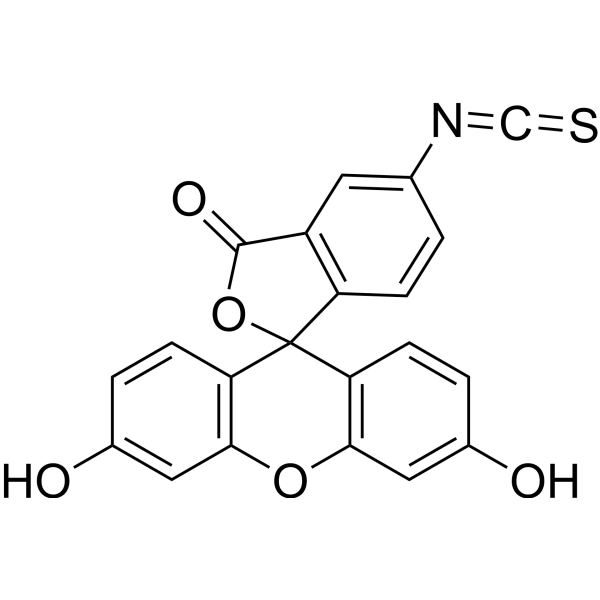
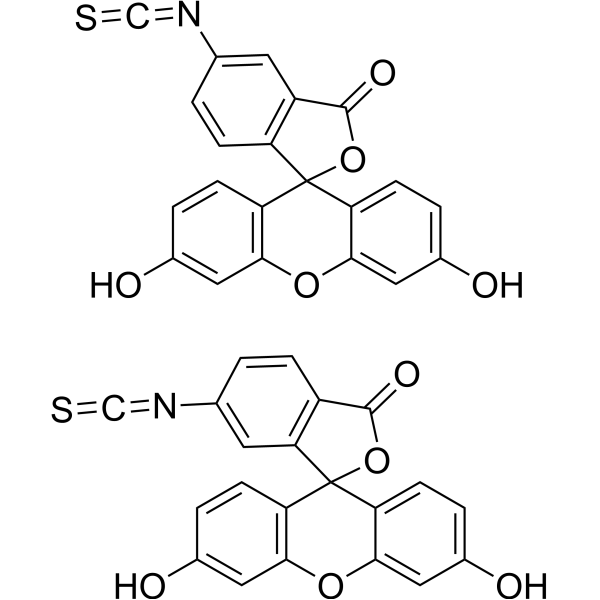
FITC (Fluorescein Isothiocyanate), is one of the green fluorescein derivatives widely used in biology. FITC has the characteristics of high absorptivity and excellent fluorescence quantum yield. The isothiocyanate group of FITC can be combined with amino, sulfhydryl, imidazole, tyrosyl, carbonyl and other groups on the protein, so as to achieve protein labeling including antibodies and lectins. In addition to its use as a protein marker, FITC can also be used as a fluorescent protein tracer to rapidly identify pathogens by labeling antibodies, or for microsequencing of proteins and peptides (HPLC). The maximum excitation wavelength of FITC is 494 nm. Once excited, it fluoresces yellow-green at a maximum emission wavelength of 520 nm. In addition, FITC is also a hapten that can induce contact hypersensitivity (CHS) and induce an atopic dermatitis model .
|
-
- HY-D2038
-
|
|
Fluorescent Dye
|
Others
|
|
ATTO 550 alkyne is a new fluorescent marker based on the Rhodamine structure. It has strong absorption, high fluorescence quantum yield, high thermal stability and photochemical stability, and is suitable for single molecule detection and high-resolution microscopy. ATTO 550 alkyne is an alkyne derivative of ATTO 550 and can be used to label proteins or antibodies.
|
-
- HY-D1961
-
|
|
Fluorescent Dye
|
Others
|
|
ATTO 565 maleimide is a new fluorescent marker based on the Rhodamine structure. It has strong absorption, high fluorescence quantum yield, high thermal stability and photochemical stability, and is suitable for single molecule detection and high-resolution microscopy. ATTO 565 maleimide is a maleimide derivative of ATTO 565, which can be used to label proteins or antibodies.
|
-
- HY-D2046
-
|
|
Fluorescent Dye
|
Others
|
|
ATTO 532 NHS ester is a new fluorescent marker based on the Rhodamine structure. It has strong absorption, high fluorescence quantum yield, high thermal stability and photochemical stability, and is suitable for single molecule detection and high-resolution microscopy. ATTO 532 NHS ester is an NHS ester derivative of ATTO 532 that can be used to label proteins or antibodies.
|
-
- HY-D1957
-
|
|
Fluorescent Dye
|
Others
|
|
ATTO 633 NHS ester is a new fluorescent marker based on the Rhodamine structure. It has strong absorption, high fluorescence quantum yield, high thermal stability and photochemical stability, and is suitable for single molecule detection and high-resolution microscopy. ATTO 633 NHS ester is an NHS ester derivative of ATTO 633 that can be used to label proteins or antibodies.
|
-
- HY-D2019
-
|
|
Fluorescent Dye
|
Others
|
|
ATTO 550 NHS ester is a new fluorescent marker based on the Rhodamine structure. It has strong absorption, high fluorescence quantum yield, high thermal stability and photochemical stability, and is suitable for single molecule detection and high-resolution microscopy. ATTO 550 NHS ester is an NHS ester derivative of ATTO 550 that can be used to label proteins or antibodies.
|
-
- HY-153524
-
|
|
Fluorescent Dye
|
Others
|
|
ATTO 425 NHS ester is a new fluorescent marker based on the Rhodamine structure. It has strong absorption, high fluorescence quantum yield, high thermal stability and photochemical stability, and is suitable for single molecule detection and high-resolution microscopy. ATTO 425 NHS ester is an NHS ester derivative of ATTO 425 that can be used to label proteins or antibodies.
|
-
- HY-D1929
-
|
|
Fluorescent Dye
|
Others
|
|
ATTO 594 NHS ester is a new fluorescent marker based on the Rhodamine structure. It has strong absorption, high fluorescence quantum yield, high thermal stability and photochemical stability, and is suitable for single molecule detection and high-resolution microscopy. ATTO 594 NHS ester is an NHS ester derivative of ATTO 594 that can be used to label proteins or antibodies.
|
-
- HY-D2014
-
|
|
Fluorescent Dye
|
Others
|
|
ATTO 565 alkyne is a new fluorescent marker based on the Rhodamine structure. It has strong absorption, high fluorescence quantum yield, high thermal stability and photochemical stability, and is suitable for single molecule detection and high-resolution microscopy. ATTO 565 alkyne is an alkyne derivative of ATTO 565 and can be used to label proteins or antibodies.
|
-
- HY-D2035
-
|
|
Fluorescent Dye
|
Others
|
|
ATTO 514 alkyne is a new fluorescent marker based on the Rhodamine structure. It has strong absorption, high fluorescence quantum yield, high thermal stability and photochemical stability, and is suitable for single molecule detection and high-resolution microscopy. ATTO 514 alkyne is an alkyne derivative of ATTO 514 and can be used to label proteins or antibodies.
|
-
- HY-110213
-
|
|
Fluorescent Dye
|
Others
|
|
BODIPY 630/650X is a red fluorescent dye that targets amine groups. BODIPY 630/650X displays excitation/emission maxima of 630/650 nm, respectively. BODIPY 630/650X can be used to covalently label proteins, antibodies, or other amine-containing biomolecules for detection and imaging .
|
-
- HY-15940
-
|
5(6)-FAM; 5-(and-6)-Carboxyfluorescein mixed isomers
|
Fluorescent Dye
|
Cancer
|
|
5(6)-Carboxyfluorescein (5(6)-FAM) is an amine-reactive pH-sensitive green fluorescent probe. 5(6)-Carboxyfluorescein (5(6)-FAM) can be used to label proteins, peptides and nucleotides. 5(6)-Carboxyfluorescein can be used for the detection of tumour areas in vivo .
|
-
- HY-D2047
-
|
|
Fluorescent Dye
|
Others
|
|
ATTO 532 maleimide is a new fluorescent marker based on the Rhodamine structure. It has strong absorption, high fluorescence quantum yield, high thermal stability and photochemical stability, and is suitable for single molecule detection and high-resolution microscopy. ATTO 532 maleimide is a maleimide derivative of ATTO 532, which can be used to label proteins or antibodies.
|
-
- HY-D2016
-
|
|
Fluorescent Dye
|
Others
|
|
ATTO 565 cadaverine is a new fluorescent marker based on the Rhodamine structure. It has strong absorption, high fluorescence quantum yield, high thermal stability and photochemical stability, and is suitable for single molecule detection and high-resolution microscopy. ATTO 565 cadaverine is a cadaverine derivative of ATTO 565, which can be used to label proteins or antibodies.
|
-
- HY-D1959
-
|
|
Fluorescent Dye
|
Others
|
|
ATTO 565 NHS ester is a new fluorescent marker based on the Rhodamine structure. It has strong absorption, high fluorescence quantum yield, high thermal stability and photochemical stability, and is suitable for single molecule detection and high-resolution microscopy. ATTO 565 NHS ester is an NHS ester derivative of ATTO 565 that can be used to label proteins or antibodies.
|
-
- HY-D1939
-
|
|
Fluorescent Dye
|
Others
|
|
ATTO 465 amine is a new fluorescent marker based on the Rhodamine structure. It has strong absorption, high fluorescence quantum yield, high thermal stability and photochemical stability, and is suitable for single molecule detection and high-resolution microscopy. ATTO 465 amine is an amine derivative of ATTO 465 and can be used to label proteins or antibodies.
|
-
- HY-D2063
-
|
|
Fluorescent Dye
|
Others
|
|
ATTO 740 maleimide is a new fluorescent marker based on the Rhodamine structure. It has strong absorption, high fluorescence quantum yield, high thermal stability and photochemical stability, and is suitable for single molecule detection and high-resolution microscopy. ATTO 740 maleimide is a maleimide derivative of ATTO 740, which can be used to label proteins or antibodies.
|
-
- HY-D2015
-
|
|
Fluorescent Dye
|
Others
|
|
ATTO 488 alkyne is a new fluorescent marker based on the Rhodamine structure. It has strong absorption, high fluorescence quantum yield, high thermal stability and photochemical stability, and is suitable for single molecule detection and high-resolution microscopy. ATTO 488 alkyne is an alkyne derivative of ATTO 488 and can be used to label proteins or antibodies.
|
-
- HY-D1933
-
|
|
Fluorescent Dye
|
Others
|
|
ATTO 590 maleimide is a new fluorescent marker based on the Rhodamine structure. It has strong absorption, high fluorescence quantum yield, high thermal stability and photochemical stability, and is suitable for single molecule detection and high-resolution microscopy. ATTO 590 maleimide is a maleimide derivative of ATTO 590, which can be used to label proteins or antibodies.
|
-
- HY-D2059
-
|
|
Fluorescent Dye
|
Others
|
|
ATTO 700 maleimide is a new fluorescent marker based on the Rhodamine structure. It has strong absorption, high fluorescence quantum yield, high thermal stability and photochemical stability, and is suitable for single molecule detection and high-resolution microscopy. ATTO 700 maleimide is a maleimide derivative of ATTO 700, which can be used to label proteins or antibodies.
|
-
- HY-D2058
-
|
|
Fluorescent Dye
|
Others
|
|
ATTO 700 NHS ester is a new fluorescent marker based on the Rhodamine structure. It has strong absorption, high fluorescence quantum yield, high thermal stability and photochemical stability, and is suitable for single molecule detection and high-resolution microscopy. ATTO 700 NHS ester is an NHS ester derivative of ATTO 700 that can be used to label proteins or antibodies.
|
-
- HY-N16316
-
|
|
Fluorescent Dye
|
Others
|
|
Meso-Cl cyanine 7 free acid chloride is a Meso-Cl cyanine fluorescent dye. Meso-Cl cyanine 7 free acid chloride can be used for labelling amine groups such as those on antibodies, nucleic acids, and proteins and can be detected using a variety of fluorescence detection techniques such as microscopy and flow cytometry (Ex/Em = 778/805 nm) .
|
-
- HY-D2026
-
|
|
Fluorescent Dye
|
Others
|
|
ATTO 514 NHS ester is a new fluorescent marker based on the Rhodamine structure. It has strong absorption, high fluorescence quantum yield, high thermal stability and photochemical stability, and is suitable for single molecule detection and high-resolution microscopy. ATTO 514 NHS ester is an NHS ester derivative of ATTO 514 that can be used to label proteins or antibodies.
|
-
- HY-D1999
-
|
|
Fluorescent Dye
|
Others
|
|
ATTO 665 NHS ester is a new fluorescent marker based on the Rhodamine structure. It has strong absorption, high fluorescence quantum yield, high thermal stability and photochemical stability, and is suitable for single molecule detection and high-resolution microscopy. ATTO 665 NHS ester is an NHS ester derivative of ATTO 665 that can be used to label proteins or antibodies.
|
-
- HY-D1932
-
|
|
Fluorescent Dye
|
Others
|
|
ATTO 590 NHS ester is a new fluorescent marker based on the Rhodamine structure. It has strong absorption, high fluorescence quantum yield, high thermal stability and photochemical stability, and is suitable for single molecule detection and high-resolution microscopy. ATTO 590 NHS ester is an NHS ester derivative of ATTO 590 that can be used to label proteins or antibodies.
|
-
- HY-D2073
-
|
|
Fluorescent Dye
|
Others
|
|
ATTO 680 NHS ester is a new fluorescent marker based on the Rhodamine structure. It has strong absorption, high fluorescence quantum yield, high thermal stability and photochemical stability, and is suitable for single molecule detection and high-resolution microscopy. ATTO 680 NHS ester is an NHS ester derivative of ATTO 680 that can be used to label proteins or antibodies.
|
-
- HY-D2074
-
|
|
Fluorescent Dye
|
Others
|
|
ATTO 680 maleimide is a new fluorescent marker based on the Rhodamine structure. It has strong absorption, high fluorescence quantum yield, high thermal stability and photochemical stability, and is suitable for single molecule detection and high-resolution microscopy. ATTO 680 maleimide is a maleimide derivative of ATTO 680, which can be used to label proteins or antibodies.
|
-
- HY-D2021
-
|
|
Fluorescent Dye
|
Others
|
|
ATTO 550 maleimide is a new fluorescent marker based on the Rhodamine structure. It has strong absorption, high fluorescence quantum yield, high thermal stability and photochemical stability, and is suitable for single molecule detection and high-resolution microscopy. ATTO 550 maleimide is a maleimide derivative of ATTO 550, which can be used to label proteins or antibodies.
|
-
- HY-D1917
-
|
|
Fluorescent Dye
|
Others
|
|
ATTO 390 NHS ester is a new fluorescent marker based on the Rhodamine structure. It has strong absorption, high fluorescence quantum yield, high thermal stability and photochemical stability, and is suitable for single molecule detection and high-resolution microscopy. ATTO 390 NHS ester is an NHS ester derivative of ATTO 390 that can be used to label proteins or antibodies.
|
-
- HY-D2052
-
|
|
Fluorescent Dye
|
Others
|
|
ATTO 532 iodacetamid is a new fluorescent marker based on the Rhodamine structure. It has strong absorption, high fluorescence quantum yield, high thermal stability and photochemical stability, and is suitable for single molecule detection and high-resolution microscopy. ATTO 532 iodacetamid is an iodoacetamide derivative of ATTO 532, which can be used to label proteins or antibodies.
|
-
- HY-D2001
-
|
|
Fluorescent Dye
|
Others
|
|
ATTO 488 NHS ester is a new fluorescent marker based on the Rhodamine structure. It has strong absorption, high fluorescence quantum yield, high thermal stability and photochemical stability, and is suitable for single molecule detection and high-resolution microscopy. ATTO 488 NHS ester is an NHS ester derivative of ATTO 488 that can be used to label proteins or antibodies.
|
-
- HY-D1935
-
|
|
Fluorescent Dye
|
Others
|
|
ATTO 465 NHS ester is a new fluorescent marker based on the Rhodamine structure. It has strong absorption, high fluorescence quantum yield, high thermal stability and photochemical stability, and is suitable for single molecule detection and high-resolution microscopy. ATTO 465 NHS ester is an NHS ester derivative of ATTO 465 that can be used to label proteins or antibodies.
|
-
- HY-D1946
-
|
|
Fluorescent Dye
|
Others
|
|
ATTO 590 alkyne is a new fluorescent marker based on the Rhodamine structure. It has strong absorption, high fluorescence quantum yield, high thermal stability and photochemical stability, and is suitable for single molecule detection and high-resolution microscopy. ATTO 590 alkyne is an alkyne derivative of ATTO 590 and can be used to label proteins or antibodies.
|
-
- HY-66020
-
6-FITC
1 Publications Verification
6-Fluorescein Isothiocyanate
|
Fluorescent Dye
Drug Isomer
|
Others
|
|
6-FITC (6-Fluorescein Isothiocyanate) is a fluorescein isomer and also serves as a fluorescent label for biomolecules (FITC isomers have similar excitation/emission wavelengths, which are 495 nm/519 nm in fluorescence detection) .
|
-
- HY-D1506
-
|
|
Fluorescent Dye
|
Others
|
|
Fl-DIBO (fluorogenic dibenzocyclooctyne) is a selective and high sensitivity fluorescent probe to azide compounds. Fl-DIBO can react rapidly with azide compounds to form new highly fluorescent products with a maximum emission wavelength of 469 nm and excitation wavelength of 363 nm. Fl-DIBO can be used to label diazo-tagged proteins without detectable background signal interference . Fl-DIBO is a click chemistry reagent, it contains an Alkyne group and can undergo copper-catalyzed azide-alkyne cycloaddition (CuAAc) with molecules containing Azide groups.
|
-
- HY-N16307
-
|
|
Fluorescent Dye
|
Others
|
|
Meso-Cl cyanine 7.5 free acid chloride is a Meso-Cl cyanine fluorescent dye. Meso-Cl cyanine 7.5 free acid chloride can be used for labelling amine groups such as those on antibodies, nucleic acids, and proteins and can be detected using a variety of fluorescence detection techniques such as microscopy and flow cytometry (Ex/Em = 815/825 nm) .
|
-
- HY-D2001A
-
|
|
Fluorescent Dye
|
Others
|
|
TTO 488 NHS ester TEA is a new fluorescent marker based on the Rhodamine structure. It has strong absorption, high fluorescence quantum yield, high thermal stability and photochemical stability, and is suitable for single molecule detection and high-resolution microscopy. TTO 488 NHS ester TEA is an NHS ester derivative of ATTO 488 that can be used to label proteins or antibodies.
|
-
- HY-153845
-
|
|
Biochemical Assay Reagents
|
Others
|
|
RNA Aptamer Broccoli sodium is a 49-nucleotide nucleic acid aptamer that is much shorter than Spinach and Spinach2. It exhibits bright green fluorescence when binding to DFHBI or DFHBI-1T (a soluble analog of the green fluorescent protein label). RNA Aptamer Broccoli sodium can be used for RNA expression or localization in living cells .
|
-
- HY-D1596A
-
|
Cy3.5 NHS ester bromide; Cy 3.5 bromide
|
Fluorescent Dye
|
Others
|
|
Cyanine 3.5 bromide (Cy3.5 NHS ester bromide) is an analog of the Cy3.5 fluorophore. Cyanine 3.5 bromide is a red reactive fluorescent dye. Cyanine 3.5 bromide is used to label amino groups in peptides, proteins, and oligonucleotides. (λex=591 nm, λem=604 nm) .
|
-
- HY-158450
-
|
FA2G2 N-linked oligosaccharide, 2-AB labelled; F(6)A2G2, 2-AB labelled
|
Biochemical Assay Reagents
|
Others
|
|
FA2G2 glycan (G2F), 2-AB labelled (FA2G2 N-linked oligosaccharide, 2-AB labelled; F(6)A2G2, 2-AB labelled) is a N-polysaccharide protein and a multifunctional fluorescent linker. The resulting conjugates exhibit high sensitivity and specificity by mimicking the antennal elements of N-glycans .
|
-
- HY-D2930
-
|
SNAP-SS-SulfoCy5
|
Fluorescent Dye
|
Others
|
|
BG-SS-SulfoCy5 (SNAP-SS-SulfoCy5) is a SulfoCy5-labeled SNAP tag fluorescent probe, linked by a disulfide bond. BG-SS-SulfoCy5 combines the specific recognition of SNAP-tag, the cleavability of disulfide bond, and the excellent optical properties of SulfoCy5. BG-SS-SulfoCy5 can be used for tracking the internalization of cell surface proteins and multiple labeling experiments .
|
-
- HY-158510
-
|
A2G2S2 N-linked oligosaccharide, APTS labelled; A2G(4)2S(6)2 glycan, APTS labelled
|
Biochemical Assay Reagents
|
Others
|
|
A2G2S2 glycan (G2S2), APTS labelled (A2G2S2 N-linked oligosaccharide, APTS labelled; A2G(4)2S(6)2 glycan, APTS labelled) is a N-polysaccharide protein and a multifunctional fluorescent linker. The resulting conjugates exhibit high sensitivity and specificity by mimicking the antennal elements of N-glycans .
|
-
- HY-D1794
-
|
VF 405 SE
|
Fluorescent Dye
|
Others
|
|
Vari Fluor 405 SE (VF 405 SE) is a dye marker of the Vari Fluor SE series (Ex/Em=399 nm/421 nm). The Vari Fluor SE series of dyes are a class of fluorescent dyes containing NHS ester groups used to label free amines (-NHX) on antibodies, proteins, peptides, amine-modified oligonucleotides and other biomolecules.
|
-
- HY-D1791
-
|
VF 750 SE
|
Fluorescent Dye
|
Others
|
|
Vari Fluor 750 SE (VF 750 SE) is a dye marker of the Vari Fluor SE series (Ex/Em=747 nm/770 nm). The Vari Fluor SE series of dyes are a class of fluorescent dyes containing NHS ester groups used to label free amines (-NHX) on antibodies, proteins, peptides, amine-modified oligonucleotides and other biomolecules.
|
-
- HY-D2891
-
|
|
Fluorescent Dye
|
Others
|
|
5-TAMRA-DBCO is a fluorescent dye that combines 5-TAMRA (HY-15942) with a dibenzocyclooctyne (DBCO) moiety. 5-TAMRA-DBCO is able to copper-free click chemistry reactions with azide-functionalized molecules. 5-TAMRA-DBCO can be used for labeling proteins, peptides, nucleic acids (Ex/Em = 541/567 nm) .
|
-
- HY-D1797
-
|
VF 660 SE
|
Fluorescent Dye
|
Others
|
|
Vari Fluor 660 SE (VF 660 SE) is a dye marker of the Vari Fluor SE series (Ex/Em=660 nm/679 nm). The Vari Fluor SE series of dyes are a class of fluorescent dyes containing NHS ester groups used to label free amines (-NHX) on antibodies, proteins, peptides, amine-modified oligonucleotides and other biomolecules.
|
-
- HY-D1802
-
|
VF 425 SE
|
Fluorescent Dye
|
Others
|
|
Vari Fluor 425 SE (VF 425 SE) is a dye marker of the Vari Fluor SE series (Ex/Em=430 nm/475 nm). The Vari Fluor SE series of dyes are a class of fluorescent dyes containing NHS ester groups used to label free amines (-NHX) on antibodies, proteins, peptides, amine-modified oligonucleotides and other biomolecules.
|
-
- HY-D1800
-
|
VF 680 SE
|
Fluorescent Dye
|
Others
|
|
Vari Fluor 680 SE (VF 680 SE) is a dye marker of the Vari Fluor SE series (Ex/Em=680 nm/700 nm). The Vari Fluor SE series of dyes are a class of fluorescent dyes containing NHS ester groups used to label free amines (-NHX) on antibodies, proteins, peptides, amine-modified oligonucleotides and other biomolecules.
|
-
- HY-D1792
-
|
VF 555 SE
|
Fluorescent Dye
|
Others
|
|
Vari Fluor 555 SE (VF 555 SE) is a dye marker of the Vari Fluor SE series (Ex/Em=550 nm/561 nm). The Vari Fluor SE series of dyes are a class of fluorescent dyes containing NHS ester groups used to label free amines (-NHX) on antibodies, proteins, peptides, amine-modified oligonucleotides and other biomolecules.
|
-
- HY-D1790
-
|
VF 640 SE
|
Fluorescent Dye
|
Others
|
|
Vari Fluor 640 SE (VF 640 SE) is a dye marker of the Vari Fluor SE series (Ex/Em=648 nm/664 nm). The Vari Fluor SE series of dyes are a class of fluorescent dyes containing NHS ester groups used to label free amines (-NHX) on antibodies, proteins, peptides, amine-modified oligonucleotides and other biomolecules.
|
-
- HY-D1803
-
|
VF 565 SE
|
Fluorescent Dye
|
Others
|
|
Vari Fluor 565 SE (VF 565 SE) is a dye marker of the Vari Fluor SE series (Ex/Em=563 nm/594 nm). The Vari Fluor SE series of dyes are a class of fluorescent dyes containing NHS ester groups used to label free amines (-NHX) on antibodies, proteins, peptides, amine-modified oligonucleotides and other biomolecules.
|
-
- HY-D1607
-
|
|
Fluorescent Dye
|
Others
|
|
BODIPY FL SSE is a potent fluorescent dye. BODIPY FL SSE is used to label the primary amines (R-NH2) of proteins, amine-modified oligonucleotides, and other amine-containing molecules. BODIPY FL SSE can reactive with primary amines on biomolecules to emit green fluorescence. (λex=502 nm, λem=511 nm) .
|
-
- HY-D1798
-
|
VF 350 SE
|
Fluorescent Dye
|
Others
|
|
Vari Fluor 350 SE (VF 350 SE) is a dye marker of the Vari Fluor SE series (Ex/Em=350 nm/448 nm). The Vari Fluor SE series of dyes are a class of fluorescent dyes containing NHS ester groups used to label free amines (-NHX) on antibodies, proteins, peptides, amine-modified oligonucleotides and other biomolecules.
|
-
- HY-D1796
-
|
VF 594 SE
|
Fluorescent Dye
|
Others
|
|
Vari Fluor 594 SE (VF 594 SE) is a dye marker of the Vari Fluor SE series (Ex/Em=585 nm/609 nm). The Vari Fluor SE series of dyes are a class of fluorescent dyes containing NHS ester groups used to label free amines (-NHX) on antibodies, proteins, peptides, amine-modified oligonucleotides and other biomolecules.
|
-
- HY-D1801
-
|
VF 488 SE
|
Fluorescent Dye
|
Others
|
|
Vari Fluor 488 SE (VF 488 SE) is a dye marker of the Vari Fluor SE series (Ex/Em=488 nm/513 nm). The Vari Fluor SE series of dyes are a class of fluorescent dyes containing NHS ester groups used to label free amines (-NHX) on antibodies, proteins, peptides, amine-modified oligonucleotides and other biomolecules.
|
-
- HY-D1351
-
|
Sulfo-Cy5.5 maleimide potassium
|
Fluorescent Dye
|
Others
|
|
Sulfo-Cyanine5.5 maleimide (Sulfo-Cy5.5 maleimide) potassium is a fluorescent dye. Sulfo-Cyanine5.5 is a nearinfrared (NIR) fluorophore with excitation maximum 675 nm and emission maximum 694 nm. Sulfo-Cyanine5.5 maleimide potassium can be used for the labeling of sensitive proteins, nanoparticles, and highly hydrophylic biopolymers .
|
-
- HY-D1795
-
|
VF 532 SE
|
Fluorescent Dye
|
Others
|
|
Vari Fluor 532 SE (VF 532 SE) is a dye marker of the Vari Fluor SE series (Ex/Em=532 nm/545 nm). The Vari Fluor SE series of dyes are a class of fluorescent dyes containing NHS ester groups used to label free amines (-NHX) on antibodies, proteins, peptides, amine-modified oligonucleotides and other biomolecules.
|
-
- HY-D2940
-
|
SiR650-BG
|
Fluorescent Dye
|
Others
|
SiR-SNAP (SiR650-BG) is a SiR-labeled SNAP tag near-infrared fluorescent probe (Ex/Em: 645 nm/661 nm). SiR-SNAP combines excellent optical properties, good cell membrane permeability, and environmentally sensitive fluorescence characteristics, providing a powerful tool for the dynamic study of proteins in living cells .
|
-
- HY-D1799
-
|
VF 568 SE
|
Fluorescent Dye
|
Others
|
|
Vari Fluor 568 SE (VF 568 SE) is a dye marker of the Vari Fluor SE series (Ex/Em=573 nm/595 nm). The Vari Fluor SE series of dyes are a class of fluorescent dyes containing NHS ester groups used to label free amines (-NHX) on antibodies, proteins, peptides, amine-modified oligonucleotides and other biomolecules.
|
-
- HY-137042
-
|
Alkyne-Cy5
|
Oxidative Phosphorylation
Mitochondrial Metabolism
|
Cancer
|
|
Cyanine5 alkyne (Alkyne-Cy5) is a fluorescent dye used to label azide proteins and can be used to analyse post-translational modifications of proteins, glycosylation etc. Cyanine5 alkyne can also be used as a mitochondrial OXPHOS inhibitor to inhibit the growth of cancer stem cells (CSC) . Cyanine5 alkyne is a click chemistry reagent, it contains an Alkyne group and can undergo copper-catalyzed azide-alkyne cycloaddition (CuAAc) with molecules containing Azide groups.
|
-
- HY-D3325
-
|
|
Fluorescent Dye
|
Others
|
|
AF 700 NHS ester is a fluorescent dye AF 700 derivative exhibits high fluorescence quantum yield and high photostability. AF 700 NHS ester can form an ester bond with ammonia via the NHS group, and can be used to label proteins, amine-modified oligonucleotides, and other primary amines (R-NH2) containing amine molecules (Ex/Em = 702/723 nm).
|
-
- HY-D3258
-
|
|
Fluorescent Dye
|
Others
|
|
AF 660 NHS ester is a fluorescent dye AF 660 derivative exhibits high fluorescence quantum yield and high photostability. AF 660 NHS ester can form an ester bond with ammonia via the NHS group, and can be used to label proteins, amine-modified oligonucleotides, and other primary amines (R-NH2) containing amine molecules (Ex/Em = 668/698 nm).
|
-
- HY-D3257
-
|
|
Fluorescent Dye
|
Others
|
|
AF 546 NHS ester is a fluorescent dye AF 546 derivative exhibits high fluorescence quantum yield and high photostability. AF 546 NHS ester can form an ester bond with ammonia via the NHS group, and can be used to label proteins, amine-modified oligonucleotides, and other primary amines (R-NH2) containing amine molecules (Ex/Em = 554/570 nm).
|
-
- HY-D3259
-
|
|
Fluorescent Dye
|
Others
|
|
AF 680 NHS ester is a fluorescent dye AF 680 derivative exhibits high fluorescence quantum yield and high photostability. AF 680 NHS ester can form an ester bond with ammonia via the NHS group, and can be used to label proteins, amine-modified oligonucleotides, and other primary amines (R-NH2) containing amine molecules (Ex/Em = 684/707 nm).
|
-
- HY-D3326
-
|
|
Fluorescent Dye
|
Others
|
|
AF 750 NHS ester is a fluorescent dye AF 750 derivative exhibits high fluorescence quantum yield and high photostability. AF 750 NHS ester can form an ester bond with ammonia via the NHS group, and can be used to label proteins, amine-modified oligonucleotides, and other primary amines (R-NH2) containing amine molecules (Ex/Em = 753/782 nm).
|
-
- HY-D3323
-
|
|
Fluorescent Dye
|
Others
|
|
AF 350 NHS ester is a fluorescent dye AF 350 derivative exhibits high fluorescence quantum yield and high photostability. AF 350 NHS ester can form an ester bond with ammonia via the NHS group, and can be used to label proteins, amine-modified oligonucleotides, and other primary amines (R-NH2) containing amine molecules (Ex/Em = 346/445 nm) .
|
-
- HY-D3256
-
|
|
Fluorescent Dye
|
Others
|
|
AF 532 NHS ester is a fluorescent dye AF 532 derivative exhibits high fluorescence quantum yield and high photostability. AF 532 NHS ester can form an ester bond with ammonia via the NHS group, and can be used to label proteins, amine-modified oligonucleotides, and other primary amines (R-NH2) containing amine molecules (Ex/Em = 530/555 nm).
|
-
- HY-158517
-
|
FA2G2S2 N-linked oligosaccharide, APTS labelled; F(6)A2G(4)2S(6)2 glycan, APTS labelled
|
Biochemical Assay Reagents
|
Others
|
|
FA2G2S2 glycan (G2FS2), APTS labelled (FA2G2S2 N-linked oligosaccharide, APTS labelled; F(6)A2G(4)2S(6)2 glycan, APTS labelled) is a N-polysaccharide protein and a multifunctional fluorescent linker. The resulting conjugates exhibit high sensitivity and specificity by mimicking the antennal elements of N-glycans .
|
-
- HY-DY1007
-
|
|
Fluorescent Dye
|
Inflammation/Immunology
|
FITC (Fluorescein Isothiocyanate) (solution) , is one of the green fluorescein derivatives widely used in biology. FITC has the characteristics of high absorptivity and excellent fluorescence quantum yield. The isothiocyanate group of FITC can be combined with amino, sulfhydryl, imidazole, tyrosyl, carbonyl and other groups on the protein, so as to achieve protein labeling including antibodies and lectins. In addition to its use as a protein marker, FITC can also be used as a fluorescent protein tracer to rapidly identify pathogens by labeling antibodies, or for microsequencing of proteins and peptides (HPLC). The maximum excitation wavelength of FITC is 494 nm. Once excited, it fluoresces yellow-green at a maximum emission wavelength of 520 nm. In addition, FITC is also a hapten that can induce contact hypersensitivity (CHS) and induce an atopic dermatitis model . Solvent and concentration: DMSO: 20 mM The 1 mL volume is defined as the base specification. All larger sizes correspond to incremental volumes of this base.
|
-
- HY-138658
-
|
JF526, SE; JF526, NHS
|
Fluorescent Dye
|
Others
|
|
Janelia Fluor 526, SE (JF526,SE) is a fluorogenic yellow fluorescent dye that contains NHS ester group. JF526 is a versatile scaffold for fluorogenic ligands, including labels for genetically encoded self-labeling protein tags and stains for endogenous structures . Janelia Fluor products are licensed under U.S. Pat. Nos. 9,933,417, 10,018,624 and 10,161,932 and other patents from Howard Hughes Medical Institute.
|
-
- HY-15941
-
|
Fluorescein 5(6)-isothiocyanate; Fluorescein isothiocyanate 5- and 6- isomers
|
Fluorescent Dye
|
Others
|
|
5(6)-FITC (Fluorescein 5(6)-isothiocyanate) is an amine-reactive derivative of a fluorescent dye, characterized by high absorbance and excellent fluorescence quantum yield. The isothiocyanate group of FITC can react with various functional groups on proteins, including amines, thiols, imidazoles, tyrosines and carbonyls, enabling the labeling of proteins such as antibodies and lectins. 5(6)-FITC has a wide range of applications, including flow cytometry, immunofluorescence, protease assays and conjugation. The maximum excitation/emission wavelengths are 492/518 nm .
|
-
- HY-156404
-
PM-1
2 Publications Verification
|
Fluorescent Dye
|
Others
|
|
PM-1, a derivative of Thioflavin-T (ThT; HY-D0218), is a small but highly specific plasma membrane (PM) fluorescent dye for specific and long-time membrane imaging of living and fixed cells. PM-1 is embedded directly into the cell membrane and exhibits a very long retention time on the plasma membrane with a half-life of approximately 15 h. PM-1 can be used in combination with protein labeling probes to study ectodomain shedding and endocytosis processes of cell surface proteins .
|
-
- HY-D2773
-
|
|
Fluorescent Dye
|
Others
|
|
5-Carboxyrhodamine 110 NHS Ester is the nonsulfonated analog of the BP Fluor 488 dye. The amine-reactive 5(6)-Carboxyrhodamine 110 NHS Ester can be used to create bright and photostable green-fluorescent bioconjugates with excitation/emission maxima ~502/527 nm. For many applications, the dye is preferred over 5-(6)-carboxyfluorescein NHS ester or FITC because of its exceptional photostability and fluorescence insensitivity to pH (4-9).
Although the mixed isomers of Carboxyrhodamine 110 NHS Ester preferred, routinely used fluorescent dye for labeling proteins, peptides and nucleotides, purification of peptide and nucleotides labeled with 5(6) isomers might be troublesome due to significant signal broadening in HPLC purification. Peptides and nucleotides labeled with a single isomer usually give better resolution in HPLC purification that is often required in the conjugation processes.
|
-
- HY-D2919
-
|
|
Fluorescent Dye
|
Infection
|
|
DMN-Tre is a conjugate of a solvatochromic fluorescent dye and trehalose. DMN-Tre takes advantage of the substrate promiscuity of the endogenous antigen 85 protein complex in mycobacteria to be metabolically integrated into the hydrophobic mycobacterial membrane. Once entering this hydrophobic environment, the linked DMN dye fluorescence is "turned on", enabling specific labeling . DMN-Tre can be used to reflect bacterial metabolic activity and support physiological studies of Mycobacterium tuberculosis .
|
-
- HY-158508
-
|
A2G2S2 N-linked oligosaccharide, 2-AA labelled; A2G(4)2S(6)2 glycan, 2-AA labelled
|
Biochemical Assay Reagents
|
Others
|
|
A2G2S2 glycan (G2S2), 2-AA labelled (A2G2S2 N-linked oligosaccharide, 2-AA labelled; A2G(4)2S(6)2 glycan, 2-AA labelled) is a N-polysaccharide protein and a multifunctional fluorescent linker. The resulting conjugates exhibit high sensitivity and specificity by mimicking the antennal elements of N-glycans .
|
-
- HY-158512
-
|
A2G2S2 N-linked oligosaccharide, 2-AB labelled; A2G(4)2S(6)2 glycan, 2-AB labelled
|
Biochemical Assay Reagents
|
Others
|
|
A2G2S2 glycan (G2S2), 2-AB labelled (A2G2S2 N-linked oligosaccharide, 2-AB labelled; A2G(4)2S(6)2 glycan, 2-AB labelled) is a N-polysaccharide protein and a multifunctional fluorescent linker. The resulting conjugates exhibit high sensitivity and specificity by mimicking the antennal elements of N-glycans .
|
-
- HY-158515
-
|
FA2G2S2 N-linked oligosaccharide, 2-AB labelled; F(6)A2G(4)2S(6)2 glycan, 2-AB labelled
|
Biochemical Assay Reagents
|
Others
|
|
FA2G2S2 glycan (G2FS2), 2-AB labelled (FA2G2S2 N-linked oligosaccharide, 2-AB labelled; F(6)A2G(4)2S(6)2 glycan, 2-AB labelled) is a N-polysaccharide protein and a multifunctional fluorescent linker. The resulting conjugates exhibit high sensitivity and specificity by mimicking the antennal elements of N-glycans .
|
-
- HY-158518
-
|
FA2G2S2 N-linked oligosaccharide, 2-AA labelled; F(6)A2G(4)2S(6)2 glycan, 2-AA labelled
|
Biochemical Assay Reagents
|
Others
|
|
FA2G2S2 glycan (G2FS2), 2-AA labelled (FA2G2S2 N-linked oligosaccharide, 2-AA labelled; F(6)A2G(4)2S(6)2 glycan, 2-AA labelled) is a N-polysaccharide protein and a multifunctional fluorescent linker. The resulting conjugates exhibit high sensitivity and specificity by mimicking the antennal elements of N-glycans .
|
-
- HY-158480
-
|
FA2[3]G1 & FA2[6]G1 N-linked oligosaccharide, procainamide labelled
|
Biochemical Assay Reagents
|
Others
|
|
FA2[3]G1 & FA2[6]G1 glycan (G1F), procainamide labelled (FA2[3]G1 & FA2[6]G1 N-linked oligosaccharide, procainamide labelled) is a N-polysaccharide protein and a multifunctional fluorescent linker. The resulting conjugates exhibit high sensitivity and specificity by mimicking the antennal elements of N-glycans .
|
-
- HY-W800775
-
|
|
Fluorescent Dye
|
Others
|
|
BP Fluor 647 Alkyne is a bright green-fluorescent dye optimal for use with the 633, 650 nm Argon laser. The alkyne group can react with azides via copper catalyzed Click Chemistry reactions. The dye is water soluble and pH-insensitive from pH 4 to pH 10. The dye has 4 sulfonate groups which make it highly water soluble and cause less aggregation in the aqueous solution. BP Fluor 647 Alkyne is used for protein and antibody labeling, or nucleic acid applications with high labeling density.
|
-
- HY-158479
-
|
FA2[3]G1 & FA2[6]G1 N-linked oligosaccharide, APTS labelled
|
Biochemical Assay Reagents
|
Others
|
|
FA2[3]G1 & FA2[6]G1 glycan (G1F), APTS labelled (FA2[3]G1 & FA2[6]G1 N-linked oligosaccharide, APTS labelled) is a N-polysaccharide protein and a multifunctional fluorescent linker. The resulting conjugates exhibit high sensitivity and specificity by mimicking the antennal elements of N-glycans .
|
-
- HY-130916
-
|
5(6)-CarboxyrhodaMine 6G, succinimidyl ester
|
Biochemical Assay Reagents
|
Others
|
|
5(6)-CR6G,SE (5(6)-CarboxyrhodaMine 6G) is a trace fluorescent labeling reagent for fluorescence imaging of protein crystallization. 5(6)-CR6G,SE can efficiently bind to proteins to produce characteristic fluorescence under specific excitation conditions. 5(6)-CR6G,SE shows a peak absorption wavelength of approximately 525 nm and exhibits a peak fluorescence emission wavelength of around 550 nm when excited by a 530 nm green LED .
|
-
- HY-D1736
-
|
|
Fluorescent Dye
|
Others
|
|
BODIPY FL-C16 is a BODIPY-labeled analog of Palmitic acid (HY-N0830), which serves as a fluorescent lipid tracer. BODIPY FL-C16 also acts as a ligand for liver fatty acid-binding protein (L-FABP) and intestinal fatty acid-binding protein (I-FABP) , with Kd values of 270 nM and 330 nM, respectively. BODIPY FL-C16 is rapidly taken up by cells, and after metabolic conversion to phospholipids, it is incorporated into the membrane structures of intracellular organelles and extracellular vesicles .
|
-
- HY-D2923
-
|
|
Fluorescent Dye
|
Others
|
|
PA-JF549-Halo ligand is a covalently linked conjugate comprising the photoactivatable fluorescent dye PA-JF549 and a ligand for the HaloTag protein. PA-JF549-Halo ligand exhibts inherent structural properties and predispose it to localize within mitochondria. PA-JF549-Halo ligand combines the exceptional brightness, photostability, and cell permeability of the JF549 dye with photoactivation capabilities and the high specificity characteristic of HaloTag protein labeling technology. PA-JF549-Halo ligand enables high-quality single-molecule imaging and super-resolution imaging of specific proteins within live cells .
|
-
- HY-D1314
-
|
6-FAM azide
|
Fluorescent Dye
|
Others
|
|
FAM azide, 6-isomer (6-FAM azide) is a 6-carboxyfluorescein derivative with an azide functional group and coupling partner in copper-catalyzed azide-alkyne cycloaddition. FAM azide, 6-isomer participates in synthesis of fluorescently tagged disparlure enantiomers for pheromone-binding protein binding assays. FAM azide, 6-isomer is widely used for labeling oligonucleotides (Ex/Em = 493/517 nm) .
|
-
- HY-D1390
-
|
|
Fluorescent Dye
|
Others
|
|
Sulfo-Cy5-Mal potassium is a fluorescent dye derivative composed of a CY5 dye and a maleimide functional group. Sulfo-Cy5-Mal potassium specifically covalently binds to thiol-containing (-SH) biomolecules. Sulfo-Cy5-Mal potassium can be used for protein labeling, antibody conjugation, molecular imaging, and drug delivery studies (Ex/Em = 633 nm/670 nm) .
|
-
- HY-D1390A
-
|
|
Fluorescent Dye
|
Others
|
|
Sulfo-Cy5-Mal is a fluorescent dye derivative composed of a CY5 dye and a maleimide functional group. Sulfo-Cy5-Mal specifically covalently binds to thiol-containing (-SH) biomolecules. Sulfo-Cy5-Mal can be used for protein labeling, antibody conjugation, molecular imaging, and drug delivery studies (Ex/Em = 633 nm/670 nm) .
|
-
- HY-D2745
-
|
|
Fluorescent Dye
|
Others
|
|
BP Fluor 594 NHS ester is the most popular tool for modifying proteins or antibodies through the primary amines (Lys), amine-modified oligonucleotides, and other amine-containing biomolecules with BP Fluor 594 label. The labeling occurs most efficiently at pH 7-9 and forms a stable, covalent amide bond. BP Fluor 594 dye can be used for proteins labeling at high molar ratios without significant self-quenching, enabling brighter conjugates and more sensitive detection.
BP Fluor 594 is bright, water-soluble, and pH-insensitive from pH 4 to pH 10 red-fluorescent dye with absorption and emission maxima at 590 and 617 nm, respectively. It can be used with the 561 nm and 594 nm laser lines. BP Fluor 594 dye conjugated to a variety of antibodies, peptides, proteins, tracers, and amplification substrates often used for generation of stable signal in imaging and flow cytometry.
|
-
- HY-177435
-
|
|
FAP
|
Inflammation/Immunology
|
|
FAPI-800CW is a near-infrared (NIR) fluorescent-labeled fibroblast activation protein (FAP) inhibitor. FAPI-800CW shows specific uptake in inflamed paws in collagen-induced arthritis (CIA) model mice. FAPI-800CW can be used for in vivo molecular imaging of FAP expression in inflammatory diseases such as rheumatoid arthritis (RA) to monitor joint inflammation and disease activity .
|
-
- HY-125452
-
|
|
Fluorescent Dye
|
Others
|
|
DiSBAC10 is a voltage-sensitive fluorescent probe used to study cell membrane electrical activity in FRET assays. In a resting polarized cell, DiSBAC10 resides on the outer leaflet of the membrane where it accepts photons from excited fluorescein-labeled proteins and re-emits the photons at a higher wavelength. Depolarization of the cell causes rapid translocation of DiSBAC10 to the inner leaflet of the membrane, thereby increasing the distance between fluorophores and reducing the FRET signal.
|
-
- HY-D0823
-
CY3-SE
1 Publications Verification
Sulfo-Cy3 NHS ester; Sulfo Cyanine3 NHS ester
|
Fluorescent Dye
|
Others
|
|
Cy3-SE (Sulfo-Cy3 NHS ester; Sulfo Cyanine3 NHS ester) is a sulfonated cyanine dye-derived fluorescent labeling reagent with λex of about 515 nm and λem of about 568 nm. Cy3-SE can interact with the π-π stacking of biomolecules (e.g., nucleoside monophosphates, proteins), inhibiting the photoisomerization process and increasing the fluorescence quantum yield and lifetime .
|
-
- HY-D2735
-
|
|
Fluorescent Dye
|
Others
|
|
QSY-9-succinimidyl ester is a nonfluorescent acceptor molecule with a terminal NHS ester group. QSY-9-succinimidyl ester has a wide and intense quenching range from 500-600 nm that makes it useful as an acceptor in fluorescence resonance energy transfer (FRET) applications in conjunction with fluorescent dyes at 500 nm to 600 nm. The NHS ester can be applied to label the primary amines (-NH2) of proteins, amine-modified oligonucleotides, and other amine-containing molecules.
|
-
- HY-DY1102
-
|
|
Fluorescent Dye
|
Others
|
BODIPY FL-C16 (solution) is a BODIPY-labeled analog of Palmitic acid (HY-N0830), which serves as a fluorescent lipid tracer. BODIPY FL-C16 (solution) also acts as a ligand for liver fatty acid-binding protein (L-FABP) and intestinal fatty acid-binding protein (I-FABP) , with Kd values of 270 nM and 330 nM, respectively. BODIPY FL-C16 (solution) is rapidly taken up by cells, and after metabolic conversion to phospholipids, it is incorporated into the membrane structures of intracellular organelles and extracellular vesicles . Solvent and concentration: DMSO: 5 mM
|
-
- HY-179554
-
|
PI(4,5)P2-fluorescein triethylammonium
|
Fluorescent Dye
|
Others
|
|
PtdIns-(4,5)-P2-fluorescein (PI(4,5)P2-fluorescein) triethylammonium is a fluorescently labeled phosphatidylinositol-4,5-bisphosphate, which is a marked form of an important phospholipid signaling molecule (PIP2) on the cell membrane. PtdIns-(4,5)-P2-fluorescein triethylammonium can be used to detect proteins that interact with phosphatidylinositol-4,5-bisphosphate, such as PI3K, PTEN, and PH domain proteins, etc .
|
-
- HY-158481
-
|
FA2[3]G1 & FA2[6]G1 N-linked oligosaccharide, 2-AA labelled
|
Biochemical Assay Reagents
|
Others
|
|
FA2[3]G1 & FA2[6]G1 glycan (G1F), 2-AA labelled (FA2[3]G1 & FA2[6]G1 N-linked oligosaccharide, 2-AA labelled) is a N-polysaccharide protein and a multifunctional fluorescent linker. The resulting conjugates exhibit high sensitivity and specificity by mimicking the antennal elements of N-glycans .
|
-
- HY-158520
-
|
A2[3]G1 & A2[6]G1 N-linked oligosaccharide, 2-AA labelled
|
Biochemical Assay Reagents
|
Others
|
|
A2[3]G1 & A2[6]G1 glycan (G1), 2-AA labelled (A2[3]G1 & A2[6]G1 N-linked oligosaccharide, 2-AA labelled) is a N-polysaccharide protein and a multifunctional fluorescent linker. The resulting conjugates exhibit high sensitivity and specificity by mimicking the antennal elements of N-glycans .
|
-
- HY-158478
-
|
FA2[3]G1 & FA2[6]G1 N-linked oligosaccharide, 2-AB labelled
|
Biochemical Assay Reagents
|
Others
|
|
FA2[3]G1 & FA2[6]G1 glycan (G1F), 2-AB labelled (FA2[3]G1 & FA2[6]G1 N-linked oligosaccharide, 2-AB labelled) is a N-polysaccharide protein and a multifunctional fluorescent linker. The resulting conjugates exhibit high sensitivity and specificity by mimicking the antennal elements of N-glycans .
|
-
- HY-D2738
-
|
|
Fluorescent Dye
|
Others
|
|
BP Fluor 532 NHS ester is an amine reactive, yellow-emitting dye routinely used to label proteins or antibodies through primary amines (Lys), amine-modified oligonucleotides, and other amine-containing biomolecules. The labeling occurs most efficiently at pH 7-9 and forms a stable, covalent amide bond.
BP Fluor 532 is a bright yellow-fluorescent dye with pH insensitive emission from pH 4 to pH 10. The excitation of BP Fluor 532 is ideally suited for the frequency-doubled Nd:YAG laser line. BP Fluor 532 can be conjugated to a variety of antibodies, peptides, proteins, tracers, and amplification substrates, and is often used for the generation of stable signals in imaging and flow cytometry.
|
-
- HY-D2768
-
|
|
Fluorescent Dye
|
Others
|
|
BP Fluor 430 NHS Ester is a water-soluble, green-fluorescent dye that is often used in multi-color applications, including flow cytometry and super-resolution microscopy using STORM. Its excitation is ideally suited for the 407 nm spectral line of the krypton laser or the 408 nm violet laser diode. BP Fluor 405 conjugates are pH-insensitive from pH 4 to pH 10.
The NHS ester (or succinimidyl ester) is the most popular amine reactive group for labeling the primary amines of proteins (Lys), amine-modified oligonucleotides, and other amine-containing molecules. Proteins can be labeled with BP Fluor 430 NHS Ester at high molar ratios without significant self-quenching, leading to brighter conjugates and more sensitive detection.
|
-
- HY-165424
-
|
|
Fluorescent Dye
Glycosidase
|
Cardiovascular Disease
Cancer
|
|
NIR-BG2 is a near-infrared fluorescent probe targeting senescence-associated β-galactosidase (SA-β-Gal). NIR-BG2 is activated by SA-β-Gal and undergoes hydrolysis to release electrophilic quinone methide that covalently binds to surrounding proteins for in situ labeling, with a 16-fold enhancement of fluorescence signal at 709 nm . NIR-BG2 is promising for research of vivo imaging of cellular senescence .
|
-
- HY-110210
-
|
BODIPY FL,SE
|
Fluorescent Dye
|
Others
|
|
BODIPY FL NHS ester (BODIPY FL, SE) is a cell membranes-penatrable amine-reactive fluorescent probe. The maximum excitation/emission wavelength of the BODIPY-FL NHS ester are 502/511 nm, respectively. BODIPY-FL NHS ester has high stability and is insensitive to the polarity, pH and type of solvent, and can maintain stable fluorescence properties under different environmental conditions. BODIPY-FL NHS ester can be used for the synthesis of protease substrates, live cell imaging, protein labeling and immunoassay .
|
-
- HY-158455
-
|
FA2[3]BG1 & FA2[6]BG1 glycan N-linked oligosaccharide, 2-AA labelled; G1F with bisecting GlcNAc, 2-AA labelled
|
Biochemical Assay Reagents
|
Others
|
|
FA2[3]BG1 & FA2[6]BG1 glycan (G1B), 2-AA labelled (FA2[3]BG1 & FA2[6]BG1 glycan N-linked oligosaccharide, 2-AA labelled; G1F with bisecting GlcNAc, 2-AA labelled) is a N-polysaccharide protein and a multifunctional fluorescent linker. The resulting conjugates exhibit high sensitivity and specificity by mimicking the antennal elements of N-glycans .
|
-
- HY-158456
-
|
FA2[3]BG1 & FA2[6]BG1 glycan N-linked oligosaccharide, 2-AB labelled; G1F with bisecting GlcNAc, 2-AB labelled
|
Biochemical Assay Reagents
|
Others
|
|
FA2[3]BG1 & FA2[6]BG1 glycan (G1B), 2-AB labelled (FA2[3]BG1 & FA2[6]BG1 glycan N-linked oligosaccharide, 2-AB labelled; G1F with bisecting GlcNAc, 2-AB labelled) is a N-polysaccharide protein and a multifunctional fluorescent linker. The resulting conjugates exhibit high sensitivity and specificity by mimicking the antennal elements of N-glycans .
|
-
- HY-D2771
-
|
|
Fluorescent Dye
|
Others
|
|
BP Fluor 405 NHS Ester is a water-soluble, blue-fluorescent dye that is often used in multi-color applications, including flow cytometry and super-resolution microscopy using STORM. Its excitation is ideally suited for the 407 nm spectral line of the krypton laser or the 408 nm violet laser diode. BP Fluor 405 conjugates are pH-insensitive from pH 4 to pH 10.
The NHS ester (or succinimidyl ester) is the most popular amine reactive group for labeling with the primary amines of proteins (Lys), amine-modified oligonucleotides, and other amine-containing molecules. Proteins can be labeled with BP Fluor 405 NHS Ester at high molar ratios without significant self-quenching, leading to brighter conjugates and more sensitive detection. BP Fluor 405 conjugates can also be used for the detection of abundance targets.
|
-
- HY-D0098
-
|
N-(5-Fluoresceinyl)maleimide
|
Fluorescent Dye
|
Others
|
Fluorescein-5-maleimide (N-(5-Fluoresceinyl)maleimide) is a fluorescent dye. Fluorescein-5-maleimide can be used to detect the redox state of thiols in eukaryotic cells. Fluorescein-5-maleimide can label peptides and is used to detect negatively charged nanoparticles. Fluorescein-5-maleimide can also label actin to explore its interaction with cardiac myosin-binding protein C (cMyBP-C), which helps in developing small molecule modulators for heart failure. Fluorescein-5-maleimide can screen mutant proteins that contain cysteine residues. The excitation wavelength of Fluorescein-5-maleimide is 494 nm, and the emission wavelength is 519 nm .
|
-
- HY-158476
-
|
FA2G2S1 N-linked oligosaccharide, procainamide labelled; α(2,6)/FA2G2S(6)1 glycan, procainamide labelled; F(6)A2G(4)2S(6)1 glycan, procainamide labelled
|
Biochemical Assay Reagents
|
Others
|
|
FA2G2S1 glycan (G2FS1), procainamide labelled (FA2G2S1 N-linked oligosaccharide, procainamide labelled; α(2,6)/FA2G2S(6)1 glycan, procainamide labelled; F(6)A2G(4)2S(6)1 glycan, procainamide labelled) is a N-polysaccharide protein and a multifunctional fluorescent linker. The resulting conjugates exhibit high sensitivity and specificity by mimicking the antennal elements of N-glycans .
|
-
- HY-137115
-
|
|
Smo
|
Cancer
|
|
BODIPY-Cyclopamine is a fluorescently labeled ligand for the Smoothened (SMO) receptor. The activation of SMO is regulated by Patch protein, and over-activated SMO signaling pathways are associated with tumorigenesis. The NanoBRET (Nanofluorescein bioluminescence resonance energy transfer) technique used in the study can sensitively detect the resonance energy transfer between SMO and BODIPY-Cyclopamine, which can be used for high-throughput screening and kinetic analysis. Studying the binding site of BODIPY-Cyclopamine on SMO can also further explore SMO-targeted drugs .
|
-
- HY-D1051
-
|
|
Fluorescent Dye
|
Cancer
|
|
Cy3-N3 is a Cy3-azide fluorescent dye used to label for protein and nucleic acid. Cy3-N3 is a click chemistry reagent, it contains an Azide group and can undergo copper-catalyzed azide-alkyne cycloaddition reaction (CuAAc) with molecules containing Alkyne groups. It can also undergo strain-promoted alkyne-azide cycloaddition (SPAAC) reactions with molecules containing DBCO or BCN groups (Ex/Em = 548/563 nm).
|
-
- HY-130736
-
|
JF549, SE; JF549, NHS
|
Fluorescent Dye
|
Others
|
|
Janelia Fluor® 549, SE (JF549, SE) is a cell-permeable fluorescent dye with an NHS ester (succinimidyl ester (SE)) reactive group. NHS esters react with primary amines and are commonly used to conjugate dyes to proteins, antibodies, amine-modified oligonucleotides, and other molecules. Janelia Fluor® 549, SE also acts as a ligand for self-labeling tags such as HaloTag and SNAP-tag, and can be used in live-cell imaging studies (Ex/Em = 549 nm/571 nm) .\n
|
-
- HY-172728
-
|
|
Fluorescent Dye
|
Others
|
|
Difluorocarboxyfluorescein NHS Ester, 6-isomer is an amine-reactive fluorinated analog of fluorescein that overcomes some of the key limitations of fluorescein, including greater photostability and a lower pKa (pKa ~ 4.7 versus 6.4 for fluorescein), making its fluorescence essentially pH insensitive in the physiological pH range. Although the mixed isomers of Difluorocarboxyfluorescein NHS Ester, is a preferred, routinely used fluorescent dye for labeling proteins, peptides and nucleotides, purification of peptide and nucleotides labeled with 5(6) isomers might be troublesome due to significant signal broadening in HPLC purification. Peptides and nucleotides labeled with a single isomer usually give better resolution in HPLC purification that is often required in the conjugation processes.
|
-
- HY-DY1088
-
|
N-(5-Fluoresceinyl)maleimide (solution)
|
Fluorescent Dye
|
Others
|
Fluorescein-5-maleimide (solution) (N-(5-Fluoresceinyl)maleimide (solution)) is a fluorescent dye. Fluorescein-5-maleimide can be used to detect the redox state of thiols in eukaryotic cells. Fluorescein-5-maleimide can label peptides and is used to detect negatively charged nanoparticles. Fluorescein-5-maleimide can also label actin to explore its interaction with cardiac myosin-binding protein C (cMyBP-C), which helps in developing small molecule modulators for heart failure. Fluorescein-5-maleimide can screen mutant proteins that contain cysteine residues. The excitation wavelength of Fluorescein-5-maleimide is 494 nm, and the emission wavelength is 519 nm .
Solvent and concentration: DMSO: 10 mM
|
-
- HY-D2608
-
|
|
Fluorescent Dye
|
Others
|
|
ICG PEG10000 N3 is a Indocyanine green (ICG) (HY-D0711)-azide fluorescent dye used to label for protein and nucleic acid. ICG PEG10000 N3 is a click chemistry reagent, it contains an Azide group and can undergo copper-catalyzed azide-alkyne cycloaddition reaction (CuAAc) with molecules containing Alkyne groups. It can also undergo strain-promoted alkyne-azide cycloaddition (SPAAC) reactions with molecules containing DBCO or BCN groups (Ex/Em=785/813 nm).
|
-
- HY-D2604
-
|
|
Fluorescent Dye
|
Others
|
|
ICG PEG1000 N3 is a Indocyanine green (ICG) (HY-D0711)-azide fluorescent dye used to label for protein and nucleic acid. ICG PEG1000 N3 is a click chemistry reagent, it contains an Azide group and can undergo copper-catalyzed azide-alkyne cycloaddition reaction (CuAAc) with molecules containing Alkyne groups. It can also undergo strain-promoted alkyne-azide cycloaddition (SPAAC) reactions with molecules containing DBCO or BCN groups (Ex/Em=785/813 nm).
|
-
- HY-D2606
-
|
|
Fluorescent Dye
|
Others
|
|
ICG PEG3400 N3 is a Indocyanine green (ICG) (HY-D0711)-azide fluorescent dye used to label for protein and nucleic acid. ICG PEG3400 N3 is a click chemistry reagent, it contains an Azide group and can undergo copper-catalyzed azide-alkyne cycloaddition reaction (CuAAc) with molecules containing Alkyne groups. It can also undergo strain-promoted alkyne-azide cycloaddition (SPAAC) reactions with molecules containing DBCO or BCN groups (Ex/Em=785/813 nm).
|
-
- HY-D2605
-
|
|
Fluorescent Dye
|
Others
|
|
ICG PEG2000 N3 is a Indocyanine green (ICG) (HY-D0711)-azide fluorescent dye used to label for protein and nucleic acid. ICG PEG2000 N3 is a click chemistry reagent, it contains an Azide group and can undergo copper-catalyzed azide-alkyne cycloaddition reaction (CuAAc) with molecules containing Alkyne groups. It can also undergo strain-promoted alkyne-azide cycloaddition (SPAAC) reactions with molecules containing DBCO or BCN groups (Ex/Em=785/813 nm).
|
-
- HY-D2607
-
|
|
Fluorescent Dye
|
Others
|
|
ICG PEG5000 N3 is a Indocyanine green (ICG) (HY-D0711)-azide fluorescent dye used to label for protein and nucleic acid. ICG PEG5000 N3 is a click chemistry reagent, it contains an Azide group and can undergo copper-catalyzed azide-alkyne cycloaddition reaction (CuAAc) with molecules containing Alkyne groups. It can also undergo strain-promoted alkyne-azide cycloaddition (SPAAC) reactions with molecules containing DBCO or BCN groups (Ex/Em=785/813 nm).
|
-
- HY-D2537
-
|
|
Fluorescent Dye
|
Others
|
|
Cy3-PEG2000-N3 is a Cy3 (HY-D0822)-azide fluorescent dye used to label for protein and nucleic acid. Cy3-PEG2000-N3 is a click chemistry reagent, it contains an Azide group and can undergo copper-catalyzed azide-alkyne cycloaddition reaction (CuAAc) with molecules containing Alkyne groups. It can also undergo strain-promoted alkyne-azide cycloaddition (SPAAC) reactions with molecules containing DBCO or BCN groups.
|
-
- HY-D2539
-
|
|
Fluorescent Dye
|
Others
|
|
Cy3-PEG5000-N3 is a Cy3 (HY-D0822)-azide fluorescent dye used to label for protein and nucleic acid. Cy3-PEG5000-N3 is a click chemistry reagent, it contains an Azide group and can undergo copper-catalyzed azide-alkyne cycloaddition reaction (CuAAc) with molecules containing Alkyne groups. It can also undergo strain-promoted alkyne-azide cycloaddition (SPAAC) reactions with molecules containing DBCO or BCN groups.
|
-
- HY-D2590
-
|
|
Fluorescent Dye
|
Others
|
|
Cy7.5 PEG-N3 is a CY7.5 (HY-D0926)-azide fluorescent dye used to label for protein and nucleic acid. Cy7.5 PEG-N3 is a click chemistry reagent, it contains an Azide group and can undergo copper-catalyzed azide-alkyne cycloaddition reaction (CuAAc) with molecules containing Alkyne groups. It can also undergo strain-promoted alkyne-azide cycloaddition (SPAAC) reactions with molecules containing DBCO or BCN groups (Ex/Em = 770/820 nm).
|
-
- HY-D2534
-
|
|
Fluorescent Dye
|
Others
|
|
Cy5-PEG3400-N3 is a Cy5 (HY-D0821)-azide fluorescent dye used to label for protein and nucleic acid. Cy5-PEG3400-N3 is a click chemistry reagent, it contains an Azide group and can undergo copper-catalyzed azide-alkyne cycloaddition reaction (CuAAc) with molecules containing Alkyne groups. It can also undergo strain-promoted alkyne-azide cycloaddition (SPAAC) reactions with molecules containing DBCO or BCN groups.
|
-
- HY-D2540
-
|
|
Fluorescent Dye
|
Others
|
|
Cy3-PEG10000-N3 is a Cy3 (HY-D0822)-azide fluorescent dye used to label for protein and nucleic acid. Cy3-PEG10000-N3 is a click chemistry reagent, it contains an Azide group and can undergo copper-catalyzed azide-alkyne cycloaddition reaction (CuAAc) with molecules containing Alkyne groups. It can also undergo strain-promoted alkyne-azide cycloaddition (SPAAC) reactions with molecules containing DBCO or BCN groups.
|
-
- HY-D2538
-
|
|
Fluorescent Dye
|
Others
|
|
Cy3-PEG3400-N3 is a Cy3 (HY-D0822)-azide fluorescent dye used to label for protein and nucleic acid. Cy3-PEG3400-N3 is a click chemistry reagent, it contains an Azide group and can undergo copper-catalyzed azide-alkyne cycloaddition reaction (CuAAc) with molecules containing Alkyne groups. It can also undergo strain-promoted alkyne-azide cycloaddition (SPAAC) reactions with molecules containing DBCO or BCN groups.
|
-
- HY-D2536
-
|
|
Fluorescent Dye
|
Others
|
|
Cy5-PEG10000-N3 is a Cy5 (HY-D0821)-azide fluorescent dye used to label for protein and nucleic acid. Cy5-PEG10000-N3 is a click chemistry reagent, it contains an Azide group and can undergo copper-catalyzed azide-alkyne cycloaddition reaction (CuAAc) with molecules containing Alkyne groups. It can also undergo strain-promoted alkyne-azide cycloaddition (SPAAC) reactions with molecules containing DBCO or BCN groups.
|
-
- HY-D2365
-
|
|
Fluorescent Dye
|
Others
|
|
QSY 21 NHS is a dark quencher and an efficient energy transfer acceptor for far-red and near-infrared fluorescent probes. QSY 21 NHS operates at a wavelength range of 540-750 nm and is commonly used in FRET applications. QSY 21 NHS does not fluoresce under normal conditions. The NHS ester can be used to label primary amines (R-NH2) of proteins, amine-modified oligonucleotides and other amine-containing molecules. QSY 21 NHS can be conjugated with dendritic poly-L-lysine to achieve intramolecular quenching of Cy5 fluorescence .
|
-
- HY-D2533
-
|
|
Fluorescent Dye
|
Others
|
|
Cy5-PEG2000-N3 is a Cy5 (HY-D0821)-azide fluorescent dye used to label for protein and nucleic acid. Cy5-PEG2000-N3 is a click chemistry reagent, it contains an Azide group and can undergo copper-catalyzed azide-alkyne cycloaddition reaction (CuAAc) with molecules containing Alkyne groups. It can also undergo strain-promoted alkyne-azide cycloaddition (SPAAC) reactions with molecules containing DBCO or BCN groups.
|
-
- HY-D2535
-
|
|
Fluorescent Dye
|
Others
|
|
Cy5-PEG5000-N3 is a Cy5 (HY-D0821)-azide fluorescent dye used to label for protein and nucleic acid. Cy5-PEG5000-N3 is a click chemistry reagent, it contains an Azide group and can undergo copper-catalyzed azide-alkyne cycloaddition reaction (CuAAc) with molecules containing Alkyne groups. It can also undergo strain-promoted alkyne-azide cycloaddition (SPAAC) reactions with molecules containing DBCO or BCN groups.
|
-
- HY-114354
-
|
BOD FL alkyne
|
Fluorescent Dye
|
Inflammation/Immunology
|
|
BODIPY (BOD) FL alkyne is an alkyne-containing BODIPY fluorophore derivative. BODIPY FL alkyne is a bioorthogonal labeling reagent with low toxicity and extremely low non-specific reactivity, and it is widely used in fluorescent bioimaging. BODIPY FL alkyne specifically labels azide groups on intracellular glycoconjugates mainly via strain-promoted azide-alkyne cycloaddition (SPAAC), or mediates site-specific conjugation with proteins such as IL-33, and supports positive cross-linking with other probes (e.g., DBCO-SCy5) for dual labeling. With the advantages of high specificity and low background interference, BODIPY FL alkyne can be used in the research of related diseases such as asthma, atopic dermatitis and inflammatory bowel disease .
|
-
- HY-D2561
-
|
|
Fluorescent Dye
|
Others
|
|
Cy5.5-PEG3400-N3 is a Cy5.5 (HY-D0924)-azide fluorescent dye used to label for protein and nucleic acid. Cy5.5-PEG3400-N3 is a click chemistry reagent, it contains an Azide group and can undergo copper-catalyzed azide-alkyne cycloaddition reaction (CuAAc) with molecules containing Alkyne groups. It can also undergo strain-promoted alkyne-azide cycloaddition (SPAAC) reactions with molecules containing DBCO or BCN groups.
|
-
- HY-D1809
-
|
|
Fluorescent Dye
|
Others
|
Vari Fluor 405-Streptavidin is a dye marker of Vari Fluor-streptavidin consisting of labeling streptavidin with a Vari Fluor series of fluorescent probes. Streptavidin is a high-affinity tetramer protein, each tetramer consisting of four identical streptavidin subunits. Streptavidin binds to biotin specifically via a reversible non-covalent effect. Streptavidin can achieve rapid and efficient detection of biotin markers, and is often used in immunofluorescence (IF), enzyme-linked immunosorbent assay (ELISA), immunohistochemical staining (IFH), in situ hybridization (ISH) and other experiments. Ex/Em=405 nm/431 nm. Product Concentration: 0.8 mg/mL
|
-
- HY-D2560
-
|
|
Fluorescent Dye
|
Others
|
|
Cy5.5-PEG2000-N3 is a Cy5.5 (HY-D0924)-azide fluorescent dye used to label for protein and nucleic acid. Cy5.5-PEG2000-N3 is a click chemistry reagent, it contains an Azide group and can undergo copper-catalyzed azide-alkyne cycloaddition reaction (CuAAc) with molecules containing Alkyne groups. It can also undergo strain-promoted alkyne-azide cycloaddition (SPAAC) reactions with molecules containing DBCO or BCN groups.
|
-
- HY-D1805
-
|
|
Fluorescent Dye
|
Others
|
Vari Fluor 647-Streptavidin is a dye marker of Vari Fluor-streptavidin consisting of labeling streptavidin with a Vari Fluor series of fluorescent probes. Streptavidin is a high-affinity tetramer protein, each tetramer consisting of four identical streptavidin subunits. Streptavidin binds to biotin specifically via a reversible non-covalent effect. Streptavidin can achieve rapid and efficient detection of biotin markers, and is often used in immunofluorescence (IF), enzyme-linked immunosorbent assay (ELISA), immunohistochemical staining (IFH), in situ hybridization (ISH) and other experiments. Ex/Em=650 nm/665 nm.
Product Concentration: 0.8 mg/mL
|
-
- HY-D2562
-
|
|
Fluorescent Dye
|
Others
|
|
Cy5.5-PEG5000-N3 is a Cy5.5 (HY-D0924)-azide fluorescent dye used to label for protein and nucleic acid. Cy5.5-PEG5000-N3 is a click chemistry reagent, it contains an Azide group and can undergo copper-catalyzed azide-alkyne cycloaddition reaction (CuAAc) with molecules containing Alkyne groups. It can also undergo strain-promoted alkyne-azide cycloaddition (SPAAC) reactions with molecules containing DBCO or BCN groups.
|
-
- HY-D1808
-
|
|
Fluorescent Dye
|
Others
|
Vari Fluor 488-Streptavidin is a dye marker of Vari Fluor-streptavidin consisting of labeling streptavidin with a Vari Fluor series of fluorescent probes. Streptavidin is a high-affinity tetramer protein, each tetramer consisting of four identical streptavidin subunits. Streptavidin binds to biotin specifically via a reversible non-covalent effect. Streptavidin can achieve rapid and efficient detection of biotin markers, and is often used in immunofluorescence (IF), enzyme-linked immunosorbent assay (ELISA), immunohistochemical staining (IFH), in situ hybridization (ISH) and other experiments. Ex/Em=490 nm/515 nm. Product Concentration: 0.8 mg/mL
|
-
- HY-D1804
-
|
|
Fluorescent Dye
|
Others
|
Vari Fluor 680-Streptavidin is a dye marker of Vari Fluor-streptavidin consisting of labeling streptavidin with a Vari Fluor series of fluorescent probes. Streptavidin is a high-affinity tetramer protein, each tetramer consisting of four identical streptavidin subunits. Streptavidin binds to biotin specifically via a reversible non-covalent effect. Streptavidin can achieve rapid and efficient detection of biotin markers, and is often used in immunofluorescence (IF), enzyme-linked immunosorbent assay (ELISA), immunohistochemical staining (IFH), in situ hybridization (ISH) and other experiments. Ex/Em=680 nm/701 nm. Product Concentration: 0.8 mg/mL
|
-
- HY-D2563
-
|
|
Fluorescent Dye
|
Others
|
|
Cy5.5-PEG10000-N3 is a Cy5.5 (HY-D0924)-azide fluorescent dye used to label for protein and nucleic acid. Cy5.5-PEG10000-N3 is a click chemistry reagent, it contains an Azide group and can undergo copper-catalyzed azide-alkyne cycloaddition reaction (CuAAc) with molecules containing Alkyne groups. It can also undergo strain-promoted alkyne-azide cycloaddition (SPAAC) reactions with molecules containing DBCO or BCN groups.
|
-
- HY-D1807
-
|
|
Fluorescent Dye
|
Others
|
Vari Fluor 555-Streptavidin is a dye marker of Vari Fluor-streptavidin consisting of labeling streptavidin with a Vari Fluor series of fluorescent probes. Streptavidin is a high-affinity tetramer protein, each tetramer consisting of four identical streptavidin subunits. Streptavidin binds to biotin specifically via a reversible non-covalent effect. Streptavidin can achieve rapid and efficient detection of biotin markers, and is often used in immunofluorescence (IF), enzyme-linked immunosorbent assay (ELISA), immunohistochemical staining (IFH), in situ hybridization (ISH) and other experiments. Ex/Em=555 nm/565 nm. Product Concentration: 0.8 mg/mL
|
-
- HY-D1806
-
|
|
Fluorescent Dye
|
Others
|
Vari Fluor 594-Streptavidin is a dye marker of Vari Fluor-streptavidin consisting of labeling streptavidin with a Vari Fluor series of fluorescent probes. Streptavidin is a high-affinity tetramer protein, each tetramer consisting of four identical streptavidin subunits. Streptavidin binds to biotin specifically via a reversible non-covalent effect. Streptavidin can achieve rapid and efficient detection of biotin markers, and is often used in immunofluorescence (IF), enzyme-linked immunosorbent assay (ELISA), immunohistochemical staining (IFH), in situ hybridization (ISH) and other experiments. Ex/Em=590 nm/617 nm. Product Concentration: 0.8 mg/mL
|
-
- HY-Y0623
-
|
HOSu; 1-Hydroxy-2,5-pyrrolidinedione
|
Biochemical Assay Reagents
|
Others
|
|
N-Hydroxysuccinimide (HOSu; 1-Hydroxy-2,5-pyrrolidinedione) is a covalent crosslinker commonly used in bioconjugation technology with a primary amine group. N-Hydroxysuccinimide reacts with amino groups (-NH2) to form a stable amide bond, which can modify amino-containing biomolecules. N-Hydroxysuccinimide can be used, for example, for protein labeling with fluorescent dyes and enzymes, surface activation of chromatography supports, microbeads, nanoparticles and microarray slides, and chemical synthesis of peptides. N-Hydroxysuccinimide has a wide range of applications in biomaterial synthesis (such as collagen, chitosan crosslinking), drug delivery systems (such as hydrogel preparation) and tissue engineering .
|
-
- HY-D2772
-
|
|
Biochemical Assay Reagents
|
Others
|
|
5-TAMRA cadaverine can used to modify carboxylic acid group in the presence of activators (e.g. EDC, or DCC) or activated esters (e.g. NHS esters) through a stable amide bond. It also can be reversibly coupled to aldehydes and ketones to form a Schiff base – which can be reduced to a generate stable amine derivative by sodium borohydride (NaBH4) or sodium cyanoborohydride (NaCNH3).
Although the mixed isomers of 5(6)-TAMRA cadaverine is a preferred, routinely used orange-fluorescent dye for staining proteins, it is rearly used for labeling peptides and nucleotides. Purification of 5(6)-TAMRA labeled peptide and nucleotides might be troublesome due to significant signal broadening in HPLC purification. Peptides and nucleotides labeled with a single isomer TAMRA usually give better resolution in HPLC purification that is often required in the conjugation processes.
|
-
- HY-D1327
-
|
|
Fluorescent Dye
|
Others
|
|
Cyanine3 azide chloride, an analog of Cy3 azide, is a potent green fluorescent dye. Cyanine3 azide chloride uses click chemistry coupled with Alkyne-labeled proteins. Cyanine3 azide chloride can be detected by fluorometers, imagers, and microscopes. (λex=684 nm, λem=710 nm) [1]. Cyanine3 azide (chloride) is a click chemistry reagent, it contains an Azide group and can undergo copper-catalyzed azide-alkyne cycloaddition reaction (CuAAc) with molecules containing Alkyne groups. It can also undergo strain-promoted alkyne-azide cycloaddition (SPAAC) reactions with molecules containing DBCO or BCN groups.
|
-
- HY-D1737
-
|
|
Bacterial
|
Infection
|
|
RADA is a fluorescent D-amino acid (FDAA) with high photostability and thermostability, which emits yellow-to-orange fluorescence. RADA shows low outer membrane permeability in wild-type Gram-negative Escherichia coli, but it targets penicillin-binding proteins and L,D-transpeptidases, mimics the interaction between acyl acceptors and enzyme intermediates, and integrates into peptidoglycan during biosynthesis. As a peptidoglycan labeling reagent, RADA metabolically integrates into the nascent peptidoglycan of live bacterial cells, labels the peptidoglycan at the poles and lateral walls of mycobacteria, and enables visualization of peptidoglycan synthesis and remodeling processes. RADA serves as a non-specific stain for fixed cells, is non-toxic to bacterial cells, and its red-shifted excitation/emission spectra reduce phototoxicity. RADA also supports virtual pulse-chase labeling experiments and stochastic optical reconstruction microscopy for sub-diffraction-limited imaging of bacterial cell walls .
|
-
-
- HY-66019
-
FITC
Maximum Cited Publications
92 Publications Verification
Fluorescein 5-isothiocyanate
|
蛍光色素
|
|
FITC (Fluorescein Isothiocyanate), is one of the green fluorescein derivatives widely used in biology. FITC has the characteristics of high absorptivity and excellent fluorescence quantum yield. The isothiocyanate group of FITC can be combined with amino, sulfhydryl, imidazole, tyrosyl, carbonyl and other groups on the protein, so as to achieve protein labeling including antibodies and lectins. In addition to its use as a protein marker, FITC can also be used as a fluorescent protein tracer to rapidly identify pathogens by labeling antibodies, or for microsequencing of proteins and peptides (HPLC). The maximum excitation wavelength of FITC is 494 nm. Once excited, it fluoresces yellow-green at a maximum emission wavelength of 520 nm. In addition, FITC is also a hapten that can induce contact hypersensitivity (CHS) and induce an atopic dermatitis model .
|
-
- HY-66022
-
5-FAM
4 Publications Verification
5-Carboxyfluorescein
|
蛍光色素
|
|
5-FAM (5-Carboxyfluorescein) is a green fluorescent reagent used for in situ labeling peptides, proteins and nucleotides. 5-FAM is a single isomer with Ex/Em of 490 nm/520 nm .
|
-
- HY-138200
-
|
Cyanine5 maleimide
|
蛍光色素
|
|
Cy5 maleimide (Cyanine5 maleimide) is a single-reactive dye containing a maleimide group and a CY5 fluorescent group, which can selectively couple with a thiol group. Cy5 maleimide can be used to label antibodies, peptides, or proteins (Ex/Em = 646/664 nm).
|
-
- HY-D0822
-
CY3
4 Publications Verification
Sulfo-Cyanine3
|
蛍光色素
|
|
Cy3 (Sulfo-Cyanine3) is an orange-fluorescent label for protein and nucleic acid (λex=554, λem=568).
|
-
- HY-D2449
-
|
|
蛍光色素
|
|
DQ-BSA-Red is a bovine serum albumin labeled with a red fluorescent dye that can be used to detect lysosomal activity. The excitation wavelength and emission wavelength of DQ-BSA-Red are 590 nm and 620 nm, respectively. The BSA molecule in DQ-BSA-Red is labeled with high concentration of red fluorescent dye in multiple sites, which shows high fluorescence self-inhibition. Once DQ-BSA-RED enters the lysosome, DQ-BSA is cleaved by lysosomal proteases, resulting in unquenched and released fluorescent fragments, emitting bright fluorescence. Inactivated lysosomes are unable to degrade the BSA protein and thus have a lower or even no fluorescent signal .
|
-
- HY-15944
-
|
5(6)-Carboxytetramethylrhodamine
|
蛍光色素
|
|
5(6)-TAMRA (5(6)-Carboxytetramethylrhodamine) is a fluorescent dye molecule widely used as a label for peptides and proteins (Ex/Em = 520/600 nm).
|
-
- HY-112697
-
|
|
蛍光色素
|
|
Rhodamine B isothiocyanate (RBITC) is a fluorescent dye commonly used in biological imaging and labeling applications. It has an isothiocyanate functional group that can be covalently attached to amino groups on proteins and other biomolecules, making it useful for fluorescent labeling of cells and tissues. RBITC fluoresces bright orange-red under green light excitation, which makes it easy to detect and track labeled molecules in complex samples. Due to its stability and sensitivity, RBITC has been widely used in various research fields, including cell biology, immunology, and neurobiology.
|
-
- HY-15938
-
|
|
蛍光色素
|
|
5-FAM SE is a single isomer, is a fluorescent labeling reagent used for labeling peptides, proteins and nucleotides. 5-FAM SE can react with amines and can yield stable amine conjugates .
|
-
- HY-135414
-
|
|
蛍光色素
|
|
Cyanine5 NHS ester chloride is a red emitting fluorescent dye for labeling of amino-groups in peptides, proteins, and oligonucleotides .
|
-
- HY-D1817
-
|
|
蛍光色素
|
|
Vari Fluor 488-Phalloidin is a fluorescent derivative of Phalloidin that specifically labels myofilament proteins and exhibits green fluorescence when labeled, allowing for fluorescence imaging using FITC channels (Ex/Em=488 nm/513 nm) .
|
-
- HY-15937
-
|
5(6)-Carboxyfluorescein N-hydroxysuccinimide ester; 5(6)-Carboxyfluorescein succinimidyl ester mixed isomers
|
蛍光色素
|
|
5(6)-FAM SE is a green fluorescent dye widely used for protein labeling.
|
-
- HY-D1819
-
|
|
蛍光色素
|
|
Vari Fluor 633-Phalloidin is a fluorescent derivative of Phalloidin that specifically labels myofilament proteins and exhibits red fluorescence at 630/650 nm when labeled .
|
-
- HY-D1612
-
|
|
蛍光色素
|
|
The Golgi apparatus is composed of flattened vesicles superimposed on each other by unit membranes. The flattened vesicles are round with expanded and perforated edges. The Golgi fluorescent probe is a BODIPY-labeled ceramide derivative, the synthesis of which occurs in the endoplasmic reticulum and can then be transported to the Golgi via ceramide transport protein (CERT) or vesicular translocation, allowing specific labeling of the dye . BODIPY Fl C5-Ceramide is a Golgi-specific green fluorescent dye, which can visualise individual cells . Ex/Em= 505 nm/512 nm.
|
-
- HY-D2906
-
|
|
蛍光色素
|
|
Alexa fluor 647 maleimide is a bright, far-red-emitting fluorescent dye for labeling of protein SH groups (Ex/Em = 656/670 nm). Alexa fluor 647 maleimide can be used to attach AF 647 fluorophore to proteins and peptides containing cysteine residues, as well as to other thiolated molecules (such as thiol-containing oligonucleotides). Alexa Fluor 647 maleimide is promising for research of cell biology, neuroscience, and disease diagnostics .
|
-
- HY-D0807
-
5-IAF
1 Publications Verification
5-Iodoacetamidofluorescein
|
蛍光色素
|
|
5-IAF (5-Iodoacetamidofluorescein) is an idoacetamide derivate of fluoresceine. 5-IAF can be used as fluorescent probe that labels proteins and other molecules having free thiols (cysteine side chains) .
|
-
- HY-D1849
-
|
|
蛍光色素
|
|
Cy3B NHS ester is a fluorescent dye compound that is commonly used in biomarking and fluorescent labeling experiments, especially for labeling biomolecules containing amino functional groups (amine groups), such as proteins, antibodies or peptides.
|
-
- HY-D1605
-
|
|
蛍光色素
|
|
BODIPY FL L-Cystine is a thiol-reactive, green-fluorescent dye. BODIPY FL L-Cystine can be the labeling of membrane proteins, proteins with hydrophobic binding sites, or hydrophobic ligands. (λex=504 nm, λem=511 nm) .
|
-
- HY-D1816
-
|
|
蛍光色素
|
|
Vari Fluor 555-Phalloidin is a fluorescent derivative of Phalloidin that specifically labels myofilament proteins and exhibits red fluorescence when labeled, allowing for fluorescence imaging using the PE channel (Ex/Em=550 nm/561 nm) .
|
-
- HY-W998680
-
|
5-FITC-Maleimide
|
蛍光色素
|
|
Fluorescein-maleimide (5-FITC-Maleimide) is a thiol-reactive fluorescent derivatization reagent and non-specific protein labeling reagent. Fluorescein-maleimide covalently binds to protein thiol groups for protein labeling. Fluorescein-maleimide covalently binds to protein amino and imidazole groups under neutral pH conditions. Fluorescein-maleimide is used for fluorescent labeling of proteins, nucleic acids or other molecules containing one or more thiol groups (Ex/Em = 494/519 nm) .
|
-
- HY-D1781
-
|
|
蛍光色素
|
|
NTPAN-MI is a fluorescent probe (excitation wavelength: 405 nm). NTPAN-MI is selectively activated after labeling unfolded proteins with exposed thiols, thereby reporting the degree of protein homeostasis .
|
-
- HY-W273413
-
|
NBD-H
|
蛍光色素
|
|
4-Hydrazino-7-nitro-benzofurazan hydrazine adduct (NBD-H) is a fluorescent reagent used for protein labeling .
|
-
- HY-D1820
-
|
|
蛍光色素
|
|
Vari Fluor 594-Phalloidin is a fluorescent derivative of Phalloidin that specifically labels myofilament proteins and exhibits red fluorescence at 585/609 nm when labeled .
|
-
- HY-D1365
-
|
|
蛍光色素
|
|
Sulfo-Cy3(Me)COOH is a sulfo-Cyanine3 derivative. Cyanine3 is an orange-fluorescent label dye for protein and nucleic acid (Ex=554 nm, Em=568 nm) .
|
-
- HY-D1735
-
|
Golgi-Red Tracke
|
蛍光色素
|
|
The Golgi apparatus is composed of flattened vesicles superimposed on each other by unit membranes. The flattened vesicles are round with expanded and perforated edges. The Golgi fluorescent probe is a BODIPY-labeled ceramide derivative, the synthesis of which occurs in the endoplasmic reticulum and can then be transported to the Golgi via ceramide transport protein (CERT) or vesicular translocation, allowing specific labeling of the dye. BODIPY TR Ceramide (Golgi-Red Tracke) is a Golgi-specific fluorescent dye, which can visualise individual cells . Ex/Em=589 nm/616 nm.
|
-
- HY-D2328
-
|
Alexa Fluor 680 succinimidyl ester
|
蛍光色素
|
|
Alexa Fluor 680 NHS ester (Alexa Fluor 680 succinimidyl ester) is a near-infrared (NIR) fluorescent dye. NHS esters can be used to label to the primary amines (R-NH2) of proteins, amine-modified oligonucleotides, and other amine-containing molecules (Ex/Em = 679/702 nm) .
|
-
- HY-D0099
-
|
|
蛍光色素
|
|
Fluorescein-5-thiosemicarbazide is a amine containing fluorescent probe that can be used for labeling saccharides and protein carbonyl derivatives .
|
-
- HY-124197
-
|
|
蛍光色素
|
|
Coumarin hydrazine is a fluorescent chemical probe (λex=420–450/λem=468nm) to label cellular protein- and lipid-bound carbonyls .
|
-
- HY-D2443
-
|
|
蛍光色素
|
|
AF594 DBCO is an AlexaFluor 594-conjugated DBCO click chemistry probe for fluorescent labeling of azido-modified cholesterol probes. DBCO is a commonly used chemical biomarker group. AF594 DBCO (Excitation wavelength about 590 nm, emission wavelength about 617 nm) can be used to label proteins, cells and other biomolecules for fluorescence imaging and flow cytometry detection .
|
-
- HY-D1818
-
|
|
蛍光色素
|
|
Vari Fluor 680-Phalloidin is a fluorescent derivative of Phalloidin that specifically labels myofilament proteins and exhibits red fluorescence when labeled at 680/700 nm .
|
-
- HY-110211
-
|
|
蛍光色素
|
|
BODIPY TMR-X SE is a potent fluorescent dye. BODIPY TMR-X SE can be used to label the primary amines (R-NH2) of proteins, amine-modified oligonucleotides, and other amine-containing molecules. BODIPY TR-X binds to protein or antibody and has bright, orange fluorescent light. (λex=544 nm, λem=570 nm) .
|
-
- HY-D2498
-
|
|
蛍光色素
|
|
Cy7 maleimide is a fluorescent dye containing a Maleimide (HY-W007324) functional group. Maleimide can be used to label thiol groups on antibodies, proteins and peptides .
|
-
- HY-151759
-
|
|
蛍光色素
|
|
Sulfo-Cy5-TCO is a water-soluble sulfonated Cy5 fluorescent reagent containing trans-cyclooctene (TCO). Sulfo-Cy5-TCO undergoes an inverse electron demand Diels‑Alder reaction with tetrazine-labeled fixed breast cancer cells to achieve cell labeling. Sulfo-Cy5-TCO is used for fluorescent labeling and imaging of biological samples such as proteins and cells .
|
-
- HY-137098
-
|
|
蛍光色素
|
|
Sulfo-Cy3 maleimide potassium is a fluorescent dye with a maleimide functionality at the end a short alkyl linker. Sulfo-Cy3 maleimide potassium can be used for the labeling of antibodies and other labile proteins .
|
-
- HY-D2170
-
|
|
蛍光色素
|
|
AF488 streptavidin is a fluorescently labeled streptavidin. AF488 streptavidin is a streptavidin conjugated to Alexa Fluor 488, with 4 fluorophores per protein molecule, enabling stoichiometric fluorescent labeling of cell surface targets. AF488 streptavidin can form a complex with biotinylated E07 aptamer to stain cells expressing EGFR, and the staining is reversible after treatment with mA9 detoxifying oligonucleotides (Ex/Em = 470/520 nm) .
|
-
- HY-D1305
-
|
|
蛍光色素
|
|
ATTO 488 carboxylic acid is a new fluorescent label based on the Rhodamine structure. It has strong absorption, high fluorescence quantum yield, high thermal stability and photochemical stability, and is suitable for single molecule detection and high-resolution microscopy. ATTO 488 carboxylic acid is a carboxylic acid derivative of ATTO 488, which can be used to label proteins or antibodies.
|
-
- HY-135414B
-
|
|
蛍光色素
|
|
Cyanine5 NHS ester iodide is a red emitting fluorescent dye for labeling of amino-groups in peptides, proteins, and oligonucleotides .
|
-
- HY-137100
-
|
Cyanine5 hydrazide
|
蛍光色素
|
|
Cy 5 hydrazide (Cyanine5 hydrazide) is a fluorescent dye for aldehydes and ketones. Cy 5 hydrazide can be used for labeling proteins .
|
-
- HY-D1830
-
|
VF 680 Carboxylic acid(free acid)
|
蛍光色素
|
|
Vari Fluor 680 Carboxylic acid (VF 680 Carboxylic acid) free acid is a carboxylic acid derivative of Vari Fluor. Vari Fluor carboxylic acid derivatives are unactivated labeled fluorescent dyes for protein, antibody, and polysaccharide labeling that require carboxylic acid activation for use .
|
-
- HY-D1692
-
|
|
蛍光色素
|
|
BODIPY 650/665 NHS ester is bright, far-red fluorescent dye that can be used to label the primary amines (R-NH2) of proteins, amine-modified oligonucleotides, and other amine-containing molecules . Ex / Em = 646 / 660 nm
|
-
- HY-D2328A
-
|
Alexa Fluor 680 succinimidyl ester diTEA
|
蛍光色素
|
|
Alexa Fluor 680 NHS ester (Alexa Fluor 680 succinimidyl ester) diTEA is a near-infrared (NIR) fluorescent dye. NHS esters can be used to label to the primary amines (R-NH2) of proteins, amine-modified oligonucleotides, and other amine-containing molecules (Ex/Em = 679/702 nm) .
|
-
- HY-D2444
-
|
|
蛍光色素
|
|
AF555 NHS is a red fluorescent dye with excellent fluorescence properties and light stability. The excitation wavelength is 556 nm and the emission wavelength is 571 nm, which can be used for protein labeling, antibody labeling, and cell imaging .
|
-
- HY-D0968
-
|
Cyanine3
|
蛍光色素
|
|
Cy 3 Non-Sulfonated (Cyanine3) is a fluorescent label for protein and nucleic acid.
|
-
- HY-D2956
-
|
CLIP-GLA-NHS
|
蛍光色素
|
|
BC-GLA-NHS (CLIP-GLA-NHS) is a NHS-labeled CLIP tag, which is an amine-reactive crosslinker and can achieve site-specific protein labeling. The NHS ester of BC-GLA-NHS reacts with the primary amine of the target molecule (such as antibodies, quantum dots) in a pH 7.5-8.5 buffer solution to form a stable amide bond. After coupling, the BC molecule undergoes a nucleophilic substitution reaction with the active site (Cys) of the CLIP-tagged fusion protein, releasing benzylcytosine and forming an irreversible thioether bond, achieving covalent labeling. BC-GLA-NHS can be used for click chemistry labeling .
|
-
- HY-DY1066
-
|
|
蛍光色素
|
Cy3 (Sulfo-Cyanine3) (solution) is an orange-fluorescent label for protein and nucleic acid (λex=554, λem=568). Solvent and concentration: DMSO: 10 mM
|
-
- HY-D2488
-
|
|
蛍光色素
|
|
Sulfo Cy5.5-maleimide is a fluorescent dye containing a Maleimide (HY-W007324) functional group. Maleimide can be used to label thiol groups on antibodies, proteins and peptides.
|
-
- HY-148958
-
|
|
蛍光色素
|
SNAP-Biotin is a biotin-labeled SNAP tag probe. SNAP-Biotin can be used for protein biotinylation .
|
-
- HY-D1591
-
|
|
蛍光色素
|
|
BODIPY R6G methyl ester (compound 5′-1) is a BODIPY-like fluorescent dye with good light stability and insensitive to pH value. BODIPY R6G methyl ester shows good photostability, high sensitivity and insensitive to pH value. BODIPY R6G methyl ester can be used in research areas such as photodynamic research, PH probes, ion recognition, photocatalysis, protein labeling, cell imaging, and proteomic analysis .
|
-
- HY-D2931
-
|
|
蛍光色素
|
|
SNAP-FAM is a FAM-labeled SNAP tag fluorescent probe, specifically designed for live-cell protein labeling and real-time imaging applications .
|
-
- HY-D1109
-
|
|
蛍光色素
|
|
5(6)-SFX ,SE (Compound SFX-SE) is a fluorescent dye for labeling primary amines and nascent proteins .
|
-
- HY-110212
-
|
BODIPY TR-X NHS Ester
|
蛍光色素
|
|
BODIPY TR-X (BODIPY TR-X NHS Ester) is a potent fluorescent dye. BODIPY TR-X can be used to label the primary amines (R-NH2) of proteins, amine-modified oligonucleotides, and other amine-containing molecules. BODIPY TR-X binds to protein or antibody and has bright, red fluorescent light. (λex=545 nm, λem=560 nm) .
|
- HY-D2933
-
|
|
蛍光色素
|
|
SNAP-505 is a green fluorescent O6 benzylguanine derivative. SNAP-505 labels SNAP-tagged proteins covalently.
SNAP-505 can be used to label cells (green) .
|
- HY-D2949
-
|
|
蛍光色素
|
|
SNAP-549 is a DY-549P1-labeled SNAP tag fluorescent probe, specifically designed for single-molecule imaging and dynamic tracking of proteins in living cells. SNAP-549 only labels SNAP-tag fusion proteins, with low background signals and forming irreversible connections, making it suitable for long-term observation .
|
- HY-D2291
-
|
|
蛍光色素
|
|
BODIPY TMR NHS ester is bright, orange fluorescent dye with Ex/Em of 544/570 nm. The NHS ester (or succinimidyl ester) of BODIPY TMR NHS ester is a popular tool for conjugating the dye to a protein or antibody. NHS esters can be used to label the primary amines (R-NH2) of proteins, amine-modified oligonucleotides, and other amine-containing molecules .
|
- HY-D2459
-
|
|
蛍光色素
|
|
Alexa Fluor 430 NHS ester is a compound that couples green fluorescent dye Alexa Fluor 430 to a protein or antibody. Alexa Fluor 430 is used for the generation of stable signals in imaging and flow cytometry. NHS ester can be used to label proteins, amine-modified oligonucleotides and other primary amines (R-NH2) containing amine molecules .
|
- HY-172285
-
|
|
蛍光色素
|
|
Cy3 hydrazide is a cyanine dye linker containing hydrazide, which can be used to label aldehydes and ketones. This reagent allows to label various carbonyl-containing molecules such as antibodies and other glycoproteins after periodate oxidation, proteins after oxidative stress or deamination, or reducing saccarides. Cyanine3 is compatible with a number of fluorescent instruments.
|
- HY-D0152
-
|
|
蛍光色素
|
|
Tetramethylrhodamine-6-maleimide is a fluorescent dye with a reactive sulfhydryl-specific moiety is covalently coupled to this cysteine. Tetramethylrhodamine-6-maleimide can be used as labels to detect local protein motions of the fully active Na+/K+-ATPase in real time .
|
- HY-D0115
-
|
|
蛍光色素
|
|
7-Hydroxycoumarin-3-carboxylic acid N-succinimidyl ester is the amine-reactive succinimidyl ester of 7-Hydroxycoumarin-3-carboxylic acid. 7-Hydroxycoumarin-3-carboxylic acid N-succinimidyl ester is a blue fluorescent dye for labeling proteins and nucleic acids .
|
- HY-D1596
-
|
Cy3.5 NHS ester chloride; Cy 3.5 chloride
|
蛍光色素
|
|
Cyanine 3.5 (Cy3.5 NHS ester) chloride is an analog of Cy3.5 fluorophore. Cyanine 3.5 chloride is a reactive, red fluorescent dye. Cyanine 3.5 chloride is used for labeling of amino-groups in peptides, proteins, and oligonucleotides. (λex=591 nm, λem=604 nm) .
|
- HY-D2046
-
|
|
蛍光色素
|
|
ATTO 532 NHS ester is a new fluorescent marker based on the Rhodamine structure. It has strong absorption, high fluorescence quantum yield, high thermal stability and photochemical stability, and is suitable for single molecule detection and high-resolution microscopy. ATTO 532 NHS ester is an NHS ester derivative of ATTO 532 that can be used to label proteins or antibodies.
|
- HY-D1957
-
|
|
蛍光色素
|
|
ATTO 633 NHS ester is a new fluorescent marker based on the Rhodamine structure. It has strong absorption, high fluorescence quantum yield, high thermal stability and photochemical stability, and is suitable for single molecule detection and high-resolution microscopy. ATTO 633 NHS ester is an NHS ester derivative of ATTO 633 that can be used to label proteins or antibodies.
|
- HY-D2019
-
|
|
蛍光色素
|
|
ATTO 550 NHS ester is a new fluorescent marker based on the Rhodamine structure. It has strong absorption, high fluorescence quantum yield, high thermal stability and photochemical stability, and is suitable for single molecule detection and high-resolution microscopy. ATTO 550 NHS ester is an NHS ester derivative of ATTO 550 that can be used to label proteins or antibodies.
|
- HY-D1890
-
|
|
蛍光色素
|
|
N-(2-Aminooxyethyl)-7-DCCAm (Compound 7) is a fluorescent dye, and can be used for protein labeling .
|
- HY-D1496
-
|
|
蛍光色素
|
|
Fluorescent Red Mega 485 NHS-ester is an amine conjugating fluorescent biolabel that can be used to label proteins .
|
- HY-D2495
-
|
|
蛍光色素
|
|
Cy7 SE (nosulfo) is a fluorescent dye for the labeling of amino-groups in peptides, proteins, and oligonucleotides.
|
- HY-W879234
-
|
Sulfo Cy5.5-DBCO
|
蛍光色素
|
|
TriSulfo-Cy5.5 DBCO is a near infrared (NIR) fluorescent anthocyanin fluorescent dye.TriSulfo-Cy5.5 DBCO can be used to label proteins, antibodies, peptides, nucleic acid molecules.
|
- HY-D2290
-
|
|
蛍光色素
|
|
Demethoxy-BODIPY TMR NHS ester is an amine-reactive fluorescent probe, and can be used for the labeling of proteins, peptides, and other molecules .
|
- HY-D2960
-
|
CLIP-OG
|
蛍光色素
|
|
BC-OG is an oregon green labeled CLIP tag fluorescent probe. BC-OG can be used for labeling CLIP-tag fusion protein in cells .
|
- HY-D0122
-
|
|
蛍光色素
|
|
6-Iodoacetamidofluorescein, a sulphhydryl-specific fluorescent dye, and can be used to selectively label the -SH groups of nuclear matrix polypeptides and proteins .
|
- HY-D1825
-
|
VF 532 Carboxylic acid(free acid)
|
蛍光色素
|
|
Vari Fluor 532 Carboxylic acid (VF 532 Carboxylic acid) free acid is a carboxylic acid derivative of Vari Fluor. Vari Fluor carboxylic acid derivatives are unactivated labeled fluorescent dyes for protein, antibody, and polysaccharide labeling that require carboxylic acid activation for use .
|
- HY-D1823
-
|
VF 647A Carboxylic acid(free acid)
|
蛍光色素
|
|
Vari Fluor 647A Carboxylic acid (VF 647A Carboxylic acid) free acid is a carboxylic acid derivative of Vari Fluor. Vari Fluor carboxylic acid derivatives are unactivated labeled fluorescent dyes for protein, antibody, and polysaccharide labeling that require carboxylic acid activation for use .
|
- HY-D1824
-
|
VF 488 Carboxylic acid(free acid)
|
蛍光色素
|
|
Vari Fluor 488 Carboxylic acid (VF 488 Carboxylic acid) free acid is a carboxylic acid derivative of Vari Fluor. Vari Fluor carboxylic acid derivatives are unactivated labeled fluorescent dyes for protein, antibody, and polysaccharide labeling that require carboxylic acid activation for use .
|
- HY-D1822
-
|
VF 555 Carboxylic acid(free acid)
|
蛍光色素
|
|
Vari Fluor 555 Carboxylic acid (VF 555 Carboxylic acid) free acid is a carboxylic acid derivative of Vari Fluor. Vari Fluor carboxylic acid derivatives are unactivated labeled fluorescent dyes for protein, antibody, and polysaccharide labeling that require carboxylic acid activation for use .
|
- HY-D1821
-
|
VF 750 Carboxylic acid(free acid)
|
蛍光色素
|
|
Vari Fluor 750 Carboxylic acid (VF 750 Carboxylic acid) free acid is a carboxylic acid derivative of Vari Fluor. Vari Fluor carboxylic acid derivatives are unactivated labeled fluorescent dyes for protein, antibody, and polysaccharide labeling that require carboxylic acid activation for use .
|
- HY-D1828
-
|
VF 640 Carboxylic acid(free acid)
|
蛍光色素
|
|
Vari Fluor 640 Carboxylic acid (VF 640 Carboxylic acid) free acid is a carboxylic acid derivative of Vari Fluor. Vari Fluor carboxylic acid derivatives are unactivated labeled fluorescent dyes for protein, antibody, and polysaccharide labeling that require carboxylic acid activation for use .
|
- HY-D1829
-
|
VF 568 Carboxylic acid(free acid)
|
蛍光色素
|
|
Vari Fluor 568 Carboxylic acid (VF 568 Carboxylic acid) free acid is a carboxylic acid derivative of Vari Fluor. Vari Fluor carboxylic acid derivatives are unactivated labeled fluorescent dyes for protein, antibody, and polysaccharide labeling that require carboxylic acid activation for use .
|
- HY-D1826
-
|
VF 594 Carboxylic acid(free acid)
|
蛍光色素
|
|
Vari Fluor 594 Carboxylic acid (VF 594 Carboxylic acid) free acid is a carboxylic acid derivative of Vari Fluor. Vari Fluor carboxylic acid derivatives are unactivated labeled fluorescent dyes for protein, antibody, and polysaccharide labeling that require carboxylic acid activation for use .
|
- HY-D1827
-
|
VF 660 Carboxylic acid(free acid)
|
蛍光色素
|
|
Vari Fluor 660 Carboxylic acid (VF 660 Carboxylic acid) free acid is a carboxylic acid derivative of Vari Fluor. Vari Fluor carboxylic acid derivatives are unactivated labeled fluorescent dyes for protein, antibody, and polysaccharide labeling that require carboxylic acid activation for use .
|
- HY-D2948
-
|
|
蛍光色素
|
|
SNAP-430 is a (diethylamino) coumarin-labeled SNAP tag fluorescent probe. SNAP-430 can be used for making SNAP-tag fusion proteins inside living cells, on cell surfaces, or in vitro.
|
- HY-D1885
-
|
|
蛍光色素
|
|
Vari Fluor 647 Carboxylic acid free acid is a carboxylic acid derivative of Vari Fluor. Vari Fluor carboxylic acid derivative is an inactive labeled fluorescent dye, which can be used to label proteins, antibodies, polysaccharides. The use of Vari Fluor carboxylic acid derivatives requires carboxylic acid activation.
|
- HY-D1365A
-
|
|
蛍光色素
|
|
Sulfo-Cy3(Me)COOH TEA is a sulfo-Cyanine3 derivative. Cyanine3 is an orange-fluorescent label dye for protein and nucleic acid (Ex=554 nm, Em=568 nm) .
|
- HY-D2943
-
|
SNAP-SS-SulfoCy3
|
蛍光色素
|
|
BG-SS-SulfoCy3 is a SulfoCy3-labeled SNAP tag fluorescent probe, which is linked by a disulfide bond to achieve selective labeling and controllable cleavage. BG-SS-SulfoCy3 can be used to study the endocytosis and trafficking of membrane proteins such as GPCRs .
|
- HY-D2946
-
|
BC-TMR
|
蛍光色素
|
CLIP-TMR (BC-TMR) is a TMR-labeled CLIP tag fluorescent probe. CLIP-TMR combines the high specificity recognition ability of the CLIP-tag and the excellent optical performance of the TMR fluorophore, and can be used for the specific labeling and visualization of the HCV NS5A protein .
|
- HY-D2953
-
|
CLIP-CPY
|
蛍光色素
|
|
BC-CPY is a CLIP-tagged probe based on the pyridine-benzoanthrone (CPY) fluorophore (Ex/Em: 580 nm/610 nm). BC-CPY has excellent cell membrane permeability, enabling deep imaging, low phototoxicity and high signal-to-noise ratio. BC-CPY can be used for super-resolution microscopy imaging of living cells .
|
- HY-D1756
-
|
|
蛍光色素
|
|
ROX NHS ester, 6-isomer is a highly fluorescent, and photostable rhodamine dye for various applications. ROX labeled oligonucleotide probes are often used in qPCR, and qPCR instruments have ROX channel. This is reactive dye for the labeling of amino-groups in peptides, proteins, and amino-oligonucleotides. Pure single isomer.
|
- HY-149117
-
|
|
蛍光色素
|
|
AF430 NHS ester is an AF 430 maleimide is a derivative of the yellow fluorescent dye AF 430. AF430 has an excitation wavelength of 425 nm and an emission wavelength of 542 nm. AF430 NHS ester can be uesd for the labeling of amino-groups in peptides, proteins, and oligonucleotides. To achieve specific coupling of dye labels and biomolecules .
|
- HY-D0968B
-
|
Cyanine3 triethylamine
|
蛍光色素
|
|
Cy 3 Non-Sulfonated (Cyanine3) triethylamine is a cyanine (Cy) dye, and a fluorescent label with green channel for protein and nucleic acid. Cy 3 Non-Sulfonated triethylamine is a fluorescent photoproduct of Cyanine5 via photoconversion upon photoexcitation. Cy 3 Non-Sulfonated triethylamine can be used to high-density single-particle tracking in a living cell without using UV illumination and cell-toxic additives (Ex=470 nm; Em=515 nm and 565 nm nm) .
|
- HY-D2741
-
|
|
蛍光色素
|
|
MB 488 NHS ester is a fluroescent agent with a terminal NHS ester group. MB 488 NHS ester is a green fluorescent, very hydrophilic dye molecule that has a maximal absorption of 501 nm and emission at 524 nm. The NHS ester can be applied to label the primary amines (-NH2) of proteins, amine-modified oligonucleotides, and other amine-containing molecules.
|
- HY-D2767
-
|
|
蛍光色素
|
|
MB 660R NHS Ester is a fluroescent agent with a terminal NHS ester group.MB 660R NHS Ester is a far-red fluorescent dye that has a maximal absorption of 665 nm and emission at 690 nm. The NHS ester can be applied to label the primary amines (-NH2) of proteins, amine-modified oligonucleotides, and other amine-containing molecules.
|
- HY-D2038
-
|
|
蛍光色素
|
|
ATTO 550 alkyne is a new fluorescent marker based on the Rhodamine structure. It has strong absorption, high fluorescence quantum yield, high thermal stability and photochemical stability, and is suitable for single molecule detection and high-resolution microscopy. ATTO 550 alkyne is an alkyne derivative of ATTO 550 and can be used to label proteins or antibodies.
|
- HY-D1961
-
|
|
蛍光色素
|
|
ATTO 565 maleimide is a new fluorescent marker based on the Rhodamine structure. It has strong absorption, high fluorescence quantum yield, high thermal stability and photochemical stability, and is suitable for single molecule detection and high-resolution microscopy. ATTO 565 maleimide is a maleimide derivative of ATTO 565, which can be used to label proteins or antibodies.
|
- HY-D2941
-
|
SNAP-AF
|
蛍光色素
|
BGAF (SNAP-AF) is a fluorescent diacetyl fluorescein-labeled SNAP tag fluorescent probe, specifically designed for the covalent labeling of SNAP-tag fusion proteins in living cells. BGAF utilizes the specific reaction of the human DNA repair protein hAGT to achieve specific fluorescent labeling of the target protein in the living cell environment .
|
- HY-D2942
-
|
|
蛍光色素
|
|
BDP-V BG-BODIPY is a SNAP tag fluorescent probe labeled with a BODIPY molecular motor. BDP-V BG-BODIPY contains a BODIPY molecular rotor that functions as a viscosity-sensitive fluorophore, which is highly responsive to local viscosity changes and enables the specific monitoring of the local microviscosity of proteins. BDP-V BG-BODIPY supports one-photon and two-photon imaging, with an excitation wavelength (Ex) of 488 nm (for one-photon excitation) and 850 nm (for two-photon excitation), and an emission wavelength (Em) of 500-600 nm .
|
- HY-D2939
-
|
|
蛍光色素
|
BGSBD is a SNAP-tag-based fluorescent probe (Ex/Em: 435 nm/516 nm) based on the environmentally sensitive fluorescent group SBD, specifically designed for protein labeling of live cells without washing. BGSBD achieves a 280-fold fluorescence enhancement after labeling by ingeniously utilizing the hydrophobic binding pocket of the SNAP-tag protein, providing an ideal tool for real-time monitoring of protein dynamics within cells .
|
- HY-D2959
-
|
CLIP-DF
|
蛍光色素
|
|
BC-DF is a diacetyl fluorescein labeled CLIP tag fluorescent probe. BC-DF can be used for labeling CLIP-tag fusion protein in cells .
|
- HY-D2945
-
|
|
蛍光色素
|
|
CLIP-Biotin is a Biotin-labeled CLIP tag fluorescent probe. CLIP-Biotin can be used for marking the CLIP-tag fusion proteins in cells.
|
- HY-D3272
-
|
|
蛍光色素
|
|
IR 680LT NHS ester is a fluorescent dye with an NHS ester moiety, which can be used to label antibodies, proteins, etc (Ex/Em = 675/694 nm) .
|
- HY-D3263
-
|
|
蛍光色素
|
|
IR 650 NHS ester is a far-red-fluorescent probe with NHS ester. NHS ester is the most popular amine-reactive group for labeling with the primary amines of proteins (Lys), amine-modified oligonucleotides, and other amine-containing molecules. (Ex=651nm, Em=668 nm)
|
- HY-D3346
-
|
|
蛍光色素
|
|
Dusquench1 NHS ester is an amino-reactive fluorescent quencher (it does not emit light and has no emission wavelength, Ex = 480-580 nM), specially designed for labeling proteins, oligonucleotides and other biopolymers containing primary amines. It is a core reagent in the fields of qPCR probes, FRET detection and molecular beacons.
|
- HY-D2755
-
|
|
蛍光色素
|
|
BP Light 650 carboxylic acid is an vibrant far-red fluorochrome with comparable or improved performance over other dyes, including BP Fluor 647 and Cy5 dye, for fluorescent applications. It is used to label antibodies and other proteins as molecular probes for cellular imaging and other fluorescence detection methods application.
|
- HY-DY1085
-
|
5(6)-Carboxytetramethylrhodamine (solution)
|
蛍光色素
|
5(6)-TAMRA (solution) (5(6)-Carboxytetramethylrhodamine (solution)) is a fluorescent dye molecule widely used as a label for peptides and proteins (Ex/Em = 520/600 nm). Solvent and concentration: DMSO: 10 mM The 1 mL volume is defined as the base specification. All larger sizes correspond to incremental volumes of this base.
|
- HY-153524
-
|
|
蛍光色素
|
|
ATTO 425 NHS ester is a new fluorescent marker based on the Rhodamine structure. It has strong absorption, high fluorescence quantum yield, high thermal stability and photochemical stability, and is suitable for single molecule detection and high-resolution microscopy. ATTO 425 NHS ester is an NHS ester derivative of ATTO 425 that can be used to label proteins or antibodies.
|
- HY-D1929
-
|
|
蛍光色素
|
|
ATTO 594 NHS ester is a new fluorescent marker based on the Rhodamine structure. It has strong absorption, high fluorescence quantum yield, high thermal stability and photochemical stability, and is suitable for single molecule detection and high-resolution microscopy. ATTO 594 NHS ester is an NHS ester derivative of ATTO 594 that can be used to label proteins or antibodies.
|
- HY-D2014
-
|
|
蛍光色素
|
|
ATTO 565 alkyne is a new fluorescent marker based on the Rhodamine structure. It has strong absorption, high fluorescence quantum yield, high thermal stability and photochemical stability, and is suitable for single molecule detection and high-resolution microscopy. ATTO 565 alkyne is an alkyne derivative of ATTO 565 and can be used to label proteins or antibodies.
|
- HY-D2035
-
|
|
蛍光色素
|
|
ATTO 514 alkyne is a new fluorescent marker based on the Rhodamine structure. It has strong absorption, high fluorescence quantum yield, high thermal stability and photochemical stability, and is suitable for single molecule detection and high-resolution microscopy. ATTO 514 alkyne is an alkyne derivative of ATTO 514 and can be used to label proteins or antibodies.
|
- HY-110213
-
|
|
蛍光色素
|
|
BODIPY 630/650X is a red fluorescent dye that targets amine groups. BODIPY 630/650X displays excitation/emission maxima of 630/650 nm, respectively. BODIPY 630/650X can be used to covalently label proteins, antibodies, or other amine-containing biomolecules for detection and imaging .
|
- HY-15940
-
|
5(6)-FAM; 5-(and-6)-Carboxyfluorescein mixed isomers
|
蛍光色素
|
|
5(6)-Carboxyfluorescein (5(6)-FAM) is an amine-reactive pH-sensitive green fluorescent probe. 5(6)-Carboxyfluorescein (5(6)-FAM) can be used to label proteins, peptides and nucleotides. 5(6)-Carboxyfluorescein can be used for the detection of tumour areas in vivo .
|
- HY-D2047
-
|
|
蛍光色素
|
|
ATTO 532 maleimide is a new fluorescent marker based on the Rhodamine structure. It has strong absorption, high fluorescence quantum yield, high thermal stability and photochemical stability, and is suitable for single molecule detection and high-resolution microscopy. ATTO 532 maleimide is a maleimide derivative of ATTO 532, which can be used to label proteins or antibodies.
|
- HY-D2016
-
|
|
蛍光色素
|
|
ATTO 565 cadaverine is a new fluorescent marker based on the Rhodamine structure. It has strong absorption, high fluorescence quantum yield, high thermal stability and photochemical stability, and is suitable for single molecule detection and high-resolution microscopy. ATTO 565 cadaverine is a cadaverine derivative of ATTO 565, which can be used to label proteins or antibodies.
|
- HY-D1959
-
|
|
蛍光色素
|
|
ATTO 565 NHS ester is a new fluorescent marker based on the Rhodamine structure. It has strong absorption, high fluorescence quantum yield, high thermal stability and photochemical stability, and is suitable for single molecule detection and high-resolution microscopy. ATTO 565 NHS ester is an NHS ester derivative of ATTO 565 that can be used to label proteins or antibodies.
|
- HY-D1939
-
|
|
蛍光色素
|
|
ATTO 465 amine is a new fluorescent marker based on the Rhodamine structure. It has strong absorption, high fluorescence quantum yield, high thermal stability and photochemical stability, and is suitable for single molecule detection and high-resolution microscopy. ATTO 465 amine is an amine derivative of ATTO 465 and can be used to label proteins or antibodies.
|
- HY-D2063
-
|
|
蛍光色素
|
|
ATTO 740 maleimide is a new fluorescent marker based on the Rhodamine structure. It has strong absorption, high fluorescence quantum yield, high thermal stability and photochemical stability, and is suitable for single molecule detection and high-resolution microscopy. ATTO 740 maleimide is a maleimide derivative of ATTO 740, which can be used to label proteins or antibodies.
|
- HY-D2015
-
|
|
蛍光色素
|
|
ATTO 488 alkyne is a new fluorescent marker based on the Rhodamine structure. It has strong absorption, high fluorescence quantum yield, high thermal stability and photochemical stability, and is suitable for single molecule detection and high-resolution microscopy. ATTO 488 alkyne is an alkyne derivative of ATTO 488 and can be used to label proteins or antibodies.
|
- HY-D1933
-
|
|
蛍光色素
|
|
ATTO 590 maleimide is a new fluorescent marker based on the Rhodamine structure. It has strong absorption, high fluorescence quantum yield, high thermal stability and photochemical stability, and is suitable for single molecule detection and high-resolution microscopy. ATTO 590 maleimide is a maleimide derivative of ATTO 590, which can be used to label proteins or antibodies.
|
- HY-D2059
-
|
|
蛍光色素
|
|
ATTO 700 maleimide is a new fluorescent marker based on the Rhodamine structure. It has strong absorption, high fluorescence quantum yield, high thermal stability and photochemical stability, and is suitable for single molecule detection and high-resolution microscopy. ATTO 700 maleimide is a maleimide derivative of ATTO 700, which can be used to label proteins or antibodies.
|
- HY-D2058
-
|
|
蛍光色素
|
|
ATTO 700 NHS ester is a new fluorescent marker based on the Rhodamine structure. It has strong absorption, high fluorescence quantum yield, high thermal stability and photochemical stability, and is suitable for single molecule detection and high-resolution microscopy. ATTO 700 NHS ester is an NHS ester derivative of ATTO 700 that can be used to label proteins or antibodies.
|
- HY-D2026
-
|
|
蛍光色素
|
|
ATTO 514 NHS ester is a new fluorescent marker based on the Rhodamine structure. It has strong absorption, high fluorescence quantum yield, high thermal stability and photochemical stability, and is suitable for single molecule detection and high-resolution microscopy. ATTO 514 NHS ester is an NHS ester derivative of ATTO 514 that can be used to label proteins or antibodies.
|
- HY-D1999
-
|
|
蛍光色素
|
|
ATTO 665 NHS ester is a new fluorescent marker based on the Rhodamine structure. It has strong absorption, high fluorescence quantum yield, high thermal stability and photochemical stability, and is suitable for single molecule detection and high-resolution microscopy. ATTO 665 NHS ester is an NHS ester derivative of ATTO 665 that can be used to label proteins or antibodies.
|
- HY-D1932
-
|
|
蛍光色素
|
|
ATTO 590 NHS ester is a new fluorescent marker based on the Rhodamine structure. It has strong absorption, high fluorescence quantum yield, high thermal stability and photochemical stability, and is suitable for single molecule detection and high-resolution microscopy. ATTO 590 NHS ester is an NHS ester derivative of ATTO 590 that can be used to label proteins or antibodies.
|
- HY-D2073
-
|
|
蛍光色素
|
|
ATTO 680 NHS ester is a new fluorescent marker based on the Rhodamine structure. It has strong absorption, high fluorescence quantum yield, high thermal stability and photochemical stability, and is suitable for single molecule detection and high-resolution microscopy. ATTO 680 NHS ester is an NHS ester derivative of ATTO 680 that can be used to label proteins or antibodies.
|
- HY-D2074
-
|
|
蛍光色素
|
|
ATTO 680 maleimide is a new fluorescent marker based on the Rhodamine structure. It has strong absorption, high fluorescence quantum yield, high thermal stability and photochemical stability, and is suitable for single molecule detection and high-resolution microscopy. ATTO 680 maleimide is a maleimide derivative of ATTO 680, which can be used to label proteins or antibodies.
|
- HY-D2021
-
|
|
蛍光色素
|
|
ATTO 550 maleimide is a new fluorescent marker based on the Rhodamine structure. It has strong absorption, high fluorescence quantum yield, high thermal stability and photochemical stability, and is suitable for single molecule detection and high-resolution microscopy. ATTO 550 maleimide is a maleimide derivative of ATTO 550, which can be used to label proteins or antibodies.
|
- HY-D1917
-
|
|
蛍光色素
|
|
ATTO 390 NHS ester is a new fluorescent marker based on the Rhodamine structure. It has strong absorption, high fluorescence quantum yield, high thermal stability and photochemical stability, and is suitable for single molecule detection and high-resolution microscopy. ATTO 390 NHS ester is an NHS ester derivative of ATTO 390 that can be used to label proteins or antibodies.
|
- HY-D2052
-
|
|
蛍光色素
|
|
ATTO 532 iodacetamid is a new fluorescent marker based on the Rhodamine structure. It has strong absorption, high fluorescence quantum yield, high thermal stability and photochemical stability, and is suitable for single molecule detection and high-resolution microscopy. ATTO 532 iodacetamid is an iodoacetamide derivative of ATTO 532, which can be used to label proteins or antibodies.
|
- HY-D2001
-
|
|
蛍光色素
|
|
ATTO 488 NHS ester is a new fluorescent marker based on the Rhodamine structure. It has strong absorption, high fluorescence quantum yield, high thermal stability and photochemical stability, and is suitable for single molecule detection and high-resolution microscopy. ATTO 488 NHS ester is an NHS ester derivative of ATTO 488 that can be used to label proteins or antibodies.
|
- HY-D1935
-
|
|
蛍光色素
|
|
ATTO 465 NHS ester is a new fluorescent marker based on the Rhodamine structure. It has strong absorption, high fluorescence quantum yield, high thermal stability and photochemical stability, and is suitable for single molecule detection and high-resolution microscopy. ATTO 465 NHS ester is an NHS ester derivative of ATTO 465 that can be used to label proteins or antibodies.
|
- HY-D1946
-
|
|
蛍光色素
|
|
ATTO 590 alkyne is a new fluorescent marker based on the Rhodamine structure. It has strong absorption, high fluorescence quantum yield, high thermal stability and photochemical stability, and is suitable for single molecule detection and high-resolution microscopy. ATTO 590 alkyne is an alkyne derivative of ATTO 590 and can be used to label proteins or antibodies.
|
- HY-66020
-
6-FITC
1 Publications Verification
6-Fluorescein Isothiocyanate
|
蛍光色素
|
|
6-FITC (6-Fluorescein Isothiocyanate) is a fluorescein isomer and also serves as a fluorescent label for biomolecules (FITC isomers have similar excitation/emission wavelengths, which are 495 nm/519 nm in fluorescence detection) .
|
- HY-D1506
-
|
|
蛍光色素
|
|
Fl-DIBO (fluorogenic dibenzocyclooctyne) is a selective and high sensitivity fluorescent probe to azide compounds. Fl-DIBO can react rapidly with azide compounds to form new highly fluorescent products with a maximum emission wavelength of 469 nm and excitation wavelength of 363 nm. Fl-DIBO can be used to label diazo-tagged proteins without detectable background signal interference . Fl-DIBO is a click chemistry reagent, it contains an Alkyne group and can undergo copper-catalyzed azide-alkyne cycloaddition (CuAAc) with molecules containing Azide groups.
|
- HY-D2001A
-
|
|
蛍光色素
|
|
TTO 488 NHS ester TEA is a new fluorescent marker based on the Rhodamine structure. It has strong absorption, high fluorescence quantum yield, high thermal stability and photochemical stability, and is suitable for single molecule detection and high-resolution microscopy. TTO 488 NHS ester TEA is an NHS ester derivative of ATTO 488 that can be used to label proteins or antibodies.
|
- HY-D1596A
-
|
Cy3.5 NHS ester bromide; Cy 3.5 bromide
|
蛍光色素
|
|
Cyanine 3.5 bromide (Cy3.5 NHS ester bromide) is an analog of the Cy3.5 fluorophore. Cyanine 3.5 bromide is a red reactive fluorescent dye. Cyanine 3.5 bromide is used to label amino groups in peptides, proteins, and oligonucleotides. (λex=591 nm, λem=604 nm) .
|
- HY-D2930
-
|
SNAP-SS-SulfoCy5
|
蛍光色素
|
|
BG-SS-SulfoCy5 (SNAP-SS-SulfoCy5) is a SulfoCy5-labeled SNAP tag fluorescent probe, linked by a disulfide bond. BG-SS-SulfoCy5 combines the specific recognition of SNAP-tag, the cleavability of disulfide bond, and the excellent optical properties of SulfoCy5. BG-SS-SulfoCy5 can be used for tracking the internalization of cell surface proteins and multiple labeling experiments .
|
- HY-D1794
-
|
VF 405 SE
|
蛍光色素
|
|
Vari Fluor 405 SE (VF 405 SE) is a dye marker of the Vari Fluor SE series (Ex/Em=399 nm/421 nm). The Vari Fluor SE series of dyes are a class of fluorescent dyes containing NHS ester groups used to label free amines (-NHX) on antibodies, proteins, peptides, amine-modified oligonucleotides and other biomolecules.
|
- HY-D1791
-
|
VF 750 SE
|
蛍光色素
|
|
Vari Fluor 750 SE (VF 750 SE) is a dye marker of the Vari Fluor SE series (Ex/Em=747 nm/770 nm). The Vari Fluor SE series of dyes are a class of fluorescent dyes containing NHS ester groups used to label free amines (-NHX) on antibodies, proteins, peptides, amine-modified oligonucleotides and other biomolecules.
|
- HY-D2891
-
|
|
蛍光色素
|
|
5-TAMRA-DBCO is a fluorescent dye that combines 5-TAMRA (HY-15942) with a dibenzocyclooctyne (DBCO) moiety. 5-TAMRA-DBCO is able to copper-free click chemistry reactions with azide-functionalized molecules. 5-TAMRA-DBCO can be used for labeling proteins, peptides, nucleic acids (Ex/Em = 541/567 nm) .
|
- HY-D1797
-
|
VF 660 SE
|
蛍光色素
|
|
Vari Fluor 660 SE (VF 660 SE) is a dye marker of the Vari Fluor SE series (Ex/Em=660 nm/679 nm). The Vari Fluor SE series of dyes are a class of fluorescent dyes containing NHS ester groups used to label free amines (-NHX) on antibodies, proteins, peptides, amine-modified oligonucleotides and other biomolecules.
|
- HY-D1802
-
|
VF 425 SE
|
蛍光色素
|
|
Vari Fluor 425 SE (VF 425 SE) is a dye marker of the Vari Fluor SE series (Ex/Em=430 nm/475 nm). The Vari Fluor SE series of dyes are a class of fluorescent dyes containing NHS ester groups used to label free amines (-NHX) on antibodies, proteins, peptides, amine-modified oligonucleotides and other biomolecules.
|
- HY-D1800
-
|
VF 680 SE
|
蛍光色素
|
|
Vari Fluor 680 SE (VF 680 SE) is a dye marker of the Vari Fluor SE series (Ex/Em=680 nm/700 nm). The Vari Fluor SE series of dyes are a class of fluorescent dyes containing NHS ester groups used to label free amines (-NHX) on antibodies, proteins, peptides, amine-modified oligonucleotides and other biomolecules.
|
- HY-D1792
-
|
VF 555 SE
|
蛍光色素
|
|
Vari Fluor 555 SE (VF 555 SE) is a dye marker of the Vari Fluor SE series (Ex/Em=550 nm/561 nm). The Vari Fluor SE series of dyes are a class of fluorescent dyes containing NHS ester groups used to label free amines (-NHX) on antibodies, proteins, peptides, amine-modified oligonucleotides and other biomolecules.
|
- HY-D1790
-
|
VF 640 SE
|
蛍光色素
|
|
Vari Fluor 640 SE (VF 640 SE) is a dye marker of the Vari Fluor SE series (Ex/Em=648 nm/664 nm). The Vari Fluor SE series of dyes are a class of fluorescent dyes containing NHS ester groups used to label free amines (-NHX) on antibodies, proteins, peptides, amine-modified oligonucleotides and other biomolecules.
|
- HY-D1803
-
|
VF 565 SE
|
蛍光色素
|
|
Vari Fluor 565 SE (VF 565 SE) is a dye marker of the Vari Fluor SE series (Ex/Em=563 nm/594 nm). The Vari Fluor SE series of dyes are a class of fluorescent dyes containing NHS ester groups used to label free amines (-NHX) on antibodies, proteins, peptides, amine-modified oligonucleotides and other biomolecules.
|
- HY-D1607
-
|
|
蛍光色素
|
|
BODIPY FL SSE is a potent fluorescent dye. BODIPY FL SSE is used to label the primary amines (R-NH2) of proteins, amine-modified oligonucleotides, and other amine-containing molecules. BODIPY FL SSE can reactive with primary amines on biomolecules to emit green fluorescence. (λex=502 nm, λem=511 nm) .
|
- HY-D1798
-
|
VF 350 SE
|
蛍光色素
|
|
Vari Fluor 350 SE (VF 350 SE) is a dye marker of the Vari Fluor SE series (Ex/Em=350 nm/448 nm). The Vari Fluor SE series of dyes are a class of fluorescent dyes containing NHS ester groups used to label free amines (-NHX) on antibodies, proteins, peptides, amine-modified oligonucleotides and other biomolecules.
|
- HY-D1796
-
|
VF 594 SE
|
蛍光色素
|
|
Vari Fluor 594 SE (VF 594 SE) is a dye marker of the Vari Fluor SE series (Ex/Em=585 nm/609 nm). The Vari Fluor SE series of dyes are a class of fluorescent dyes containing NHS ester groups used to label free amines (-NHX) on antibodies, proteins, peptides, amine-modified oligonucleotides and other biomolecules.
|
- HY-D1801
-
|
VF 488 SE
|
蛍光色素
|
|
Vari Fluor 488 SE (VF 488 SE) is a dye marker of the Vari Fluor SE series (Ex/Em=488 nm/513 nm). The Vari Fluor SE series of dyes are a class of fluorescent dyes containing NHS ester groups used to label free amines (-NHX) on antibodies, proteins, peptides, amine-modified oligonucleotides and other biomolecules.
|
- HY-D1351
-
|
Sulfo-Cy5.5 maleimide potassium
|
蛍光色素
|
|
Sulfo-Cyanine5.5 maleimide (Sulfo-Cy5.5 maleimide) potassium is a fluorescent dye. Sulfo-Cyanine5.5 is a nearinfrared (NIR) fluorophore with excitation maximum 675 nm and emission maximum 694 nm. Sulfo-Cyanine5.5 maleimide potassium can be used for the labeling of sensitive proteins, nanoparticles, and highly hydrophylic biopolymers .
|
- HY-D1795
-
|
VF 532 SE
|
蛍光色素
|
|
Vari Fluor 532 SE (VF 532 SE) is a dye marker of the Vari Fluor SE series (Ex/Em=532 nm/545 nm). The Vari Fluor SE series of dyes are a class of fluorescent dyes containing NHS ester groups used to label free amines (-NHX) on antibodies, proteins, peptides, amine-modified oligonucleotides and other biomolecules.
|
- HY-D2940
-
|
SiR650-BG
|
蛍光色素
|
SiR-SNAP (SiR650-BG) is a SiR-labeled SNAP tag near-infrared fluorescent probe (Ex/Em: 645 nm/661 nm). SiR-SNAP combines excellent optical properties, good cell membrane permeability, and environmentally sensitive fluorescence characteristics, providing a powerful tool for the dynamic study of proteins in living cells .
|
- HY-D1799
-
|
VF 568 SE
|
蛍光色素
|
|
Vari Fluor 568 SE (VF 568 SE) is a dye marker of the Vari Fluor SE series (Ex/Em=573 nm/595 nm). The Vari Fluor SE series of dyes are a class of fluorescent dyes containing NHS ester groups used to label free amines (-NHX) on antibodies, proteins, peptides, amine-modified oligonucleotides and other biomolecules.
|
- HY-137042
-
|
Alkyne-Cy5
|
蛍光色素
|
|
Cyanine5 alkyne (Alkyne-Cy5) is a fluorescent dye used to label azide proteins and can be used to analyse post-translational modifications of proteins, glycosylation etc. Cyanine5 alkyne can also be used as a mitochondrial OXPHOS inhibitor to inhibit the growth of cancer stem cells (CSC) . Cyanine5 alkyne is a click chemistry reagent, it contains an Alkyne group and can undergo copper-catalyzed azide-alkyne cycloaddition (CuAAc) with molecules containing Azide groups.
|
- HY-D3325
-
|
|
蛍光色素
|
|
AF 700 NHS ester is a fluorescent dye AF 700 derivative exhibits high fluorescence quantum yield and high photostability. AF 700 NHS ester can form an ester bond with ammonia via the NHS group, and can be used to label proteins, amine-modified oligonucleotides, and other primary amines (R-NH2) containing amine molecules (Ex/Em = 702/723 nm).
|
- HY-D3258
-
|
|
蛍光色素
|
|
AF 660 NHS ester is a fluorescent dye AF 660 derivative exhibits high fluorescence quantum yield and high photostability. AF 660 NHS ester can form an ester bond with ammonia via the NHS group, and can be used to label proteins, amine-modified oligonucleotides, and other primary amines (R-NH2) containing amine molecules (Ex/Em = 668/698 nm).
|
- HY-D3257
-
|
|
蛍光色素
|
|
AF 546 NHS ester is a fluorescent dye AF 546 derivative exhibits high fluorescence quantum yield and high photostability. AF 546 NHS ester can form an ester bond with ammonia via the NHS group, and can be used to label proteins, amine-modified oligonucleotides, and other primary amines (R-NH2) containing amine molecules (Ex/Em = 554/570 nm).
|
- HY-D3259
-
|
|
蛍光色素
|
|
AF 680 NHS ester is a fluorescent dye AF 680 derivative exhibits high fluorescence quantum yield and high photostability. AF 680 NHS ester can form an ester bond with ammonia via the NHS group, and can be used to label proteins, amine-modified oligonucleotides, and other primary amines (R-NH2) containing amine molecules (Ex/Em = 684/707 nm).
|
- HY-D3326
-
|
|
蛍光色素
|
|
AF 750 NHS ester is a fluorescent dye AF 750 derivative exhibits high fluorescence quantum yield and high photostability. AF 750 NHS ester can form an ester bond with ammonia via the NHS group, and can be used to label proteins, amine-modified oligonucleotides, and other primary amines (R-NH2) containing amine molecules (Ex/Em = 753/782 nm).
|
- HY-D3323
-
|
|
蛍光色素
|
|
AF 350 NHS ester is a fluorescent dye AF 350 derivative exhibits high fluorescence quantum yield and high photostability. AF 350 NHS ester can form an ester bond with ammonia via the NHS group, and can be used to label proteins, amine-modified oligonucleotides, and other primary amines (R-NH2) containing amine molecules (Ex/Em = 346/445 nm) .
|
- HY-D3256
-
|
|
蛍光色素
|
|
AF 532 NHS ester is a fluorescent dye AF 532 derivative exhibits high fluorescence quantum yield and high photostability. AF 532 NHS ester can form an ester bond with ammonia via the NHS group, and can be used to label proteins, amine-modified oligonucleotides, and other primary amines (R-NH2) containing amine molecules (Ex/Em = 530/555 nm).
|
- HY-DY1007
-
|
|
蛍光色素
|
FITC (Fluorescein Isothiocyanate) (solution) , is one of the green fluorescein derivatives widely used in biology. FITC has the characteristics of high absorptivity and excellent fluorescence quantum yield. The isothiocyanate group of FITC can be combined with amino, sulfhydryl, imidazole, tyrosyl, carbonyl and other groups on the protein, so as to achieve protein labeling including antibodies and lectins. In addition to its use as a protein marker, FITC can also be used as a fluorescent protein tracer to rapidly identify pathogens by labeling antibodies, or for microsequencing of proteins and peptides (HPLC). The maximum excitation wavelength of FITC is 494 nm. Once excited, it fluoresces yellow-green at a maximum emission wavelength of 520 nm. In addition, FITC is also a hapten that can induce contact hypersensitivity (CHS) and induce an atopic dermatitis model . Solvent and concentration: DMSO: 20 mM The 1 mL volume is defined as the base specification. All larger sizes correspond to incremental volumes of this base.
|
- HY-138658
-
|
JF526, SE; JF526, NHS
|
蛍光色素
|
|
Janelia Fluor 526, SE (JF526,SE) is a fluorogenic yellow fluorescent dye that contains NHS ester group. JF526 is a versatile scaffold for fluorogenic ligands, including labels for genetically encoded self-labeling protein tags and stains for endogenous structures . Janelia Fluor products are licensed under U.S. Pat. Nos. 9,933,417, 10,018,624 and 10,161,932 and other patents from Howard Hughes Medical Institute.
|
- HY-15941
-
|
Fluorescein 5(6)-isothiocyanate; Fluorescein isothiocyanate 5- and 6- isomers
|
蛍光色素
|
|
5(6)-FITC (Fluorescein 5(6)-isothiocyanate) is an amine-reactive derivative of a fluorescent dye, characterized by high absorbance and excellent fluorescence quantum yield. The isothiocyanate group of FITC can react with various functional groups on proteins, including amines, thiols, imidazoles, tyrosines and carbonyls, enabling the labeling of proteins such as antibodies and lectins. 5(6)-FITC has a wide range of applications, including flow cytometry, immunofluorescence, protease assays and conjugation. The maximum excitation/emission wavelengths are 492/518 nm .
|
- HY-156404
-
PM-1
2 Publications Verification
|
蛍光色素
|
|
PM-1, a derivative of Thioflavin-T (ThT; HY-D0218), is a small but highly specific plasma membrane (PM) fluorescent dye for specific and long-time membrane imaging of living and fixed cells. PM-1 is embedded directly into the cell membrane and exhibits a very long retention time on the plasma membrane with a half-life of approximately 15 h. PM-1 can be used in combination with protein labeling probes to study ectodomain shedding and endocytosis processes of cell surface proteins .
|
- HY-D2773
-
|
|
蛍光色素
|
|
5-Carboxyrhodamine 110 NHS Ester is the nonsulfonated analog of the BP Fluor 488 dye. The amine-reactive 5(6)-Carboxyrhodamine 110 NHS Ester can be used to create bright and photostable green-fluorescent bioconjugates with excitation/emission maxima ~502/527 nm. For many applications, the dye is preferred over 5-(6)-carboxyfluorescein NHS ester or FITC because of its exceptional photostability and fluorescence insensitivity to pH (4-9).
Although the mixed isomers of Carboxyrhodamine 110 NHS Ester preferred, routinely used fluorescent dye for labeling proteins, peptides and nucleotides, purification of peptide and nucleotides labeled with 5(6) isomers might be troublesome due to significant signal broadening in HPLC purification. Peptides and nucleotides labeled with a single isomer usually give better resolution in HPLC purification that is often required in the conjugation processes.
|
- HY-D2919
-
|
|
蛍光色素
|
|
DMN-Tre is a conjugate of a solvatochromic fluorescent dye and trehalose. DMN-Tre takes advantage of the substrate promiscuity of the endogenous antigen 85 protein complex in mycobacteria to be metabolically integrated into the hydrophobic mycobacterial membrane. Once entering this hydrophobic environment, the linked DMN dye fluorescence is "turned on", enabling specific labeling . DMN-Tre can be used to reflect bacterial metabolic activity and support physiological studies of Mycobacterium tuberculosis .
|
- HY-W800775
-
|
|
蛍光色素
|
|
BP Fluor 647 Alkyne is a bright green-fluorescent dye optimal for use with the 633, 650 nm Argon laser. The alkyne group can react with azides via copper catalyzed Click Chemistry reactions. The dye is water soluble and pH-insensitive from pH 4 to pH 10. The dye has 4 sulfonate groups which make it highly water soluble and cause less aggregation in the aqueous solution. BP Fluor 647 Alkyne is used for protein and antibody labeling, or nucleic acid applications with high labeling density.
|
- HY-130916
-
|
5(6)-CarboxyrhodaMine 6G, succinimidyl ester
|
蛍光色素
|
|
5(6)-CR6G,SE (5(6)-CarboxyrhodaMine 6G) is a trace fluorescent labeling reagent for fluorescence imaging of protein crystallization. 5(6)-CR6G,SE can efficiently bind to proteins to produce characteristic fluorescence under specific excitation conditions. 5(6)-CR6G,SE shows a peak absorption wavelength of approximately 525 nm and exhibits a peak fluorescence emission wavelength of around 550 nm when excited by a 530 nm green LED .
|
- HY-D1736
-
|
|
蛍光色素
|
|
BODIPY FL-C16 is a BODIPY-labeled analog of Palmitic acid (HY-N0830), which serves as a fluorescent lipid tracer. BODIPY FL-C16 also acts as a ligand for liver fatty acid-binding protein (L-FABP) and intestinal fatty acid-binding protein (I-FABP) , with Kd values of 270 nM and 330 nM, respectively. BODIPY FL-C16 is rapidly taken up by cells, and after metabolic conversion to phospholipids, it is incorporated into the membrane structures of intracellular organelles and extracellular vesicles .
|
- HY-D2923
-
|
|
蛍光色素
|
|
PA-JF549-Halo ligand is a covalently linked conjugate comprising the photoactivatable fluorescent dye PA-JF549 and a ligand for the HaloTag protein. PA-JF549-Halo ligand exhibts inherent structural properties and predispose it to localize within mitochondria. PA-JF549-Halo ligand combines the exceptional brightness, photostability, and cell permeability of the JF549 dye with photoactivation capabilities and the high specificity characteristic of HaloTag protein labeling technology. PA-JF549-Halo ligand enables high-quality single-molecule imaging and super-resolution imaging of specific proteins within live cells .
|
- HY-D1314
-
|
6-FAM azide
|
蛍光色素
|
|
FAM azide, 6-isomer (6-FAM azide) is a 6-carboxyfluorescein derivative with an azide functional group and coupling partner in copper-catalyzed azide-alkyne cycloaddition. FAM azide, 6-isomer participates in synthesis of fluorescently tagged disparlure enantiomers for pheromone-binding protein binding assays. FAM azide, 6-isomer is widely used for labeling oligonucleotides (Ex/Em = 493/517 nm) .
|
- HY-D1390
-
|
|
蛍光色素
|
|
Sulfo-Cy5-Mal potassium is a fluorescent dye derivative composed of a CY5 dye and a maleimide functional group. Sulfo-Cy5-Mal potassium specifically covalently binds to thiol-containing (-SH) biomolecules. Sulfo-Cy5-Mal potassium can be used for protein labeling, antibody conjugation, molecular imaging, and drug delivery studies (Ex/Em = 633 nm/670 nm) .
|
- HY-D1390A
-
|
|
蛍光色素
|
|
Sulfo-Cy5-Mal is a fluorescent dye derivative composed of a CY5 dye and a maleimide functional group. Sulfo-Cy5-Mal specifically covalently binds to thiol-containing (-SH) biomolecules. Sulfo-Cy5-Mal can be used for protein labeling, antibody conjugation, molecular imaging, and drug delivery studies (Ex/Em = 633 nm/670 nm) .
|
- HY-D2745
-
|
|
蛍光色素
|
|
BP Fluor 594 NHS ester is the most popular tool for modifying proteins or antibodies through the primary amines (Lys), amine-modified oligonucleotides, and other amine-containing biomolecules with BP Fluor 594 label. The labeling occurs most efficiently at pH 7-9 and forms a stable, covalent amide bond. BP Fluor 594 dye can be used for proteins labeling at high molar ratios without significant self-quenching, enabling brighter conjugates and more sensitive detection.
BP Fluor 594 is bright, water-soluble, and pH-insensitive from pH 4 to pH 10 red-fluorescent dye with absorption and emission maxima at 590 and 617 nm, respectively. It can be used with the 561 nm and 594 nm laser lines. BP Fluor 594 dye conjugated to a variety of antibodies, peptides, proteins, tracers, and amplification substrates often used for generation of stable signal in imaging and flow cytometry.
|
- HY-125452
-
|
|
蛍光色素
|
|
DiSBAC10 is a voltage-sensitive fluorescent probe used to study cell membrane electrical activity in FRET assays. In a resting polarized cell, DiSBAC10 resides on the outer leaflet of the membrane where it accepts photons from excited fluorescein-labeled proteins and re-emits the photons at a higher wavelength. Depolarization of the cell causes rapid translocation of DiSBAC10 to the inner leaflet of the membrane, thereby increasing the distance between fluorophores and reducing the FRET signal.
|
- HY-D0823
-
CY3-SE
1 Publications Verification
Sulfo-Cy3 NHS ester; Sulfo Cyanine3 NHS ester
|
蛍光色素
|
|
Cy3-SE (Sulfo-Cy3 NHS ester; Sulfo Cyanine3 NHS ester) is a sulfonated cyanine dye-derived fluorescent labeling reagent with λex of about 515 nm and λem of about 568 nm. Cy3-SE can interact with the π-π stacking of biomolecules (e.g., nucleoside monophosphates, proteins), inhibiting the photoisomerization process and increasing the fluorescence quantum yield and lifetime .
|
- HY-D2735
-
|
|
蛍光色素
|
|
QSY-9-succinimidyl ester is a nonfluorescent acceptor molecule with a terminal NHS ester group. QSY-9-succinimidyl ester has a wide and intense quenching range from 500-600 nm that makes it useful as an acceptor in fluorescence resonance energy transfer (FRET) applications in conjunction with fluorescent dyes at 500 nm to 600 nm. The NHS ester can be applied to label the primary amines (-NH2) of proteins, amine-modified oligonucleotides, and other amine-containing molecules.
|
- HY-DY1102
-
|
|
蛍光色素
|
BODIPY FL-C16 (solution) is a BODIPY-labeled analog of Palmitic acid (HY-N0830), which serves as a fluorescent lipid tracer. BODIPY FL-C16 (solution) also acts as a ligand for liver fatty acid-binding protein (L-FABP) and intestinal fatty acid-binding protein (I-FABP) , with Kd values of 270 nM and 330 nM, respectively. BODIPY FL-C16 (solution) is rapidly taken up by cells, and after metabolic conversion to phospholipids, it is incorporated into the membrane structures of intracellular organelles and extracellular vesicles . Solvent and concentration: DMSO: 5 mM
|
- HY-D2738
-
|
|
蛍光色素
|
|
BP Fluor 532 NHS ester is an amine reactive, yellow-emitting dye routinely used to label proteins or antibodies through primary amines (Lys), amine-modified oligonucleotides, and other amine-containing biomolecules. The labeling occurs most efficiently at pH 7-9 and forms a stable, covalent amide bond.
BP Fluor 532 is a bright yellow-fluorescent dye with pH insensitive emission from pH 4 to pH 10. The excitation of BP Fluor 532 is ideally suited for the frequency-doubled Nd:YAG laser line. BP Fluor 532 can be conjugated to a variety of antibodies, peptides, proteins, tracers, and amplification substrates, and is often used for the generation of stable signals in imaging and flow cytometry.
|
- HY-D2768
-
|
|
蛍光色素
|
|
BP Fluor 430 NHS Ester is a water-soluble, green-fluorescent dye that is often used in multi-color applications, including flow cytometry and super-resolution microscopy using STORM. Its excitation is ideally suited for the 407 nm spectral line of the krypton laser or the 408 nm violet laser diode. BP Fluor 405 conjugates are pH-insensitive from pH 4 to pH 10.
The NHS ester (or succinimidyl ester) is the most popular amine reactive group for labeling the primary amines of proteins (Lys), amine-modified oligonucleotides, and other amine-containing molecules. Proteins can be labeled with BP Fluor 430 NHS Ester at high molar ratios without significant self-quenching, leading to brighter conjugates and more sensitive detection.
|
- HY-110210
-
|
BODIPY FL,SE
|
蛍光色素
|
|
BODIPY FL NHS ester (BODIPY FL, SE) is a cell membranes-penatrable amine-reactive fluorescent probe. The maximum excitation/emission wavelength of the BODIPY-FL NHS ester are 502/511 nm, respectively. BODIPY-FL NHS ester has high stability and is insensitive to the polarity, pH and type of solvent, and can maintain stable fluorescence properties under different environmental conditions. BODIPY-FL NHS ester can be used for the synthesis of protease substrates, live cell imaging, protein labeling and immunoassay .
|
- HY-D2771
-
|
|
蛍光色素
|
|
BP Fluor 405 NHS Ester is a water-soluble, blue-fluorescent dye that is often used in multi-color applications, including flow cytometry and super-resolution microscopy using STORM. Its excitation is ideally suited for the 407 nm spectral line of the krypton laser or the 408 nm violet laser diode. BP Fluor 405 conjugates are pH-insensitive from pH 4 to pH 10.
The NHS ester (or succinimidyl ester) is the most popular amine reactive group for labeling with the primary amines of proteins (Lys), amine-modified oligonucleotides, and other amine-containing molecules. Proteins can be labeled with BP Fluor 405 NHS Ester at high molar ratios without significant self-quenching, leading to brighter conjugates and more sensitive detection. BP Fluor 405 conjugates can also be used for the detection of abundance targets.
|
- HY-D0098
-
|
N-(5-Fluoresceinyl)maleimide
|
蛍光色素
|
Fluorescein-5-maleimide (N-(5-Fluoresceinyl)maleimide) is a fluorescent dye. Fluorescein-5-maleimide can be used to detect the redox state of thiols in eukaryotic cells. Fluorescein-5-maleimide can label peptides and is used to detect negatively charged nanoparticles. Fluorescein-5-maleimide can also label actin to explore its interaction with cardiac myosin-binding protein C (cMyBP-C), which helps in developing small molecule modulators for heart failure. Fluorescein-5-maleimide can screen mutant proteins that contain cysteine residues. The excitation wavelength of Fluorescein-5-maleimide is 494 nm, and the emission wavelength is 519 nm .
|
- HY-D1051
-
|
|
蛍光色素
|
|
Cy3-N3 is a Cy3-azide fluorescent dye used to label for protein and nucleic acid. Cy3-N3 is a click chemistry reagent, it contains an Azide group and can undergo copper-catalyzed azide-alkyne cycloaddition reaction (CuAAc) with molecules containing Alkyne groups. It can also undergo strain-promoted alkyne-azide cycloaddition (SPAAC) reactions with molecules containing DBCO or BCN groups (Ex/Em = 548/563 nm).
|
- HY-130736
-
|
JF549, SE; JF549, NHS
|
蛍光色素
|
|
Janelia Fluor® 549, SE (JF549, SE) is a cell-permeable fluorescent dye with an NHS ester (succinimidyl ester (SE)) reactive group. NHS esters react with primary amines and are commonly used to conjugate dyes to proteins, antibodies, amine-modified oligonucleotides, and other molecules. Janelia Fluor® 549, SE also acts as a ligand for self-labeling tags such as HaloTag and SNAP-tag, and can be used in live-cell imaging studies (Ex/Em = 549 nm/571 nm) .\n
|
- HY-DY1088
-
|
N-(5-Fluoresceinyl)maleimide (solution)
|
蛍光色素
|
Fluorescein-5-maleimide (solution) (N-(5-Fluoresceinyl)maleimide (solution)) is a fluorescent dye. Fluorescein-5-maleimide can be used to detect the redox state of thiols in eukaryotic cells. Fluorescein-5-maleimide can label peptides and is used to detect negatively charged nanoparticles. Fluorescein-5-maleimide can also label actin to explore its interaction with cardiac myosin-binding protein C (cMyBP-C), which helps in developing small molecule modulators for heart failure. Fluorescein-5-maleimide can screen mutant proteins that contain cysteine residues. The excitation wavelength of Fluorescein-5-maleimide is 494 nm, and the emission wavelength is 519 nm .
Solvent and concentration: DMSO: 10 mM
|
- HY-D2608
-
|
|
蛍光色素
|
|
ICG PEG10000 N3 is a Indocyanine green (ICG) (HY-D0711)-azide fluorescent dye used to label for protein and nucleic acid. ICG PEG10000 N3 is a click chemistry reagent, it contains an Azide group and can undergo copper-catalyzed azide-alkyne cycloaddition reaction (CuAAc) with molecules containing Alkyne groups. It can also undergo strain-promoted alkyne-azide cycloaddition (SPAAC) reactions with molecules containing DBCO or BCN groups (Ex/Em=785/813 nm).
|
- HY-D2604
-
|
|
蛍光色素
|
|
ICG PEG1000 N3 is a Indocyanine green (ICG) (HY-D0711)-azide fluorescent dye used to label for protein and nucleic acid. ICG PEG1000 N3 is a click chemistry reagent, it contains an Azide group and can undergo copper-catalyzed azide-alkyne cycloaddition reaction (CuAAc) with molecules containing Alkyne groups. It can also undergo strain-promoted alkyne-azide cycloaddition (SPAAC) reactions with molecules containing DBCO or BCN groups (Ex/Em=785/813 nm).
|
- HY-D2606
-
|
|
蛍光色素
|
|
ICG PEG3400 N3 is a Indocyanine green (ICG) (HY-D0711)-azide fluorescent dye used to label for protein and nucleic acid. ICG PEG3400 N3 is a click chemistry reagent, it contains an Azide group and can undergo copper-catalyzed azide-alkyne cycloaddition reaction (CuAAc) with molecules containing Alkyne groups. It can also undergo strain-promoted alkyne-azide cycloaddition (SPAAC) reactions with molecules containing DBCO or BCN groups (Ex/Em=785/813 nm).
|
- HY-D2605
-
|
|
蛍光色素
|
|
ICG PEG2000 N3 is a Indocyanine green (ICG) (HY-D0711)-azide fluorescent dye used to label for protein and nucleic acid. ICG PEG2000 N3 is a click chemistry reagent, it contains an Azide group and can undergo copper-catalyzed azide-alkyne cycloaddition reaction (CuAAc) with molecules containing Alkyne groups. It can also undergo strain-promoted alkyne-azide cycloaddition (SPAAC) reactions with molecules containing DBCO or BCN groups (Ex/Em=785/813 nm).
|
- HY-D2607
-
|
|
蛍光色素
|
|
ICG PEG5000 N3 is a Indocyanine green (ICG) (HY-D0711)-azide fluorescent dye used to label for protein and nucleic acid. ICG PEG5000 N3 is a click chemistry reagent, it contains an Azide group and can undergo copper-catalyzed azide-alkyne cycloaddition reaction (CuAAc) with molecules containing Alkyne groups. It can also undergo strain-promoted alkyne-azide cycloaddition (SPAAC) reactions with molecules containing DBCO or BCN groups (Ex/Em=785/813 nm).
|
- HY-D2537
-
|
|
蛍光色素
|
|
Cy3-PEG2000-N3 is a Cy3 (HY-D0822)-azide fluorescent dye used to label for protein and nucleic acid. Cy3-PEG2000-N3 is a click chemistry reagent, it contains an Azide group and can undergo copper-catalyzed azide-alkyne cycloaddition reaction (CuAAc) with molecules containing Alkyne groups. It can also undergo strain-promoted alkyne-azide cycloaddition (SPAAC) reactions with molecules containing DBCO or BCN groups.
|
- HY-D2539
-
|
|
蛍光色素
|
|
Cy3-PEG5000-N3 is a Cy3 (HY-D0822)-azide fluorescent dye used to label for protein and nucleic acid. Cy3-PEG5000-N3 is a click chemistry reagent, it contains an Azide group and can undergo copper-catalyzed azide-alkyne cycloaddition reaction (CuAAc) with molecules containing Alkyne groups. It can also undergo strain-promoted alkyne-azide cycloaddition (SPAAC) reactions with molecules containing DBCO or BCN groups.
|
- HY-D2590
-
|
|
蛍光色素
|
|
Cy7.5 PEG-N3 is a CY7.5 (HY-D0926)-azide fluorescent dye used to label for protein and nucleic acid. Cy7.5 PEG-N3 is a click chemistry reagent, it contains an Azide group and can undergo copper-catalyzed azide-alkyne cycloaddition reaction (CuAAc) with molecules containing Alkyne groups. It can also undergo strain-promoted alkyne-azide cycloaddition (SPAAC) reactions with molecules containing DBCO or BCN groups (Ex/Em = 770/820 nm).
|
- HY-D2534
-
|
|
蛍光色素
|
|
Cy5-PEG3400-N3 is a Cy5 (HY-D0821)-azide fluorescent dye used to label for protein and nucleic acid. Cy5-PEG3400-N3 is a click chemistry reagent, it contains an Azide group and can undergo copper-catalyzed azide-alkyne cycloaddition reaction (CuAAc) with molecules containing Alkyne groups. It can also undergo strain-promoted alkyne-azide cycloaddition (SPAAC) reactions with molecules containing DBCO or BCN groups.
|
- HY-D2540
-
|
|
蛍光色素
|
|
Cy3-PEG10000-N3 is a Cy3 (HY-D0822)-azide fluorescent dye used to label for protein and nucleic acid. Cy3-PEG10000-N3 is a click chemistry reagent, it contains an Azide group and can undergo copper-catalyzed azide-alkyne cycloaddition reaction (CuAAc) with molecules containing Alkyne groups. It can also undergo strain-promoted alkyne-azide cycloaddition (SPAAC) reactions with molecules containing DBCO or BCN groups.
|
- HY-D2538
-
|
|
蛍光色素
|
|
Cy3-PEG3400-N3 is a Cy3 (HY-D0822)-azide fluorescent dye used to label for protein and nucleic acid. Cy3-PEG3400-N3 is a click chemistry reagent, it contains an Azide group and can undergo copper-catalyzed azide-alkyne cycloaddition reaction (CuAAc) with molecules containing Alkyne groups. It can also undergo strain-promoted alkyne-azide cycloaddition (SPAAC) reactions with molecules containing DBCO or BCN groups.
|
- HY-D2536
-
|
|
蛍光色素
|
|
Cy5-PEG10000-N3 is a Cy5 (HY-D0821)-azide fluorescent dye used to label for protein and nucleic acid. Cy5-PEG10000-N3 is a click chemistry reagent, it contains an Azide group and can undergo copper-catalyzed azide-alkyne cycloaddition reaction (CuAAc) with molecules containing Alkyne groups. It can also undergo strain-promoted alkyne-azide cycloaddition (SPAAC) reactions with molecules containing DBCO or BCN groups.
|
- HY-D2365
-
|
|
蛍光色素
|
|
QSY 21 NHS is a dark quencher and an efficient energy transfer acceptor for far-red and near-infrared fluorescent probes. QSY 21 NHS operates at a wavelength range of 540-750 nm and is commonly used in FRET applications. QSY 21 NHS does not fluoresce under normal conditions. The NHS ester can be used to label primary amines (R-NH2) of proteins, amine-modified oligonucleotides and other amine-containing molecules. QSY 21 NHS can be conjugated with dendritic poly-L-lysine to achieve intramolecular quenching of Cy5 fluorescence .
|
- HY-D2533
-
|
|
蛍光色素
|
|
Cy5-PEG2000-N3 is a Cy5 (HY-D0821)-azide fluorescent dye used to label for protein and nucleic acid. Cy5-PEG2000-N3 is a click chemistry reagent, it contains an Azide group and can undergo copper-catalyzed azide-alkyne cycloaddition reaction (CuAAc) with molecules containing Alkyne groups. It can also undergo strain-promoted alkyne-azide cycloaddition (SPAAC) reactions with molecules containing DBCO or BCN groups.
|
- HY-D2535
-
|
|
蛍光色素
|
|
Cy5-PEG5000-N3 is a Cy5 (HY-D0821)-azide fluorescent dye used to label for protein and nucleic acid. Cy5-PEG5000-N3 is a click chemistry reagent, it contains an Azide group and can undergo copper-catalyzed azide-alkyne cycloaddition reaction (CuAAc) with molecules containing Alkyne groups. It can also undergo strain-promoted alkyne-azide cycloaddition (SPAAC) reactions with molecules containing DBCO or BCN groups.
|
- HY-114354
-
|
BOD FL alkyne
|
蛍光色素
|
|
BODIPY (BOD) FL alkyne is an alkyne-containing BODIPY fluorophore derivative. BODIPY FL alkyne is a bioorthogonal labeling reagent with low toxicity and extremely low non-specific reactivity, and it is widely used in fluorescent bioimaging. BODIPY FL alkyne specifically labels azide groups on intracellular glycoconjugates mainly via strain-promoted azide-alkyne cycloaddition (SPAAC), or mediates site-specific conjugation with proteins such as IL-33, and supports positive cross-linking with other probes (e.g., DBCO-SCy5) for dual labeling. With the advantages of high specificity and low background interference, BODIPY FL alkyne can be used in the research of related diseases such as asthma, atopic dermatitis and inflammatory bowel disease .
|
- HY-D2561
-
|
|
蛍光色素
|
|
Cy5.5-PEG3400-N3 is a Cy5.5 (HY-D0924)-azide fluorescent dye used to label for protein and nucleic acid. Cy5.5-PEG3400-N3 is a click chemistry reagent, it contains an Azide group and can undergo copper-catalyzed azide-alkyne cycloaddition reaction (CuAAc) with molecules containing Alkyne groups. It can also undergo strain-promoted alkyne-azide cycloaddition (SPAAC) reactions with molecules containing DBCO or BCN groups.
|
- HY-D1809
-
|
|
蛍光色素
|
Vari Fluor 405-Streptavidin is a dye marker of Vari Fluor-streptavidin consisting of labeling streptavidin with a Vari Fluor series of fluorescent probes. Streptavidin is a high-affinity tetramer protein, each tetramer consisting of four identical streptavidin subunits. Streptavidin binds to biotin specifically via a reversible non-covalent effect. Streptavidin can achieve rapid and efficient detection of biotin markers, and is often used in immunofluorescence (IF), enzyme-linked immunosorbent assay (ELISA), immunohistochemical staining (IFH), in situ hybridization (ISH) and other experiments. Ex/Em=405 nm/431 nm. Product Concentration: 0.8 mg/mL
|
- HY-D2560
-
|
|
蛍光色素
|
|
Cy5.5-PEG2000-N3 is a Cy5.5 (HY-D0924)-azide fluorescent dye used to label for protein and nucleic acid. Cy5.5-PEG2000-N3 is a click chemistry reagent, it contains an Azide group and can undergo copper-catalyzed azide-alkyne cycloaddition reaction (CuAAc) with molecules containing Alkyne groups. It can also undergo strain-promoted alkyne-azide cycloaddition (SPAAC) reactions with molecules containing DBCO or BCN groups.
|
- HY-D1805
-
|
|
蛍光色素
|
Vari Fluor 647-Streptavidin is a dye marker of Vari Fluor-streptavidin consisting of labeling streptavidin with a Vari Fluor series of fluorescent probes. Streptavidin is a high-affinity tetramer protein, each tetramer consisting of four identical streptavidin subunits. Streptavidin binds to biotin specifically via a reversible non-covalent effect. Streptavidin can achieve rapid and efficient detection of biotin markers, and is often used in immunofluorescence (IF), enzyme-linked immunosorbent assay (ELISA), immunohistochemical staining (IFH), in situ hybridization (ISH) and other experiments. Ex/Em=650 nm/665 nm.
Product Concentration: 0.8 mg/mL
|
- HY-D2562
-
|
|
蛍光色素
|
|
Cy5.5-PEG5000-N3 is a Cy5.5 (HY-D0924)-azide fluorescent dye used to label for protein and nucleic acid. Cy5.5-PEG5000-N3 is a click chemistry reagent, it contains an Azide group and can undergo copper-catalyzed azide-alkyne cycloaddition reaction (CuAAc) with molecules containing Alkyne groups. It can also undergo strain-promoted alkyne-azide cycloaddition (SPAAC) reactions with molecules containing DBCO or BCN groups.
|
- HY-D1808
-
|
|
蛍光色素
|
Vari Fluor 488-Streptavidin is a dye marker of Vari Fluor-streptavidin consisting of labeling streptavidin with a Vari Fluor series of fluorescent probes. Streptavidin is a high-affinity tetramer protein, each tetramer consisting of four identical streptavidin subunits. Streptavidin binds to biotin specifically via a reversible non-covalent effect. Streptavidin can achieve rapid and efficient detection of biotin markers, and is often used in immunofluorescence (IF), enzyme-linked immunosorbent assay (ELISA), immunohistochemical staining (IFH), in situ hybridization (ISH) and other experiments. Ex/Em=490 nm/515 nm. Product Concentration: 0.8 mg/mL
|
- HY-D1804
-
|
|
蛍光色素
|
Vari Fluor 680-Streptavidin is a dye marker of Vari Fluor-streptavidin consisting of labeling streptavidin with a Vari Fluor series of fluorescent probes. Streptavidin is a high-affinity tetramer protein, each tetramer consisting of four identical streptavidin subunits. Streptavidin binds to biotin specifically via a reversible non-covalent effect. Streptavidin can achieve rapid and efficient detection of biotin markers, and is often used in immunofluorescence (IF), enzyme-linked immunosorbent assay (ELISA), immunohistochemical staining (IFH), in situ hybridization (ISH) and other experiments. Ex/Em=680 nm/701 nm. Product Concentration: 0.8 mg/mL
|
- HY-D2563
-
|
|
蛍光色素
|
|
Cy5.5-PEG10000-N3 is a Cy5.5 (HY-D0924)-azide fluorescent dye used to label for protein and nucleic acid. Cy5.5-PEG10000-N3 is a click chemistry reagent, it contains an Azide group and can undergo copper-catalyzed azide-alkyne cycloaddition reaction (CuAAc) with molecules containing Alkyne groups. It can also undergo strain-promoted alkyne-azide cycloaddition (SPAAC) reactions with molecules containing DBCO or BCN groups.
|
- HY-D1807
-
|
|
蛍光色素
|
Vari Fluor 555-Streptavidin is a dye marker of Vari Fluor-streptavidin consisting of labeling streptavidin with a Vari Fluor series of fluorescent probes. Streptavidin is a high-affinity tetramer protein, each tetramer consisting of four identical streptavidin subunits. Streptavidin binds to biotin specifically via a reversible non-covalent effect. Streptavidin can achieve rapid and efficient detection of biotin markers, and is often used in immunofluorescence (IF), enzyme-linked immunosorbent assay (ELISA), immunohistochemical staining (IFH), in situ hybridization (ISH) and other experiments. Ex/Em=555 nm/565 nm. Product Concentration: 0.8 mg/mL
|
- HY-D1806
-
|
|
蛍光色素
|
Vari Fluor 594-Streptavidin is a dye marker of Vari Fluor-streptavidin consisting of labeling streptavidin with a Vari Fluor series of fluorescent probes. Streptavidin is a high-affinity tetramer protein, each tetramer consisting of four identical streptavidin subunits. Streptavidin binds to biotin specifically via a reversible non-covalent effect. Streptavidin can achieve rapid and efficient detection of biotin markers, and is often used in immunofluorescence (IF), enzyme-linked immunosorbent assay (ELISA), immunohistochemical staining (IFH), in situ hybridization (ISH) and other experiments. Ex/Em=590 nm/617 nm. Product Concentration: 0.8 mg/mL
|
- HY-D2772
-
|
|
蛍光色素
|
|
5-TAMRA cadaverine can used to modify carboxylic acid group in the presence of activators (e.g. EDC, or DCC) or activated esters (e.g. NHS esters) through a stable amide bond. It also can be reversibly coupled to aldehydes and ketones to form a Schiff base – which can be reduced to a generate stable amine derivative by sodium borohydride (NaBH4) or sodium cyanoborohydride (NaCNH3).
Although the mixed isomers of 5(6)-TAMRA cadaverine is a preferred, routinely used orange-fluorescent dye for staining proteins, it is rearly used for labeling peptides and nucleotides. Purification of 5(6)-TAMRA labeled peptide and nucleotides might be troublesome due to significant signal broadening in HPLC purification. Peptides and nucleotides labeled with a single isomer TAMRA usually give better resolution in HPLC purification that is often required in the conjugation processes.
|
- HY-D1327
-
|
|
蛍光色素
|
|
Cyanine3 azide chloride, an analog of Cy3 azide, is a potent green fluorescent dye. Cyanine3 azide chloride uses click chemistry coupled with Alkyne-labeled proteins. Cyanine3 azide chloride can be detected by fluorometers, imagers, and microscopes. (λex=684 nm, λem=710 nm) [1]. Cyanine3 azide (chloride) is a click chemistry reagent, it contains an Azide group and can undergo copper-catalyzed azide-alkyne cycloaddition reaction (CuAAc) with molecules containing Alkyne groups. It can also undergo strain-promoted alkyne-azide cycloaddition (SPAAC) reactions with molecules containing DBCO or BCN groups.
|
- HY-D1737
-
|
|
蛍光色素
|
|
RADA is a fluorescent D-amino acid (FDAA) with high photostability and thermostability, which emits yellow-to-orange fluorescence. RADA shows low outer membrane permeability in wild-type Gram-negative Escherichia coli, but it targets penicillin-binding proteins and L,D-transpeptidases, mimics the interaction between acyl acceptors and enzyme intermediates, and integrates into peptidoglycan during biosynthesis. As a peptidoglycan labeling reagent, RADA metabolically integrates into the nascent peptidoglycan of live bacterial cells, labels the peptidoglycan at the poles and lateral walls of mycobacteria, and enables visualization of peptidoglycan synthesis and remodeling processes. RADA serves as a non-specific stain for fixed cells, is non-toxic to bacterial cells, and its red-shifted excitation/emission spectra reduce phototoxicity. RADA also supports virtual pulse-chase labeling experiments and stochastic optical reconstruction microscopy for sub-diffraction-limited imaging of bacterial cell walls .
|
-
- HY-Y0623
-
|
HOSu; 1-Hydroxy-2,5-pyrrolidinedione
|
生化学アッセイ試薬
|
|
N-Hydroxysuccinimide (HOSu; 1-Hydroxy-2,5-pyrrolidinedione) is a covalent crosslinker commonly used in bioconjugation technology with a primary amine group. N-Hydroxysuccinimide reacts with amino groups (-NH2) to form a stable amide bond, which can modify amino-containing biomolecules. N-Hydroxysuccinimide can be used, for example, for protein labeling with fluorescent dyes and enzymes, surface activation of chromatography supports, microbeads, nanoparticles and microarray slides, and chemical synthesis of peptides. N-Hydroxysuccinimide has a wide range of applications in biomaterial synthesis (such as collagen, chitosan crosslinking), drug delivery systems (such as hydrogel preparation) and tissue engineering .
|
-
- HY-143702
-
|
NBD-DOTAP
|
生化学アッセイ試薬
|
|
Fluorescent DOTAP (NBD-DOTAP) is a cationic lipid which can be used for nucleic acid and protein delivery. Fluorescent DOTAP is labeled with a fluorophore NBD (maximum excitation/emission wavelength ∼463/536 nm). Fluorescent DOTAP can be used for gene delivery systems, drug delivery, as well as cell imaging and nanocarrier tracking. Fluorescent DOTAP is an ideal candidate for both biological and pharmaceutical formulation (e.g. co-delivery of vaccines) research .
|
-
- HY-141618
-
|
|
生化学アッセイ試薬
|
|
5(6)-Carboxyrhodamine 110 is an amine-reactive fluorescent probe for labeling DNA, cells and proteins (Ex/Em = 498/530 nm) .
|
-
- HY-158531
-
|
A3 N-linked oligosaccharide, procainamide labelled
|
生化学アッセイ試薬
|
|
A3 glycan, procainamide labelled (A3 N-linked oligosaccharide, procainamide labelled) is a N-polysaccharide protein and a multifunctional fluorescent linker. The resulting conjugates exhibit high sensitivity and specificity by mimicking the antennal elements of N-glycans .
|
-
- HY-158541
-
|
A4 N-linked oligosaccharide, 2-AB labelled
|
生化学アッセイ試薬
|
|
A4 glycan, 2-AB labelled (A4 N-linked oligosaccharide, 2-AB labelled) is a N-polysaccharide protein and a multifunctional fluorescent linker. The resulting conjugates exhibit high sensitivity and specificity by mimicking the antennal elements of N-glycans .
|
-
- HY-158540
-
|
A4 N-linked oligosaccharide, 2-AA labelled
|
生化学アッセイ試薬
|
|
A4 glycan, 2-AA labelled (A4 N-linked oligosaccharide, 2-AA labelled) is a N-polysaccharide protein and a multifunctional fluorescent linker. The resulting conjugates exhibit high sensitivity and specificity by mimicking the antennal elements of N-glycans .
|
-
- HY-158507
-
|
Mannose-5 N-linked oligosaccharide, procainamide labelled; Oligomannose 5 glycan, procainamide labelled
|
生化学アッセイ試薬
|
|
M5 glycan (Man5), procainamide labelled (Mannose-5 N-linked oligosaccharide, procainamide labelled; Oligomannose 5 glycan, procainamide labelled) is a N-polysaccharide protein and a multifunctional fluorescent linker. The resulting conjugates exhibit high sensitivity and specificity by mimicking the antennal elements of N-glycans .
|
-
- HY-158496
-
|
A2 N-linked oligosaccharide, 2-AB labelled
|
生化学アッセイ試薬
|
|
A2 glycan (G0), 2-AB labelled (A2 N-linked oligosaccharide, 2-AB labelled) is a N-polysaccharide protein and a multifunctional fluorescent linker. The resulting conjugates exhibit high sensitivity and specificity by mimicking the antennal elements of N-glycans .
|
-
- HY-158446
-
|
A2G2 N-linked oligosaccharide, APTS labelled
|
生化学アッセイ試薬
|
|
A2G2 glycan (G2), APTS labelled (A2G2 N-linked oligosaccharide, APTS labelled) is a N-polysaccharide protein and a multifunctional fluorescent linker. The resulting conjugates exhibit high sensitivity and specificity by mimicking the antennal elements of N-glycans .
|
-
- HY-158461
-
|
Galactose-alpha-1,3-galactose, 2-AA labelled
|
生化学アッセイ試薬
|
|
Alpha-Gal standard, 2-AA labelled (Galactose-alpha-1,3-galactose, 2-AA labelled) is a N-polysaccharide protein and a multifunctional fluorescent linker. The resulting conjugates exhibit high sensitivity and specificity by mimicking the antennal elements of N-glycans .
|
-
- HY-158462
-
|
Galactose-alpha-1,3-galactose, 2-AB labelled
|
生化学アッセイ試薬
|
|
Alpha-Gal standard, 2-AB labelled (Galactose-alpha-1,3-galactose, 2-AB labelled) is a N-polysaccharide protein and a multifunctional fluorescent linker. The resulting conjugates exhibit high sensitivity and specificity by mimicking the antennal elements of N-glycans .
|
-
- HY-158492
-
|
A4G4 N-linked oligosaccharide, 2-AB labelled
|
生化学アッセイ試薬
|
|
A4G4 glycan, 2-AB labelled (A4G4 N-linked oligosaccharide, 2-AB labelled) is a N-polysaccharide protein and a multifunctional fluorescent linker. The resulting conjugates exhibit high sensitivity and specificity by mimicking the antennal elements of N-glycans .
|
-
- HY-158537
-
|
A3G3S3 N-linked oligosaccharide, procainamide labelled
|
生化学アッセイ試薬
|
|
A3G3S3 glycan, procainamide labelled (A3G3S3 N-linked oligosaccharide, procainamide labelled) is a N-polysaccharide protein and a multifunctional fluorescent linker. The resulting conjugates exhibit high sensitivity and specificity by mimicking the antennal elements of N-glycans .
|
-
- HY-158488
-
|
A3G3 N-linked oligosaccharide, 2-AB labelled
|
生化学アッセイ試薬
|
|
A3G3 glycan (G3), 2-AB labelled (A3G3 N-linked oligosaccharide, 2-AB labelled) is a N-polysaccharide protein and a multifunctional fluorescent linker. The resulting conjugates exhibit high sensitivity and specificity by mimicking the antennal elements of N-glycans .
|
-
- HY-158445
-
|
A2G2 N-linked oligosaccharide, 2-AB labelled
|
生化学アッセイ試薬
|
|
A2G2 glycan (G2), 2-AB labelled (A2G2 N-linked oligosaccharide, 2-AB labelled) is a N-polysaccharide protein and a multifunctional fluorescent linker. The resulting conjugates exhibit high sensitivity and specificity by mimicking the antennal elements of N-glycans .
|
-
- HY-158468
-
|
|
生化学アッセイ試薬
|
|
Sialylated Core 1 O-glycan (C1S(3)1), 2AB labelled () is a N-polysaccharide protein and a multifunctional fluorescent linker. The resulting conjugates exhibit high sensitivity and specificity by mimicking the antennal elements of N-glycans .
|
-
- HY-158514
-
|
Mannose-6 N-linked oligosaccharide, 2-AB labelled; Oligomannose 6 glycan, 2-AB labelled
|
生化学アッセイ試薬
|
|
M6 glycan (Man6), 2-AB labelled (Mannose-6 N-linked oligosaccharide, 2-AB labelled; Oligomannose 6 glycan, 2-AB labelled) is a N-polysaccharide protein and a multifunctional fluorescent linker. The resulting conjugates exhibit high sensitivity and specificity by mimicking the antennal elements of N-glycans .
|
-
- HY-158503
-
|
Mannose-5 N-linked oligosaccharide, 2-AB labelled; Oligomannose 5 glycan, 2-AB labelled
|
生化学アッセイ試薬
|
|
M5 glycan (Man5), 2-AB labelled (Mannose-5 N-linked oligosaccharide, 2-AB labelled; Oligomannose 5 glycan, 2-AB labelled) is a N-polysaccharide protein and a multifunctional fluorescent linker. The resulting conjugates exhibit high sensitivity and specificity by mimicking the antennal elements of N-glycans .
|
-
- HY-158536
-
|
Mannose-8 N-linked oligosaccharide, 2-AA labelled; Oligomannose 8 glycan, 2-AA labelled
|
生化学アッセイ試薬
|
|
M8 glycan (Man8), 2-AA labelled (Mannose-8 N-linked oligosaccharide, 2-AA labelled; Oligomannose 8 glycan, 2-AA labelled) is a N-polysaccharide protein and a multifunctional fluorescent linker. The resulting conjugates exhibit high sensitivity and specificity by mimicking the antennal elements of N-glycans .
|
-
- HY-158489
-
|
A3G3 N-linked oligosaccharide, procainamide labelled; A3G(4)3 glycan, procainamide labelled
|
生化学アッセイ試薬
|
|
A3G3 glycan (G3), procainamide labelled (A3G3 N-linked oligosaccharide, procainamide labelled; A3G(4)3 glycan, procainamide labelled) is a N-polysaccharide protein and a multifunctional fluorescent linker. The resulting conjugates exhibit high sensitivity and specificity by mimicking the antennal elements of N-glycans .
|
-
- HY-W740363
-
|
5-AF hydrochloride
|
生化学アッセイ試薬
|
|
5-Aminofluorescein hydrochloride (5-AF hydrochloride) is a protein fluorescent labeling reagent with excellent fluorescence activity. It is widely used in cell imaging and molecular probes in biomedical research. 5-Aminofluorescein hydrochloride can be used to observe the location of proteins and their dynamic changes, providing in-depth biological understanding. 5-Aminofluorescein hydrochloride is also used to detect interactions between biomolecules and help analyze complex biological processes.
|
-
- HY-158454
-
|
FA2B N-linked oligosaccharide, 2-AB labelled; G0F with bisecting GlcNAc, 2-AB labelled
|
生化学アッセイ試薬
|
|
FA2B glycan (G0B), 2-AB labelled (FA2B N-linked oligosaccharide, 2-AB labelled; G0F with bisecting GlcNAc, 2-AB labelled) is a N-polysaccharide protein and a multifunctional fluorescent linker. The resulting conjugates exhibit high sensitivity and specificity by mimicking the antennal elements of N-glycans .
|
-
- HY-158499
-
|
FA2 N-linked oligosaccharide, 2-AA labelled; F(6)A2 glycan, 2-AA labelled
|
生化学アッセイ試薬
|
|
FA2 glycan (G0F), 2-AA labelled (FA2 N-linked oligosaccharide, 2-AA labelled; F(6)A2 glycan, 2-AA labelled) is a N-polysaccharide protein and a multifunctional fluorescent linker. The resulting conjugates exhibit high sensitivity and specificity by mimicking the antennal elements of N-glycans .
|
-
- HY-158500
-
|
FA2 N-linked oligosaccharide, 2-AB labelled; F(6)A2 glycan, 2-AB labelled
|
生化学アッセイ試薬
|
|
FA2 glycan (G0F), 2-AB labelled (FA2 N-linked oligosaccharide, 2-AB labelled; F(6)A2 glycan, 2-AB labelled) is a N-polysaccharide protein and a multifunctional fluorescent linker. The resulting conjugates exhibit high sensitivity and specificity by mimicking the antennal elements of N-glycans .
|
-
- HY-158443
-
|
A2G2S1 N-linked oligosaccharide, 2-AB labelled
|
生化学アッセイ試薬
|
|
A2G2S1 glycan (G2S1), 2-AB labelled (A2G2S1 N-linked oligosaccharide, 2-AB labelled) is a N-polysaccharide protein and a multifunctional fluorescent linker. The resulting conjugates exhibit high sensitivity and specificity by mimicking the antennal elements of N-glycans .
|
-
- HY-158502
-
|
FA2G2S1 N-linked oligosaccharide, 2-AB labelled
|
生化学アッセイ試薬
|
|
FA2G2S1 glycan (G2FS1), 2-AB labelled (FA2G2S1 N-linked oligosaccharide, 2-AB labelled) is a N-polysaccharide protein and a multifunctional fluorescent linker. The resulting conjugates exhibit high sensitivity and specificity by mimicking the antennal elements of N-glycans .
|
-
- HY-158486
-
|
FA2G2S1 N-linked oligosaccharide, 2-AA labelled
|
生化学アッセイ試薬
|
|
FA2G2S1 glycan (G2FS1), 2-AA labelled (FA2G2S1 N-linked oligosaccharide, 2-AA labelled) is a N-polysaccharide protein and a multifunctional fluorescent linker. The resulting conjugates exhibit high sensitivity and specificity by mimicking the antennal elements of N-glycans .
|
-
- HY-158450
-
|
FA2G2 N-linked oligosaccharide, 2-AB labelled; F(6)A2G2, 2-AB labelled
|
生化学アッセイ試薬
|
|
FA2G2 glycan (G2F), 2-AB labelled (FA2G2 N-linked oligosaccharide, 2-AB labelled; F(6)A2G2, 2-AB labelled) is a N-polysaccharide protein and a multifunctional fluorescent linker. The resulting conjugates exhibit high sensitivity and specificity by mimicking the antennal elements of N-glycans .
|
-
- HY-158508
-
|
A2G2S2 N-linked oligosaccharide, 2-AA labelled; A2G(4)2S(6)2 glycan, 2-AA labelled
|
生化学アッセイ試薬
|
|
A2G2S2 glycan (G2S2), 2-AA labelled (A2G2S2 N-linked oligosaccharide, 2-AA labelled; A2G(4)2S(6)2 glycan, 2-AA labelled) is a N-polysaccharide protein and a multifunctional fluorescent linker. The resulting conjugates exhibit high sensitivity and specificity by mimicking the antennal elements of N-glycans .
|
-
- HY-158512
-
|
A2G2S2 N-linked oligosaccharide, 2-AB labelled; A2G(4)2S(6)2 glycan, 2-AB labelled
|
生化学アッセイ試薬
|
|
A2G2S2 glycan (G2S2), 2-AB labelled (A2G2S2 N-linked oligosaccharide, 2-AB labelled; A2G(4)2S(6)2 glycan, 2-AB labelled) is a N-polysaccharide protein and a multifunctional fluorescent linker. The resulting conjugates exhibit high sensitivity and specificity by mimicking the antennal elements of N-glycans .
|
-
- HY-158480
-
|
FA2[3]G1 & FA2[6]G1 N-linked oligosaccharide, procainamide labelled
|
生化学アッセイ試薬
|
|
FA2[3]G1 & FA2[6]G1 glycan (G1F), procainamide labelled (FA2[3]G1 & FA2[6]G1 N-linked oligosaccharide, procainamide labelled) is a N-polysaccharide protein and a multifunctional fluorescent linker. The resulting conjugates exhibit high sensitivity and specificity by mimicking the antennal elements of N-glycans .
|
-
- HY-158481
-
|
FA2[3]G1 & FA2[6]G1 N-linked oligosaccharide, 2-AA labelled
|
生化学アッセイ試薬
|
|
FA2[3]G1 & FA2[6]G1 glycan (G1F), 2-AA labelled (FA2[3]G1 & FA2[6]G1 N-linked oligosaccharide, 2-AA labelled) is a N-polysaccharide protein and a multifunctional fluorescent linker. The resulting conjugates exhibit high sensitivity and specificity by mimicking the antennal elements of N-glycans .
|
-
- HY-158478
-
|
FA2[3]G1 & FA2[6]G1 N-linked oligosaccharide, 2-AB labelled
|
生化学アッセイ試薬
|
|
FA2[3]G1 & FA2[6]G1 glycan (G1F), 2-AB labelled (FA2[3]G1 & FA2[6]G1 N-linked oligosaccharide, 2-AB labelled) is a N-polysaccharide protein and a multifunctional fluorescent linker. The resulting conjugates exhibit high sensitivity and specificity by mimicking the antennal elements of N-glycans .
|
-
- HY-158455
-
|
FA2[3]BG1 & FA2[6]BG1 glycan N-linked oligosaccharide, 2-AA labelled; G1F with bisecting GlcNAc, 2-AA labelled
|
生化学アッセイ試薬
|
|
FA2[3]BG1 & FA2[6]BG1 glycan (G1B), 2-AA labelled (FA2[3]BG1 & FA2[6]BG1 glycan N-linked oligosaccharide, 2-AA labelled; G1F with bisecting GlcNAc, 2-AA labelled) is a N-polysaccharide protein and a multifunctional fluorescent linker. The resulting conjugates exhibit high sensitivity and specificity by mimicking the antennal elements of N-glycans .
|
-
- HY-158542
-
|
A4 N-linked oligosaccharide, procainamide labelled
|
生化学アッセイ試薬
|
|
A4 glycan, procainamide labelled (A4 N-linked oligosaccharide, procainamide labelled) is a N-polysaccharide protein and a multifunctional fluorescent linker. The resulting conjugates exhibit high sensitivity and specificity by mimicking the antennal elements of N-glycans .
|
-
- HY-NP218
-
|
|
生化学アッセイ試薬
|
|
NP-APC (Allophycocyanin) is a conjugate that links NP (a hapten) and APC (fluorescent protein) together. NP-APC (Allophycocyanin) is used in immunological research as a tool for specifically labeling cells and antibodies (Ex/Em = 650/660 nm).
|
-
- HY-158493
-
|
A2 N-linked oligosaccharide, procainamide labelled
|
生化学アッセイ試薬
|
|
A2 glycan (G0), procainamide labelled (A2 N-linked oligosaccharide, procainamide labelled) is a N-polysaccharide protein and a multifunctional fluorescent linker. The resulting conjugates exhibit high sensitivity and specificity by mimicking the antennal elements of N-glycans .
|
-
- HY-158497
-
|
A2 N-linked oligosaccharide, APTS labelled
|
生化学アッセイ試薬
|
|
A2 glycan (G0), APTS labelled (A2 N-linked oligosaccharide, APTS labelled) is a N-polysaccharide protein and a multifunctional fluorescent linker. The resulting conjugates exhibit high sensitivity and specificity by mimicking the antennal elements of N-glycans .
|
-
- HY-158516
-
|
Mannose-6 N-linked oligosaccharide, procainamide labelled; Oligomannose 6 glycan, procainamide labelled
|
生化学アッセイ試薬
|
|
M6 glycan (Man6), procainamide labelled (Mannose-6 N-linked oligosaccharide, procainamide labelled) is a N-polysaccharide protein and a multifunctional fluorescent linker. The resulting conjugates exhibit high sensitivity and specificity by mimicking the antennal elements of N-glycans .
|
-
- HY-158529
-
|
A3 N-linked oligosaccharide, 2-AA labelled
|
生化学アッセイ試薬
|
|
A3 glycan, 2-AA labelled (A3 N-linked oligosaccharide, 2-AA labelled) is a N-polysaccharide protein and a multifunctional fluorescent linker. The resulting conjugates exhibit high sensitivity and specificity by mimicking the antennal elements of N-glycans .
|
-
- HY-158530
-
|
A3 N-linked oligosaccharide, 2-AB labelled
|
生化学アッセイ試薬
|
|
A3 glycan, 2-AB labelled (A3 N-linked oligosaccharide, 2-AB labelled) is a N-polysaccharide protein and a multifunctional fluorescent linker. The resulting conjugates exhibit high sensitivity and specificity by mimicking the antennal elements of N-glycans .
|
-
- HY-158539
-
|
Mannose-8 N-linked oligosaccharide, procainamide labelled; Oligomannose 8 glycan, procainamide labelled
|
生化学アッセイ試薬
|
|
M8 glycan (Man8), procainamide labelled (Mannose-8 N-linked oligosaccharide, procainamide labelled; Oligomannose 8 glycan, procainamide labelled) is a N-polysaccharide protein and a multifunctional fluorescent linker. The resulting conjugates exhibit high sensitivity and specificity by mimicking the antennal elements of N-glycans .
|
-
- HY-158546
-
|
Mannose-9 N-linked oligosaccharide, procainamide labelled; Oligomannose 9 glycan, procainamide labelled
|
生化学アッセイ試薬
|
|
M9 glycan (Man9), procainamide labelled (Mannose-9 N-linked oligosaccharide, procainamide labelled; Oligomannose 9 glycan, procainamide labelled) is a N-polysaccharide protein and a multifunctional fluorescent linker. The resulting conjugates exhibit high sensitivity and specificity by mimicking the antennal elements of N-glycans .
|
-
- HY-158505
-
|
Mannose-5 N-linked oligosaccharide, APTS labelled; Oligomannose 5 glycan, APTS labelled
|
生化学アッセイ試薬
|
|
M5 glycan (Man5), APTS labelled (Mannose-5 N-linked oligosaccharide, APTS labelled; Oligomannose 5 glycan, APTS labelled) is a N-polysaccharide protein and a multifunctional fluorescent linker. The resulting conjugates exhibit high sensitivity and specificity by mimicking the antennal elements of N-glycans .
|
-
- HY-158526
-
|
Mannose-7 N-linked oligosaccharide, procainamide labelled; Oligomannose 7 glycan, procainamide labelled
|
生化学アッセイ試薬
|
|
M7 glycan (Man7), procainamide labelled (Mannose-7 N-linked oligosaccharide, procainamide labelled; Oligomannose 7 glycan, procainamide labelled) is a N-polysaccharide protein and a multifunctional fluorescent linker. The resulting conjugates exhibit high sensitivity and specificity by mimicking the antennal elements of N-glycans .
|
-
- HY-158491
-
|
A4G4 N-linked oligosaccharide, 2-AA labelled
|
生化学アッセイ試薬
|
|
A4G4 glycan, 2-AA labelled (A4G4 N-linked oligosaccharide, 2-AA labelled) is a N-polysaccharide protein and a multifunctional fluorescent linker. The resulting conjugates exhibit high sensitivity and specificity by mimicking the antennal elements of N-glycans .
|
-
- HY-158527
-
|
FA2 N-linked oligosaccharide, APTS labelled; F(6)A2 glycan, APTS labelled
|
生化学アッセイ試薬
|
|
FA2 glycan (G0F), APTS labelled (FA2 N-linked oligosaccharide, APTS labelled; F(6)A2 glycan, APTS labelled) is a N-polysaccharide protein and a multifunctional fluorescent linker. The resulting conjugates exhibit high sensitivity and specificity by mimicking the antennal elements of N-glycans .
|
-
- HY-158444
-
|
A2G2 N-linked oligosaccharide, 2-AA labelled
|
生化学アッセイ試薬
|
|
A2G2 glycan (G2), 2-AA labelled (A2G2 N-linked oligosaccharide, 2-AA labelled) is a N-polysaccharide protein and a multifunctional fluorescent linker. The resulting conjugates exhibit high sensitivity and specificity by mimicking the antennal elements of N-glycans .
|
-
- HY-158487
-
|
A3G3 N-linked oligosaccharide, 2-AA labelled
|
生化学アッセイ試薬
|
|
A3G3 glycan (G3), 2-AA labelled (A3G3 N-linked oligosaccharide, 2-AA labelled) is a N-polysaccharide protein and a multifunctional fluorescent linker. The resulting conjugates exhibit high sensitivity and specificity by mimicking the antennal elements of N-glycans .
|
-
- HY-158483
-
|
Mannose-3 N-linked oligosaccharide, 2-AA labelled; Oligomannose 3 glycan, 2-AA labelled
|
生化学アッセイ試薬
|
|
M3 glycan (Man3), 2-AA labelled (Mannose-3 N-linked oligosaccharide, 2-AA labelled; Oligomannose 3 glycan, 2-AA labelled) is a N-polysaccharide protein and a multifunctional fluorescent linker. The resulting conjugates exhibit high sensitivity and specificity by mimicking the antennal elements of N-glycans .
|
- HY-158511
-
|
Mannose-6 N-linked oligosaccharide, 2-AA labelled; Oligomannose 6 glycan, 2-AA labelled
|
生化学アッセイ試薬
|
|
M6 glycan (Man6), 2-AA labelled (Mannose-6 N-linked oligosaccharide, 2-AA labelled; Oligomannose 6 glycan, 2-AA labelled) is a N-polysaccharide protein and a multifunctional fluorescent linker. The resulting conjugates exhibit high sensitivity and specificity by mimicking the antennal elements of N-glycans .
|
- HY-158521
-
|
Mannose-7 N-linked oligosaccharide, 2-AA labelled; Oligomannose 7 glycan, 2-AA labelled
|
生化学アッセイ試薬
|
|
M7 glycan (Man7), 2-AA labelled (Mannose-7 N-linked oligosaccharide, 2-AA labelled; Oligomannose 7 glycan, 2-AA labelled) is a N-polysaccharide protein and a multifunctional fluorescent linker. The resulting conjugates exhibit high sensitivity and specificity by mimicking the antennal elements of N-glycans .
|
- HY-158524
-
|
Mannose-7 N-linked oligosaccharide, 2-AB labelled; Oligomannose 7 glycan, 2-AB labelled
|
生化学アッセイ試薬
|
|
M7 glycan (Man7), 2-AB labelled (Mannose-7 N-linked oligosaccharide, 2-AB labelled; Oligomannose 7 glycan, 2-AB labelled) is a N-polysaccharide protein and a multifunctional fluorescent linker. The resulting conjugates exhibit high sensitivity and specificity by mimicking the antennal elements of N-glycans .
|
- HY-158545
-
|
Mannose-9 N-linked oligosaccharide, 2-AB labelled; Oligomannose 9 glycan, 2-AB labelled
|
生化学アッセイ試薬
|
|
M9 glycan (Man9), 2-AB labelled (Mannose-9 N-linked oligosaccharide, 2-AB labelled; Oligomannose 9 glycan, 2-AB labelled) is a N-polysaccharide protein and a multifunctional fluorescent linker. The resulting conjugates exhibit high sensitivity and specificity by mimicking the antennal elements of N-glycans .
|
- HY-158544
-
|
Mannose-9 N-linked oligosaccharide, 2-AA labelled; Oligomannose 9 glycan, 2-AA labelled
|
生化学アッセイ試薬
|
|
M9 glycan (Man9), 2-AA labelled (Mannose-9 N-linked oligosaccharide, 2-AA labelled; Oligomannose 9 glycan, 2-AA labelled) is a N-polysaccharide protein and a multifunctional fluorescent linker. The resulting conjugates exhibit high sensitivity and specificity by mimicking the antennal elements of N-glycans .
|
- HY-158484
-
|
Mannose-3 N-linked oligosaccharide, 2-AB labelled; Oligomannose 3 glycan, 2-AB labelled
|
生化学アッセイ試薬
|
|
M3 glycan (Man3), 2-AB labelled (Mannose-3 N-linked oligosaccharide, 2-AB labelled; Oligomannose 3 glycan, 2-AB labelled) is a N-polysaccharide protein and a multifunctional fluorescent linker. The resulting conjugates exhibit high sensitivity and specificity by mimicking the antennal elements of N-glycans .
|
- HY-158501
-
|
Mannose-5 N-linked oligosaccharide, 2-AA labelled; Oligomannose 5 glycan, 2-AA labelled
|
生化学アッセイ試薬
|
|
M5 glycan (Man5), 2-AA labelled (Mannose-5 N-linked oligosaccharide, 2-AA labelled; Oligomannose 5 glycan, 2-AA labelled) is a N-polysaccharide protein and a multifunctional fluorescent linker. The resulting conjugates exhibit high sensitivity and specificity by mimicking the antennal elements of N-glycans .
|
- HY-158538
-
|
Mannose-8 N-linked oligosaccharide, 2-AB labelled; Oligomannose 8 glycan, 2-AB labelled
|
生化学アッセイ試薬
|
|
M8 glycan (Man8), 2-AB labelled (Mannose-8 N-linked oligosaccharide, 2-AB labelled; Oligomannose 8 glycan, 2-AB labelled) is a N-polysaccharide protein and a multifunctional fluorescent linker. The resulting conjugates exhibit high sensitivity and specificity by mimicking the antennal elements of N-glycans .
|
- HY-158474
-
|
A2G2S1 N-linked oligosaccharide, APTS labelled
|
生化学アッセイ試薬
|
|
A2G2S1 glycan (G2S1), APTS labelled (A2G2S1 N-linked oligosaccharide, APTS labelled) is a N-polysaccharide protein and a multifunctional fluorescent linker. The resulting conjugates exhibit high sensitivity and specificity by mimicking the antennal elements of N-glycans .
|
- HY-158504
-
|
FA2G2S1 N-linked oligosaccharide, APTS labelled
|
生化学アッセイ試薬
|
|
FA2G2S1 glycan (G2FS1), APTS labelled (FA2G2S1 N-linked oligosaccharide, APTS labelled) is a N-polysaccharide protein and a multifunctional fluorescent linker. The resulting conjugates exhibit high sensitivity and specificity by mimicking the antennal elements of N-glycans .
|
- HY-158533
-
|
A3G3S3 N-linked oligosaccharide, 2-AA labelled
|
生化学アッセイ試薬
|
|
A3G3S3 glycan, 2-AA labelled (A3G3S3 N-linked oligosaccharide, 2-AA labelled) is a N-polysaccharide protein and a multifunctional fluorescent linker. The resulting conjugates exhibit high sensitivity and specificity by mimicking the antennal elements of N-glycans .
|
- HY-158535
-
|
A3G3S3 N-linked oligosaccharide, 2-AB labelled
|
生化学アッセイ試薬
|
|
A3G3S3 glycan, 2-AB labelled (A3G3S3 N-linked oligosaccharide, 2-AB labelled) is a N-polysaccharide protein and a multifunctional fluorescent linker. The resulting conjugates exhibit high sensitivity and specificity by mimicking the antennal elements of N-glycans .
|
- HY-158447
-
|
A2G2 N-linked oligosaccharide, procainamide labelled; A2G(4)2 glycan, procainamide labelled
|
生化学アッセイ試薬
|
|
A2G2 glycan (G2), procainamide labelled (A2G2 N-linked oligosaccharide, procainamide labelled; A2G(4)2 glycan, procainamide labelled) is a N-polysaccharide protein and a multifunctional fluorescent linker. The resulting conjugates exhibit high sensitivity and specificity by mimicking the antennal elements of N-glycans .
|
- HY-158453
-
|
FA2B N-linked oligosaccharide, 2-AA labelled; G0F with bisecting GlcNAc, 2-AA labelled
|
生化学アッセイ試薬
|
|
FA2B glycan (G0B), 2-AA labelled (FA2B N-linked oligosaccharide, 2-AA labelled; G0F with bisecting GlcNAc, 2-AA labelled) is a N-polysaccharide protein and a multifunctional fluorescent linker. The resulting conjugates exhibit high sensitivity and specificity by mimicking the antennal elements of N-glycans .
|
- HY-158451
-
|
FA2G2 N-linked oligosaccharide, APTS labelled; F(6)A2G2, APTS labelled
|
生化学アッセイ試薬
|
|
FA2G2 glycan (G2F), APTS labelled (FA2G2 N-linked oligosaccharide, APTS labelled; F(6)A2G2, APTS labelled) is a N-polysaccharide protein and a multifunctional fluorescent linker. The resulting conjugates exhibit high sensitivity and specificity by mimicking the antennal elements of N-glycans .
|
- HY-158441
-
|
A2G2S1 N-linked oligosaccharide, 2-AA labelled
|
生化学アッセイ試薬
|
|
A2G2S1 glycan (G2S1), 2-AA labelled (A2G2S1 N-linked oligosaccharide, 2-AA labelled) is a N-polysaccharide protein and a multifunctional fluorescent linker. The resulting conjugates exhibit high sensitivity and specificity by mimicking the antennal elements of N-glycans .
|
- HY-158449
-
|
FA2G2 N-linked oligosaccharide, 2-AA labelled; F(6)A2G2, 2-AA labelled
|
生化学アッセイ試薬
|
|
FA2G2 glycan (G2F), 2-AA labelled (FA2G2 N-linked oligosaccharide, 2-AA labelled; F(6)A2G2, 2-AA labelled) is a N-polysaccharide protein and a multifunctional fluorescent linker. The resulting conjugates exhibit high sensitivity and specificity by mimicking the antennal elements of N-glycans .
|
- HY-158510
-
|
A2G2S2 N-linked oligosaccharide, APTS labelled; A2G(4)2S(6)2 glycan, APTS labelled
|
生化学アッセイ試薬
|
|
A2G2S2 glycan (G2S2), APTS labelled (A2G2S2 N-linked oligosaccharide, APTS labelled; A2G(4)2S(6)2 glycan, APTS labelled) is a N-polysaccharide protein and a multifunctional fluorescent linker. The resulting conjugates exhibit high sensitivity and specificity by mimicking the antennal elements of N-glycans .
|
- HY-158517
-
|
FA2G2S2 N-linked oligosaccharide, APTS labelled; F(6)A2G(4)2S(6)2 glycan, APTS labelled
|
生化学アッセイ試薬
|
|
FA2G2S2 glycan (G2FS2), APTS labelled (FA2G2S2 N-linked oligosaccharide, APTS labelled; F(6)A2G(4)2S(6)2 glycan, APTS labelled) is a N-polysaccharide protein and a multifunctional fluorescent linker. The resulting conjugates exhibit high sensitivity and specificity by mimicking the antennal elements of N-glycans .
|
- HY-158515
-
|
FA2G2S2 N-linked oligosaccharide, 2-AB labelled; F(6)A2G(4)2S(6)2 glycan, 2-AB labelled
|
生化学アッセイ試薬
|
|
FA2G2S2 glycan (G2FS2), 2-AB labelled (FA2G2S2 N-linked oligosaccharide, 2-AB labelled; F(6)A2G(4)2S(6)2 glycan, 2-AB labelled) is a N-polysaccharide protein and a multifunctional fluorescent linker. The resulting conjugates exhibit high sensitivity and specificity by mimicking the antennal elements of N-glycans .
|
- HY-158518
-
|
FA2G2S2 N-linked oligosaccharide, 2-AA labelled; F(6)A2G(4)2S(6)2 glycan, 2-AA labelled
|
生化学アッセイ試薬
|
|
FA2G2S2 glycan (G2FS2), 2-AA labelled (FA2G2S2 N-linked oligosaccharide, 2-AA labelled; F(6)A2G(4)2S(6)2 glycan, 2-AA labelled) is a N-polysaccharide protein and a multifunctional fluorescent linker. The resulting conjugates exhibit high sensitivity and specificity by mimicking the antennal elements of N-glycans .
|
- HY-158479
-
|
FA2[3]G1 & FA2[6]G1 N-linked oligosaccharide, APTS labelled
|
生化学アッセイ試薬
|
|
FA2[3]G1 & FA2[6]G1 glycan (G1F), APTS labelled (FA2[3]G1 & FA2[6]G1 N-linked oligosaccharide, APTS labelled) is a N-polysaccharide protein and a multifunctional fluorescent linker. The resulting conjugates exhibit high sensitivity and specificity by mimicking the antennal elements of N-glycans .
|
- HY-158520
-
|
A2[3]G1 & A2[6]G1 N-linked oligosaccharide, 2-AA labelled
|
生化学アッセイ試薬
|
|
A2[3]G1 & A2[6]G1 glycan (G1), 2-AA labelled (A2[3]G1 & A2[6]G1 N-linked oligosaccharide, 2-AA labelled) is a N-polysaccharide protein and a multifunctional fluorescent linker. The resulting conjugates exhibit high sensitivity and specificity by mimicking the antennal elements of N-glycans .
|
- HY-158456
-
|
FA2[3]BG1 & FA2[6]BG1 glycan N-linked oligosaccharide, 2-AB labelled; G1F with bisecting GlcNAc, 2-AB labelled
|
生化学アッセイ試薬
|
|
FA2[3]BG1 & FA2[6]BG1 glycan (G1B), 2-AB labelled (FA2[3]BG1 & FA2[6]BG1 glycan N-linked oligosaccharide, 2-AB labelled; G1F with bisecting GlcNAc, 2-AB labelled) is a N-polysaccharide protein and a multifunctional fluorescent linker. The resulting conjugates exhibit high sensitivity and specificity by mimicking the antennal elements of N-glycans .
|
- HY-158476
-
|
FA2G2S1 N-linked oligosaccharide, procainamide labelled; α(2,6)/FA2G2S(6)1 glycan, procainamide labelled; F(6)A2G(4)2S(6)1 glycan, procainamide labelled
|
生化学アッセイ試薬
|
|
FA2G2S1 glycan (G2FS1), procainamide labelled (FA2G2S1 N-linked oligosaccharide, procainamide labelled; α(2,6)/FA2G2S(6)1 glycan, procainamide labelled; F(6)A2G(4)2S(6)1 glycan, procainamide labelled) is a N-polysaccharide protein and a multifunctional fluorescent linker. The resulting conjugates exhibit high sensitivity and specificity by mimicking the antennal elements of N-glycans .
|
-
- HY-KD1103
-
|
|
|
Red Fluorescent Rapid Labelling Kit (CY3) enables red fluorescent labelling of proteins. Maximum excitation/ Emission Wavelength: 550/570 nm. Based on NHS ester chemistry, the NHS ester-activated fluorescent dye reacts with primary amines in the antibody/protein to be labelled at pH 7-9, forming stable amide bonds to achieve conjugation with the antibody/protein. Typically, one IgG molecule can bind 2–8 molecules of CY3. The entire experiment can be completed within 2 hours.
|
-
- HY-KD1106
-
|
|
|
Red Fluorescent Rapid Labelling Kit (AF647) enables red fluorescent labelling of proteins. Maximum excitation/ Emission Wavelength: 647/665 nm. Based on NHS ester chemistry, the NHS ester-activated fluorescent dye reacts with primary amines in the antibody/protein to be labelled at pH 7-9, forming stable amide bonds to achieve conjugation. Typically, one IgG molecule can bind 2-8 molecules of AF647. The entire procedure can be completed within two hours.
|
-
- HY-KD1107
-
|
|
|
Deep Red Fluorescent Rapid Labelling Kit (CY5) enables red fluorescent labelling of proteins. Maximum excitation/ emission wavelengths: 649/667 nm. Based on NHS ester chemistry, the NHS ester-activated fluorescent dye reacts with primary amines in the antibody/protein to be labelled at pH 7-9, forming stable amide bonds to achieve conjugation. Typically, one IgG molecule can bind 2–8 molecules of CY5. The entire experiment can be completed within 2 hours.
|
-
- HY-KD1109
-
|
|
|
Near-infrared Fluorescent Rapid Labelling Kit (CY7) enables red fluorescent labelling of proteins. Maximum excitation/ emission wavelengths: 750/773 nm. Based on NHS ester chemistry, the NHS ester-activated fluorescent dye reacts with primary amines in the antibody/protein to be labelled at pH 7-9, forming stable amide bonds to achieve conjugation. Typically, one IgG molecule can bind 2–8 molecules of CY7. The entire experiment can be completed within 2 hours.
|
-
- HY-KD1101
-
|
|
|
Green Fluorescent Rapid Labelling Kit (FITC) enables green fluorescent labelling of proteins. Maximum excitation/ emission wavelengths: 488/515 nm. Based on NHS-ester chemistry, the NHS-ester-activated fluorescent dye reacts with primary amines in pH 7-9 solutions to form stable amide bonds, thereby achieving conjugation with antibodies/proteins. Typically, one IgG molecule can bind 2-8 molecules of FITC. The entire procedure can be completed within two hours.
|
-
- HY-KD1108
-
|
|
|
Deep Red Fluorescent Rapid Labelling Kit (CY5.5) enables red fluorescent labelling of proteins. Maximum excitation/ emission wavelengths: 678/695 nm. Based on NHS ester chemistry, the NHS ester-activated fluorescent dye reacts with primary amines in the antibody/protein to be labelled at pH 7-9, forming stable amide bonds to achieve conjugation. Typically, one IgG molecule can bind 2-8 molecules of CY5.5. The entire procedure can be completed within two hours.
|
-
- HY-KD1111
-
|
|
|
Near-infrared Fluorescent Rapid Labelling Kit (AF750) enables red fluorescent labelling of proteins. Maximum excitation/ Emission Wavelength: 750/775 nm. Based on NHS ester chemistry, the NHS ester-activated fluorescent dye reacts with primary amines in pH 7-9 solutions to form stable amide bonds, thereby achieving conjugation with antibodies/proteins. Typically, one IgG molecule can bind 2-8 molecules of AF750. The entire procedure can be completed within two hours.
|
-
- HY-KD1102
-
|
|
|
Green Fluorescent Rapid Labelling Kit (AF488) enables green fluorescent labelling of proteins. Maximum excitation/ emission wavelengths: 480/525 nm. Based on NHS ester chemistry, the NHS ester-activated fluorescent dye reacts with primary amines in pH 7-9 solutions to form stable amide bonds, thereby achieving conjugation with antibodies/proteins. Typically, one IgG molecule can bind 2-8 molecules of AF488. The entire procedure can be completed within two hours.
|
-
- HY-KD1105
-
|
|
|
Red Fluorescent Rapid Labelling Kit (AF594) enables red fluorescent labelling of proteins. Maximum excitation/ Emission Wavelength: 594/617 nm. Based on NHS ester chemistry, the NHS ester-activated fluorescent dye reacts with primary amines in pH 7-9 solutions to form stable amide bonds, thereby achieving conjugation with antibodies/proteins. Typically, one IgG molecule can bind 2-8 molecules of AF594. The entire procedure can be completed within two hours.
|
-
- HY-KD1104
-
|
|
|
Red Fluorescent Rapid Labelling Kit (AF555) enables red fluorescent labelling of proteins. Maximum excitation/ Emission Wavelength: 555/565 nm. Based on NHS ester chemistry, the NHS ester-activated fluorescent dye reacts with primary amines in pH 7-9 solutions to form stable amide bonds with the target antibody/protein, achieving conjugation. Typically, one IgG molecule can bind 2-8 molecules of AF555. The entire procedure can be completed within two hours.
|
-
- HY-KD1112
-
|
|
|
TheBlue Fluorescence Rapid Labelling Kit (AF350) enables red fluorescent labelling of proteins. Maximum excitation/ emission wavelengths: 346/442 nm. Based on NHS ester chemistry, the NHS ester-activated fluorescent dye reacts with primary amines in the antibody/protein to be labelled at pH 7-9, forming stable amide bonds to achieve conjugation. Typically, one IgG molecule can bind 2-8 molecules of AF350. The entire procedure can be completed within two hours.
|
-
- HY-KD1110
-
|
|
|
The Near-Infrared Fluorescence Rapid Labelling Kit (CY7.5) enables red fluorescent labelling of proteins. Maximum excitation/ emission wavelengths: 788/814 nm. Based on NHS ester chemistry, the NHS ester-activated fluorescent dye reacts with primary amines in the antibody/protein to be labelled at pH 7-9, forming stable amide bonds to achieve conjugation. Typically, one IgG molecule can bind 2-8 molecules of CY7.5. The entire procedure can be completed within two hours.
|
-
- HY-KD1114
-
|
|
|
The NOTA Rapid Labelling Kit enables NOTA labelling of proteins. Based on NHS ester chemistry, NHS ester-activated fluorescent dyes react with primary amines on the antibody/protein to be labelled in a pH 7-9 solution, forming stable amide bonds to achieve conjugation with the antibody/protein. Typically, a single IgG molecule can bind 2–8 NOTA molecules. The entire procedure can be completed within two hours.
|
-
- HY-KD1113
-
|
|
|
The Biotinylation Rapid Labelling Kit enables biotinylation of proteins. Based on NHS ester chemistry, the NHS ester-activated fluorescent dye reacts with primary amines in the antibody/protein to be labelled within a pH 7-9 solution, forming stable amide bonds to achieve conjugation with the antibody/protein. Typically, a single IgG molecule can bind 2-8 molecules of biotin. The entire procedure can be completed within two hours.
|
-
- HY-KD1115
-
|
|
|
The DOTA rapid labelling kit enables DOTA labelling of proteins. Based on NHS ester chemistry, NHS ester-activated fluorescent dyes react with primary amines on the antibody/protein to form stable amide bonds at pH 7–9, thereby achieving conjugation with the antibody/protein. Typically, a single IgG molecule can bind 2–8 DOTA molecules. The entire procedure can be completed within 2 hours.
|
| 製品番号 |
製品名 |
Category |
Target |
構造式 |
-
- HY-N16309
-
|
|
Lipid
|
Fluorescent Dye
|
|
Cyanine 7 free acid bromide is a near-infrared fluorescent probe for labelling amine groups such as those on antibodies, nucleic acids, and proteins and can be detected using a variety of fluorescence detection techniques such as microscopy and flow cytometry.
|
-
-
- HY-165424
-
-
-
- HY-D1365B
-
|
|
Lipid
|
Fluorescent Dye
|
|
Sulfo-Cyanine 3 free acid potassium is a sulfo-Cyanine3 derivative. Cyanine3 is an orange-fluorescent label dye for protein and nucleic acid (Ex=554 nm, Em=568 nm) .
|
-
-
- HY-N16316
-
|
|
Lipid
|
Fluorescent Dye
|
|
Meso-Cl cyanine 7 free acid chloride is a Meso-Cl cyanine fluorescent dye. Meso-Cl cyanine 7 free acid chloride can be used for labelling amine groups such as those on antibodies, nucleic acids, and proteins and can be detected using a variety of fluorescence detection techniques such as microscopy and flow cytometry (Ex/Em = 778/805 nm) .
|
-
-
- HY-N16307
-
|
|
Lipid
|
Fluorescent Dye
|
|
Meso-Cl cyanine 7.5 free acid chloride is a Meso-Cl cyanine fluorescent dye. Meso-Cl cyanine 7.5 free acid chloride can be used for labelling amine groups such as those on antibodies, nucleic acids, and proteins and can be detected using a variety of fluorescence detection techniques such as microscopy and flow cytometry (Ex/Em = 815/825 nm) .
|
-
-
- HY-D0017S
-
|
|
|
Dansyl chloride-d6 is the deuterium labeled Dansyl chloride (HY-D0017). Dansyl chloride is a reagent that produces stable blue or blue-green fluorescent sulfonamide adducts in the reaction of aliphatic and aromatic amines with primary amino groups, and is widely used for modified amino acids, protein sequencing and amino acid analysis .
|
-
-
- HY-124197S
-
|
|
|
Coumarin hydrazine-d7 is the deuterium labeled Coumarin hydrazine (HY-124197). Coumarin hydrazine is a fluorescent chemical probe (λex=420–450/λem=468nm) to label cellular protein- and lipid-bound carbonyls .
|
-
-
- HY-D0017S1
-
|
|
|
Dansyl chloride- 13C2 is the 13C labeled Dansyl chloride (HY-D0017) . Dansyl chloride is a reagent that produces stable blue or blue-green fluorescent sulfonamide adducts in the reaction of aliphatic and aromatic amines with primary amino groups, and is widely used for modified amino acids, protein sequencing and amino acid analysis.
|
-
-
- HY-D1314
-
|
6-FAM azide
|
|
Labeling and Fluorescence Imaging
Azide
|
|
FAM azide, 6-isomer (6-FAM azide) is a 6-carboxyfluorescein derivative with an azide functional group and coupling partner in copper-catalyzed azide-alkyne cycloaddition. FAM azide, 6-isomer participates in synthesis of fluorescently tagged disparlure enantiomers for pheromone-binding protein binding assays. FAM azide, 6-isomer is widely used for labeling oligonucleotides (Ex/Em = 493/517 nm) .
|
-
- HY-D1506
-
|
|
|
Labeling and Fluorescence Imaging
|
|
Fl-DIBO (fluorogenic dibenzocyclooctyne) is a selective and high sensitivity fluorescent probe to azide compounds. Fl-DIBO can react rapidly with azide compounds to form new highly fluorescent products with a maximum emission wavelength of 469 nm and excitation wavelength of 363 nm. Fl-DIBO can be used to label diazo-tagged proteins without detectable background signal interference . Fl-DIBO is a click chemistry reagent, it contains an Alkyne group and can undergo copper-catalyzed azide-alkyne cycloaddition (CuAAc) with molecules containing Azide groups.
|
-
- HY-D1051
-
|
|
|
Labeling and Fluorescence Imaging
Azide
|
|
Cy3-N3 is a Cy3-azide fluorescent dye used to label for protein and nucleic acid. Cy3-N3 is a click chemistry reagent, it contains an Azide group and can undergo copper-catalyzed azide-alkyne cycloaddition reaction (CuAAc) with molecules containing Alkyne groups. It can also undergo strain-promoted alkyne-azide cycloaddition (SPAAC) reactions with molecules containing DBCO or BCN groups (Ex/Em = 548/563 nm).
|
-
- HY-137042
-
|
Alkyne-Cy5
|
|
Labeling and Fluorescence Imaging
Alkynes
|
|
Cyanine5 alkyne (Alkyne-Cy5) is a fluorescent dye used to label azide proteins and can be used to analyse post-translational modifications of proteins, glycosylation etc. Cyanine5 alkyne can also be used as a mitochondrial OXPHOS inhibitor to inhibit the growth of cancer stem cells (CSC) . Cyanine5 alkyne is a click chemistry reagent, it contains an Alkyne group and can undergo copper-catalyzed azide-alkyne cycloaddition (CuAAc) with molecules containing Azide groups.
|
-
- HY-D2443
-
|
|
|
DBCO
|
|
AF594 DBCO is an AlexaFluor 594-conjugated DBCO click chemistry probe for fluorescent labeling of azido-modified cholesterol probes. DBCO is a commonly used chemical biomarker group. AF594 DBCO (Excitation wavelength about 590 nm, emission wavelength about 617 nm) can be used to label proteins, cells and other biomolecules for fluorescence imaging and flow cytometry detection .
|
-
- HY-151759
-
|
|
|
TCO
Labeling and Fluorescence Imaging
|
|
Sulfo-Cy5-TCO is a water-soluble sulfonated Cy5 fluorescent reagent containing trans-cyclooctene (TCO). Sulfo-Cy5-TCO undergoes an inverse electron demand Diels‑Alder reaction with tetrazine-labeled fixed breast cancer cells to achieve cell labeling. Sulfo-Cy5-TCO is used for fluorescent labeling and imaging of biological samples such as proteins and cells .
|
-
- HY-D1327
-
|
|
|
Azide
Labeling and Fluorescence Imaging
|
|
Cyanine3 azide chloride, an analog of Cy3 azide, is a potent green fluorescent dye. Cyanine3 azide chloride uses click chemistry coupled with Alkyne-labeled proteins. Cyanine3 azide chloride can be detected by fluorometers, imagers, and microscopes. (λex=684 nm, λem=710 nm) [1]. Cyanine3 azide (chloride) is a click chemistry reagent, it contains an Azide group and can undergo copper-catalyzed azide-alkyne cycloaddition reaction (CuAAc) with molecules containing Alkyne groups. It can also undergo strain-promoted alkyne-azide cycloaddition (SPAAC) reactions with molecules containing DBCO or BCN groups.
|
-
- HY-D2891
-
|
|
|
DBCO
|
|
5-TAMRA-DBCO is a fluorescent dye that combines 5-TAMRA (HY-15942) with a dibenzocyclooctyne (DBCO) moiety. 5-TAMRA-DBCO is able to copper-free click chemistry reactions with azide-functionalized molecules. 5-TAMRA-DBCO can be used for labeling proteins, peptides, nucleic acids (Ex/Em = 541/567 nm) .
|
-
- HY-W879234
-
|
Sulfo Cy5.5-DBCO
|
|
DBCO
|
|
TriSulfo-Cy5.5 DBCO is a near infrared (NIR) fluorescent anthocyanin fluorescent dye.TriSulfo-Cy5.5 DBCO can be used to label proteins, antibodies, peptides, nucleic acid molecules.
|
-
- HY-143702
-
|
NBD-DOTAP
|
|
Cationic Lipids
|
|
Fluorescent DOTAP (NBD-DOTAP) is a cationic lipid which can be used for nucleic acid and protein delivery. Fluorescent DOTAP is labeled with a fluorophore NBD (maximum excitation/emission wavelength ∼463/536 nm). Fluorescent DOTAP can be used for gene delivery systems, drug delivery, as well as cell imaging and nanocarrier tracking. Fluorescent DOTAP is an ideal candidate for both biological and pharmaceutical formulation (e.g. co-delivery of vaccines) research .
|
-
- HY-153845
-
|
|
|
Aptamers
|
|
RNA Aptamer Broccoli sodium is a 49-nucleotide nucleic acid aptamer that is much shorter than Spinach and Spinach2. It exhibits bright green fluorescence when binding to DFHBI or DFHBI-1T (a soluble analog of the green fluorescent protein label). RNA Aptamer Broccoli sodium can be used for RNA expression or localization in living cells .
|
入力情報は安全に管理されます. ※ 必須入力項目.
Inquiry Information
- 製品名:
- 製品番号:
- 数量:
- MCE 日本正規代理店:

