10 Results for "

Merkel cells

" in MedChemExpress (MCE) Product Catalog:
Products (10)

10 Results for "Merkel cells" in MCE Product Catalog:

52
52 Publications Verification
Cat. No.: HY-15947
CAS No.: 1453848-26-4
Synonyms: GDC-0994
Research Areas:  

Cancer

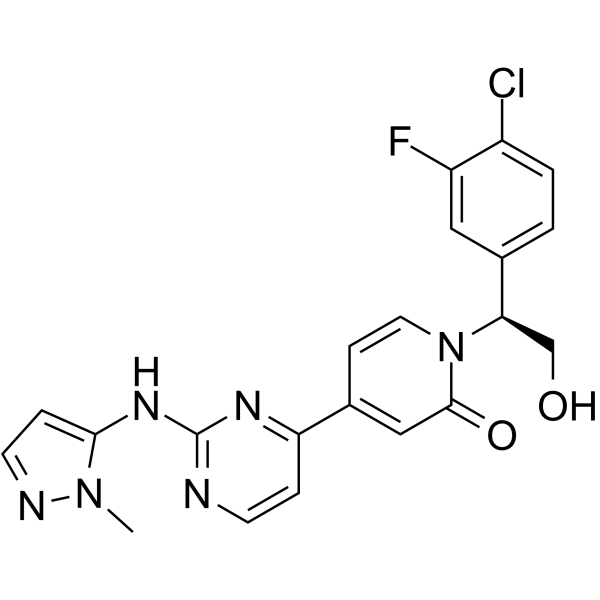
Ravoxertinib (GDC-0994) is an orally active ERK1/2 inhibitor. Ravoxertinib inhibits the ERK1/2 MAPK signaling pathway and reduces the expression levels of c-Myc, HK2 and LDHA. Ravoxertinib decreases mammosphere formation, and exerts additive and/or superadditive cytotoxicity when combined with Ipatasertib (HY-15186) in 3D tumor sphere models. Ravoxertinib can be used in research related to various cancers including breast cancer, melanoma, head and neck cancer, non-small cell lung cancer, ovarian cancer and Merkel cell carcinoma .
loading...
    loading...
52
52 Publications Verification
Cat. No.: HY-15947A
CAS No.: 2070009-58-2
Synonyms: GDC-0994 hydrochloride
Research Areas:  

Cancer

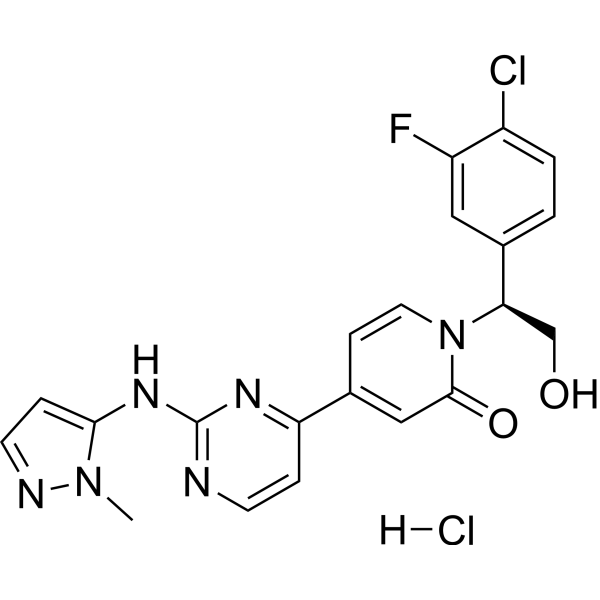
Ravoxertinib hydrochloride (GDC-0994 hydrochloride) is an orally active ERK1/2 inhibitor. Ravoxertinib hydrochloride inhibits the ERK1/2 MAPK signaling pathway and reduces the expression levels of c-Myc, HK2 and LDHA. Ravoxertinib hydrochloride decreases mammosphere formation, and exerts additive and/or superadditive cytotoxicity when combined with Ipatasertib (HY-15186) in 3D tumor sphere models. Ravoxertinib hydrochloride can be used in research related to various cancers including breast cancer, melanoma, head and neck cancer, non-small cell lung cancer, ovarian cancer and Merkel cell carcinoma .
loading...
    loading...
Cat. No.: HY-131686
CAS No.: 59247-13-1
Ganglioside GT1b (bovine) ammonium is a member of the ganglioside family. Ganglioside GT1b (bovine) ammonium acts as a protective signal against nerve injury-induced spinal synapse elimination. Ganglioside GT1b (bovine) ammonium induces HA synthesis and the phosphorylation of Akt/mTOR in orbital fibroblasts. Ganglioside GT1b (bovine) ammonium enhances porcine oocyte maturation and induce activation of EGFR and ERK1/2 signaling. Ganglioside GT1b (bovine) ammonium is a putative host cell receptor for the Merkel cell polyomavirus. Ganglioside GT1b (bovine) ammonium can be used for the researches of cancer, infection, immunology, endocrinology and neurological disease, such as Thyroid eye disease .
loading...
    loading...
Cat. No.: HY-131686A
CAS No.: 59247-13-1
Ganglioside GT1b (porcine) ammonium is a member of the ganglioside family. Ganglioside GT1b (porcine) ammonium acts as a protective signal against nerve injury-induced spinal synapse elimination. Ganglioside GT1b (porcine) ammonium induces HA synthesis and the phosphorylation of Akt/mTOR in orbital fibroblasts. Ganglioside GT1b (porcine) ammonium enhances porcine oocyte maturation and induces activation of EGFR and ERK1/2 signaling. Ganglioside GT1b (porcine) ammonium is a putative host cell receptor for the Merkel cell polyomavirus. Ganglioside GT1b (porcine) ammonium can be used for the researches of cancer, infection, immunology, endocrinology and neurological disease, such as Thyroid eye disease .
loading...
    loading...
Cat. No.: HY-101266A
CAS No.: 1398569-75-9
Synonyms: DS-3032 tosylate
Target:  

MDM-2/p53

Research Areas:  

Cancer

Milademetan tosylate is the tosylate salt form of Milademetan (HY-101266). Milademetan tosylate is an orally active inhibitor for MDM2. Milademetan tosylate arrests the cell cycle at G1 pahse, induces the apoptosis Milademetan tosylate restores the p53 activity by targeting the p53-MDM2 interaction, and exhibits anticancer activity against Merkel cell carcinoma (MCC) .
loading...
    loading...
Cat. No.: HY-D3640
CAS No.: 3020765-75-4
Target:  

Drug Isomer

Research Areas:  

Cancer

WX-02-13 is an inactive enantiomer of WX-02-33 (HY-D3639). WX-02-33 is a TOE1 inhibitor. WX-02-13 can be used in research on Merkel cell carcinoma .
loading...
    loading...
Cat. No.: HY-N21933
CAS No.: 845811-30-5
Tonantzitlolone is a diterpenoid natural product found in Stillingia lineata ssp. lineata, and is a selective and reversible agonist of human TRPC1/4/5 ion channels. Tonantzitlolone reduces cancer cell viability and shows selectivity markedly restricted to a single cancer cell line. Tonantzitlolone can be used in research related to Merkel cell carcinoma and renal cell carcinoma .
loading...
    loading...
Cat. No.: HY-D3639
CAS No.: 3020765-74-3
Target:  

DNA/RNA Synthesis

Research Areas:  

Cancer

WX-02-33 is a TOE1 inhibitor that covalently binds TOE1 and allosterically inhibits its 3′ RNA exonuclease activity. WX-02-33 promotes the binding of TOE1 to spliceosome-associated protein complexes involved in pre-mRNA splicing in a site-specific and stereoselective manner. WX-02-33 exhibits good proteome selectivity in cancer cells, binding only TOE1_C80 and a few other cysteines. WX-02-33 can be used for research on Merkel cell carcinoma .
loading...
    loading...
Cat. No.: HY-15947B
CAS No.: 1817728-45-2
Synonyms: GDC-0994 benzenesulfonate
Research Areas:  

Cancer

Ravoxertinib benzenesulfonate (GDC-0994 benzenesulfonate) is an orally active ERK1/2 inhibitor. Ravoxertinib benzenesulfonate inhibits the ERK1/2 MAPK signaling pathway and reduces the expression levels of c-Myc, HK2 and LDHA. Ravoxertinib benzenesulfonate decreases mammosphere formation, and exerts additive and/or superadditive cytotoxicity when combined with Ipatasertib (HY-15186) in 3D tumor sphere models. Ravoxertinib benzenesulfonate can be used in research related to various cancers including breast cancer, melanoma, head and neck cancer, non-small cell lung cancer, ovarian cancer and Merkel cell carcinoma .
loading...
    loading...
Cat. No.: HY-15947G
CAS No.: 1453848-26-4
Synonyms: GDC-0994 (GMP)
Ravoxertinib GMP is Ravoxertinib (HY-15947) produced by using GMP guidelines. GMP small molecules works appropriately as an auxiliary reagent for cell therapy manufacture. Ravoxertinib (GDC-0994) is an orally active ERK1/2 inhibitor. Ravoxertinib inhibits the ERK1/2 MAPK signaling pathway and reduces the expression levels of c-Myc, HK2 and LDHA. Ravoxertinib decreases mammosphere formation, and exerts additive and/or superadditive cytotoxicity when combined with Ipatasertib (HY-15186) in 3D tumor sphere models. Ravoxertinib can be used in research related to various cancers including breast cancer, melanoma, head and neck cancer, non-small cell lung cancer, ovarian cancer and Merkel cell carcinoma .
loading...
    loading...

