1. Search Result
Search Result
Results for "

Plasmodium falciparum K1

" in MedChemExpress (MCE) Product Catalog:

18

Inhibitors & Agonists

9

Natural
Products

1

Isotope-Labeled Compounds

Cat. No. Nombre del producto Target Áreas de investigación Chemical Structure
  • HY-N6742
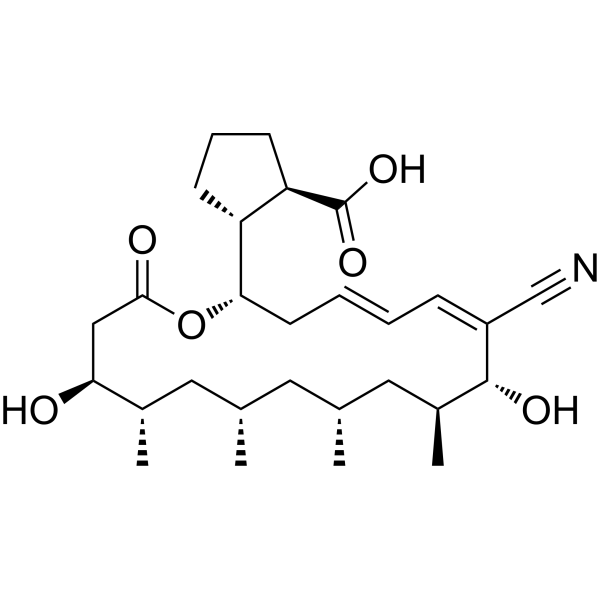
    Borrelidin
    1 Publications Verification

    Treponemycin

    CDK Parasite Apoptosis Antibiotic Infection
    Borrelidin (Treponemycin) is a bacterial and eukaryal threonyl-tRNA synthetase inhibitor which is a nitrile-containing macrolide antibiotic isolated from Streptomyces rochei . Borrelidin is an inhibitor of Cdc28/Cln2 of the budding yeast, with an IC50 of 24 μM . Borrelidin is a potent angiogenesis inhibitor, with an IC50 of 0.8 nM. Borrelidin induces apoptosis in the tube-forming cells . Borrelidin has strong antimalarial activities, with IC50s of 1.9 nM and 1.8 nM against K1 and FCR3 strains of Plasmodium falciparum, respectively .
    Borrelidin
  • HY-N5109

    Parasite Infection
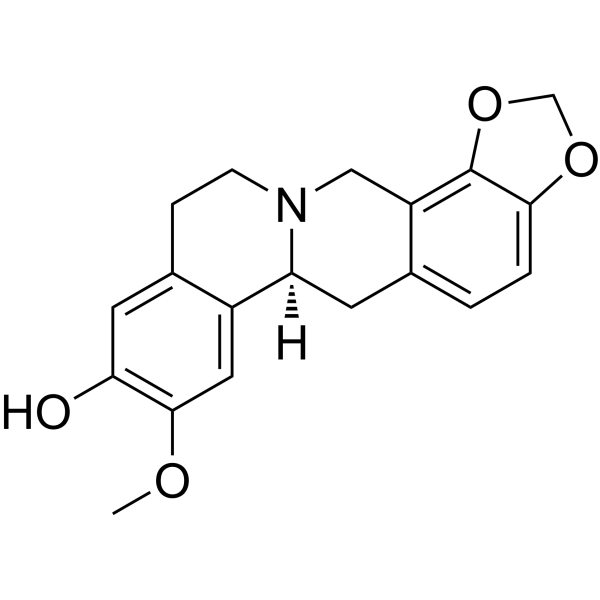
    Cheilanthifoline, an alkaloid, is isolated from Corydalis calliantha. Cheilanthifoline exhibits antiplasmodial activities against Plasmodium falciparum, with IC50s of 0.90 μg/mL and 1.22 μg/mL for wild type (TM4) and multidrug resistant (K1) strains, respectively .
    Cheilanthifoline
  • HY-N5005

    Atisinium chloride

    Parasite Infection
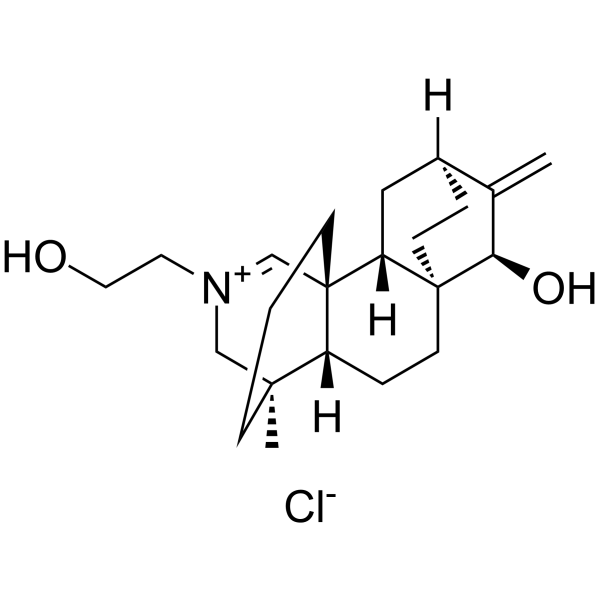
    Guanfu base H (Atisinium chloride) is a diterpenoid alkaloid isolated from Aconitum coreanum and has antiplasmodial activity against the malarial Plasmodium falciparum strains TM4/8.2 (wild type) and K1CB1 with IC50 values of 4 μM and 3.6 μM, respectively .
    Guanfu base H
  • HY-N15748

    (-)-Pelorol

    Parasite Infection
    Pelorol ((-)-Pelorol) is a sesquiterpene found in the tropical marine sponge Dactylospongia elegans. Pelorol has weak antitrypanosomal activity with an IC50 of 17.4 μg/mL and antiplasmodial activity against Plasmodium falciparum clones K1 and NF54 with IC50 values of 786 ng/mL and 1911 ng/mL, respectively. Pelorol is promising for research of parasitic diseases, such as trypanosomiasis and malaria .
    Pelorol
  • HY-126640

    Parasite Infection Cancer
    Phomoxanthone A is a xanthone dimer, which can be isolated from Phomopsis. Phomoxanthone A exhibits antimalarial and antitubercular activities against Plasmodium falciparum (K1, multidrug-resistant strain, IC50 is 0.11 µg/mL) and Mycobacterium tuberculosis (H37Ra strain, MIC is 0.50 µg/mL). Phomoxanthone A exhibits cytotoxicity in cells KB, BC-1 and Vero, IC50 is 0.99, 0.51 and 1.4 µg/mL, respectively .
    Phomoxanthone A
  • HY-N8383

    Parasite Infection
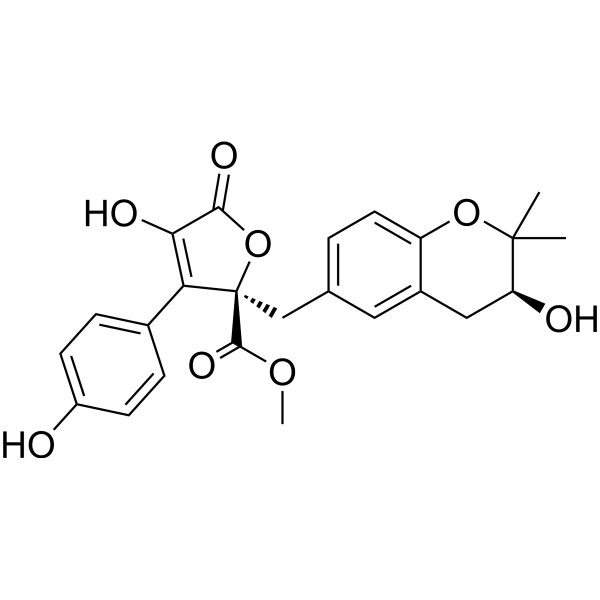
    Butyrolactone V is a butanolide compound. Butyrolactone V shows antiplasmodial activity against Plasmodium falciparum K1 with an IC50 of 7.9 µg/ml .
    Butyrolactone V
  • HY-106515

    WR228258

    Parasite Infection
    Tebuquine (WR228258), a 4-aminoquinoline, is a potent antimalarial agent. Tebuquine is active against the Chloroquine (HY-17589A) sensitive HB3 strain and the Chloroquine resistant K1 strain of Plasmodium falciparum with IC50s of 0.9 nM and 20.8 nM, respectively .
    Tebuquine
  • HY-157892

    Parasite Infection
    Antimalarial agent 38 is an orally active antimalarial agent, which inhibits Plasmodium falciparum D6 strain, Chloroquine (HY-17589A)-sensitive Thai strain and Chloroquine-resistant FcB1 strain and K1 strain, with IC50s of 0.5, 13, 1 and 13 μM, respectively. Antimalarial agent 38 is non-cytotoxic for mammalian cells MCR58 (IC50 >140 μM). Antimalarial agent 38 improves the survival rate of Plasmodium yoelii nigeriensis infected mouse model .
    Antimalarial agent 38
  • HY-155354

    Parasite Infection
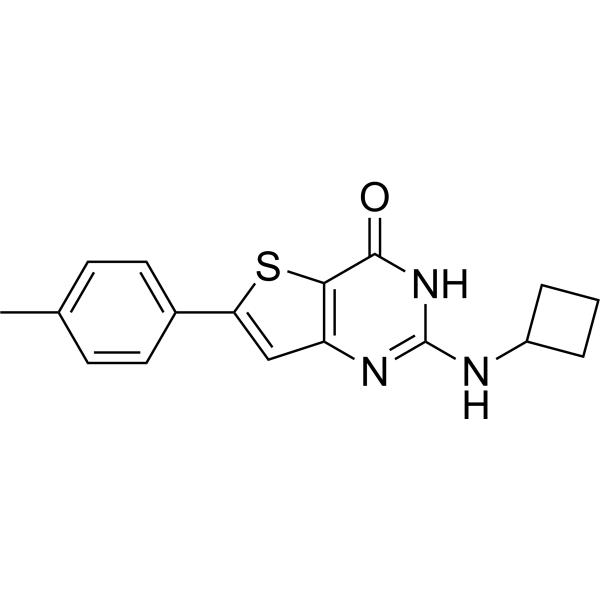
    Antimalarial agent 33 (compound 5g) has antiplasmodial activity against erythrocytic and hepatic stages of Plasmodium with an EC50 of 1.1 μM for K1 P. falciparum strain. Antimalarial agent 33 demonstrats enhanced microsomal stability (T1/2=29 min). Antimalarial agent 33 has no significant cytotoxicity against primary hepatocytes .
    Antimalarial agent 33
  • HY-170848

    Parasite Infection
    Antimalarial agent 48 (Compound 15a) is a triazine-class compound with antimalarial activity, showing inhibitory concentrations of 280 nM against Plasmodium falciparum K1 and 290 nM against Plasmodium falciparum FCR3. Antimalarial agent 48 is expected to be useful for research in the field of antimalarial infections .
    Antimalarial agent 48
  • HY-N8374

    Parasite Infection
    Pheanthine (Compound 2) is an antiplasmodial agent, that inhibits chloroquine-resistant Plasmodium falciparum K-1 (IC50 is 0.8 μM) and chloroquine-sensitive P. falciparum strain NF54 A19A (IC50 of 0.03 μM). Pheanthine exhibits low cytotoxicity in human lung fibrosblast (MRC-5, IC50 is 11.2 μM) and macrophages (PMM, IC50 is 8 μM) .
    Pheanthine
  • HY-145379

    Parasite Endogenous Metabolite Infection
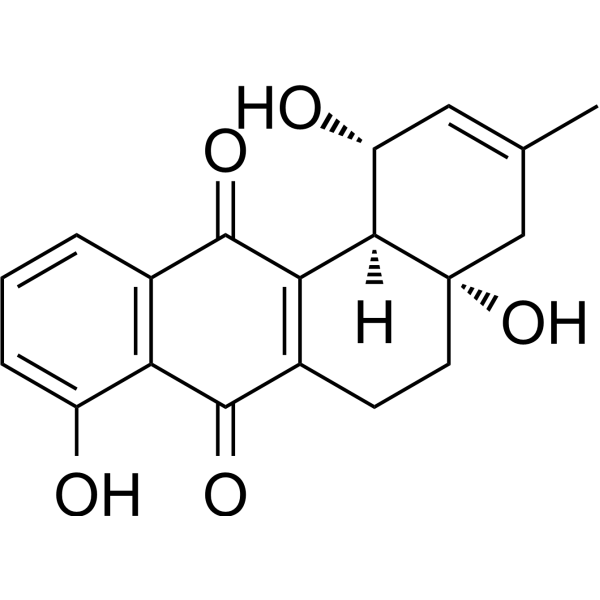
    Miaosporone A, an angucyclic quinone, exhibits antimalarial activity against Plasmodium falciparum K1 and antibacterial activity against Mycobacterium tuberculosis with respective IC50 values of 2.5 and 2.4 μM and displays cytotoxic activities against both cancerous (MCF-7 and NCI-H187) and nonmalignant (Vero) cells .
    Miaosporone A
  • HY-163765

    PI4K Potassium Channel Infection
    Antimalarial agent 41 (Compound 17) exhibits antimalarial activity, which inhibits Plasmodium falciparum with an IC50 of 40 nM (NF54 strain) and 76 nM (K1 strain). Antimalarial agent 41 is an inhibitor for P. falciparum phosphatidylinositol-4-kinase β (Pf PI4K) and hERG channel, with an IC50 of 53 nM and 3 μM. Antimalarial agent 41 exhibits cytotoxicity to CHO cells with an IC50 of 34 μM. Antimalarial agent 41 ameliorates the malaria infection and exhibits good pharmacokinetic characters in mouse models .
    Antimalarial agent 41
  • HY-W413619

    NITD609 enantiomer; KAE609 enantiomer

    Parasite Infection
    Cipargamin enantiomer (NITD609 enantiomer) is a Plasmodium falciparum inhibitor that can be characterized as a spirotetrahydro β-carboline (1S,3R stereoisomer). Cipargamin enantiomer exerts antiplasmodial activity against Plasmodium falciparum strains NF54 (IC50 of 77 nM) and K1. Cipargamin enantiomer displays low liver microsomal intrinsic clearance in mouse and human systems. Cipargamin enantiomer does not inhibit CYP2C9. Cipargamin enantiomer can be used for the research of malaria .
    Cipargamin enantiomer
  • HY-137985

    Stachybotrydial; F 1839M; Stachybotrydial

    HSV Virus Protease Infection
    Mer-NF5003F (Stachybotrydial; F 1839M), a sesquiterpene isolated from Stachybotrys, inhibits avian medulloblastoma virus (AMV) protease (IC50=7.8 μM). Mer-NF5003F inhibits sialyltransferase 6N (ST6N), ST3O, and ST3N (IC50=0.61, 6.7, and 10 μg/mL, respectively), and fucosyltransferase (IC50=11.3 μg/mL). Mer-NF5003F has in vitro activity against herpes simplex virus HSV-1 (IC50=4.32 μg/mL) and multidrug-resistant Plasmodium falciparum K1 strain (IC50=0.85 μg/mL).
    Mer-NF5003F
  • HY-N12700S

    Isotope-Labeled Compounds Parasite Infection
    Puberulic acid- 13C8 is the 13C-labeled Puberulic acid. Puberulic acid possesses anti-malarial activity with an IC50 value of 0.050 μM against Plasmodium falciparum K1 (chloroquine-resistant) .
    Puberulic acid-13C8
  • HY-182319

    Parasite Infection
    Dehatrine is a dibenzylisoquinoline alkaloid with antiplasmodial activity. Dehatrine can be found in the Indonesian medicinal plant Beilschmiedia madang. Dehatrine is applicable to malaria-related research .
    Dehatrine
  • HY-W701798

    (S)-Tritopin; D-Laudanine

    Drug Derivative Others
    (+)-Laudanidine ((S)-Tritopin) is a benzyltetrahydroisoquinoline alkaloid found in Stephania species .
    (+)-Laudanidine

Consulta en línea

Your information is safe with us. * Required Fields.

Saludo


Country or Region *

Nombre del solicitante *


Nombre de la Organizaciòn *

Department *


Direcciòn del E-mail *


Nombre del producto *

Cat. No.


Requested quantity *

Número de teléfono *


Observaciones

Consulta en línea

Inquiry Information

Nombre del producto:
Cat. No.:
Cantidad:
MCE Japan Authorized Agent:

