1. Search Result
Search Result
Results for "

phase

" in MedChemExpress (MCE) Product Catalog:

1556

Inhibitors & Agonists

6

Screening Libraries

21

Fluorescent Dye

87

Biochemical Assay Reagents

43

Peptides

1

MCE Kits

10

Inhibitory Antibodies

220

Natural
Products

7

Recombinant Proteins

49

Isotope-Labeled Compounds

19

Antibodies

11

Click Chemistry

22

Oligonucleotides

1

GMP Molecules

Cat. No. Product Name Target Research Areas Chemical Structure
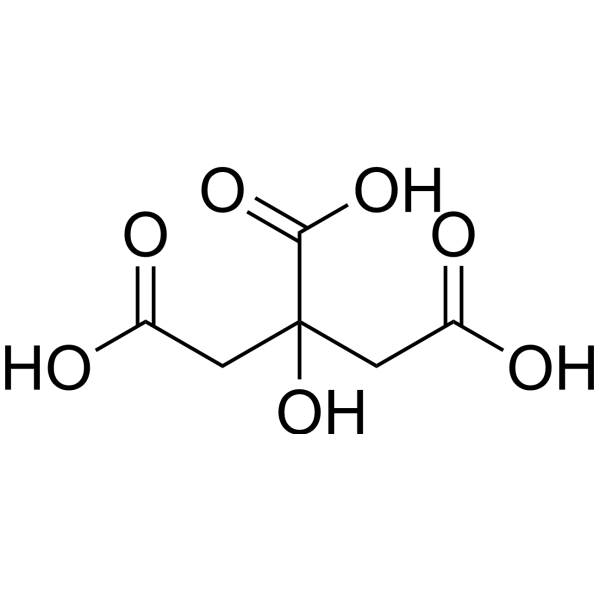
  • HY-N1428
    Citric acid
    30+ Cited Publications

    Environmental Pollutants Endogenous Metabolite Bacterial Apoptosis Infection Cardiovascular Disease Metabolic Disease Inflammation/Immunology Cancer
    Citric acid is a natural preservative and food tartness enhancer. Citric acid induces apoptosis and cell cycle arrest at G2/M phase and S phase in HaCaT cells. Citric acid cause oxidative damage of the liver by means of the decrease of antioxidative enzyme activities. Citric acid is also an acidulant, emulsifier, sequestrant and buffering agent widely used across many industries .
    Citric acid
  • HY-B2201
    Citric acid trisodium
    Maximum Cited Publications
    11 Publications Verification

    Sodium citrate; Trisodium citrate anhydrous

    Environmental Pollutants Endogenous Metabolite Bacterial Apoptosis Infection Cardiovascular Disease Metabolic Disease Inflammation/Immunology Cancer
    Citric acid trisodium (Sodium citrate) is a natural preservative and food tartness enhancer. Citric acid trisodium induces apoptosis and cell cycle arrest at G2/M phase and S phase in HaCaT cells. Citric acid trisodium cause oxidative damage of the liver by means of the decrease of antioxidative enzyme activities. Citric acid trisodium is also an acidulant, emulsifier, sequestrant and buffering agent widely used across many industries .
    Citric acid trisodium
  • HY-N6722
    Swainsonine
    1 Publications Verification

    Tridolgosir

    Apoptosis Antibiotic Infection Cancer
    Swainsonine (Tridolgosir) is an natural indolizidine alkaloid, a potent and reversible α-mannosidase inhibitor. Swainsonine induces apoptosis and cell cycle arrest at G2/M phase. Swainsonine shows anti-tumor activity .
    Swainsonine
  • HY-N0047
    Polyphyllin I
    5 Publications Verification

    JNK mTOR Akt PDK-1 Autophagy Apoptosis Cancer
    Polyphyllin I is a bioactive constituent extracted from Paris polyphylla, has strong anti-tumor activity. Polyphyllin I is an activator of the JNK signaling pathway and is an inhibitor of PDK1/Akt/mTOR signaling. Polyphyllin I induces autophagy, G2/M phase arrest and apoptosis .
    Polyphyllin I
  • HY-W134422

    Polyoxyethylene octylphenol ether

    Environmental Pollutants Biochemical Assay Reagents Others
    (1,1,3,3-Tetramethylbutyl)phenyl-polyethylene glycol X-114 is a surfactant. (1,1,3,3-Tetramethylbutyl)phenyl-polyethylene glycol X-114 is used to solubilize membranes and whole cells. A solution of (1,1,3,3-Tetramethylbutyl)phenyl-polyethylene glycol X-114 is homogeneous at 0 degrees C but separates in an aqueous phase and a detergent phase above 20 degrees C. (1,1,3,3-Tetramethylbutyl)phenyl-polyethylene glycol X-114 can be used in phase separation studies .
    (1,1,3,3-Tetramethylbutyl)phenyl-polyethylene glycol X-114
  • HY-N1428A
    Citric acid monohydrate
    5+ Cited Publications

    Environmental Pollutants Endogenous Metabolite Apoptosis Bacterial Infection Cardiovascular Disease Metabolic Disease Inflammation/Immunology Cancer
    Citric acid monohydrate is a natural preservative and food tartness enhancer. Citric acid monohydrate induces apoptosis and cell cycle arrest at G2/M phase and S phase in HaCaT cells. Citric acid monohydrate cause oxidative damage of the liver by means of the decrease of antioxidative enzyme activities. Citric acid monohydrate is also an acidulant, emulsifier, sequestrant and buffering agent widely used across many industries .
    Citric acid monohydrate
  • HY-110111
    T2AA
    2 Publications Verification

    DNA/RNA Synthesis Cancer
    T2AA is a monoubiquitinated proliferating cell nuclear antigen (PCNA) inhibitor that prevents DNA repair, increases double-strand break (DSB) formation and promotes necroptosis and cell cycle arrest in G1 phase .
    T2AA
  • HY-B1508

    Acetomenaphthone

    Endogenous Metabolite Apoptosis Cardiovascular Disease Cancer
    Vitamin K4 is a chemically synthesized Vitamin K which plays an important role in the normal blood coagulation system. Vitamin K4 arrests the cells in S phase and induces apoptosis. Vitamin K4 can be used for the research of cancer, such as prostate cancer and osteosarcoma .
    Vitamin K4
  • HY-100789
    ON1231320
    2 Publications Verification

    Apoptosis Polo-like Kinase (PLK) Mitosis Cancer
    ON1231320 is a highly specific polo like kinase 2 (PLK2) inhibitor with an IC50 of 0.31 μM. ON1231320 blocks tumor cell cycle progression in the G2/M phase in mitosis, causing apoptotic cell death. ON1231320, an arylsulfonyl pyrido-pyrimidinone, has antitumor activity .
    ON1231320
  • HY-W009156
    Citric acid tripotassium hydrate
    10+ Cited Publications

    Potassium citrate monohydrate

    Environmental Pollutants Endogenous Metabolite Bacterial Apoptosis Infection Cardiovascular Disease Metabolic Disease Inflammation/Immunology Cancer
    Citric acid tripotassium hydrate (Potassium citrate monohydrate) is a natural preservative and food tartness enhancer. Citric acid tripotassium hydrate induces apoptosis and cell cycle arrest at G2/M phase and S phase in HaCaT cells. Citric acid tripotassium hydrate cause oxidative damage of the liver by means of the decrease of antioxidative enzyme activities. Citric acid tripotassium hydrate is also an acidulant, emulsifier, sequestrant and buffering agent widely used across many industries .
    Citric acid tripotassium hydrate
  • HY-126437A
    Poly-L-lysine hydrochloride
    1 Publications Verification

    Bacterial Infection Inflammation/Immunology
    Poly-L-lysine hydrochloride is a nonspecific attachment factor for cells useful in promoting cell adhesion to solid substrates by enhancing electrostatic interaction between negatively charged ions of the cell membrane and the culture surface. Poly-L-lysine hydrochloride is a strong-attraction regulator that promotes liquid-liquid phase separation (LLPS) at low concentrations but suppresses LLPS at high concentrations. Antibacterial cationic peptide. .
    Poly-L-lysine hydrochloride
  • HY-13680
    Meisoindigo
    2 Publications Verification

    Dian III; N-Methylisoindigotin; Natura-α

    Apoptosis Cancer
    Meisoindigo (Dian III), a derivative of Indirubin (HY-N0117), halts the cell cycle at the G0/G1 phase and induces apoptosis in primary acute myeloid leukemia (AML) cells. Meisoindigo exhibits high antitumor activity .
    Meisoindigo
  • HY-15221
    Methylstat
    3 Publications Verification

    Apoptosis Histone Demethylase MDM-2/p53 Cardiovascular Disease Cancer
    Methylstat is a potent histone demethylases inhibitor. Methylstat shows anti-proliferative activity with low cytotoxicity. Methylstat induces apoptosis and cell cycle arrest at G0/G1 phase. Methylstat increases the expression of p53 and p21 protein levels. Methylstat inhibits angiogenesis induced by various cytokines. Methylstat can be used as a chemical probe for addressing its role in angiogenesis .
    Methylstat
  • HY-W094846

    n-Tetradecane

    Environmental Pollutants Biochemical Assay Reagents Others
    Tetradecane (n-Tetradecane) is a low-temperature phase change material with a phase change temperature of 5°C and a latent heat of phase change of 220 J/g. Tetradecane undergoes solid-liquid phase transition around 5°C, and achieves temperature regulation by absorbing or releasing latent heat .
    Tetradecane
  • HY-B1295
    Lithium citrate tetrahydrate
    Maximum Cited Publications
    11 Publications Verification

    Litarex tetrahydrate

    Apoptosis Endogenous Metabolite Bacterial Infection Cardiovascular Disease Metabolic Disease Inflammation/Immunology Cancer
    Lithium citrate (Litarex) tetrahydrate is a natural preservative and food tartness enhancer. Lithium citrate tetrahydrate induces apoptosis and cell cycle arrest at G2/M phase and S phase in HaCaT cells. Lithium citrate tetrahydrate cause oxidative damage of the liver by means of the decrease of antioxidative enzyme activities. Lithium citrate tetrahydrate is also an acidulant, emulsifier, sequestrant and buffering agent widely used across many industries .
    Lithium citrate tetrahydrate
  • HY-N1428CA

    Apoptosis Endogenous Metabolite Bacterial Cardiovascular Disease Infection Metabolic Disease Inflammation/Immunology Cancer
    Ferric citrate, suitable for cell culture is a natural preservative and food tartness enhancer. Ferric citrate, suitable for cell culture induces apoptosis and cell cycle arrest at G2/M phase and S phase in HaCaT cells. Ferric citrate, suitable for cell culture causes oxidative damage of the liver by means of the decrease of antioxidative enzyme activities. Ferric citrate, suitable for cell culture is also an acidulant, emulsifier, sequestrant and buffering agent widely used across many industries .
    Ferric citrate,suitable for cell culture
  • HY-147895
    PCAF-IN-2
    2 Publications Verification

    Histone Acetyltransferase Apoptosis Cancer
    PCAF-IN-2 (compound 17) is a potent PCAF inhibitor with an IC50 value of 5.31 µM. PCAF-IN-2 shows anti-tumour activity. CAF-IN-2 induces apoptosis and arrest the cell cycle at the G2/M phase .
    PCAF-IN-2
  • HY-174801

    Cyclic GMP-AMP Synthase Inflammation/Immunology
    XL-3156 is a cGAS inhibitor. XL-3156 occupies both allosteric and orthosteric sites simultaneously, and inhibits the interaction and phase separation between cGAS and DNA by stabilizing the closed conformation of the activation loop. XL-3156 can be used in the research of diseases such as autoimmune diseases and inflammation .
    XL-3156
  • HY-15228
    RX-3117
    2 Publications Verification

    TV-1360; Fluorocyclopentenylcytosine

    Nucleoside Antimetabolite/Analog Apoptosis Cancer
    RX-3117 (TV-1360) is a potent and orally active anticancer and antimetaboliteagent. RX-3117 inhibits DNA methyltransferase 1 (DNMT1). RX-3117 shows antiproliferative and anti-tumour activity. RX-3117 induces cell cycle arrest at S phase and apoptosis .
    RX-3117
  • HY-W008606

    Citric acid monosodium salt

    Environmental Pollutants Endogenous Metabolite Bacterial Apoptosis Infection Cardiovascular Disease Metabolic Disease Inflammation/Immunology Cancer
    Sodium citrate monobasic (Citric acid monosodium salt) is a natural preservative and food tartness enhancer. Sodium citrate monobasic induces apoptosis and cell cycle arrest at G2/M phase and S phase in HaCaT cells. Sodium citrate monobasic cause oxidative damage of the liver by means of the decrease of antioxidative enzyme activities. Sodium citrate monobasic is also an acidulant, emulsifier, sequestrant and buffering agent widely used across many industries .
    Sodium citrate monobasic
  • HY-111428
    Phleomycin D1
    2 Publications Verification

    PLM D1

    Antibiotic Infection
    Phleomycin D1 (PLM D1), a glycopeptide antibiotic, is a member of the Bleomycin/Phleomycin family. Phleomycin D1 causes cell death by binding and cleaving DNA. Phleomycin D1 induces cell cycle arrest at S phase .
    Phleomycin D1
  • HY-N1428R
    Citric acid (standard)
    5+ Cited Publications

    Reference Standards Apoptosis Endogenous Metabolite Bacterial Infection Cardiovascular Disease Metabolic Disease Inflammation/Immunology Cancer
    Citric acid (Standard) is the analytical standard of Citric acid (HY-N1428). This product is intended for research and analytical applications. Citric acid is a natural preservative and food tartness enhancer. Citric acid induces apoptosis and cell cycle arrest at G2/M phase and S phase in HaCaT cells. Citric acid cause oxidative damage of the liver by means of the decrease of antioxidative enzyme activities. Citric acid is also an acidulant, emulsifier, sequestrant and buffering agent widely used across many industries .
    Citric acid (standard)
  • HY-N1039A

    Others Cancer
    Manool is a diterpene from Salvia officinalis. Manool induces selective cytotoxicity in cancer cells. Manool arrests the cancer cells at the G(2)/M phase of the cell cycle .
    Manool
  • HY-129811

    Microtubule/Tubulin Neurological Disease
    Bis-ANS dipotassium is a fluorescent probe of hydrophobic protein. Bis-ANS binds to tubulin with a Kd of 2 μM . Bis-ANS dipotassium is a potent biphasic modulator of protein liquid-liquid phase separation (LLPS). Bis-ANS dipotassium promotes LLPS at low concentrations but suppresses LLPS at high concentrations .
    Bis-ANS dipotassium
  • HY-W017054

    Biochemical Assay Reagents Others
    2-Amino-2-methyl-1,3-propanediol is a solid-solid phase change material with energy release and heat storage properties. 2-Amino-2-methyl-1,3-propanediol can crystallize from a supercooled solid state, release thermal energy during heating, and store thermal energy in the supercooled solid state. 2-Amino-2-methyl-1,3-propanediol can be used in the production of surfactants, vulcanization accelerators, and as a biological buffer .
    2-Amino-2-methyl-1,3-propanediol
  • HY-N8432

    Environmental Pollutants Bacterial Apoptosis Fungal Infection Inflammation/Immunology Cancer
    Dipyrithione is a potent antimicrobial agent. Dipyrithione shows antifungal activity and antiproliferative activity. Dipyrithione induces apoptosis and cycle arrest at G1 phase. Dipyrithione shows anti-inflammatory activity in vivo. Dipyrithione shows anti-tumor activity. Dipyrithione has the potential for the research of dermatophytosis .
    Dipyrithione
  • HY-161302

    Apoptosis DNA/RNA Synthesis PARP Cancer
    Polθ/PARP-IN-1 (compound 25d) is a potent dual DNA polymerase theta (Polθ) and PARP inhibitor with IC50 values of 45.6, 5.4 nM, respectively. Polθ/PARP-IN-1 shows antiproliferative activity. Polθ/PARP-IN-1 induces apoptosis and cell cycle arrest at G2/M phase, causes DNA damage. Polθ/PARP-IN-1 shows anti-tumor activity .
    Polθ/PARP-IN-1
  • HY-111973

    Phytohormone iGluR Neurological Disease
    Phaseic acid is a Abscisic acid terpenoid catabolite that can able to activate a subset of Abscisic acid repectors. Phaseic acid is a plant hormone associated with photosynthesis arrest and abscission. Phaseic acid is the antagonist for NMDA-type glutamate receptor (NMDAR) that inhibits NMDAR currents with an IC50 of 34.37 μM. Phaseic acid reduces intracellular calcium influx, and exhibits neuroprotective effect .
    Phaseic acid
  • HY-10815
    σ1 Receptor antagonist-1
    1 Publications Verification

    Sigma Receptor Apoptosis Neurological Disease Cancer
    σ1 Receptor antagonist-1 is a highly potent and selective sigma 1 receptor antagonist (pKi=10.28). σ1 Receptor antagonist-1 inhibits cell growth, arrests cell cycle at G0/G1 phase and induces apoptosis of MCF-7/ADR cells .
    σ1 Receptor antagonist-1
  • HY-W012184

    Biochemical Assay Reagents Inflammation/Immunology
    CDAP is an organic cyanylating reagent that can be used for preparation of solid phase affinity reagents, modification of protein thiols and nucleotide delivery. CDAP also activates polysaccharides with a variety of chemical properties. CDAP can be used to prepare conjugate vaccines and other immune reagents .
    CDAP
  • HY-163697

    Wee1 Apoptosis Cancer
    WEE1-IN-7 (compound 12h) is a potent and orally activeWEE1 inhibitor with an IC50 value of 2.1 nM. WEE1-IN-7 induces apoptosis and cell cycle arrest at the S phase. WEE1-IN-7 shows antitumor activity .
    WEE1-IN-7
  • HY-118798

    NSC663285

    Phosphatase Cancer
    DA 3003-2 is a potent and selectively Cdc25 inhibitor. DA 3003-2 shows antiproliferative activity. DA 3003-2 induces cell cycle arrest at the G2/M phase and increases the expression of P-tyr 15 Cdc2. DA 3003-2 has the potential for the research of prostate cancer .
    DA 3003-2
  • HY-115909

    CDK Cancer
    ZDLD20, a β-carboline, is orally active and selective CDK4/CycD3 inhibitor with an IC50 value of 6.51  μM. ZDLD20 exhibits potent anti-HCT116 activity including inhibition of colony formation, inhibition of invasion and migration, inducing of apoptosis, and arresting of G1 phase in cell cycle. ZDLD20 exhibits potent anticancer activity .
    ZDLD20
  • HY-W067358

    Environmental Pollutants Biochemical Assay Reagents Others
    2-Methylpyrazine is a flavoring agent and also a green solvent used in the preparation of non-solvent induced phase separation membranes .
    2-Methylpyrazine
  • HY-115683

    Apoptosis Cancer
    NUN82647 is a potent cytotoxic compound that inhibits cell cycle at G2 phase and induces apoptosis. NUN82647 can be used for the study of leukemia .
    NUN82647
  • HY-161268

    Apoptosis NEDD8-activating Enzyme Reactive Oxygen Species (ROS) Cancer
    NAE-IN-1 (compound X-10) is a potent NAE1 inhibitor. NAE-IN-1 induces apoptosis and cell cycle arrest at the G2/M phase. NAE-IN-1 increases ROS levels and prevents cell migration. NAE-IN-1 shows anti-proliferation activity .
    NAE-IN-1
  • HY-W011762

    Apoptosis Cancer
    VK3-OCH3 is a potent antitumor agent. VK3-OCH3 shows cytotoxicity for neuroblastoma cell lines and low cytotoxicity for normal cell lines. VK3-OCH3 induces apoptosis and cell cycle arrest at G2/M phase in IMR-32 cells. VK3-OCH3 shows antitumor activity .
    VK3-OCH3
  • HY-118331

    PD 124895; CL-1957E

    Antibiotic Infection Cancer
    Kazusamycin B is an antibiotic that could be isolated from the fermentation broth of Streptomyces sp. No. 81-484. Kazusamycin B inhibits cell growth and arrests cell cycle at G1 phase. Kazusamycin B can be used in research of cancer .
    Kazusamycin B
  • HY-118529

    Phosphatase Cancer
    JUN-1111 is an irreversible and selective Cdc25 phosphatase inhibitor with IC50 values of 0.38, 1.8, 0.66, 28, 37 µM for Cdc25A, Cdc25B, Cdc25C, VHR, PTP1B, respectively. JUN-1111 induces cell cycle arrest at G1 and G2/M phases. JUN-1111 decreases the expression of phosphoCdk1 .
    JUN-1111
  • HY-W016413

    Biochemical Assay Reagents Others
    4-(Hydroxymethyl)phenoxyacetic acid is an acid-labile resin linkage agent for use in solid phase peptide synthesis .
    4-(Hydroxymethyl)phenoxyacetic acid
  • HY-N1428AR

    Reference Standards Endogenous Metabolite Apoptosis Bacterial Infection Cardiovascular Disease Metabolic Disease Inflammation/Immunology Cancer
    Citric acid monohydrate (Standard) is the analytical standard of Citric acid monohydrate (HY-N1428A). This product is intended for research and analytical applications. Citric acid monohydrate is a natural preservative and food tartness enhancer. Citric acid monohydrate induces apoptosis and cell cycle arrest at G2/M phase and S phase in HaCaT cells. Citric acid monohydrate cause oxidative damage of the liver by means of the decrease of antioxidative enzyme activities. Citric acid monohydrate is also an acidulant, emulsifier, sequestrant and buffering agent widely used across many industries .
    Citric acid monohydrate (Standard)
  • HY-147896

    Microtubule/Tubulin Cancer
    Tubulin polymerization-IN-29 (compound 6g) is a potent tubulin polymerization inhibitor. Tubulin polymerization-IN-29 exhibits potent antiproliferative activity. Tubulin polymerization-IN-29 can induce HeLa cells arrest in G2/M phase .
    Tubulin polymerization-IN-29
  • HY-N8287

    Microtubule/Tubulin Cancer
    Oxaline is a fungal alkaloid that can be isolated from Penicillium oxalicum. Oxaline inhibits tubulin polymerization, resulting in cell cycle arrest at the M phase .
    Oxaline
  • HY-150048

    CD73 Apoptosis Cancer
    BK50164 is a potent CD73 inhibitor with an IC50 value of 13.089 μM. BK50164 binds to CD99 with a KD value of 1.5 μM. BK50164 shows antiproliferative activity. BK50164 induced Apoptosis and cell cycle arrest at Sub-G1 phase .
    BK50164
  • HY-149029

    HDAC Apoptosis Reactive Oxygen Species (ROS) Cancer
    TH-6 is a potent HDAC inhibitor with IC50s of 0.115, 0.135, 0.242, 0.138, 2.120 µM for HDAC1, HDAC2, HDAC3, HDAC6, HDAC8, respectively. TH-6 inhibits cell migration and invasion. TH-6 induces apoptosis and cell cycle arrest at G2/M phase. TH-6 shows anti-tumor activity .
    TH-6
  • HY-168205

    HSP Apoptosis Cancer
    HSP90-IN-33 (compound 24e) is a potent Hsp90 inhibitor with Kd values of ≥200, 7.3 µM for Hsp90α, Hsp90β, respectively. HSP90-IN-33 induces apoptosis and cell cycle arrest at G0/G1 phase. HSP90-IN-33 decreases the protein expression of ERα, CDK4 and Akt .
    HSP90-IN-33
  • HY-137005

    Topoisomerase Apoptosis Cancer
    CS1 is a potent DNA Topo II α inhibitor. CS1 displays broad-spectrum in vitro antitumor effects, low toxicity in vivo and potential anti-multidrug resistance capabilities. CS1 leads to DNA damage, cell cycle arrest at G2/M phase and apoptosis .
    CS1
  • HY-176738

    Apoptosis Reactive Oxygen Species (ROS) Cancer
    Antitumor agent-204 (compound 15a) is a potent antitumor agent. Antitumor agent-204 shows cytotoxicity. Antitumor agent-204 induces nitric oxide (NO) release and reactive oxygen species (ROS) generation. Antitumor agent-204 induces apoptosis and induces cell cycle arrest at G2/M phase. Antitumor agent-204 shows antitumor activity .
    Antitumor agent-204
  • HY-D2196

    Fluorescent Dye Others
    AgAuSe Oil phase (1000 nm) is a bright and biocompatible fluorescent nanoprobe in the second near-infrared window.
    AgAuSe Oil phase (1120 nm)
  • HY-D2193

    Fluorescent Dye Others
    AgAuSe Oil phase (1000 nm) is a bright and biocompatible fluorescent nanoprobe in the second near-infrared window .
    AgAuSe Oil phase (1000 nm)

Inquiry Online

Your information is safe with us. * Required Fields.

Salutation


Country or Region *

Applicant Name *


Organization Name *

Department *


Email Address *


Product Name *

Cat. No.


Requested quantity *

Phone Number *


Remarks

Inquiry Online

Inquiry Information

Product Name:
Cat. No.:
Quantity:
MCE Japan Authorized Agent:

