



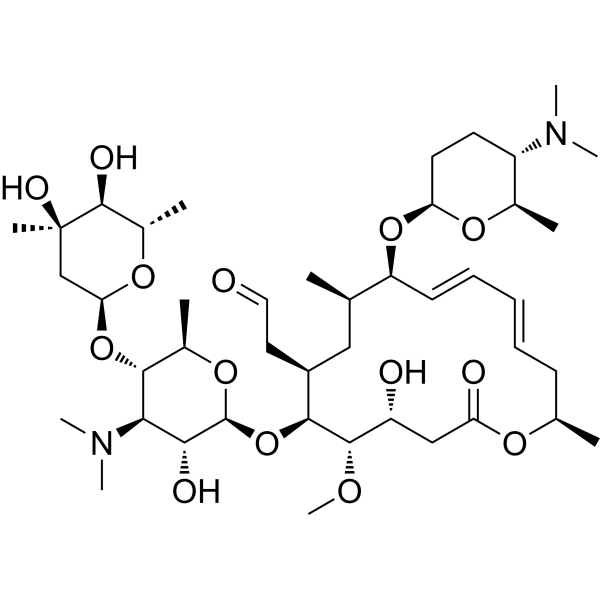
Spiramycin I
Based on 3 publication(s) in Google Scholar
Spiramycin I is a macrolide antibiotic and antiparasitic.
연구목적의 판매만을 진행합니다. 환자를 대상으로 한 판매는 하지 않습니다.
- Purity : 91.52%
- CAS No.: 24916-50-5
- 화학식: C43H74N2O14
- 분자량:843.05
-
보관:Powder -20°C, 3 years ; In solvent -80°C, 6 months , -20°C, 1 month

To place orders, for customer services and technical support, please contact: MedChemExpress USA
Tel: 609-228-6898 E-mail: [email protected] [email protected]


-
 Biological Activity
-
Chemical Information
-
용액&용해도
- 순도&문서
- References
-
 Help & FAQs



Publications Citing Use of MedChemExpress (MCE) Spiramycin I
MoreAll Antibiotic Isoforms
MoreAll Parasite Isoforms
More

Biological Activity
제품 설명
IC50 & Target
|
Macrolide |
Cellular Effect
|
Cell Line

|
Type | Value | Description | References |
|---|---|---|---|---|
| HeLa | IC50 |
189 μM
Compound: Spiramycin
|
Cytotoxicity against human HeLa cells assessed as cell growth inhibition measured after 24 hrs by MTT assay
Cytotoxicity against human HeLa cells assessed as cell growth inhibition measured after 24 hrs by MTT assay
|
[PMID: 34894691] |
| HeLa | IC50 |
34.41 μM
Compound: 1
|
Cytotoxicity against human HeLa cells assessed as reduction in cell survival after 72 hrs by sulforhodamine B assay
Cytotoxicity against human HeLa cells assessed as reduction in cell survival after 72 hrs by sulforhodamine B assay
|
[PMID: 27501415] |
| HepG2 | IC50 |
30.51 μM
Compound: 1
|
Cytotoxicity against human HepG2 cells assessed as reduction in cell survival after 72 hrs by sulforhodamine B assay
Cytotoxicity against human HepG2 cells assessed as reduction in cell survival after 72 hrs by sulforhodamine B assay
|
[PMID: 27501415] |
| KB | IC50 |
31.26 μM
Compound: 1
|
Cytotoxicity against human KB cells assessed as reduction in cell survival after 72 hrs by sulforhodamine B assay
Cytotoxicity against human KB cells assessed as reduction in cell survival after 72 hrs by sulforhodamine B assay
|
[PMID: 27501415] |
| MCF7 | IC50 |
33.11 μM
Compound: 1
|
Cytotoxicity against human MCF7 cells assessed as reduction in cell survival after 72 hrs by sulforhodamine B assay
Cytotoxicity against human MCF7 cells assessed as reduction in cell survival after 72 hrs by sulforhodamine B assay
|
[PMID: 27501415] |
| NHDF | IC50 |
31.1 μM
Compound: 1
|
Cytotoxicity against HDF assessed as reduction in cell survival after 72 hrs by sulforhodamine B assay
Cytotoxicity against HDF assessed as reduction in cell survival after 72 hrs by sulforhodamine B assay
|
[PMID: 27501415] |
In Vitro
Spiramycin I binds to the 50S subunit of the ribosome, blocks the channel for peptide chain synthesis, thereby exhibiting inhibitory activity against Gram-positive bacteria. Spiramycin I inhibits B. subtilis, M. luteus, S. aureus, S. epidermidis, and S. pneumoniae with MICs of 0.5-8 μg/mL[2].
Spiramycin I (0.1-20 μM, 72 h) exhibits cytotoxicity in cancer cells HeLa, KB, MCF-7, HepG2 and U87 with IC50 of 34.41, 31.26, 33.11, 30.51 and 31.10 μM, respectively[2].
MedChemExpress (MCE) has not independently confirmed the accuracy of these methods. They are for reference only.
-
Cell Line:HeLa, KB, MCF-7, HepG2 and U87
-
Concentration:0.1-20 μM
-
Incubation Time:72 h
-
Result:Inhibited the cell proliferation.


Chemical Information
-
CAS No. 24916-50-5
-
Appearance Solid
-
분자량 843.05
-
화학식 C43H74N2O14
-
Color Off-white to light yellow
-
SMILES
O=CC[C@@H](C[C@H]([C@H](/C=C/C=C/C[C@H](OC(C[C@H]([C@@H]1OC)O)=O)C)O[C@@H]2O[C@@H]([C@H](CC2)N(C)C)C)C)[C@@H]1O[C@H]3[C@@H]([C@H]([C@@H]([C@H](O3)C)O[C@H]4C[C@@](O)([C@H]([C@@H](O4)C)O)C)N(C)C)O
-
Structure Classification
-
Initial Source
Streptomyces ambofaciens
-
선적
Room temperature in continental US; may vary elsewhere.
-
보관
Powder -20°C 3 years In solvent -80°C 6 months -20°C 1 month


Publications (3)
-
Journal Impact Factor
-
Most Recent
-
Int J Biol Macromol
Molecular basis of BACE1 modulation revealed by machine learning, molecular simulations, and experimental validation. [Abstract]2026 May 6:152409. PMID: 42103119 -
Int J Biol Macromol
Structural and dynamic characterization of papain-like protease ligand recognition using integrated computational and biochemical approaches. [Abstract]2026 Mar 18:355:151493. PMID: 41861871 -
Anticancer Res
Gossypol Inhibits GLI3-dependent SHH Signaling to Selectively Target SPOP-deficient Breast Cancer Cells. [Abstract]2026 May;46(5):2317-2327. PMID: 42049345


용액&용해도
In Vitro:
DMSO : 100 mg/mL (118.62 mM; Need ultrasonic; Hygroscopic DMSO has a significant impact on the solubility of product, please use newly opened DMSO)
Please refer to the solubility information to select the appropriate solvent. Once prepared, please aliquot and store the solution to prevent product inactivation from repeated freeze-thaw cycles.
Storage method and period of stock solution: -80°C, 6 months; -20°C, 1 month. When stored at -80°C, please use it within 6 months. When stored at -20°C, please use it within 1 month.
Please refer to the solubility information to select the appropriate solvent. Once prepared, please aliquot and store the solution to prevent product inactivation from repeated freeze-thaw cycles.
Storage method and period of stock solution: -80°C, 6 months; -20°C, 1 month. When stored at -80°C, please use it within 6 months. When stored at -20°C, please use it within 1 month.
Concentration (start) × Volume (start) = Concentration (final) × Volume (final)
In Vivo:
Select the appropriate dissolution method based on your experimental animal and administration route.
- For the following dissolution methods, please ensure to first prepare a clear stock solution using an In Vitro approach and then sequentially add co-solvents:
- To ensure reliable experimental results, the clarified stock solution can be appropriately stored based on storage conditions. As for the working solution for In Vivo experiments, it is recommended to prepare freshly and use it on the same day.
- The percentages shown for the solvents indicate their volumetric ratio in the final prepared solution. If precipitation or phase separation occurs during preparation, heat and/or sonication can be used to aid dissolution.
Add each solvent one by one: 10% DMSO 40% PEG300 5% Tween-80 45% Saline
Solubility: ≥ 2.5 mg/mL (2.97 mM); Clear solution
This protocol yields a clear solution of ≥ 2.5 mg/mL (saturation unknown).
Taking 1 mL working solution as an example, add 100 μL DMSO stock solution (25.0 mg/mL) to 400 μL PEG300, and mix evenly; then add 50 μL Tween-80 and mix evenly; then add 450 μL Saline to adjust the volume to 1 mL.
Preparation of Saline: Dissolve 0.9 g sodium chloride in ddH₂O and dilute to 100 mL to obtain a clear Saline solution.
Add each solvent one by one: 10% DMSO 90% (20% SBE-β-CD in Saline)
Solubility: ≥ 2.5 mg/mL (2.97 mM); Clear solution
This protocol yields a clear solution of ≥ 2.5 mg/mL (saturation unknown).
Taking 1 mL working solution as an example, add 100 μL DMSO stock solution (25.0 mg/mL) to 900 μL 20% SBE-β-CD in Saline, and mix evenly.
Preparation of 20% SBE-β-CD in Saline (4°C, storage for one week): 2 g SBE-β-CD powder is dissolved in 10 mL Saline, completely dissolve until clear.
In Vivo Dissolution Calculator
Please enter the basic information of animal experiments:
-
-
-
-
Recommended: Prepare an additional quantity of animals to account for potential losses during experiments.
Please enter your animal formula composition:
-
%DMSO +
Recommended: Keep the proportion of DMSO in working solution below 2% if your animal is weak.
-
%+
-
+%Tween-80 + +
-
%Saline +
The co-solvents required include: DMSO, . All of co-solvents are available by MedChemExpress (MCE). , Tween 80. All of co-solvents are available by MedChemExpress (MCE).
Working solution concentration: 0.22 mg/mL
Method for preparing stock solution: mg drug dissolved in μL DMSO. Stock solution concentration: mg/mL.
1. Take μL DMSO stock solution;
2. Add μL .
μL , mix evenly;
3. Then add μL Tween 80, mix evenly;
4. Then add μL
Please ensure that the stock solution in the first step is dissolved to a clear state, and add co-solvents in sequence. You can use ultrasonic heating (ultrasonic cleaner, recommended frequency 20-40 kHz), vortexing, etc. to assist dissolution.


순도&문서
-
Data Sheet (281 KB)
-
SDS (393 KB)
- English - EN (393 KB)
- Français - FR (393 KB)
- Deutsch - DE (393 KB)
- Norwegian - NO (393 KB)
- Español - ES (393 KB)
- Swedish - SV (393 KB)
- Italian - IT (393 KB)
- Korean - KR (393 KB)
- Portuguese - PT (393 KB)
-
Handling Instructions (2659 KB)
References
[1]. Zhu P, et al. Hydroxylation and hydrolysis: two main metabolic ways of spiramycin I in anaerobic digestion. Bioresour Technol. 2014 Feb;153:95-100. [Content Brief]
[2]. Klich K, et al., Synthesis, Antibacterial, and Anticancer Evaluation of Novel Spiramycin-Like Conjugates Containing C(5) Triazole Arm. J Med Chem. 2016 Sep 8;59(17):7963-73. [Content Brief]


Complete Stock Solution Preparation Table
Please refer to the solubility information to select the appropriate solvent. Once prepared, please aliquot and store the solution to prevent product inactivation from repeated freeze-thaw cycles.
Storage method and period of stock solution: -80°C, 6 months; -20°C, 1 month. When stored at -80°C, please use it within 6 months. When stored at -20°C, please use it within 1 month.
| Optional Solvent | Concentration Solvent Mass | 1 mg | 5 mg | 10 mg | 25 mg |
|---|---|---|---|---|---|
| DMSO | 1 mM | 1.1862 mL | 5.9308 mL | 11.8617 mL | 29.6542 mL |
| 5 mM | 0.2372 mL | 1.1862 mL | 2.3723 mL | 5.9308 mL | |
| 10 mM | 0.1186 mL | 0.5931 mL | 1.1862 mL | 2.9654 mL | |
| 15 mM | 0.0791 mL | 0.3954 mL | 0.7908 mL | 1.9769 mL | |
| 20 mM | 0.0593 mL | 0.2965 mL | 0.5931 mL | 1.4827 mL | |
| 25 mM | 0.0474 mL | 0.2372 mL | 0.4745 mL | 1.1862 mL | |
| 30 mM | 0.0395 mL | 0.1977 mL | 0.3954 mL | 0.9885 mL | |
| 40 mM | 0.0297 mL | 0.1483 mL | 0.2965 mL | 0.7414 mL | |
| 50 mM | 0.0237 mL | 0.1186 mL | 0.2372 mL | 0.5931 mL | |
| 60 mM | 0.0198 mL | 0.0988 mL | 0.1977 mL | 0.4942 mL | |
| 80 mM | 0.0148 mL | 0.0741 mL | 0.1483 mL | 0.3707 mL | |
| 100 mM | 0.0119 mL | 0.0593 mL | 0.1186 mL | 0.2965 mL |


Spiramycin I Related Classifications
HY-N7141 Related Classifications
 Powered by Bioz