



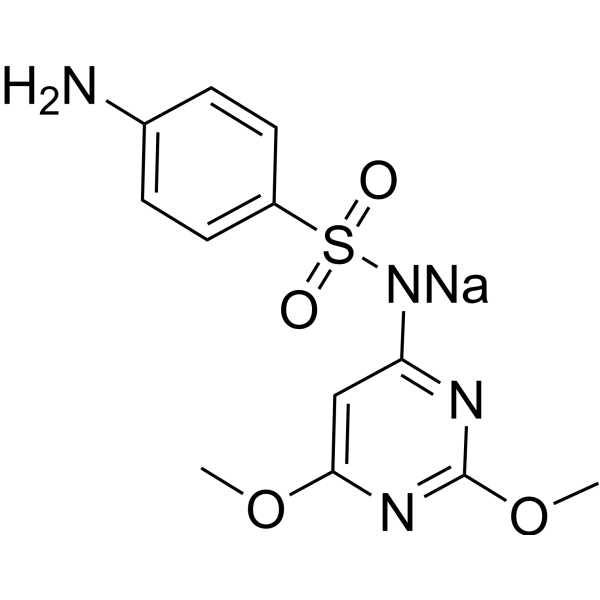
Sulfadimethoxine sodium
Based on 3 publication(s) in Google Scholar
Sulfadimethoxine (Sulphadimethoxine) sodium is an orally active sulfonamide antibiotic. Sulfadimethoxine sodium reduces Eimeria-related mortality, weight loss, and lesions. Sulfadimethoxine sodium can be used for the research of avian coccidiosis.
For research use only. We do not sell to patients.
- Purity : 99.44%
- CAS No.: 1037-50-9
- Formula: C12H13N4NaO4S
- Molecular Weight:332.31
-
Storage:
4°C, sealed storage, away from moisture and light
* In solvent : -80°C, 6 months; -20°C, 1 month (sealed storage, away from moisture and light)

To place orders, for customer services and technical support, please contact: MedChemExpress USA
Tel: 609-228-6898 E-mail: [email protected] [email protected]


-
 Biological Activity
-
Chemical Information
-
Solvent & Solubility
- Purity & Documentation
- References
-
 Help & FAQs


Publications Citing Use of MedChemExpress (MCE) Sulfadimethoxine sodium
MoreAll Antibiotic Isoforms
More

Biological Activity
Description
IC50 & Target
Antibacterial[1]
In Vitro
Sulfadimethoxine (50 µg/mL; 24 h) sodium exhibits extensive (87.5%) binding to plasma proteins from domestic short-haired cats when tested via equilibrium dialysis at 37°C[3].
MedChemExpress (MCE) has not independently confirmed the accuracy of these methods. They are for reference only. .
In Vivo
Sulfadimethoxine (0.025-0.1%; p.o.; daily; 6 days) sodium administered in drinking water starting 3 days post-infection provides complete mortality protection and reduces pathological lesions in Eimeria necatrix-infected chicks, while 0.025% is ineffective against this species[1].
Sulfadimethoxine (0.025-0.1%; p.o.; daily; 6 days) sodium administered in drinking water starting 3 days post-infection provides complete mortality protection and reduces pathological lesions in Eimeria acervulina-infected chicks, with 0.05% supporting weight gain equal to uninfected controls[1].
Sulfadimethoxine (0.025-0.1%; p.o.; daily; 6 days) sodium administered in drinking water starting 3 days post-infection provides complete mortality protection and reduces pathological lesions in Eimeria maxima-infected chicks, with all doses supporting similar weight gain[1].
Sulfadimethoxine (0.025-0.1%; p.o.; daily; 6 days) sodium administered in drinking water starting 3 days post-infection provides complete mortality protection and eliminates pathological lesions in Eimeria brunetti-infected chicks[1].
Sulfadimethoxine (0.025-0.1%; p.o.; daily; 6 days) sodium administered in drinking water starting 3 days post-infection provides complete mortality protection and reduces pathological lesions in Eimeria mivati-infected chicks, with 0.05% supporting weight gain greater than uninfected controls[1].
Sulfadimethoxine (0.05%; p.o.; daily; 6 days) sodium administered in drinking water starting 3 days post-infection provides complete mortality protection and reduces pathological lesions in chicks with mixed Eimeria infections[1].
Sulfadimethoxine (0.0125-0.05%; p.o.; daily; 6 days) sodium administered in drinking water starting 3 days post-infection provides complete mortality protection and reduces pathological lesions in Eimeria gallopavonis-infected turkey poults, with 0.025% supporting weight gain greater than uninfected controls[1].
Sulfadimethoxine (0.0125-0.05%; p.o.; daily; 6 days) sodium administered in drinking water starting 3 days post-infection provides complete mortality protection and reduces pathological lesions in Eimeria meleagrimitis-infected turkey poults[1].
Sulfadimethoxine (0.0125-0.05%; p.o.; daily; 6 days) sodium administered in drinking water starting 3 days post-infection provides complete mortality protection and reduces pathological lesions in Eimeria adenoeides-infected turkey poults[1].
MedChemExpress (MCE) has not independently confirmed the accuracy of these methods. They are for reference only.
-
Animal Model:Peterson Cross (1 day old, grouped by weight and sex, 2 weeks old at test initiation)[1]
-
Dosage:0.025%; 0.05%; 0.1%
-
Administration:p.o.; daily; 6 days
-
Result:Achieved 0% mortality, 82% weight gain relative to uninfected unmedicated controls (UUC), and average degree of infection (ADI) of 0.3 at 0.1% dose in Eimeria tenella-infected chicks.
Achieved 0% mortality, 89% weight gain relative to UUC, and ADI of 0.8 at 0.05% dose in Eimeria tenella-infected chicks.
Achieved 0% mortality, 86% weight gain relative to UUC, and ADI of 1.6 at 0.025% dose in Eimeria tenella-infected chicks.
Achieved 0% mortality, 71% weight gain relative to UUC, and ADI of 0.7 at 0.1% dose in Eimeria necatrix-infected chicks.
Achieved 5% mortality, 60% weight gain relative to UUC, and ADI of 1.9 at 0.05% dose in Eimeria necatrix-infected chicks.
Achieved 50% mortality, 39% weight gain relative to UUC, and ADI of 3.4 at 0.025% dose in Eimeria necatrix-infected chicks.
Achieved 0% mortality, 86% weight gain relative to UUC, and ADI of 0.3 at 0.1% dose in Eimeria acervulina-infected chicks.
Achieved 0% mortality, 101% weight gain relative to UUC, and ADI of 0.3 at 0.05% dose in Eimeria acervulina-infected chicks.
Achieved 0% mortality, 92% weight gain relative to UUC, and ADI of 1.6 at 0.025% dose in Eimeria acervulina-infected chicks.
Achieved 0% mortality, 83% weight gain relative to UUC, and ADI of 0.5 at 0.1% dose in Eimeria maxima-infected chicks.
Achieved 0% mortality, 84% weight gain relative to UUC, and ADI of 0.2 at 0.05% dose in Eimeria maxima-infected chicks.
Achieved 0% mortality, 84% weight gain relative to UUC, and ADI of 0.4 at 0.025% dose in Eimeria maxima-infected chicks.
Achieved 0% mortality, 80% weight gain relative to UUC, and no detectable lesions at 0.1% dose in Eimeria brunetti-infected chicks.
Achieved 0% mortality, 92% weight gain relative to UUC, and no detectable lesions at 0.05% dose in Eimeria brunetti-infected chicks.
Achieved 0% mortality, 89% weight gain relative to UUC, and no detectable lesions at 0.025% dose in Eimeria brunetti-infected chicks.
Achieved 0% mortality, 86% weight gain relative to UUC, and ADI of 0.0 at 0.1% dose in Eimeria mivati-infected chicks.
Achieved 0% mortality, 101% weight gain relative to UUC, and ADI of 0.0 at 0.05% dose in Eimeria mivati-infected chicks.
Achieved 0% mortality, 102% weight gain relative to UUC, and ADI of 0.4 at 0.025% dose in Eimeria mivati-infected chicks.
-
Animal Model:Peterson Cross (1 day old, grouped by weight and sex, 2 weeks old at test initiation)[1]
-
Dosage:0.05%
-
Administration:p.o.; daily; 6 days
-
Result:Achieved 0% mortality, 90% weight gain relative to UUC, and ADI of 0.3 in chicks with mixed Eimeria infections.
-
Animal Model:Broad Breasted White (1 day old, grouped by weight and sex, 2 weeks old at test initiation)[1]
-
Dosage:0.05%
-
Administration:0.0125%; 0.025%; 0.05%
-
Result:Achieved 0% mortality, 94% weight gain relative to UUC, and ADI of 0.1 at 0.05% dose in Eimeria gallopavonis-infected turkey poults.
Achieved 0% mortality, 101% weight gain relative to UUC, and ADI of 0.0 at 0.025% dose in Eimeria gallopavonis-infected turkey poults.
Achieved 0% mortality, 89% weight gain relative to UUC, and ADI of 0.1 at 0.0125% dose in Eimeria gallopavonis-infected turkey poults.
Achieved 0% mortality, 77% weight gain relative to UUC, and ADI of 0.0 at 0.05% dose in Eimeria meleagrimitis-infected turkey poults.
Achieved 0% mortality, 78% weight gain relative to UUC, and ADI of 0.5 at 0.025% dose in Eimeria meleagrimitis-infected turkey poults.
Achieved 0% mortality, 79% weight gain relative to UUC, and ADI of 0.8 at 0.0125% dose in Eimeria meleagrimitis-infected turkey poults.
Achieved 0% mortality, 89% weight gain relative to UUC, and ADI of 0.0 at 0.05% dose in Eimeria adenoeides-infected turkey poults.
Achieved 0% mortality, 98% weight gain relative to UUC, and ADI of 0.0 at 0.025% dose in Eimeria adenoeides-infected turkey poults.
Achieved 0% mortality, 100% weight gain relative to UUC, and ADI of 0.1 at 0.0125% dose in Eimeria adenoeides-infected turkey poults.


Chemical Information
-
CAS No. 1037-50-9
-
Appearance Solid
-
Molecular Weight 332.31
-
Formula C12H13N4NaO4S
-
Color White to off-white
-
SMILES
O=S(C1=CC=C(N)C=C1)(N([Na])C2=NC(OC)=NC(OC)=C2)=O
-
Synonyms
Sulphadimethoxine sodium
-
Shipping
Room temperature in continental US; may vary elsewhere.
-
Storage
4°C, sealed storage, away from moisture and light
* In solvent : -80°C, 6 months; -20°C, 1 month (sealed storage, away from moisture and light)


Publications (3)
-
Journal Impact Factor
-
Most Recent
-
ACS Environ Au
Machine Learning-Assisted Recognition of Environmental Sulfur-Containing Chemicals in Nontargeted Mass Spectrometry Analysis of Inadequate Mass Resolution. [Abstract]2025 Aug 5;5(6):573-582. PMID: 41277996 -
Anal Chem
Exposome-Scale Investigation of Cl-/Br-Containing Chemicals Using High-Resolution Mass Spectrometry, Multistage Machine Learning, and Cloud Computing. [Abstract]2025 Jun 3;97(21):11099-11109. PMID: 40401576 -
Chemosphere
Mass-balance-model-based evaluation of sewage treatment plant contribution to residual pharmaceuticals in environmental waters. [Abstract]2019 Jun:225:378-387. PMID: 30884299


Solvent & Solubility
In Vitro:
DMSO : 250 mg/mL (752.31 mM; Need ultrasonic; Hygroscopic DMSO has a significant impact on the solubility of product, please use newly opened DMSO)
Please refer to the solubility information to select the appropriate solvent. Once prepared, please aliquot and store the solution to prevent product inactivation from repeated freeze-thaw cycles.
Storage method and period of stock solution: -80°C, 6 months; -20°C, 1 month (sealed storage, away from moisture and light). When stored at -80°C, please use it within 6 months. When stored at -20°C, please use it within 1 month.
Please refer to the solubility information to select the appropriate solvent. Once prepared, please aliquot and store the solution to prevent product inactivation from repeated freeze-thaw cycles.
Storage method and period of stock solution: -80°C, 6 months; -20°C, 1 month (sealed storage, away from moisture and light). When stored at -80°C, please use it within 6 months. When stored at -20°C, please use it within 1 month.
Concentration (start) × Volume (start) = Concentration (final) × Volume (final)
In Vivo:
Select the appropriate dissolution method based on your experimental animal and administration route.
- For the following dissolution methods, please ensure to first prepare a clear stock solution using an In Vitro approach and then sequentially add co-solvents:
- To ensure reliable experimental results, the clarified stock solution can be appropriately stored based on storage conditions. As for the working solution for In Vivo experiments, it is recommended to prepare freshly and use it on the same day.
- The percentages shown for the solvents indicate their volumetric ratio in the final prepared solution. If precipitation or phase separation occurs during preparation, heat and/or sonication can be used to aid dissolution.
Add each solvent one by one: 10% DMSO 40% PEG300 5% Tween-80 45% Saline
Solubility: ≥ 2.08 mg/mL (6.26 mM); Clear solution
This protocol yields a clear solution of ≥ 2.08 mg/mL (saturation unknown).
Taking 1 mL working solution as an example, add 100 μL DMSO stock solution (20.8 mg/mL) to 400 μL PEG300, and mix evenly; then add 50 μL Tween-80 and mix evenly; then add 450 μL Saline to adjust the volume to 1 mL.
Preparation of Saline: Dissolve 0.9 g sodium chloride in ddH₂O and dilute to 100 mL to obtain a clear Saline solution.
Add each solvent one by one: 10% DMSO 90% (20% SBE-β-CD in Saline)
Solubility: ≥ 2.08 mg/mL (6.26 mM); Clear solution
This protocol yields a clear solution of ≥ 2.08 mg/mL (saturation unknown).
Taking 1 mL working solution as an example, add 100 μL DMSO stock solution (20.8 mg/mL) to 900 μL 20% SBE-β-CD in Saline, and mix evenly.
Preparation of 20% SBE-β-CD in Saline (4°C, storage for one week): 2 g SBE-β-CD powder is dissolved in 10 mL Saline, completely dissolve until clear.
In Vivo Dissolution Calculator
Please enter the basic information of animal experiments:
-
-
-
-
Recommended: Prepare an additional quantity of animals to account for potential losses during experiments.
Please enter your animal formula composition:
-
%DMSO +
Recommended: Keep the proportion of DMSO in working solution below 2% if your animal is weak.
-
%+
-
+%Tween-80 + +
-
%Saline +
The co-solvents required include: DMSO, . All of co-solvents are available by MedChemExpress (MCE). , Tween 80. All of co-solvents are available by MedChemExpress (MCE).
Working solution concentration: 0.22 mg/mL
Method for preparing stock solution: mg drug dissolved in μL DMSO. Stock solution concentration: mg/mL. * In solvent : -80°C, 6 months; -20°C, 1 month (sealed storage, away from moisture and light)
1. Take μL DMSO stock solution;
2. Add μL .
μL , mix evenly;
3. Then add μL Tween 80, mix evenly;
4. Then add μL
Please ensure that the stock solution in the first step is dissolved to a clear state, and add co-solvents in sequence. You can use ultrasonic heating (ultrasonic cleaner, recommended frequency 20-40 kHz), vortexing, etc. to assist dissolution.


Purity & Documentation
-
Data Sheet (288 KB)
-
SDS (393 KB)
- English - EN (393 KB)
- Français - FR (393 KB)
- Deutsch - DE (393 KB)
- Norwegian - NO (393 KB)
- Español - ES (393 KB)
- Swedish - SV (393 KB)
- Italian - IT (393 KB)
- Korean - KR (393 KB)
- Portuguese - PT (393 KB)
-
Handling Instructions (2659 KB)
References
[1]. AGUIRRE M, [Sulfadimethoxine in various infections. Results]. Rev Clin Esp. 1961 Sep 30;82:394-9. [Content Brief]
[2]. Guerard JJ, et al. Photochemical fate of sulfadimethoxine in aquaculture waters. Environ Sci Technol. 2009 Nov 15;43(22):8587-92. [Content Brief]
[3]. Yu HY, et al. Effect of sulfadimethoxine on thiopental distribution and elimination in rats. J Pharm Sci. 1981 Mar;70(3):323-6. [Content Brief]
[4]. FAULKNER JW, et al. The use of sulfadimethoxine in the treatment of urinary tract infections. J Urol. 1960 Feb;83:181-3. [Content Brief]


Complete Stock Solution Preparation Table
Please refer to the solubility information to select the appropriate solvent. Once prepared, please aliquot and store the solution to prevent product inactivation from repeated freeze-thaw cycles.
Storage method and period of stock solution: -80°C, 6 months; -20°C, 1 month (sealed storage, away from moisture and light). When stored at -80°C, please use it within 6 months. When stored at -20°C, please use it within 1 month.
| Optional Solvent | Concentration Solvent Mass | 1 mg | 5 mg | 10 mg | 25 mg |
|---|---|---|---|---|---|
| DMSO | 1 mM | 3.0092 mL | 15.0462 mL | 30.0924 mL | 75.2310 mL |
| 5 mM | 0.6018 mL | 3.0092 mL | 6.0185 mL | 15.0462 mL | |
| 10 mM | 0.3009 mL | 1.5046 mL | 3.0092 mL | 7.5231 mL | |
| 15 mM | 0.2006 mL | 1.0031 mL | 2.0062 mL | 5.0154 mL | |
| 20 mM | 0.1505 mL | 0.7523 mL | 1.5046 mL | 3.7615 mL | |
| 25 mM | 0.1204 mL | 0.6018 mL | 1.2037 mL | 3.0092 mL | |
| 30 mM | 0.1003 mL | 0.5015 mL | 1.0031 mL | 2.5077 mL | |
| 40 mM | 0.0752 mL | 0.3762 mL | 0.7523 mL | 1.8808 mL | |
| 50 mM | 0.0602 mL | 0.3009 mL | 0.6018 mL | 1.5046 mL | |
| 60 mM | 0.0502 mL | 0.2508 mL | 0.5015 mL | 1.2538 mL | |
| 80 mM | 0.0376 mL | 0.1881 mL | 0.3762 mL | 0.9404 mL | |
| 100 mM | 0.0301 mL | 0.1505 mL | 0.3009 mL | 0.7523 mL |


Sulfadimethoxine sodium Related Classifications
HY-B0337A Related Classifications
 Powered by Bioz