



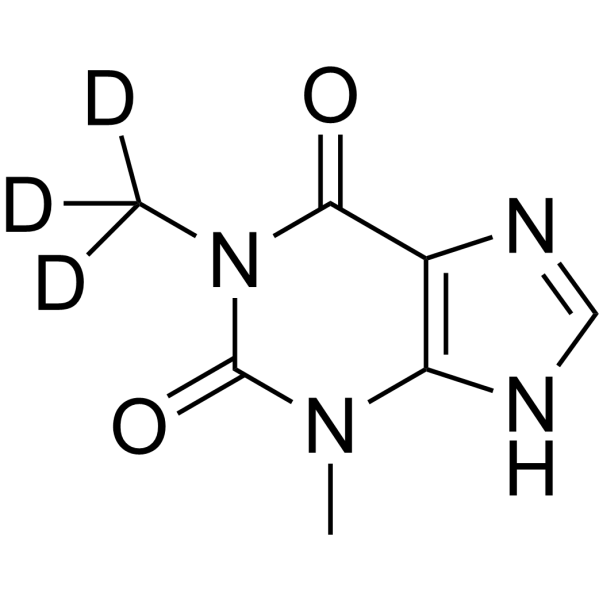
Theophylline-d3
Theophylline-d3 is deuterated labeled Theophylline (HY-B0809). Theophylline (1,3-Dimethylxanthine) is a potent phosphodiesterase (PDE) inhibitor, adenosine receptor antagonist, and histone deacetylase (HDAC) activator. Theophylline (1,3-Dimethylxanthine) inhibits PDE3 activity to relax airway smooth muscle. Theophylline (1,3-Dimethylxanthine) has anti-inflammatory activity by increase IL-10 and inhibit NF-κB into the nucleus. Theophylline (1,3-Dimethylxanthine) induces apoptosis. Theophylline (1,3-Dimethylxanthine) can be used for asthma and chronic obstructive pulmonary disease (COPD) research.
商品は「研究用試薬」です。人や動物の医療用・臨床診断用・食品用の製品ではありません。
研究用途以外に使用した場合、当社は一切の責任を負いかねます。
- CAS 番号: 65566-68-9
- 分子式: C7H5D3N4O2
- 分子量:183.18
-
保管条件:
Please store the product under the recommended conditions in the Certificate of Analysis.

To place orders, for customer services and technical support, please contact: MedChemExpress USA
Tel: 609-228-6898 E-mail: [email protected] [email protected]


-
 生物活性
生物活性
-
化学情報
- プロトコル
- 純度とドキュメンテーション
- 参考文献
-
 Help & FAQs




生物活性
製品説明
体外実験
Stable heavy isotopes of hydrogen, carbon, and other elements have been incorporated into drug molecules, largely as tracers for quantitation during the drug development process. Deuteration has gained attention because of its potential to affect the pharmacokinetic and metabolic profiles of drugs[1].
Theophylline (1,3-Dimethylxanthine) (1-1000 μM) inhibits cAMP hydrolysis by PDE in homogenates of bronchial tissue to relax human bronchus and pulmonary arteries[2].
Theophylline (1,3-Dimethylxanthine) (10 μg/mL; 24 h; eosinophils) induces apoptosis through a reduction in the antiapoptotic protein Bcl-2[3].
Theophylline (1,3-Dimethylxanthine) (0-500 μM; 2 h; A549 cells) inhibits NF-κB activation, I kappa B alpha (I-κBα) degradation and decreases the level of IL-6 in a concentration-dependent manner[4].
Theophylline (1,3-Dimethylxanthine) (0-1000 μM; 30 min; A549 cells) induces histone deacetylase activity to decrease inflammatory gene expression[5].
MedChemExpress (MCE) has not independently confirmed the accuracy of these methods. They are for reference only.
体内実験
MedChemExpress (MCE) has not independently confirmed the accuracy of these methods. They are for reference only.
アプリケーション
1. This compound can be used as a tracer
2. This compound can be used as an internal standard for quantitative analysis by NMR, GC-MS, or LC-MS.


化学情報
-
CAS 番号 65566-68-9
-
非標識Cas 58-55-9
-
分子量 183.18
-
分子式 C7H5D3N4O2
-
SMILES
O=C(N1C([2H])([2H])[2H])N(C)C2=C(N=CN2)C1=O
-
別名
1,3-Dimethylxanthine-d3; Theo-24-d3
-
輸送条件
Room temperature in continental US; may vary elsewhere.
-
保管条件
Please store the product under the recommended conditions in the Certificate of Analysis.


純度とドキュメンテーション
参考文献
[1]. Russak EM, et al. Impact of Deuterium Substitution on the Pharmacokinetics of Pharmaceuticals. Ann Pharmacother. 2019 Feb;53(2):211-216. [Content Brief]
[2]. Rabe KF, et, al. Theophylline and selective PDE inhibitors as bronchodilators and smooth muscle relaxants. Eur Respir J. 1995 Apr;8(4):637-42. [Content Brief]
[3]. Németh ZH, et, al. Amrinone and theophylline differentially regulate cytokine and nitric oxide production in endotoxemic mice. Shock. 1997 May;7(5):371-5. [Content Brief]
[4]. Ichiyama T, et, al. Theophylline inhibits NF-kappa B activation and I kappa B alpha degradation in human pulmonary epithelial cells. Naunyn Schmiedebergs Arch Pharmacol. 2001 Dec;364(6):558-61. [Content Brief]
[5]. Ito K, et, al, Adcock IM, Barnes PJ. A molecular mechanism of action of theophylline: Induction of histone deacetylase activity to decrease inflammatory gene expression. Proc Natl Acad Sci U S A. 2002 Jun 25;99(13):8921-6. [Content Brief]
[6]. Barnes PJ. Theophylline. Am J Respir Crit Care Med. 2013 Oct 15;188(8):901-6. [Content Brief]

Calculators
濃度 (開始) × 体積 (開始) = 濃度 (終了) × 体積 (終了)


Theophylline-d3 関連分類
HY-B0809S1 関連分類
 Powered by Bioz
Keywords
- Theophylline-d3
- 65566-68-9
- 1,3-Dimethylxanthine-d3
- Theo-24-d3
- Endogenous Metabolite
- TNF Receptor
- Apoptosis
- HDAC
- Phosphodiesterase (PDE)
- Adenosine Receptor
- Interleukin Related
- Isotope-Labeled Compounds
- airway smooth muscle
- NF-κB
- I-κBα
- asthma
- chronic obstructive pulmonary disease
- A549 cells
- eosinophils
- Inhibitor
- inhibitor
- inhibit