



Organoid Culture
An organoid is a 3D multicellular in vitro tissue construct that mimics the complex structure and functionality of corresponding in vivo organ. Organoids can be generated from stem cells in adult tissue or from pluripotent stem cells.
Organoid structures provide a very useful tool as a model to study tissue development and disease, personalized medicine, drug screening and cell therapy.
Organoids recapitulate multiple biological parameters including the spatial organization of heterogeneous tissue-specific cells, cell-cell interactions, and cell-matrix interactions, and certain physiological functions generated by tissue-specific cells within the organoid.
They are more physiologically relevant than monolayer culture models and are far more amenable to manipulation of niche components, signalling pathways and genome editing than in vivo models.
Organoids can be fast expanded long-term, cryopreserved and applied to high-throughput analyses.

Organoids are generated from tissue-specific adult stem cells or ESCs/iPSCs. Organoids are typically cultured in an extracellular matrix (ECM) surrounded by culture media supplemented with niche factors specific to the organoid type. Common niche and ECM factors: R-spondin (RSPO1), EGF, Noggin, Activin A, Collagen.
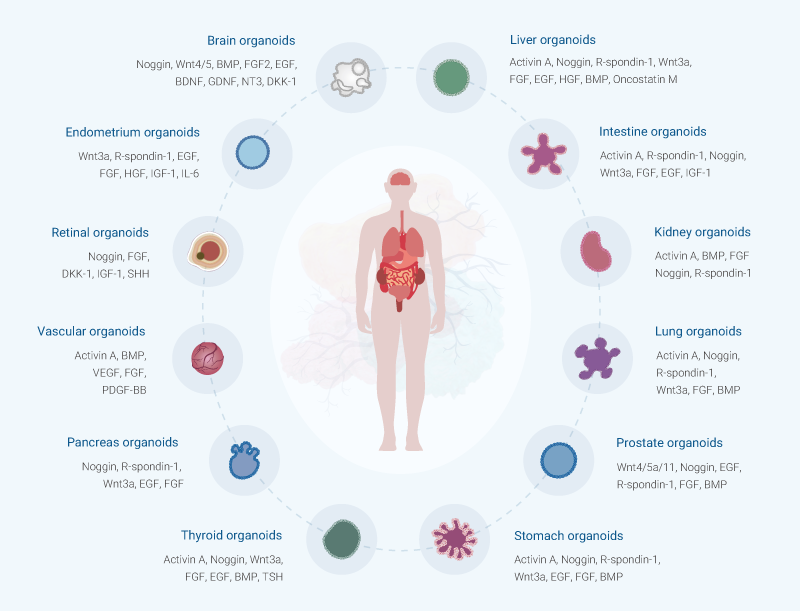
Common Reagents for Organoid Culture
Recombinant Proteins
| Cat. No | Product Name | Proteins | Function |
|---|---|---|---|
| Wnt | An essential niche component for maintaining the proliferation of Lgr5-positive stem cells in various organoids, such as the intestinal, gastric, pancreatic and liver organoids. | ||
| EGF | A growth factor for epithelial tissues; binding to EGF receptors, induces hyperplasic changes. Used for the generation of intestinal, liver, thyroid, and brain organoids. | ||
| Noggin | An inhibitor of bone morphogenetic proteins that modulates cellular differentiation, proliferation, and apoptosis. | ||
| R-spondin | The ligand of Lgr5 and a niche factor that is required for the self-renewal of stem cells and activates Wnt signaling. An essential additive of the organoid culture system. | ||
| FGF | FGFs play crucial roles in a wide variety of cellular functions, including cell proliferation, survival, metabolism, morphogenesis, and differentiation, as well as in tissue repair and regeneration. In a 3D extracellular matrix, FGF-2, FGF-7, FGF-9, and FGF-10 promote lung organoid formation. | ||
| BMP | BMPs play crucial roles in embryogenesis and development, and also in maintenance of adult tissue homeostasis. BMP-2 and BMP-4 are widely used in in vitro generation of hepatic cells from iPSCs and ESCs. | ||
| VEGF | VEGF-A is required during embryogenesis to regulate the proliferation, migration, and survival of endothelial cells. It is used in the generation of vascular organoids. | ||
| PDGF | PDGF-BB induces vascular smooth muscle cells (VSMC) specification and cell differentiation in the vascular. | ||
| HGF | A known hepatocyte mitogen that can be used for the liver organoid culture. | ||
| Activin A | A cytokine with multiple roles in development and homeostasis.In the case of intestinal organoids, it activates TGF-β signaling in PSCs to trigger endodermal differentiation. | ||
| DKK | A canonical WNT inhibitor that can induce retinal progenitors for self-organization. |
Basement Membrane Matrix
| Cat. No | Product Name | Application |
|---|---|---|
| In vitro angiogenesis, tumor cell migration or invasion | ||
| In vitro angiogenesis, tumor cell migration or invasion | ||
| Organoid culture, in vitro angiogenesis | ||
| Organoid culture, in vitro angiogenesis | ||
| Transplantation/induction of tumorigenic models such as PDX, CDX | ||
| Stem cell expansion and differentiation | ||
| Organoid culture |
Organoid Culture Kit
| Cat. No | Types of tissue | Cat. No | Types of tissue | organoid medium |
|---|---|---|---|---|
| HY-K6101 | Human breast cancer | HY-K6106 | Human Cholangiocarcinoma | Tumor organoid medium |
| HY-K6102 | Human Lung Adenocarcinoma | HY-K6107 | Human Cervical Cancer | |
| HY-K6103 | Human Small Cell Lung Cancer | HY-K6108 | Human Esophageal Cancer | |
| HY-K6104 | Human Colorectal Cancer | HY-K6109 | Human Endometrial Cancer | |
| HY-K6105 | Human Gastric Cancer | HY-K6110 | Human Pancreatic Cancer | |
| HY-K6111 | Human Head and Neck Squamous Cell Carcinoma | HY-K6120 | Mouse Colonic | |
| HY-K6112 | Human Colonic | HY-K6116 | Human Kidney Tubular | Normal Tissue organoid Medium |
| HY-K6113 | Human Intestinal | HY-K6117 | Human Liver Ductal | |
| HY-K6114 | Human Gastric Epithelial | HY-K6118 | Mouse Liver Ductal | |
| HY-K6115 | Human Pancreatic | HY-K6119 | Mouse Intestinal |
Experiment Validation
-

Measured by its ability to induce Topflash reporter activity in HEK293T human embryonic kidney cells. The ED50 for this effect is 5.2 ng/mL.
-

The ED50 of human Wnt Surrogate from MedChemExpress's each Lot is lower than of Competitor P.
-

The ED50 is <0.2 ng/mL as measured by murine BALB/c 3T3 cells.
-

Measured by its ability to inhibit BMP-4-induced alkaline phosphatase production by ATDC5 mouse chondrogenic cells in the presence of Recombinant Human BMP-4 (40 ng/mL), with an ED50 of 4 ng/mL.
-
D8
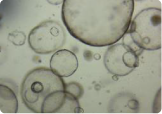
HY-K6002
Mouse liver ductal organoids
cultured by MedChemExpress (MCE) Basement
Membrane Matrix -
D7
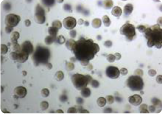
HY-K6003
Mouse trachea organoids
cultured by MedChemExpress (MCE) Basement
Membrane Matrix GFR
(Phenol Red) -
D4
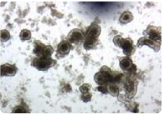
HY-K6006
Mouse intestinal organoid
cultured by MedChemExpress (MCE) Basement
Membrane Matrix
IPSC-qualified -
D11
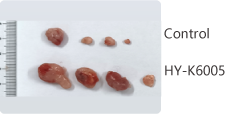
HY-K6005
Tumor volume in tumor cell-loaded tumor
model (CDX) mice by MedChemExpress (MCE) Basement
Membrane Matrix HC (Phenol Red)