



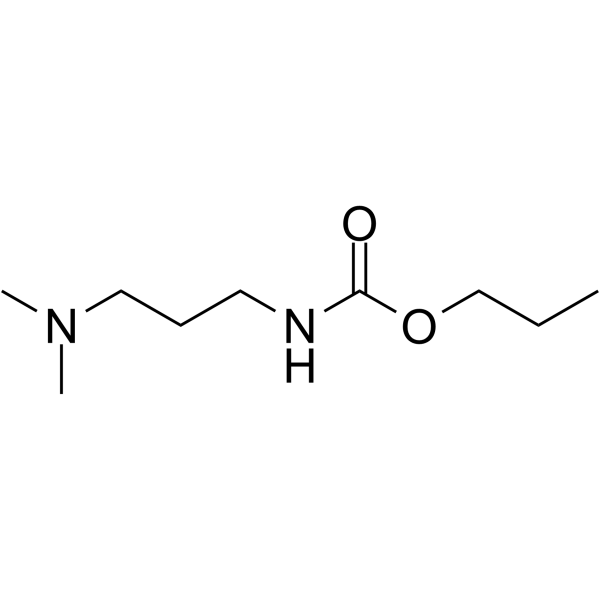
Propamocarb

Based on 1 Customer Validation
Propamocarb is an orally active phenylalanine ammonia-lyase (PAL) inducer and oomycete membrane biosynthesis inhibitor that can be present in synthetic formulations. Propamocarb is used in research on blight, gut microbiota dysbiosis and metabolic disorders, cardiovascular diseases, and potato late blight.
For research use only. We do not sell to patients.
- Purity : 99.90%
- CAS No.: 24579-73-5
- Formula: C9H20N2O2
- Molecular Weight:188.27
-
Storage:
4°C, protect from light
* In solvent : -80°C, 6 months; -20°C, 1 month (protect from light)

To place orders, for customer services and technical support, please contact: MedChemExpress USA
Tel: 609-228-6898 E-mail: [email protected] [email protected]


-
 Biological Activity
-
Chemical Information
-
Solvent & Solubility
- Protocols
- Purity & Documentation
- References
-
 Help & FAQs




Biological Activity
Description
In Vitro
Propamocarb significantly increases the activities of PAL (to 101.8 nmol·h-1·mg-1 protein) and POD (to 106.1 U·g-1 FW) in cucumber fruit peel[1].
Propamocarb significantly increases acetylbromide-extractable Lignin (HY-111830) content in cucumber fruit peel, reaching 80.76 mg/g dry weight, which is a 41.1% increase compared to the control[1].
Propamocarb (1.8-10 mg/mL; 5-7 days) provided minimal inhibition of mycelial growth for the 71 P. nicotianae isolates tested, with the most sensitive isolate showing 34.8% relative growth at 10 mg/mL[2].
Propamocarb (1-100 mg/mL; 5-7 days) is a poor inhibitor of P. nicotianae mycelial growth, with EC50 values ranging from 2.2 to 90.1 mg/mL across the nine isolates and a mean of 20.6 mg/mL[2].
Propamocarb (5-50,000 µg/mL; 10 h) potently suppressed sporangium production in P. nicotianae isolates, with EC50 values ranging from 133.8 to 481.3 µg/mL and complete inhibition at 50,000 µg/mL[2].
Propamocarb (5-50,000 µg/mL; 10 min-1 h) inhibited zoospore motility in P. nicotianae isolates, with EC50 values ranging from 88.1 to 249.8 µg/mL and complete cessation of motility within 10 min at 5,000 µg/mL or above[2].
Propamocarb (5-50,000 µg/mL; 2 days) inhibited zoospore germination in P. nicotianae isolates, with EC50 values ranging from 1.9 to 184.6 µg/mL across the nine isolates[2].
Propamocarb (0.1-50 µg/mL; 7 days) slightly affected cell viability and moderately reduced mitochondrial function, glucose consumption, and intracellular ATP in primary rat cortical neurons, with these effects being strongly mitigated or completely prevented by pyruvate and acetylcysteine supplementation; the compound showed no direct effect on GSH levels within 1 h[5].
Propamocarb controls late blight in detached potato leaves incited by P. infestans with EC90 values ranging from 72 to 122 ppm, with no significant difference between Metalaxyl (HY-B0843)-sensitive and metalaxyl-resistant isolates[6].
MedChemExpress (MCE) has not independently confirmed the accuracy of these methods. They are for reference only.
In Vivo
MedChemExpress (MCE) has not independently confirmed the accuracy of these methods. They are for reference only.
-
Animal Model:ICR mice (Male, 5 weeks old)[3]
-
Dosage:3, 30, and 300 mg/L (0.5, 5, and 50 mg/kg bw/day)
-
Administration:p.o.; ad libitum; 28 days
-
Result:Decreased hepatic TG levels to 75.8% in the 30 mg/L group and 69.7% in the 300 mg/L group.
Significantly decreased mRNA levels of Fatp2 in all treatment groups, Fabp2 in the 30 mg/L group, Acox in all groups, and Scd1 in all groups.
Significantly up-regulated colonic LPL transcription in the 30 and 300 mg/L groups and increased colonic LPL protein in the 3 and 300 mg/L groups.
Decreased colonic GPR41 transcription in all treated groups.
Altered 20 fecal metabolites in the 300 mg/L group, including increased propionate, isobutyrate, total bile acids, taurine, choline, ethanolamine, and trimethylamine, and decreased succinate, trehalose, β-galactose, glycerol, and lactate.
-
Animal Model:C57BL/6J mice (Male, 5-week-old)[4]
-
Dosage:1 mg/L; 3 mg/L; 10 mg/L
-
Administration:p.o.; in drinking water; continuously for 10 weeks
-
Result:Increased total hepatic bile acids (BAs) by 29.8% (10.9 mmol/g vs. 8.4 mmol/g) at 10 mg/L.
Down-regulated mRNA levels of Cyp7a1, Cyp8b1, Cyp27a1, and BA transporters Abcb11, Ntcp, Mrp2, and Mrp3 in the liver.
Decreased FXR expression considerably at 10 mg/L.
Decreased Lbabp mRNA level significantly in the ileum at 3 and 10 mg/L.
Increased serum levels of TCA (64.70 vs. 46.30 nmol/L), UDCA (25.81 vs. 12.80 nmol/L), TβMCA (86.4 vs. 42.79 nmol/L), TωMCA (140.60 vs. 92.33 nmol/L), βMCA (298.48 vs. 159.77 nmol/L), and ωMCA (212.62 vs. 148.17 nmol/L) at 10 mg/L.
Decreased expression of genes related to fatty acid translation, β-oxidation, and TG synthesis significantly at 10 mg/L.
Increased hepatic FMO3 protein levels significantly at 1, 3, and 10 mg/L.
Increased cardiac NO levels significantly at 10 mg/L.
Decreased cardiac NOS activities significantly at 3 and 10 mg/L.
Increased transcriptional levels of NF-κB in the heart significantly at 3 and 10 mg/L.
Increased fecal trimethylamine (TMA) significantly at 10 mg/L.


Chemical Information
-
CAS No. 24579-73-5
-
Appearance Liquid
-
Molecular Weight 188.27
-
Formula C9H20N2O2
-
Color Colorless to light yellow
-
SMILES
O=C(OCCC)NCCCN(C)C
-
Shipping
Room temperature in continental US; may vary elsewhere.
-
Storage
4°C, protect from light
* In solvent : -80°C, 6 months; -20°C, 1 month (protect from light)


Solvent & Solubility
In Vitro:
DMSO : 100 mg/mL (531.15 mM; Need ultrasonic; Hygroscopic DMSO has a significant impact on the solubility of product, please use newly opened DMSO)
Please refer to the solubility information to select the appropriate solvent. Once prepared, please aliquot and store the solution to prevent product inactivation from repeated freeze-thaw cycles.
Storage method and period of stock solution: -80°C, 6 months; -20°C, 1 month (protect from light). When stored at -80°C, please use it within 6 months. When stored at -20°C, please use it within 1 month.
Concentration (start) × Volume (start) = Concentration (final) × Volume (final)
In Vivo:
Select the appropriate dissolution method based on your experimental animal and administration route.
- For the following dissolution methods, please ensure to first prepare a clear stock solution using an In Vitro approach and then sequentially add co-solvents:
- To ensure reliable experimental results, the clarified stock solution can be appropriately stored based on storage conditions. As for the working solution for In Vivo experiments, it is recommended to prepare freshly and use it on the same day.
- The percentages shown for the solvents indicate their volumetric ratio in the final prepared solution. If precipitation or phase separation occurs during preparation, heat and/or sonication can be used to aid dissolution.
Add each solvent one by one: 10% DMSO 40% PEG300 5% Tween-80 45% Saline
Solubility: ≥ 1.67 mg/mL (8.87 mM); Clear solution
This protocol yields a clear solution of ≥ 1.67 mg/mL (saturation unknown).
Taking 1 mL working solution as an example, add 100 μL DMSO stock solution (16.7 mg/mL) to 400 μL PEG300, and mix evenly; then add 50 μL Tween-80 and mix evenly; then add 450 μL Saline to adjust the volume to 1 mL.
Preparation of Saline: Dissolve 0.9 g sodium chloride in ddH₂O and dilute to 100 mL to obtain a clear Saline solution.
Add each solvent one by one: 10% DMSO 90% (20% SBE-β-CD in Saline)
Solubility: ≥ 1.67 mg/mL (8.87 mM); Clear solution
This protocol yields a clear solution of ≥ 1.67 mg/mL (saturation unknown).
Taking 1 mL working solution as an example, add 100 μL DMSO stock solution (16.7 mg/mL) to 900 μL 20% SBE-β-CD in Saline, and mix evenly.
Preparation of 20% SBE-β-CD in Saline (4°C, storage for one week): 2 g SBE-β-CD powder is dissolved in 10 mL Saline, completely dissolve until clear.
In Vivo Dissolution Calculator
Please enter the basic information of animal experiments:
-
-
-
-
Recommended: Prepare an additional quantity of animals to account for potential losses during experiments.
Please enter your animal formula composition:
-
%DMSO +
Recommended: Keep the proportion of DMSO in working solution below 2% if your animal is weak.
-
%+
-
+%Tween-80 + +
-
%Saline +
The co-solvents required include: DMSO, . All of co-solvents are available by MedChemExpress (MCE). , Tween 80. All of co-solvents are available by MedChemExpress (MCE).
Working solution concentration: 0.22 mg/mL
Method for preparing stock solution: mg drug dissolved in μL DMSO. Stock solution concentration: mg/mL. * In solvent : -80°C, 6 months; -20°C, 1 month (protect from light)
1. Take μL DMSO stock solution;
2. Add μL .
μL , mix evenly;
3. Then add μL Tween 80, mix evenly;
4. Then add μL
Please ensure that the stock solution in the first step is dissolved to a clear state, and add co-solvents in sequence. You can use ultrasonic heating (ultrasonic cleaner, recommended frequency 20-40 kHz), vortexing, etc. to assist dissolution.


Purity & Documentation
-
Data Sheet (282 KB)
-
SDS (393 KB)
- English - EN (393 KB)
- Français - FR (393 KB)
- Deutsch - DE (393 KB)
- Norwegian - NO (393 KB)
- Español - ES (393 KB)
- Swedish - SV (393 KB)
- Italian - IT (393 KB)
- Korean - KR (393 KB)
- Portuguese - PT (393 KB)
-
Handling Instructions (2659 KB)
References
[2]. Hu J, et al. Effects of Propamocarb Hydrochloride on Mycelial Growth, Sporulation, and Infection by Phytophthora nicotianae Isolates from Virginia Nurseries. Plant disease. 2007 Apr;91(4):414-420. [Content Brief]
[3]. Wu S, et al. Exposure to the fungicide propamocarb causes gut microbiota dysbiosis and metabolic disorder in mice. Environmental pollution (Barking, Essex : 1987). 2018 Jun;237:775-783. [Content Brief]
[4]. Wu S, et al. Chronic exposure to fungicide propamocarb induces bile acid metabolic disorder and increases trimethylamine in C57BL/6J mice. Sci Total Environ. 2018 Nov 15;642:341-348. [Content Brief]
[5]. Schmuck G, et al. Effects of the carbamates fenoxycarb, propamocarb and propoxur on energy supply, glucose utilization and SH-groups in neurons. Archives of toxicology. 2004 Jun;78(6):330-7. [Content Brief]


Complete Stock Solution Preparation Table
Please refer to the solubility information to select the appropriate solvent. Once prepared, please aliquot and store the solution to prevent product inactivation from repeated freeze-thaw cycles.
Storage method and period of stock solution: -80°C, 6 months; -20°C, 1 month (protect from light). When stored at -80°C, please use it within 6 months. When stored at -20°C, please use it within 1 month.
| Optional Solvent | Concentration Solvent Mass | 1 mg | 5 mg | 10 mg | 25 mg |
|---|---|---|---|---|---|
| DMSO | 1 mM | 5.3115 mL | 26.5576 mL | 53.1152 mL | 132.7880 mL |
| 5 mM | 1.0623 mL | 5.3115 mL | 10.6230 mL | 26.5576 mL | |
| 10 mM | 0.5312 mL | 2.6558 mL | 5.3115 mL | 13.2788 mL | |
| 15 mM | 0.3541 mL | 1.7705 mL | 3.5410 mL | 8.8525 mL | |
| 20 mM | 0.2656 mL | 1.3279 mL | 2.6558 mL | 6.6394 mL | |
| 25 mM | 0.2125 mL | 1.0623 mL | 2.1246 mL | 5.3115 mL | |
| 30 mM | 0.1771 mL | 0.8853 mL | 1.7705 mL | 4.4263 mL | |
| 40 mM | 0.1328 mL | 0.6639 mL | 1.3279 mL | 3.3197 mL | |
| 50 mM | 0.1062 mL | 0.5312 mL | 1.0623 mL | 2.6558 mL | |
| 60 mM | 0.0885 mL | 0.4426 mL | 0.8853 mL | 2.2131 mL | |
| 80 mM | 0.0664 mL | 0.3320 mL | 0.6639 mL | 1.6599 mL | |
| 100 mM | 0.0531 mL | 0.2656 mL | 0.5312 mL | 1.3279 mL |


Propamocarb Related Classifications
HY-B2026 Related Classifications
 Powered by Bioz
Keywords
- Propamocarb
- 24579-73-5
- Fungal
- Biochemical Assay Reagents
- oomycete membrane biosynthesis inhibitor
- gut microbiota dysbiosis
- cardiovascular disease
- cucumber fruit peel
- late blight of potato
- Phytophthora nicotianae
- phenylpropanoid pathway
- phenylalanine ammonia-lyase (PAL) inducer
- lignin synthesis
- Phytophthora infestans
- Inhibitor
- inhibitor
- inhibit