



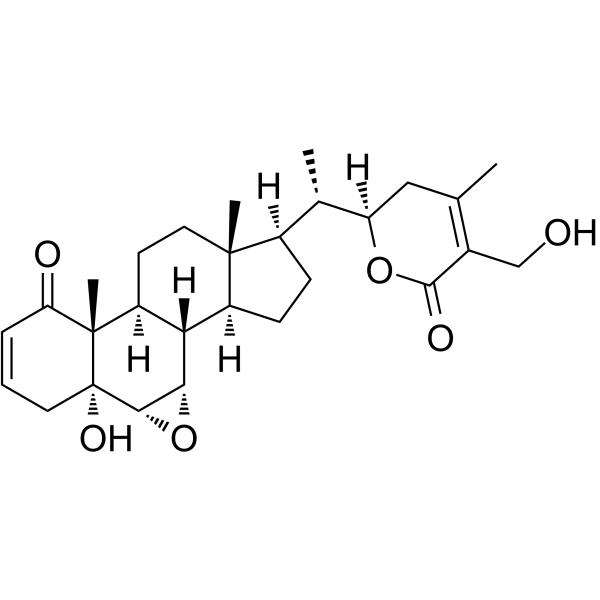
12-Deoxywithastramonolide

Based on 1 Customer Validation
12-Deoxywithastramonolide is an orally active withanolide. 12-Deoxywithastramonolide inhibits the release of pro-inflammatory cytokines (IL-6, IL-1β). 12-Deoxywithastramonolide shows no TRAIL-sensitizing activity in cell growth assays with or without the addition of TRAIL. 12-Deoxywithastramonolide produces analgesic and anti-inflammatory effects in animal models, reducing thermal hyperalgesia, acetic acid-induced writhing responses, Carrageenan (HY-125474)-induced paw edema, and vascular permeability.
For research use only. We do not sell to patients.
- Purity : 99.17%
- CAS No.: 60124-17-6
- Formula: C28H38O6
- Molecular Weight:470.60
-
Storage:Powder -20°C, 3 years , 4°C, 2 years ; In solvent -80°C, 6 months , -20°C, 1 month

To place orders, for customer services and technical support, please contact: MedChemExpress USA
Tel: 609-228-6898 E-mail: [email protected] [email protected]


-
 Biological Activity
-
Chemical Information
-
Solvent & Solubility
- Protocols
- Purity & Documentation
- References
-
 Help & FAQs




Biological Activity
Description
IC50 & Target
[2]|
IL-1β |
IL-6 |
Cellular Effect
|
Cell Line

|
Type | Value | Description | References |
|---|---|---|---|---|
| ACHN | IC50 |
>40 μM
|
Cell growth inhibition against human ACHN renal carcinoma cells in the presence and absence of TRAIL, with IC50 >40 μM.
Cell growth inhibition against human ACHN renal carcinoma cells in the presence and absence of TRAIL, with IC50 >40 μM.
|
25719250 |
In Vitro
MedChemExpress (MCE) has not independently confirmed the accuracy of these methods. They are for reference only.
-
Cell Line:J774A.1 mouse macrophages
-
Concentration:25-200 μM
-
Incubation Time:24 and 48 h
-
Result:Approximately 90% of J774A.1 macrophages remained viable even at 200 μM after 24 and 48 h.
The 1.25-10 μM range was subsequently used for anti-inflammatory assays.
-
Cell Line:J774A.1 mouse macrophages
-
Concentration:10 μM
-
Incubation Time:24 h
-
Result:At 10 μM, IL-6 release was inhibited by 29% and IL-1β release by 95%; TNF-α release was also inhibited.
In Vivo
12-Deoxywithastramonolide (20 mg/kg; p.o.; single dose) reduces acetic acid-induced writhing in mice, producing 32% inhibition[2].
12-Deoxywithastramonolide (20 mg/kg; p.o.; single dose) reduces Carrageenan (HY-125474)-induced rat paw edema, producing 17% inhibition[2].
MedChemExpress (MCE) has not independently confirmed the accuracy of these methods. They are for reference only.
-
Animal Model:BALB/c (female, 6-8 weeks, 25-30 g)[2]
-
Dosage:20 mg/kg
-
Administration:p.o.
-
Result:Reduced acute thermal nociception at 0.5-2 h post-dose relative to vehicle.
-
Animal Model:BALB/c (female, 6-8 weeks, 25-30 g)[2]
-
Dosage:20 mg/kg
-
Administration:p.o.
-
Result:Produced 32% inhibition of acetic acid-induced writhing.
-
Animal Model:Wistar (female, 6-8 weeks, 130-140 g)[2]
-
Dosage:20 mg/kg
-
Administration:p.o.
-
Result:Produced 17% inhibition of carrageenan-induced rat paw edema at 2 h.
-
Animal Model:Wistar (female, 6-8 weeks, 130-140 g)[2]
-
Dosage:20 mg/kg
-
Administration:p.o.
-
Result:Produced 36% inhibition of acetic acid-induced vascular permeability.
- LPS-Induced Endotoxemia/Systemic Inflammation
- Protocol for Cell Counting and Cell Density Analysis
- Somatic Cell Culture
- Carrageenan-Induced Paw Edema
- Transepithelial/transendothelial electrical resistance assay
- CCK-8/WST-8 Cell Proliferation Assay
- Research Protocol for Inflammation-related Diseases
- Cell Counting-Based Growth Curve Assay
- MTT Cell Proliferation Assay
- Pyroptosis Solutions
- Cell Viability Determination by MTT Colorimetric Assay


Product Details
-
Structure Classification
-
Initial Source


Chemical Information
-
CAS No. 60124-17-6
-
Appearance Solid
-
Molecular Weight 470.60
-
Formula C28H38O6
-
Color White to off-white
-
SMILES
CC(C[C@]([H])([C@H]([C@]1(CC[C@]2([C@@]3([C@H]4[C@@H]([C@@](O)(CC=CC5=O)[C@]5([C@]3(CC[C@@]21C)[H])C)O4)[H])[H])[H])C)OC6=O)=C6CO
-
Shipping
Room temperature in continental US; may vary elsewhere.
-
Storage
Powder -20°C 3 years 4°C 2 years In solvent -80°C 6 months -20°C 1 month


Solvent & Solubility
In Vitro:
DMSO : 50 mg/mL (106.25 mM; Need ultrasonic; Hygroscopic DMSO has a significant impact on the solubility of product, please use newly opened DMSO)
Please refer to the solubility information to select the appropriate solvent. Once prepared, please aliquot and store the solution to prevent product inactivation from repeated freeze-thaw cycles.
Storage method and period of stock solution: -80°C, 6 months; -20°C, 1 month. When stored at -80°C, please use it within 6 months. When stored at -20°C, please use it within 1 month.
Concentration (start) × Volume (start) = Concentration (final) × Volume (final)
In Vivo:
Select the appropriate dissolution method based on your experimental animal and administration route.
- For the following dissolution methods, please ensure to first prepare a clear stock solution using an In Vitro approach and then sequentially add co-solvents:
- To ensure reliable experimental results, the clarified stock solution can be appropriately stored based on storage conditions. As for the working solution for In Vivo experiments, it is recommended to prepare freshly and use it on the same day.
- The percentages shown for the solvents indicate their volumetric ratio in the final prepared solution. If precipitation or phase separation occurs during preparation, heat and/or sonication can be used to aid dissolution.
Add each solvent one by one: 10% DMSO 90% (20% SBE-β-CD in Saline)
Solubility: ≥ 2.5 mg/mL (5.31 mM); Clear solution
This protocol yields a clear solution of ≥ 2.5 mg/mL (saturation unknown).
Taking 1 mL working solution as an example, add 100 μL DMSO stock solution (25.0 mg/mL) to 900 μL 20% SBE-β-CD in Saline, and mix evenly.
Preparation of 20% SBE-β-CD in Saline (4°C, storage for one week): 2 g SBE-β-CD powder is dissolved in 10 mL Saline, completely dissolve until clear.
In Vivo Dissolution Calculator
Please enter the basic information of animal experiments:
-
-
-
-
Recommended: Prepare an additional quantity of animals to account for potential losses during experiments.
Please enter your animal formula composition:
-
%DMSO +
Recommended: Keep the proportion of DMSO in working solution below 2% if your animal is weak.
-
%+
-
+%Tween-80 + +
-
%Saline +
The co-solvents required include: DMSO, . All of co-solvents are available by MedChemExpress (MCE). , Tween 80. All of co-solvents are available by MedChemExpress (MCE).
Working solution concentration: 0.22 mg/mL
Method for preparing stock solution: mg drug dissolved in μL DMSO. Stock solution concentration: mg/mL.
1. Take μL DMSO stock solution;
2. Add μL .
μL , mix evenly;
3. Then add μL Tween 80, mix evenly;
4. Then add μL
Please ensure that the stock solution in the first step is dissolved to a clear state, and add co-solvents in sequence. You can use ultrasonic heating (ultrasonic cleaner, recommended frequency 20-40 kHz), vortexing, etc. to assist dissolution.
Purity & Documentation


References

Complete Stock Solution Preparation Table
Please refer to the solubility information to select the appropriate solvent. Once prepared, please aliquot and store the solution to prevent product inactivation from repeated freeze-thaw cycles.
Storage method and period of stock solution: -80°C, 6 months; -20°C, 1 month. When stored at -80°C, please use it within 6 months. When stored at -20°C, please use it within 1 month.
| Optional Solvent | Concentration Solvent Mass | 1 mg | 5 mg | 10 mg | 25 mg |
|---|---|---|---|---|---|
| DMSO | 1 mM | 2.1249 mL | 10.6247 mL | 21.2495 mL | 53.1237 mL |
| 5 mM | 0.4250 mL | 2.1249 mL | 4.2499 mL | 10.6247 mL | |
| 10 mM | 0.2125 mL | 1.0625 mL | 2.1249 mL | 5.3124 mL | |
| 15 mM | 0.1417 mL | 0.7083 mL | 1.4166 mL | 3.5416 mL | |
| 20 mM | 0.1062 mL | 0.5312 mL | 1.0625 mL | 2.6562 mL | |
| 25 mM | 0.0850 mL | 0.4250 mL | 0.8500 mL | 2.1249 mL | |
| 30 mM | 0.0708 mL | 0.3542 mL | 0.7083 mL | 1.7708 mL | |
| 40 mM | 0.0531 mL | 0.2656 mL | 0.5312 mL | 1.3281 mL | |
| 50 mM | 0.0425 mL | 0.2125 mL | 0.4250 mL | 1.0625 mL | |
| 60 mM | 0.0354 mL | 0.1771 mL | 0.3542 mL | 0.8854 mL | |
| 80 mM | 0.0266 mL | 0.1328 mL | 0.2656 mL | 0.6640 mL | |
| 100 mM | 0.0212 mL | 0.1062 mL | 0.2125 mL | 0.5312 mL |


12-Deoxywithastramonolide Related Classifications
HY-N7195 Related Classifications
 Powered by Bioz