



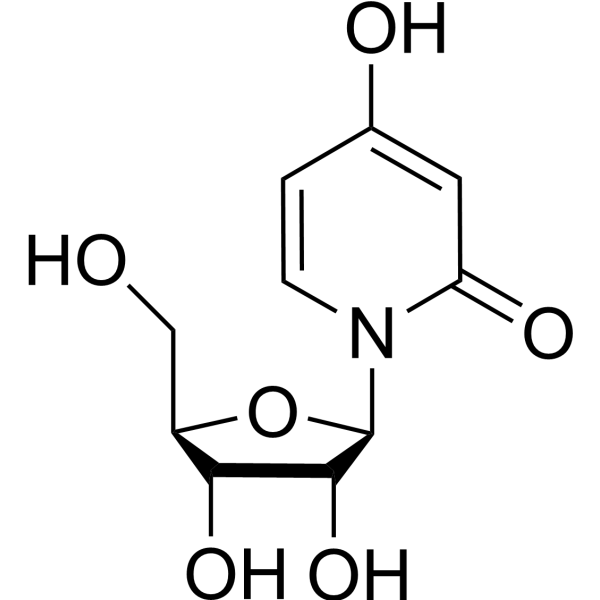
3-Deazauridine

Based on 1 Customer Validation
3-Deazauridine (NSC 126849) is a uridine analogue. 3-Deazauridine competitively inhibits cytidine triphosphate synthase to inhibit the biosynthesis of cytidine-5'-triphosphate. 3-Deazauridine acts synergistically with several antineoplastic agents, acting as a biological response modifier.
Nur für Forschungszwecke. Wir verkaufen nicht an Patienten.
- Reinheit : 99.83%
- CAS. Nr.: 23205-42-7
- Formel: C10H13NO6
- Molecular Weight:243.21
-
Speicherung:
4°C, protect from light
* In solvent : -80°C, 6 months; -20°C, 1 month (protect from light)

To place orders, for customer services and technical support, please contact: MedChemExpress USA
Tel: 609-228-6898 E-mail: [email protected] [email protected]


-
 Biologische Aktivität
-
Chemical Information
-
Lösungsmittel & Löslichkeit
- Reinheit & Dokumentation
- Verweise
-
 Help & FAQs



Alle DNA/RNA Synthesis Isoform-spezifische Produkte anzeigen
More

Biologische Aktivität
Beschreibung
IC50 & Target
Cytidine triphosphate synthase[1]
Cellular Effect
|
Cell Line

|
Type | Value | Description | References |
|---|---|---|---|---|
| CCRF-CEM | CC50 |
11 μM
Compound: 1
|
Cytostatic activity against human CEM cells after 3 days by Coulter counting analysis
Cytostatic activity against human CEM cells after 3 days by Coulter counting analysis
|
[PMID: 19378989] |
| L1210 | CC50 |
1.3 μM
Compound: 1
|
Cytostatic activity against mouse L1210 cells after 2 days by Coulter counting analysis
Cytostatic activity against mouse L1210 cells after 2 days by Coulter counting analysis
|
[PMID: 19378989] |
| Vero | CC50 |
>200 μM
Compound: 4
|
Cytotoxicity against african green monkey Vero cells after 3 days by neutral red dye method
Cytotoxicity against african green monkey Vero cells after 3 days by neutral red dye method
|
[PMID: 23141915] |
| Vero | EC50 |
>100 μM
Compound: 4
|
Antiviral activity against Herpes simplex virus type 1 infected in Vero cells at 0.01 ID50/cells assessed as protection against virus-induced cytopathic effect after 3 days by neutral red dye method
Antiviral activity against Herpes simplex virus type 1 infected in Vero cells at 0.01 ID50/cells assessed as protection against virus-induced cytopathic effect after 3 days by neutral red dye method
|
[PMID: 23141915] |
In Vitro
3-Deazauridine (DAUR) exhibits superior antitumor activity against L1210 leukemia cells[1].
MedChemExpress (MCE) has not independently confirmed the accuracy of these methods. They are for reference only. .
In Vivo
3-Deazauridine (ip; 5 times doses) has the lethal dose of 250 mg/kg/day and 417 mg/kg/day, the toxic dose low of 62.5 mg/kg/day and 104 mg/kg/day, the highest non-toxic dose of 31.25 mg/kg/day and 52 mg/kg/day, in beagle dogs and rhesus monkeys, respectively[1].
MedChemExpress (MCE) has not independently confirmed the accuracy of these methods. They are for reference only.


Chemical Information
-
CAS. Nr. 23205-42-7
-
Appearance Solid
-
Molecular Weight 243.21
-
Formel C10H13NO6
-
Color Off-white to light yellow
-
SMILES
OC[C@@H]1[C@@H](O)[C@@H](O)[C@H](N2C(C=C(C=C2)O)=O)O1
-
Synonyms
NSC 126849
-
Versand
Room temperature in continental US; may vary elsewhere.
-
Speicherung
4°C, protect from light
* In solvent : -80°C, 6 months; -20°C, 1 month (protect from light)


Lösungsmittel & Löslichkeit
In Vitro:
DMSO : 100 mg/mL (411.17 mM; Need ultrasonic; Hygroscopic DMSO has a significant impact on the solubility of product, please use newly opened DMSO)
Please refer to the solubility information to select the appropriate solvent. Once prepared, please aliquot and store the solution to prevent product inactivation from repeated freeze-thaw cycles.
Storage method and period of stock solution: -80°C, 6 months; -20°C, 1 month (protect from light). When stored at -80°C, please use it within 6 months. When stored at -20°C, please use it within 1 month.
Please refer to the solubility information to select the appropriate solvent. Once prepared, please aliquot and store the solution to prevent product inactivation from repeated freeze-thaw cycles.
Storage method and period of stock solution: -80°C, 6 months; -20°C, 1 month (protect from light). When stored at -80°C, please use it within 6 months. When stored at -20°C, please use it within 1 month.
Konzentration (Stammlösung) × Volumen (Stammlösung) = Konzentration (Ziellösung) × Volumen (Ziellösung)
In Vivo:
Select the appropriate dissolution method based on your experimental animal and administration route.
- For the following dissolution methods, please ensure to first prepare a clear stock solution using an In Vitro approach and then sequentially add co-solvents:
- To ensure reliable experimental results, the clarified stock solution can be appropriately stored based on storage conditions. As for the working solution for In Vivo experiments, it is recommended to prepare freshly and use it on the same day.
- The percentages shown for the solvents indicate their volumetric ratio in the final prepared solution. If precipitation or phase separation occurs during preparation, heat and/or sonication can be used to aid dissolution.
Add each solvent one by one: 10% DMSO 40% PEG300 5% Tween-80 45% Saline
Solubility: ≥ 2 mg/mL (8.22 mM); Clear solution
This protocol yields a clear solution of ≥ 2 mg/mL (saturation unknown).
Taking 1 mL working solution as an example, add 100 μL DMSO stock solution (20.0 mg/mL) to 400 μL PEG300, and mix evenly; then add 50 μL Tween-80 and mix evenly; then add 450 μL Saline to adjust the volume to 1 mL.
Preparation of Saline: Dissolve 0.9 g sodium chloride in ddH₂O and dilute to 100 mL to obtain a clear Saline solution.
Add each solvent one by one: 10% DMSO 90% (20% SBE-β-CD in Saline)
Solubility: ≥ 2 mg/mL (8.22 mM); Clear solution
This protocol yields a clear solution of ≥ 2 mg/mL (saturation unknown).
Taking 1 mL working solution as an example, add 100 μL DMSO stock solution (20.0 mg/mL) to 900 μL 20% SBE-β-CD in Saline, and mix evenly.
Preparation of 20% SBE-β-CD in Saline (4°C, storage for one week): 2 g SBE-β-CD powder is dissolved in 10 mL Saline, completely dissolve until clear.
In Vivo Dissolution Calculator
Please enter the basic information of animal experiments:
-
-
-
-
Recommended: Prepare an additional quantity of animals to account for potential losses during experiments.
Please enter your animal formula composition:
-
%DMSO +
Recommended: Keep the proportion of DMSO in working solution below 2% if your animal is weak.
-
%+
-
+%Tween-80 + +
-
%Saline +
The co-solvents required include: DMSO, . All of co-solvents are available by MedChemExpress (MCE). , Tween 80. All of co-solvents are available by MedChemExpress (MCE).
Working solution concentration: 0.22 mg/mL
Method for preparing stock solution: mg drug dissolved in μL DMSO. Stock solution concentration: mg/mL. * In solvent : -80°C, 6 months; -20°C, 1 month (protect from light)
1. Take μL DMSO stock solution;
2. Add μL .
μL , mix evenly;
3. Then add μL Tween 80, mix evenly;
4. Then add μL
Please ensure that the stock solution in the first step is dissolved to a clear state, and add co-solvents in sequence. You can use ultrasonic heating (ultrasonic cleaner, recommended frequency 20-40 kHz), vortexing, etc. to assist dissolution.


Reinheit & Dokumentation
-
Data Sheet (277 KB)
-
SDS (393 KB)
- English - EN (393 KB)
- Français - FR (393 KB)
- Deutsch - DE (393 KB)
- Norwegian - NO (393 KB)
- Español - ES (393 KB)
- Swedish - SV (393 KB)
- Italian - IT (393 KB)
- Korean - KR (393 KB)
- Portuguese - PT (393 KB)
-
Handling Instructions (2659 KB)
Verweise


Complete Stock Solution Preparation Table
Please refer to the solubility information to select the appropriate solvent. Once prepared, please aliquot and store the solution to prevent product inactivation from repeated freeze-thaw cycles.
Storage method and period of stock solution: -80°C, 6 months; -20°C, 1 month (protect from light). When stored at -80°C, please use it within 6 months. When stored at -20°C, please use it within 1 month.
| Optional Solvent | Concentration Solvent Mass | 1 mg | 5 mg | 10 mg | 25 mg |
|---|---|---|---|---|---|
| DMSO | 1 mM | 4.1117 mL | 20.5584 mL | 41.1167 mL | 102.7918 mL |
| 5 mM | 0.8223 mL | 4.1117 mL | 8.2233 mL | 20.5584 mL | |
| 10 mM | 0.4112 mL | 2.0558 mL | 4.1117 mL | 10.2792 mL | |
| 15 mM | 0.2741 mL | 1.3706 mL | 2.7411 mL | 6.8528 mL | |
| 20 mM | 0.2056 mL | 1.0279 mL | 2.0558 mL | 5.1396 mL | |
| 25 mM | 0.1645 mL | 0.8223 mL | 1.6447 mL | 4.1117 mL | |
| 30 mM | 0.1371 mL | 0.6853 mL | 1.3706 mL | 3.4264 mL | |
| 40 mM | 0.1028 mL | 0.5140 mL | 1.0279 mL | 2.5698 mL | |
| 50 mM | 0.0822 mL | 0.4112 mL | 0.8223 mL | 2.0558 mL | |
| 60 mM | 0.0685 mL | 0.3426 mL | 0.6853 mL | 1.7132 mL | |
| 80 mM | 0.0514 mL | 0.2570 mL | 0.5140 mL | 1.2849 mL | |
| 100 mM | 0.0411 mL | 0.2056 mL | 0.4112 mL | 1.0279 mL |


3-Deazauridine Related Classifications
HY-105336 Related Classifications
 Powered by Bioz