



Cefotiam hydrochloride

Based on 1 Customer Validation
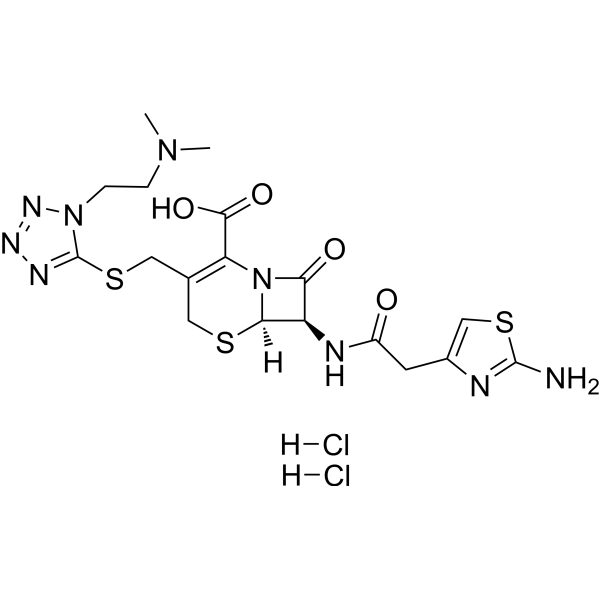
Cefotiam (SCE-963) hydrochloride is a parenteral cephalosporin antibiotic. Cefotiam hydrochloride has broad-spectrum activity against Gram-positive and Gram-negative bacteria.
연구목적의 판매만을 진행합니다. 환자를 대상으로 한 판매는 하지 않습니다.
- Purity : 98.0%
- CAS No.: 66309-69-1
- 화학식: C18H25Cl2N9O4S3
- 분자량:598.55
-
보관:
4°C, sealed storage, away from moisture
* The compound is unstable in solutions, freshly prepared is recommended.

To place orders, for customer services and technical support, please contact: MedChemExpress USA
Tel: 609-228-6898 E-mail: [email protected] [email protected]


-
 Biological Activity
-
Chemical Information
-
용액&용해도
- Protocol
- 순도&문서
- References
-
 Help & FAQs


All Antibiotic Isoforms
More

Biological Activity
제품 설명
IC50 & Target
|
β-lactam |
In Vitro
Cefotiam (SCE-963; 0-6.25 μg/mL; 8 h) hydrochloride has antibacterial activity with a MIC value of 1.56 μg/mL for P. mirabilis IFO 3849[1].
Cefotiam (SCE-963; 0-6.25 μg/mL; 8 h) hydrochloride has highly active against both Staph. aureus (27 strains, MIC values of 0.5-1 μg/mL) and Staph. albus (8 strains, MICs 0.25-0.5 μg/mL). All 29 strains of haemolytic streptococci, 9 strains of pneumococci and 6 strains of Streptococcus viridans with the MIC values of in the range 0.06-4 μg/mL[2].
MedChemExpress (MCE) has not independently confirmed the accuracy of these methods. They are for reference only. Further protocols information, click here.
In Vivo
MedChemExpress (MCE) has not independently confirmed the accuracy of these methods. They are for reference only.
-
Animal Model:Female CF1/b mice with P. mirabilis xenograft[1]
-
Dosage:12.5, 25, 50, 100, 200, 400 and 800 mg/kg
-
Administration:Subcutaneous injection; twice a day, for 5 days
-
Result:Reduced or complete eradicated bacteria in the bladder walls and kidneys of mice sacrificed the day after treatment was terminated.
Clinical Trial
| NCT Number | Sponsor | Condition | Start Date |
Phase

|
|---|---|---|---|---|
| NCT01329991 | Plexxikon| | 2011-05 | PHASE1 |


Chemical Information
-
CAS No. 66309-69-1
-
Appearance Solid
-
분자량 598.55
-
화학식 C18H25Cl2N9O4S3
-
Color White to off-white
-
SMILES
O=C(C(N12)=C(CSC3=NN=NN3CCN(C)C)CS[C@]2([H])[C@H](NC(CC4=CSC(N)=N4)=O)C1=O)O.[H]Cl.[H]Cl
-
Synonyms
SCE-963 hydrochloride
-
선적
Room temperature in continental US; may vary elsewhere.
-
보관
4°C, sealed storage, away from moisture
* The compound is unstable in solutions, freshly prepared is recommended.


용액&용해도
In Vitro:
DMSO : 100 mg/mL (167.07 mM; Need ultrasonic; Hygroscopic DMSO has a significant impact on the solubility of product, please use newly opened DMSO)
H2O : 33.33 mg/mL (55.68 mM; Need ultrasonic)
Please refer to the solubility information to select the appropriate solvent. The compound is unstable in solutions, freshly prepared is recommended.
* Note: If you choose water as the stock solution, please dilute it to the working solution, then filter and sterilize it with a 0.22 μm filter before use.
Please refer to the solubility information to select the appropriate solvent. The compound is unstable in solutions, freshly prepared is recommended.
* Note: If you choose water as the stock solution, please dilute it to the working solution, then filter and sterilize it with a 0.22 μm filter before use.
Concentration (start) × Volume (start) = Concentration (final) × Volume (final)
In Vivo:
Select the appropriate dissolution method based on your experimental animal and administration route.
- For the following dissolution methods, please ensure to first prepare a clear stock solution using an In Vitro approach and then sequentially add co-solvents:
- To ensure reliable experimental results, the clarified stock solution can be appropriately stored based on storage conditions. As for the working solution for In Vivo experiments, it is recommended to prepare freshly and use it on the same day.
- The percentages shown for the solvents indicate their volumetric ratio in the final prepared solution. If precipitation or phase separation occurs during preparation, heat and/or sonication can be used to aid dissolution.
Add each solvent one by one: 10% DMSO 40% PEG300 5% Tween-80 45% Saline
Solubility: ≥ 2.5 mg/mL (4.18 mM); Clear solution
This protocol yields a clear solution of ≥ 2.5 mg/mL (saturation unknown).
Taking 1 mL working solution as an example, add 100 μL DMSO stock solution (25.0 mg/mL) to 400 μL PEG300, and mix evenly; then add 50 μL Tween-80 and mix evenly; then add 450 μL Saline to adjust the volume to 1 mL.
Preparation of Saline: Dissolve 0.9 g sodium chloride in ddH₂O and dilute to 100 mL to obtain a clear Saline solution.
Add each solvent one by one: 10% DMSO 90% (20% SBE-β-CD in Saline)
Solubility: ≥ 2.5 mg/mL (4.18 mM); Clear solution
This protocol yields a clear solution of ≥ 2.5 mg/mL (saturation unknown).
Taking 1 mL working solution as an example, add 100 μL DMSO stock solution (25.0 mg/mL) to 900 μL 20% SBE-β-CD in Saline, and mix evenly.
Preparation of 20% SBE-β-CD in Saline (4°C, storage for one week): 2 g SBE-β-CD powder is dissolved in 10 mL Saline, completely dissolve until clear.
For the following dissolution methods, please prepare the working solution directly:
It is recommended to prepare fresh solutions and use them promptly within a short period of time.
The percentages shown for the solvents indicate their volumetric ratio in the final prepared solution. If precipitation or phase separation occurs during preparation, heat and/or sonication can be used to aid dissolution.
Add each solvent one by one: PBS
Solubility: 50 mg/mL (83.54 mM); Clear solution; Need ultrasonic
In Vivo Dissolution Calculator
Please enter the basic information of animal experiments:
-
-
-
-
Recommended: Prepare an additional quantity of animals to account for potential losses during experiments.
Working solution concentration: 0.22 mg/mL
This product has good water solubility, please refer to the measured solubility data in water/PBS/Saline for details.

Protocol
-
Gram Staining of Tissue Sections
Gram staining of tissue sections is a histochemical technique used to differentiate Gram-positive and Gram-negative bacteria within histological specimens based on differences in bacterial cell wall structure and dye retention, adapted from classical bacteriological Gram staining into tissue-compatible “histological Gram stain” variants. In tissue applications, modifications of the Brown-Hopps and Brown-Brenn methods are commonly used to improve differentiation of microorganisms embedded within host connective tissue and to reduce overstaining or loss of Gram-negative signal, which are known limitations of earlier approaches. The principle relies on crystal violet-iodine complex retention in Gram-positive organisms and subsequent decolorization and counterstaining steps that allow contrast visualization of Gram-negative organisms against tissue background.


순도&문서
-
Data Sheet (275 KB)
-
SDS (393 KB)
- English - EN (393 KB)
- Français - FR (393 KB)
- Deutsch - DE (393 KB)
- Norwegian - NO (393 KB)
- Español - ES (393 KB)
- Swedish - SV (393 KB)
- Italian - IT (393 KB)
- Korean - KR (393 KB)
- Portuguese - PT (393 KB)
-
Handling Instructions (2659 KB)
References
[1]. Iwahi T, et, al. Comparative activities of cefotiam and cefazolin against urinary tract infections with Proteus mirabilis in mice. Antimicrob Agents Chemother. 1980 Aug;18(2):257-63. [Content Brief]
[2]. Watt B, et, al. In-vitro activity of cefotiam against bacteria of clinical interest. J Antimicrob Chemother. 1982 Nov;10(5):391-5. [Content Brief]


Complete Stock Solution Preparation Table
Please refer to the solubility information to select the appropriate solvent. The compound is unstable in solutions, freshly prepared is recommended.
| Optional Solvent | Concentration Solvent Mass | 1 mg | 5 mg | 10 mg | 25 mg |
|---|---|---|---|---|---|
| H2O / DMSO | 1 mM | 1.6707 mL | 8.3535 mL | 16.7070 mL | 41.7676 mL |
| 5 mM | 0.3341 mL | 1.6707 mL | 3.3414 mL | 8.3535 mL | |
| 10 mM | 0.1671 mL | 0.8354 mL | 1.6707 mL | 4.1768 mL | |
| 15 mM | 0.1114 mL | 0.5569 mL | 1.1138 mL | 2.7845 mL | |
| 20 mM | 0.0835 mL | 0.4177 mL | 0.8354 mL | 2.0884 mL | |
| 25 mM | 0.0668 mL | 0.3341 mL | 0.6683 mL | 1.6707 mL | |
| 30 mM | 0.0557 mL | 0.2785 mL | 0.5569 mL | 1.3923 mL | |
| 40 mM | 0.0418 mL | 0.2088 mL | 0.4177 mL | 1.0442 mL | |
| 50 mM | 0.0334 mL | 0.1671 mL | 0.3341 mL | 0.8354 mL | |
| DMSO | 60 mM | 0.0278 mL | 0.1392 mL | 0.2785 mL | 0.6961 mL |
| 80 mM | 0.0209 mL | 0.1044 mL | 0.2088 mL | 0.5221 mL | |
| 100 mM | 0.0167 mL | 0.0835 mL | 0.1671 mL | 0.4177 mL |
* Note: If you choose water as the stock solution, please dilute it to the working solution, then filter and sterilize it with a 0.22 μm filter before use.


Cefotiam hydrochloride Related Classifications
HY-B0734A Related Classifications
 Powered by Bioz