



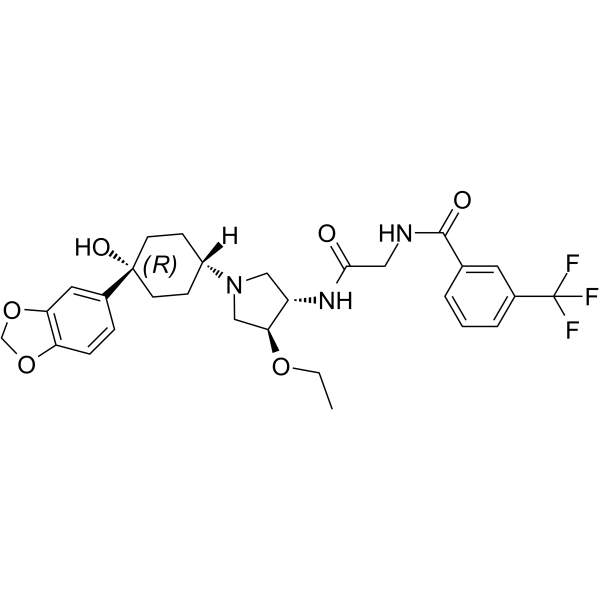
INCB3344 R-isomer

Based on 1 Customer Validation
INCB3344 R-isomer is the R-isomer of INCB3344. INCB3344 is a potent, selective and orally bioavailable CCR2 antagonist with IC50 values of 5.1 nM (hCCR2) and 9.5 nM (mCCR2) in binding antagonism and 3.8 nM (hCCR2) and 7.8 nM (mCCR2) in antagonism of chemotaxis activity.
商品は「研究用試薬」です。人や動物の医療用・臨床診断用・食品用の製品ではありません。
研究用途以外に使用した場合、当社は一切の責任を負いかねます。
- 純度 : 98.01%
- 分子式: C29H34F3N3O6
- 分子量:577.59
-
保管条件:Powder -20°C, 3 years , 4°C, 2 years ; In solvent -80°C, 2 years , -20°C, 1 year

To place orders, for customer services and technical support, please contact: MedChemExpress USA
Tel: 609-228-6898 E-mail: [email protected] [email protected]


-
 生物活性
生物活性
-
化学情報
-
溶剤 & 溶解度
- プロトコル
- 純度とドキュメンテーション
- 参考文献
-
 Help & FAQs




生物活性
製品説明
IC50 & Target
|
CCR2 |


化学情報
-
性状 Solid
-
分子量 577.59
-
分子式 C29H34F3N3O6
-
Color Off-white to yellow
-
SMILES
CCO[C@H]1CN([C@]2([H])CC[C@](C3=CC(OCO4)=C4C=C3)(O)CC2)C[C@@H]1NC(CNC(C5=CC(C(F)(F)F)=CC=C5)=O)=O
-
輸送条件
Room temperature in continental US; may vary elsewhere.
-
保管条件
Powder -20°C 3 years 4°C 2 years In solvent -80°C 2 years -20°C 1 year


溶剤 & 溶解度
体外:
DMSO : ≥ 100 mg/mL (173.13 mM; Hygroscopic DMSO has a significant impact on the solubility of product, please use newly opened DMSO)
* "≥" means soluble, but saturation unknown.
Please refer to the solubility information to select the appropriate solvent. Once prepared, please aliquot and store the solution to prevent product inactivation from repeated freeze-thaw cycles.
Storage method and period of stock solution: -80°C, 2 years; -20°C, 1 year. When stored at -80°C, please use it within 2 years. When stored at -20°C, please use it within 1 year.
Please refer to the solubility information to select the appropriate solvent. Once prepared, please aliquot and store the solution to prevent product inactivation from repeated freeze-thaw cycles.
Storage method and period of stock solution: -80°C, 2 years; -20°C, 1 year. When stored at -80°C, please use it within 2 years. When stored at -20°C, please use it within 1 year.
濃度 (開始) × 体積 (開始) = 濃度 (終了) × 体積 (終了)


純度とドキュメンテーション
-
データシート (271 KB)
-
SDS (251 KB)
- English - EN (251 KB)
- Français - FR (251 KB)
- Deutsch - DE (251 KB)
- Norwegian - NO (251 KB)
- Español - ES (251 KB)
- Swedish - SV (251 KB)
- Italian - IT (251 KB)
- Korean - KR (251 KB)
- Portuguese - PT (251 KB)
-
取扱説明書 (2659 KB)
参考文献


Complete Stock Solution Preparation Table
Please refer to the solubility information to select the appropriate solvent. Once prepared, please aliquot and store the solution to prevent product inactivation from repeated freeze-thaw cycles.
Storage method and period of stock solution: -80°C, 2 years; -20°C, 1 year. When stored at -80°C, please use it within 2 years. When stored at -20°C, please use it within 1 year.
| Optional Solvent | Concentration Solvent Mass | 1 mg | 5 mg | 10 mg | 25 mg |
|---|---|---|---|---|---|
| DMSO | 1 mM | 1.7313 mL | 8.6567 mL | 17.3133 mL | 43.2833 mL |
| 5 mM | 0.3463 mL | 1.7313 mL | 3.4627 mL | 8.6567 mL | |
| 10 mM | 0.1731 mL | 0.8657 mL | 1.7313 mL | 4.3283 mL | |
| 15 mM | 0.1154 mL | 0.5771 mL | 1.1542 mL | 2.8856 mL | |
| 20 mM | 0.0866 mL | 0.4328 mL | 0.8657 mL | 2.1642 mL | |
| 25 mM | 0.0693 mL | 0.3463 mL | 0.6925 mL | 1.7313 mL | |
| 30 mM | 0.0577 mL | 0.2886 mL | 0.5771 mL | 1.4428 mL | |
| 40 mM | 0.0433 mL | 0.2164 mL | 0.4328 mL | 1.0821 mL | |
| 50 mM | 0.0346 mL | 0.1731 mL | 0.3463 mL | 0.8657 mL | |
| 60 mM | 0.0289 mL | 0.1443 mL | 0.2886 mL | 0.7214 mL | |
| 80 mM | 0.0216 mL | 0.1082 mL | 0.2164 mL | 0.5410 mL | |
| 100 mM | 0.0173 mL | 0.0866 mL | 0.1731 mL | 0.4328 mL |


INCB3344 R-isomer 関連分類
HY-50674A 関連分類
 Powered by Bioz