



Orbifloxacin
Based on 1 publication(s) in Google Scholar
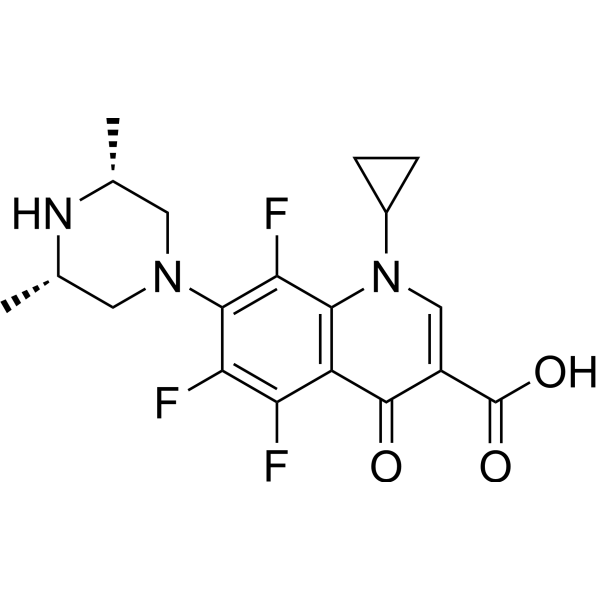
Orbifloxacin is an orally administrable Antibiotic. Orbifloxacin disrupts the replication and proliferation of Bacterial DNA, inhibits bacterial growth and exerts bactericidal activity. Orbifloxacin inhibits the growth of canine-derived E. coli and Pseudomonas aeruginosa isolates. Orbifloxacin is used in research related to bacterial infections.
For research use only. We do not sell to patients.
- Purity : 99.66%
- CAS No.: 113617-63-3
- Formula: C19H20F3N3O3
- Molecular Weight:395.38
-
Storage:Powder -20°C, 3 years , 4°C, 2 years ; In solvent -80°C, 2 years , -20°C, 1 year

To place orders, for customer services and technical support, please contact: MedChemExpress USA
Tel: 609-228-6898 E-mail: [email protected] [email protected]


-
 Biological Activity
-
Chemical Information
-
Solvent & Solubility
- Protocols
- Purity & Documentation
- References
-
 Help & FAQs




Publications Citing Use of MedChemExpress (MCE) Orbifloxacin
MoreAll Antibiotic Isoforms
More

Biological Activity
Description
IC50 & Target
|
Quinolone |
In Vitro
Orbifloxacin (0.015-4.0 μg/mL; up to 7 days) inhibits the growth of Piscirickettsia salmonis LF-89 VR-1361, and its growth-inhibitory effect persists throughout the 7-day incubation period compared with the untreated control group[1].
Orbifloxacin (0.1×-4× MIC; 0-24 h) inhibits the growth of Staphylococcus aureus ATCC 29213 and ATCC 43300, with MIC values of 0.5 mg/L and 4 mg/L, respectively, and induces concentration-dependent post-antibiotic effect (PAE) and post-antibiotic sub-MIC effect (PA-SME)[2].
Orbifloxacin (at twice the MIC; 1 h) induces a post-antibiotic effect (PAE) with an average duration of 0.29 h in clinical canine isolates of E coli, and an average PAE duration of 0.37 h in clinical canine isolates of Pseudomonas aeruginosa[3].
Orbifloxacin (0.1×MIC-0.3×MIC) induces concentration-dependent PA-SMEs in canine clinical isolates of E coli (mean 0.55 to 2.03 h) and Pseudomonas aeruginosa (mean 1.04 to 2.47 h)[3].
Orbifloxacin (0.016-16 mg/L; 18 h) inhibits visible growth of clinical Staphylococcus intermedius strains isolated from canine skin and ear infections by 50% and 90% at concentrations of 0.5 mg/L and 1 mg/L, respectively[4].
Orbifloxacin (0.063-4 mg/L; 1-24 h) exhibits concentration-dependent bactericidal activity against Staphylococcus aureus ATCC 29213, and time-dependent bactericidal activity against Staphylococcus intermedius isolates from pyoderma[4].
MedChemExpress (MCE) has not independently confirmed the accuracy of these methods. They are for reference only.
Parmacokinetics
| Species | Dose | Route | T1/2 | Tmax | Cmax | AUC0-last | AUC0-∞ | Vd/F | CL/F | MRT0-last | F | Vd | CL |
|---|---|---|---|---|---|---|---|---|---|---|---|---|---|
| Mice[2] | 2.5 mg/kg | i.v. | 1.09 h | 0.08 h | 1.96 mg/L | 1.72 μg·h/mL | 1.74 μg·h/mL | / | / | 1 h | / | 2.28 L/kg | 1.47 L/h/kg |
| Mice[2] | 5 mg/kg | i.v. | 1.12 h | 0.08 h | 3.78 mg/L | 4.78 μg·h/mL | 4.86 μg·h/mL | / | / | 1.29 h | / | 1.67 L/kg | 1.04 L/h/kg |
| Mice[2] | 20 mg/kg | i.v. | 2.08 h | 0.08 h | 8.84 mg/L | 17.06 μg·h/mL | 17.09 μg·h/mL | / | / | 1.84 h | / | 3.64 L/kg | 1.20 L/h/kg |
| Mice[2] | 80 mg/kg | i.v. | 1.95 h | 0.19 h | 21.8 mg/L | 54.94 μg·h/mL | 54.98 μg·h/mL | / | / | 3.17 h | / | 4.18 L/kg | 1.48 L/h/kg |
| Mice[2] | 2.5 mg/kg | i.m. | 1.36 h | 0.25 h | 1.45 mg/L | 1.73 μg·h/mL | 1.77 μg·h/mL | 2.96 L/kg | 1.47 L/h/kg | 1.14 h | 99.9 % | / | / |
| Mice[2] | 5 mg/kg | i.m. | 1.42 h | 0.22 h | 4.18 mg/L | 5.12 μg·h/mL | 5.15 μg·h/mL | 2.00 L/kg | 0.98 L/h/kg | 1.31 h | 107.5 % | / | / |
| Mice[2] | 20 mg/kg | i.m. | 2.24 h | 0.25 h | 9.03 mg/L | 18.80 μg·h/mL | 18.85 μg·h/mL | 3.60 L/kg | 1.14 L/h/kg | 1.94 h | 109.2 % | / | / |
| Mice[2] | 80 mg/kg | i.m. | 2.02 h | 0.25 h | 27.13 mg/L | 53.94 μg·h/mL | 53.98 μg·h/mL | 4.43 L/kg | 1.52 | 1.74 h | 98.2 % | / | / |
In Vivo
MedChemExpress (MCE) has not independently confirmed the accuracy of these methods. They are for reference only.
-
Animal Model:BALB/c (specific-pathogen-free, 6 weeks old, both sexes, 18 to 20 g, neutropenic thigh infection model induced via intraperitoneal cyclophosphamide)[2]
-
Dosage:2.5 mg/kg ; 5 mg/kg ); 20 mg/kg; 80 mg/kg
-
Administration:i.m.; twice daily; 24 hours
-
Result:Partially inhibited bacterial growth over 24 hours at total daily doses of 5 and 10 mg/kg.
Inhibited bacterial replication at a total daily dose of 40 mg/kg.
Reduced the bacterial load in the thigh by a maximum of 3.12 log10 over 24 hours at a maximum total daily dose of 160 mg/kg.


Chemical Information
-
CAS No. 113617-63-3
-
Appearance Solid
-
Molecular Weight 395.38
-
Formula C19H20F3N3O3
-
Color White to off-white
-
SMILES
O=C(C1=CN(C2CC2)C3=C(C(F)=C(F)C(N4C[C@H](C)N[C@H](C)C4)=C3F)C1=O)O
-
Synonyms
CP-104354
-
Shipping
Room temperature in continental US; may vary elsewhere.
-
Storage
Powder -20°C 3 years 4°C 2 years In solvent -80°C 2 years -20°C 1 year


Publications (1)
-
Journal Impact Factor
-
Most Recent
-
Microb Pathog
Antibiotic discovery against Piscirickettsia salmonis using a combined in silico and in vitro approach. [Abstract]2023 Jul:180:106122. PMID: 37094756


Solvent & Solubility
In Vitro:
DMF : 5 mg/mL (12.65 mM; ultrasonic and warming and heat to 60°C)
Please refer to the solubility information to select the appropriate solvent. Once prepared, please aliquot and store the solution to prevent product inactivation from repeated freeze-thaw cycles.
Storage method and period of stock solution: -80°C, 2 years; -20°C, 1 year. When stored at -80°C, please use it within 2 years. When stored at -20°C, please use it within 1 year.
Please refer to the solubility information to select the appropriate solvent. Once prepared, please aliquot and store the solution to prevent product inactivation from repeated freeze-thaw cycles.
Storage method and period of stock solution: -80°C, 2 years; -20°C, 1 year. When stored at -80°C, please use it within 2 years. When stored at -20°C, please use it within 1 year.
Concentration (start) × Volume (start) = Concentration (final) × Volume (final)
In Vivo:
Select the appropriate dissolution method based on your experimental animal and administration route.
- For the following dissolution methods, please ensure to first prepare a clear stock solution using an In Vitro approach and then sequentially add co-solvents:
- To ensure reliable experimental results, the clarified stock solution can be appropriately stored based on storage conditions. As for the working solution for In Vivo experiments, it is recommended to prepare freshly and use it on the same day.
- The percentages shown for the solvents indicate their volumetric ratio in the final prepared solution. If precipitation or phase separation occurs during preparation, heat and/or sonication can be used to aid dissolution.
In Vivo Dissolution Calculator
Please enter the basic information of animal experiments:
-
-
-
-
Recommended: Prepare an additional quantity of animals to account for potential losses during experiments.
Working solution concentration: 0.22 mg/mL


Purity & Documentation
-
Data Sheet (279 KB)
-
SDS (254 KB)
- English - EN (254 KB)
- Français - FR (254 KB)
- Deutsch - DE (254 KB)
- Norwegian - NO (254 KB)
- Español - ES (254 KB)
- Swedish - SV (254 KB)
- Italian - IT (254 KB)
- Korean - KR (254 KB)
- Portuguese - PT (254 KB)
-
Handling Instructions (2659 KB)
References
[1]. Beltrán JF, et al. Antibiotic discovery against Piscirickettsia salmonis using a combined in silico and in vitro approach. Microb Pathog. 2023;180:106122. [Content Brief]
[2]. Zhong LG, et al. In vivo pharmacokinetic and pharmacodynamic profiles of orbifloxacin against Staphylococcus aureus in a neutropenic murine thigh infection model. BMC Vet Res. 2025;21(1):531. Published 2025 Aug 29. [Content Brief]
[3]. Harada K, et al. Post-antibiotic effect of orbifloxacin against Escherichia coli and Pseudomonas aeruginosa isolates from dogs. Acta Vet Scand. 2012;54(1):16. Published 2012 Mar 20. [Content Brief]
[4]. Ganière JP, et al. In vitro antimicrobial activity of orbifloxacin against Staphylococcus intermedius isolates from canine skin and ear infections. Res Vet Sci. 2004;77(1):67-71. [Content Brief]


Complete Stock Solution Preparation Table
Please refer to the solubility information to select the appropriate solvent. Once prepared, please aliquot and store the solution to prevent product inactivation from repeated freeze-thaw cycles.
Storage method and period of stock solution: -80°C, 2 years; -20°C, 1 year. When stored at -80°C, please use it within 2 years. When stored at -20°C, please use it within 1 year.
| Optional Solvent | Concentration Solvent Mass | 1 mg | 5 mg | 10 mg | 25 mg |
|---|---|---|---|---|---|
| DMF | 1 mM | 2.5292 mL | 12.6461 mL | 25.2921 mL | 63.2303 mL |
| 5 mM | 0.5058 mL | 2.5292 mL | 5.0584 mL | 12.6461 mL | |
| 10 mM | 0.2529 mL | 1.2646 mL | 2.5292 mL | 6.3230 mL |


Orbifloxacin Related Classifications
HY-B0915 Related Classifications
 Powered by Bioz