



MDM-2/p53
The p53 tumor suppressor is a principal mediator of growth arrest, senescence, and apoptosis in response to a broad array of cellular damage. p53 is a short-lived protein that is maintained at low, often undetectable, levels in normal cells. Under stress conditions, the p53 protein accumulates in the cell, binds in its tetrameric form to p53-response elements and induces the transcription of various genes.
MDM-2 is transcriptionally activated by p53 and MDM-2, in turn, inhibits p53 activity in several ways. MDM-2 binds to the p53 transactivation domain and thereby inhibits p53-mediated transactivation. MDM-2 also contains a signal sequence that is similar to the nuclear export signal of various viral proteins and, after binding to p53, it induces its nuclear export. As p53 is a transcription factor, it needs to be in the nucleus to be able to access the DNA; its transport to the cytoplasm by MDM-2 prevents this. Finally, MDM-2 is a ubiquitin ligase, so is able to target p53 for degradation by the proteasome.
In many tumors p53 is inactivated by the overexpression of the negative regulators MDM2 and MDM4 or by the loss of activity of the MDM2 inhibitor ARF. The pathway can be reactivated in these tumors by small molecules that inhibit the interaction of MDM2 and/or MDM4 with p53. Such molecules are now in clinical trials.
All Product Categories
-
MDM-2/p53 Inhibitors
(112)
View all products
-
MDM-2/p53 Agonists
(8)
View all products
-
MDM-2/p53 Antagonists
(4)
View all products
-
MDM-2/p53 Activators
(154)
View all products
-
MDM-2/p53 Modulators
(29)
View all products
-
MDM-2/p53 MDM2 Inhibitors
(65)
View all products
-
MDM-2/p53 p53 Activators
(114)
View all products
-
MDM-2/p53 p53 Inhibitors
(16)
View all products
-
MDM-2/p53 Inducers
(17)
View all products
-
MDM-2/p53 Degraders
(8)
View all products
-
MDM-2/p53 Controls
(6)
View all products
-
MDM-2/p53 Ligands
(8)
View all products
-
MDM-2/p53 Related Products (621)
Related Products (621)

-
Antibodies (17)
-
MDM-2/p53 Signaling Pathway
-
MI-1063
 0 ImagesCat. No.: HY-133754CAS No.: 1410737-39-1MI-1063 is an inhibitor for MDM-2, that blocks the MDM2-p53 interaction, and activates the tumor suppressor function of p53. MI-1063 inhibits the growth of cancer cell RS4-11 and MV4-11 with IC50 of 179 nM and 93 nM. MI-1063 can be used as target protein ligand in synthesis of PROTAC degrader MD-265 (HY-169327).
-
PROTAC MDM2 Degrader-8
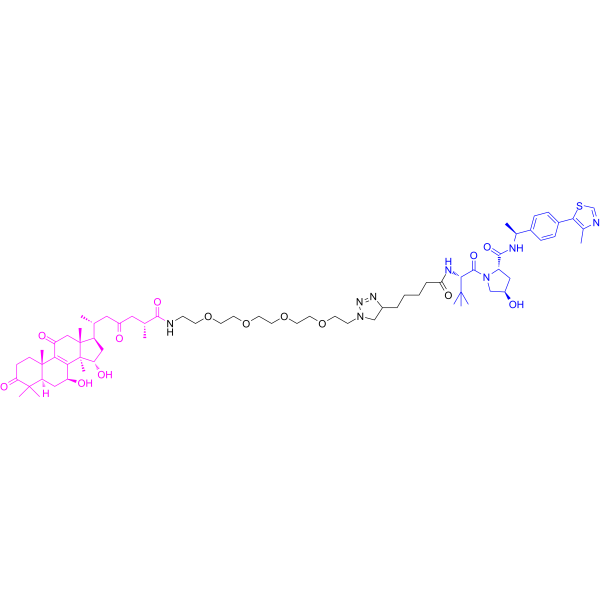 0 ImagesCat. No.: HY-162450PROTAC MDM2 Degrader-8 is a PROTAC degrader that induces the degradation of the MDM2 protein by recruiting VHL. PROTAC MDM2 Degrader-8 directly binds to MDM2 with a KD of 38.2 μM; the proteasome inhibitor MG-132 (HY-13259) reverses this degradation effect, supporting that it induces MDM2 degradation via the ubiquitin-proteasome system. PROTAC MDM2 Degrader-8 also upregulates p21, induces apoptosis and cell cycle arrest, and inhibits the migration of MDA-MB-231 cells. PROTAC MDM2 Degrader-8 can be used in studies related to MDM2-targeted protein degradation and triple-negative breast cancer.
-
CX-5461 hydrochloride
 0 ImagesCat. No.: HY-13323BCAS No.: 2101314-20-7CX-5461 hydrochloride is a selective, orally active RNA polymerase I inhibitor. CX-5461 hydrochloride disrupts the formation of the SL1-rDNA complex, thereby blocking the transcription initiation of ribosomal RNA without altering the activity of RNA polymerase II, DNA replication, or protein translation processes. CX-5461 hydrochloride upregulates the expression of p21, MDM2, Sestrin1/2, and phosphorylated AMPKα, and reduces the level of phosphorylated Akt. CX-5461 hydrochloride induces G2/G2/M cell cycle arrest, Autophagy, Apoptosis, and cellular senescence, and activates CHK1, CHK2, and RPA. CX-5461 hydrochloride can be used in research related to osteosarcoma, cervical cancer, hematologic malignancies, high-grade serous ovarian cancer, and solid tumors.
-
Higenamine-d4-1 hydrochloride
 0 ImagesCat. No.: HY-N2037AS1Synonyms: Norcoclaurine-d4-1 hydrochloride; Demethyl-Coclaurine-d4-1 hydrochlorideHigenamine-d4-1 (Norcoclaurine-d4-1) hydrochloride is deuterium labeled Higenamine (hydrochloride). Higenamine hydrochloride is a selective LSD1 inhibitor (IC50=1.47 μM) that can be isolated from aconite. Higenamine hydrochloride has anti-inflammatory and antibacterial activity. Higenamine (Norcoclaurine) can attenuate IL-1β-induced Apoptosis through ROS-mediated PI3K/Akt signaling pathway. Higenamine hydrochloride protects brain cells from oxygen deprivation. Higenamine can promote bone formation in osteoporosis through the SMAD2/3 pathway. Higenamine hydrochloride can be used to study cancer, inflammation, cardiorenal syndrome and other diseases.
-
Solasodine hydrochloride
 0 ImagesCat. No.: HY-W751400CAS No.: 6106-33-8Synonyms: Purapuridine hydrochloride; Solancarpidine hydrochloride; Solasodin hydrochlorideSolasodine (Purapuridine) hydrochloride is a steroidal alkaloid that occurs in plants of the Solanaceae family. Solasodine hydrochloride induces apoptosis by inhibiting the p53-MDM2 complex, p21Waf1/Cip1, and Bcl-2 proteins. Solasodine hydrochloride has neuroprotective, antifungal, hypotensive, anticancer, antiatherosclerotic, antiandrogenic and anti-inflammatory activities.
-
7α-Hydroxycholesterol (Standard)
 0 Images7α-Hydroxycholesterol is a cholesterol oxide and can serve as a biomarker for oxidative stress and lipid peroxidation. 7α-Hydroxycholesterol has cytotoxic and pro-inflammatory activities. 7α-Hydroxycholesterol can also inhibit sterol synthesis and reduce the activity of HMG-CoA reductase. 7α-Hydroxycholesterol can be used in the research of diseases such as diabetes and atherosclerosis.
-
Nutlin 1
 0 ImagesCat. No.: HY-118542CAS No.: 548472-58-8Nutlin 1, an antagonist of MDM2, activates a major cellular function of the p53 pathway, with an IC50 value of 0.26 μM.
-
Pancracine
 0 ImagesCat. No.: HY-N20721CAS No.: 21416-14-8Pancracine is an alkaloid. Pancracine upregulates p27, phosphorylated p38 MAPK and phosphorylated p53, while downregulating phosphorylated Akt and phosphorylated Rb. Pancracine induces G1 cell cycle arrest and Apoptosis in cells. Pancracine inhibits the replication of pseudotyped HIV-1 and Dengue virus. Pancracine can be used in research related to lung adenocarcinoma, acute lymphoblastic leukemia, cutaneous epidermoid carcinoma, human immunodeficiency virus infection and dengue virus infection.
-
Decarbamoylmitomycin C
 0 ImagesCat. No.: HY-167635CAS No.: 26909-37-5Decarbamoylmitomycin C, an analog of Mitomycin C (MC), is an DNA-alkylating agent. Decarbamoylmitomycin C (DMC) activates p53-independent ataxia telangiectasia and rad3 related protein (ATR) chromatin eviction.
-
Milademetan tosylate hydrate (Standard)
 0 ImagesCat. No.: HY-101266BRCAS No.: 2095625-97-9Synonyms: DS-3032b (Standard); DS-3032 tosylate hydrate (Standard)Milademetan (tosylate hydrate) (Standard) is the analytical standard of Milademetan (tosylate hydrate) (HY-101266B). This product is intended for research and analytical applications. Milademetan (DS-3032) tosylate hydrate is a specific and orally active MDM2 inhibitor for the research of acute myeloid leukemia (AML) or solid tumors. Milademetan (DS-3032) tosylate hydrate induces G1 cell cycle arrest, senescence and apoptosis.
-
6-Azuridine (Standard)
 0 ImagesSynonyms: 6-Azauridine (Standard)6-Azuridine (Standard) is the analytical standard of 6-Azuridine. This product is intended for research and analytical applications. 6-Azuridine (6-Azauridine) is an orally active purine nucleoside analogue. 6-Azuridine activates autophagic flux, induces Apoptosis that depends on AMPK and p53. 6-Azuridine exhibit both antitumor and antiviral activities.
-
(R)-NVP-CGM097
 0 ImagesCat. No.: HY-15954CCAS No.: 2643938-26-3Synonyms: (R)-CGM097(R)-NVP-CGM097 is the R-enantiomer of NVP-CGM097 (HY-15954). NVP-CGM097 is a potent and selective MDM2 inhibitor with an IC50 of 1.7 nM for hMDM2.
-
Sennoside
 0 ImagesSennoside is an orally active apoptosis inducer and stimulant laxative, found in Senna (Cassia angustifolia). Sennoside induces overexpression of wild-type p53 and p21/WAF as part of pathways mediating colonic epithelial cell apoptosis. Sennoside stimulates colonic peristalsis, reverses net water, sodium, chloride absorption to secretion and enhances potassium and calcium secretion. Sennoside increases paracellular permeability to small molecules, accelerates colon transit and softens fecal pellets. Sennoside can be used for the research of constipation, melanosis coli, and colorectal cancer.
-
SIRT1-IN-6
 0 ImagesCat. No.: HY-174299CAS No.: 1174387-32-6
-
S-Diclofenac (Standard)
 0 ImagesSynonyms: ACS 15 (Standard); ATB-337 (Standard)S-Diclofenac (Standard) is the analytical standard of S-Diclofenac. This product is intended for research and analytical applications. S-Diclofenac (ACS 15) is a hybrid molecule of an H2S donor and the NSAID diclofenac. S-Diclofenac activates the p53 signaling pathway, and inhibits the activation of JNK. S-Diclofenac exhibits antioxidant and anti-inflammatory activities.
-
Pemrametostat succinate
 0 ImagesCat. No.: HY-101563ACAS No.: 1848944-46-6Synonyms: GSK3326595 succinate; EPZ015938 succinateGSK3326595 succinate (EPZ015938 succinate) is a protein arginine methyltransferase 5 (PRMT5) inhibitor. GSK3326595 succinate decreases SARS-CoV-2 infection, inhibits cancer cell proliferation and induces pro-inflammatory macrophage polarization and increases hepatic triglyceride levels without affecting atherosclerosis. GSK3326595 succinate can be used for research of relapsed/refractory mantle cell lymphoma.
-
Americanin A
 0 ImagesCat. No.: HY-N18301CAS No.: 69506-79-2Americanin A is a Neolignan. Americanin A can be isolated from the seeds of Phytolacca americana. Americanin A activates ATM and ATR, initiating the subsequent signal transduction cascades that include Chk1, Chk2, and tumor suppressor p53. Americanin A targets selectively Skp2 for degradation and thereby stabilizes p27. Americanin A suppresses the activity of Cyclin B1 and its partner cdc2 to prevent entry into Mitosis. Americanin A induces Apoptosis by producing excessive ROS. Americanin A has anti-cancer activity against colorectal cancer.
-
Milademetan (Standard)
 0 ImagesSynonyms: DS-3032 (Standard)Milademetan (Standard) is the analytical standard of Milademetan (HY-101266). This product is intended for research and analytical applications. Milademetan (DS-3032) is a specific and orally active MDM2 inhibitor for the research of acute myeloid leukemia (AML) or solid tumors. Milademetan (DS-3032) induces G1 cell cycle arrest, senescence and apoptosis.




