



PD-1/PD-L1
PD-1/Programmed death-ligand 1
Programmed death-1 (PD-1) is a cell surface receptor that functions as a T cell checkpoint and plays a central role in regulating T cell exhaustion. PD-1 is activated by the engagement of its ligands PDL-1 or PDL-2. PD-1 receptor delivers inhibitory checkpoint signals to activated T cells upon binding to its ligands PD-L1 and PD-L2 expressed on antigen-presenting cells and cancer cells, resulting in suppression of T-cell effector function and tumor immune evasion. Inhibiting the programmed cell death-1 (PD-1)/programmed cell death-ligand 1 (PD-L1) pathway is an attractive strategy for tumor immunotherapy.
PD-1 is expressed on activated T cells, B cells, monocytes, dendritic cells (DCs), regulatory T cells (Tregs), and natural killer T cells (NKT). It is a member of a family of immunoglobulin domain (Ig) co-receptors that modify the outcome of activation of the T cell receptor by an antigen-presenting cell (APC) or infected target cell. PD-L1 is widely and constitutively expressed on both hematopoietic and nonhematopoietic cells; e.g., naive T and B cells, vascular endothelial cells, and pancreatic islet cells, whereas PD-L2 is exclusively and inducibly expressed on professional APCs.
All Product Categories
-
PD-1/PD-L1 Inhibitors
(349)
View all products
-
PD-1/PD-L1 Agonists
(5)
View all products
-
PD-1/PD-L1 Antagonists
(11)
View all products
-
PD-1/PD-L1 Activators
(16)
View all products
-
PD-1/PD-L1 Modulators
(7)
View all products
-
PD-1/PD-L1 Inducers
(3)
View all products
-
PD-1/PD-L1 Degraders
(13)
View all products
-
PD-1/PD-L1 Control
(1)
View all products
-
PD-1/PD-L1 Substrates
(2)
View all products
-
PD-1/PD-L1 Ligands
(7)
View all products
-
PD-1/PD-L1 Related Products (464)
Related Products (464)

-
Antibodies (8)
-
Panaxadiol (Standard)
 0 ImagesCat. No.: HY-N0596RCAS No.: 19666-76-3Synonyms: 20(R)-Panaxadiol (Standard)Panaxadiol (Standard) is the analytical standard of Panaxadiol. This product is intended for research and analytical applications. Panaxadiol (20(R)-Panaxadiol) is an orally active HIF-1α/STAT3 inhibitor. Panaxadiol can suppress HIF-1α and STAT3 then lead to downregulation of programmed cell death-ligand 1 (PD-L1) expression. Panaxadiol shows anticancer, cardioprotective, anti-arrhythmic, and antioxidative activities.
-
PD-1/PD-L1-IN-46
 0 ImagesCat. No.: HY-161748PD-1/PD-L1-IN-46 (compound (R)-C27 ) is an PD-1/PD-L1 antagonist with IC50 value of 18.66 nM.
-
LLW-018
 0 ImagesCat. No.: HY-161818CAS No.: 3049369-11-8LLW-018 is a potent PD-1/PD-L1 inhibitor with an IC50 value of 2.61 nM. LLW-018 can interrupt PD-1/PD-L1 interaction with an IC50 value of 0.88 μM by cell-based PD-1/PD-L1 blockade bioassays. LLW-018 has the potential for immunotherapy research.
-
PD-1/PD-L1-IN-62
 0 ImagesCat. No.: HY-182048PD-1/PD-L1-IN-62 is a PD-L1 inhibitor and mTOR modulator. PD-1/PD-L1-IN-62 inhibits PD-L1 with an IC50 of 6.9 nM and abrogates immune suppression mediated by the PD-1/PD-L1 pathway. By inhibiting mTOR phosphorylation and downregulating the downstream target SREBP1, PD-1/PD-L1-IN-62 significantly reduces cholesterol and triglyceride levels to decrease lipid accumulation. PD-1/PD-L1-IN-62 promotes the infiltration of CD3+CD8+ T cells into tumor tissues, thereby effectively inhibiting tumor growth. PD-1/PD-L1-IN-62 can be used for the research of hepatocellular carcinoma.
-
PD-1/PD-L1-IN 6
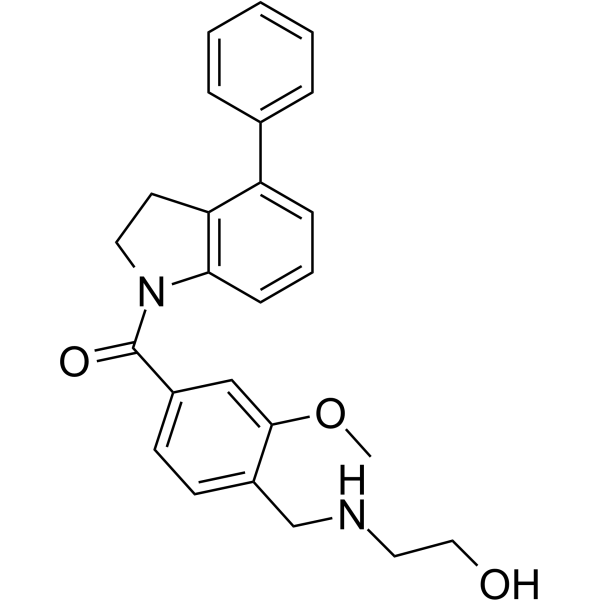 0 ImagesCat. No.: HY-130625CAS No.: 2393983-76-9PD-1/PD-L1-IN 6 (compound A13) is a potent PD-1/PD-L1 interaction inhibitor, with an IC50 of 132.8 nM. PD-1/PD-L1-IN 6 exhibits outstanding immunoregulatory activity. PD-1/PD-L1-IN 6 significantly elevates interferon-γ secretion in a Hep3B/OS-8/hPD-L1 and CD3 T cell co-culture model, without significant toxic effect. PD-1/PD-L1-IN 6 restores the immune response in a T cell-tumor co-culture model.
-
Anti-Mouse CD80 Antibody (TKMG48)
 0 ImagesCat. No.: HY-P992062Anti-Mouse CD80 Antibody (TKMG48) is an antibody that targets mouse CD80. By specifically binding to and disrupting the CD80:PD-L1 complex to release PD-L1, Anti-Mouse CD80 Antibody (TKMG48) functions as an indirect PD-1 agonist without blocking CD28 co-stimulation or CD80-CTLA4 binding. Anti-Mouse CD80 Antibody (TKMG48) inhibits T cell activation, reduces T cell effector functions and antigen-specific CD8+ T cell populations, and does not interfere with the differentiation, migration, antigen presentation or surface marker expression of dendritic cells. Anti-Mouse CD80 Antibody (TKMG48) significantly attenuates disease severity in mouse models of arthritis, spondyloarthritis, multiple sclerosis and Sjögren's syndrome, and its activity depends on the expression of PD-1 and PD-L1.
-
Anti-PDCD1/PD-1/CD279 Antibody
 0 ImagesCat. No.: HY-P990486Anti-PDCD1/PD-1/CD279 Antibody is a CHO-expressed humanized antibody that targets PDCD1/PD-1/CD279. Anti-PDCD1/PD-1/CD279 Antibody has a huIgG4SP type heavy chain and a huκ type light chain, with a predicted molecular weight (MW) of 150 kDa. The isotype control for Anti-PDCD1/PD-1/CD279 Antibody can refer to Human IgG4 kappa, Isotype Control (HY-P99003).
-
SF-9-2
 0 ImagesCat. No.: HY-175236CAS No.: 3053768-78-5SF-9-2 is a PD-L1/PD-1 binding inhibitor (IC50 = 24.9 nM). SF-9-2 inhibits epithelial-mesenchymal transition, migration, invasion, and proliferation of SK-N-SH cells, and also induces apoptosis and cell cycle arrest. SF-9-2 blocks PD-L1-induced SK-N-SH cell growth through the MAPK signaling pathway. SF-9-2 restores GSK-3β activity and enhances PD-L1 degradation through the ubiquitin-proteasome pathway. SF-9-2 inhibits tumor growth in the SK-N-SH NOG mouse model without significant toxicity. SF-9-2 also acts as an immune checkpoint inhibitor, blocking PD-L1 to restore T cell function. SF-9-2 can be used in neuroblastoma research.
-
Ledostomig
 0 ImagesCat. No.: HY-P991147CAS No.: 2769743-01-1Ledostomig is an immunoglobulin (H-γ1-scFv-L-κ) dimer monoclonal antibody targeting human netrin-5 (NTS5) and programmed death-1 (PD-1). Ledostomig is promising for research of various cancers.
-
PD-L1-IN-12
 0 ImagesCat. No.: HY-184989PD-L1-IN-12 is an orally active and potent selenium-containing small-molecule PD-L1 inhibitor (KD = 9.06 nM). PD-L1-IN-12 can mediate the internalization of PD-L1 and strongly block hPD-1 and hPD-L1 interaction (IC50 = 5.2 nM). PD-L1-IN-12 can be used in colorectal cancer immunology research.
-
PD-1/PD-L1-IN-32
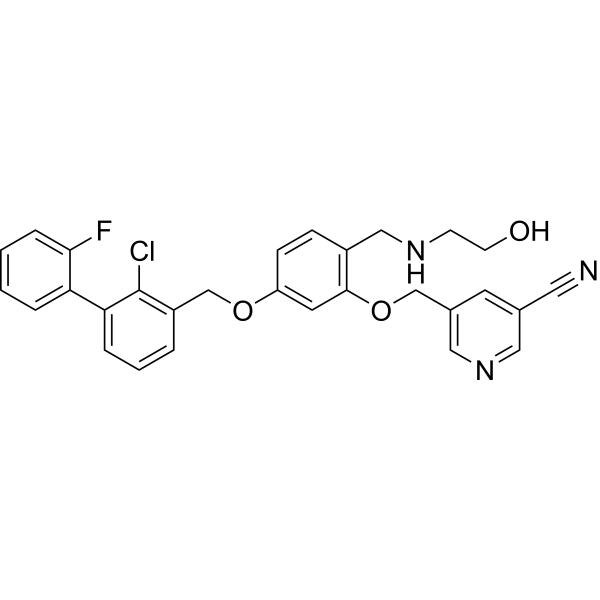 0 ImagesCat. No.: HY-155740CAS No.: 2765535-21-3PD-1/PD-L1-IN-32 (compound A56) is a potent PD-1/PD-L1 inhibitor (IC50=2.4 nM), with anticancer activity. PD-1/PD-L1-IN-32 significantly inhibits tumor growth in hPD-L1 MC38 humanized mouse model, without obvious toxicity against mouse normal ability.
-
BMS-1233
 0 ImagesCat. No.: HY-151066CAS No.: 2447065-99-6
-
(D)-PPA 1
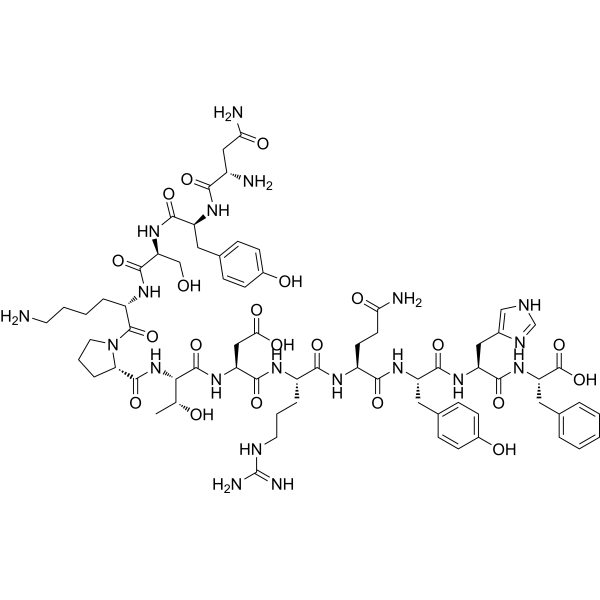 0 ImagesCat. No.: HY-P4072CAS No.: 1620813-53-7(D)-PPA 1 is a hydrolysisresistant d-peptide antagonist. (D)-PPA 1 serves as a potent PD-1/PD-L1 inhibitor. (D)-PPA 1 binds to PD-1 with the affinity 0f 0.51 μM with in vitro and in vivo efficacy.
-
2-Methylbiphenyl-oxadiazole-NH-Ph-CHO
 0 ImagesCat. No.: HY-169365CAS No.: 2766689-18-12-Methylbiphenyl-oxadiazole-NH-Ph-CHO is a PD-L1 ligand. 2-Methylbiphenyl-oxadiazole-NH-Ph-CHO serves as the PD-L1 ligand of AUTAC PDL1 degrader-2 (HY-169363). 2-Methylbiphenyl-oxadiazole-NH-Ph-CHO activates the autophagy-lysosome system and upregulates autophagy-lysosome-related genes. 2-Methylbiphenyl-oxadiazole-NH-Ph-CHO is applicable for cancer research.
-
PD-L1-IN-9
 0 ImagesCat. No.: HY-181096PD-L1-IN-9 is a PD-L1 inhibitor with an IC50 of 110.85 nM. PD-L1-IN-9 has a Kd of 319 nM for human PD-L1 and a Kd of 450 nM for murine PD-L1. PD-L1-IN-9 blocks the PD-1/PD-L1 interaction, restores T cell-mediated anti-tumor immunity, and induces PD-L1 degradation in tumor tissues. PD-L1-IN-9 exhibits anti-tumor activity and can be used in the research of tumors such as melanoma.
-
Antitumor agent-170
 0 ImagesCat. No.: HY-162644Antitumor agent-170 (Compound C6) exhibits inhibitory activities against PD-1/PD-L1 interaction and PARP7, with IC50 of 0.342 μM and 7.05 nM. Antitumor agent-170 exhibits a high affinity to human PD-L1, with a Ki of 9.31 nM. Antitumor agent-170 restores the T cell function and increases IFN-γ secretion. Antitumor agent-170 exhibits antitumor efficacy against melanoma in mouse models and good pharmacokinetic characteristics.
-
Anti-PD-L2 Antibody
 0 ImagesCat. No.: HY-P992289
-
PD-L1/Nampt-IN-1
 0 ImagesCat. No.: HY-175294CAS No.: 3054043-85-2PD-L1/Nampt-IN-1 is an orally active inhibitor that simultaneously target PD-L1 and NAMPT (nicotinamide phosphoribosyltransferase) with IC50s value of 63 nM and 582 nM. PD-L1/Nampt-IN-1 demonstrates cross-species affinity with comparable KD values for hPD-L1 (52.6 nM) and mPD-L1 (49.1 nM), respectively. PD-L1/Nampt-IN-1 effectively inhibits tumor growth by activating the tumor immune microenvironment. PD-L1/Nampt-IN-1 can be used for the study of melanoma.
-
TQB-2858
 0 ImagesCat. No.: HY-P991084TQB-2858 is a bifunctional fusion protein composed of a monoclonal antibody against PD-L1 fused with the extracellular domain of TGF-β receptor. TQB-2858 has a high affinity for PD-L1, TGF-β1, and TGF-β3 and exhibited high PD-L1 target occupancy. TQB-2858 can be used for the study of osteosarcoma and alveolar soft part sarcoma (ASPS).
-
BMS-103
 0 ImagesCat. No.: HY-134778CAS No.: 1675202-86-4BMS-103 is a PDL1 inhibitor (IC50 = 79.1 nM) (kd = 44 nM). BMS-103 reduces the survival rate of acute T-lymphoblastic leukemia cells and ovarian cells. BMS-103 can be used in research on acute T-lymphoblastic leukemia and cancers such as ovarian cancer.




