



p38 MAPK
The p38 MAPK family consists of highly conserved proline-directed serine-threonine protein kinases that are activated in response to a number many growth factors, cytokines, and chemotactic substances, such as vascular endothelial growth factor (VEGF), fibroblast growth factor (FGF), PDGF, TNF, interleukins, lipopolysaccharide (LPS) and formyl-methionyl-leucyl-phenylalanine (fMLP). It is well known that p38 is involved in inflammation, apoptosis, cardiomyocyte hypertrophy and cell differentiation.
The p38 MAPK family is composed of four proteins: p38α (encoded by the gene Mapk14), p38β (Mapk11), p38γ (Mapk12), and p38δ (Mapk13). Their coding genes have a distinct tissue distribution and they appear differentially expressed, being Mapk14 the most highly expressed. p38 MAPKs are substrates for three MAP2K (MKK6, MKK3, and MKK4). The contribution of each of these MAP2K to p38 MAPKs activation depends on the stimulus and the cell type. The MAP3Ks that lead to p38 MAPKs activation are ASK1, DLK1, TAK1, TAO1, TAO2, TPL2, MLK3, MEKK3, MEKK4, and ZAK1.
p38 MAPK Isoform Specific Products
All Product Categories
-
p38 MAPK Inhibitors
(823)
View all products
-
p38 MAPK Agonists
(6)
View all products
-
p38 MAPK Antagonists
(2)
View all products
-
p38 MAPK Activators
(219)
View all products
-
p38 MAPK Modulators
(20)
View all products
-
p38 MAPK p53 Inhibitors
(2)
View all products
-
p38 MAPK Inducers
(11)
View all products
-
p38 MAPK Degraders
(3)
View all products
-
p38 MAPK Control
(1)
View all products
-
p38 MAPK Ligands
(2)
View all products
-
AKT Serine/Threonine Kinase 1 (AKT1) Proteins
(3)
View all products
-
p38 MAPK Related Products (1180)
Related Products (1180)

-
Recombinant Proteins (3)
-
Antibodies (20)
-
p38 MAPK Isoform Comparison
-
Mapk14 Rat Pre-designed siRNA Set A
 0 ImagesCat. No.: HY-RS08109
Mapk14 Rat Pre-designed siRNA Set A contains three designed siRNAs for Mapk14 gene (Rat), as well as a negative control, a positive control, and a FAM-labeled negative control.
-
Ephemeranthol A
 0 ImagesCat. No.: HY-N17888CAS No.: 135545-86-7Ephemeranthol A is a phenanthrene compound with anticancer and anti-inflammatory activities. Ephemeranthol A exerts significant anti-inflammatory effects in macrophages by inhibiting the NF-κB and MAPK signaling pathways. Ephemeranthol A induces apoptosis and inhibits metastasis of lung cancer cells by suppressing the FAK/Akt signaling and EMT processes. Ephemeranthol A can be used for the research of acute and chronic inflammatory diseases and non-small cell lung cancer.
-
GK-136901
 0 ImagesCat. No.: HY-124487CAS No.: 1062624-71-8GK-136901 is an orally active, dual Nox1/Nox4 NADPH oxidase inhibitor with a Ki of 160 nM for Nox1 and 165 nM for Nox4. GK-136901 potently blocks high glucose-induced intracellular reactive oxygen species production, p38-MAPK phosphorylation, and upregulation of TGF-β1/2 and fibronectin (fibronectin) in renal cells. GK-136901 also inhibits the proliferation of mouse pulmonary vascular cells under hypoxic conditions. GK-136901 is applicable to the research on the pathogenesis of type 2 diabetic nephropathy, high glucose-related renal lesions and pulmonary hypertension.
-
JNK2/MKK7 PPI-IN-1
 0 ImagesCat. No.: HY-181812JNK2/MKK7 PPI-IN-1 is an orally active JNK2 inhibitor with an IC50 of 0.99 μM and a Kd of 81.6 μM. JNK2/MKK7 PPI-IN-1 inhibits JNK2 kinase activity, disrupts JNK2-MKK7 protein-protein interaction, and reduces c-Jun phosphorylation. JNK2/MKK7 PPI-IN-1 inhibits LPS-induced overexpression of inflammatory cytokines IL-6 and TNF-α. JNK2/MKK7 PPI-IN-1 can be used for the research of acute lung injury.
-
ISAM-CG557
 0 ImagesCat. No.: HY-175666ISAM-CG557 is a selective CB2R agonist, with a Ki of 54.6 nM. ISAM-CG557 reduces intracellular ROS levels and caspase activity. ISAM-CG557 exhibits significant MAPK bias and moderate G-protein bias, with CB2R EC50s of 0.60 nM (cAMP), 60.9 nM (β-arrestin) and 0.03 nM (MAPK). ISAM-CG557 exerts potent anti-inflammatory effects by reducing pro-inflammatory cytokines and increasing anti-inflammatory cytokines in cells. ISAM-CG557 can be used for the study of neuroinflammatory and neurodegenerative disorders.
-
Paris saponin VII (Standard)
 0 ImagesCat. No.: HY-N3584RCAS No.: 68124-04-9Synonyms: Chonglou Saponin VII (Standard)Paris saponin VII (Standard) is the analytical standard of Paris saponin VII. This product is intended for research and analytical applications. Paris saponin VII (Chonglou Saponin VII) is a steroidal saponin isolated from the roots and rhizomes of Trillium tschonoskii. Paris saponin VII-induced apoptosis in K562/ADR cells is associated with Akt/MAPK and the inhibition of P-gp. Paris saponin VII attenuates mitochondrial membrane potential, increases the expression of apoptosis-related proteins, such as Bax and cytochrome c, and decreases the protein expression levels of Bcl-2, caspase-9, caspase-3, PARP-1, and p-Akt. Paris saponin VII induces a robust autophagy in K562/ADR cells and provides a biochemical basis in the treatment of leukemia.
-
rel-Talmapimod hydrochloride
 0 ImagesCat. No.: HY-10406BCAS No.: 879132-01-1Synonyms: rel-SCIO-469 hydrochloriderel-Talmapimod (rel-SCIO-469) hydrochloride is an orally active and selective inhibitor of p38α MAPK with an IC50 of 9 nM. rel-Talmapimod hydrochloride inhibits the secretion of inflammatory factors (such as TNFα, IL-1β, IL-6, and VEGF) by suppressing the p38α MAPK pathway, and it also inhibits angiogenesis and osteoclast activation. rel-Talmapimod hydrochloride inhibits the growth of multiple myeloma cells and induces apoptosis. rel-Talmapimod hydrochloride can be used to study various hematological malignancies (such as multiple myeloma, myelodysplastic syndrome).
-
2-Stearoxyphenethyl phosphocholin
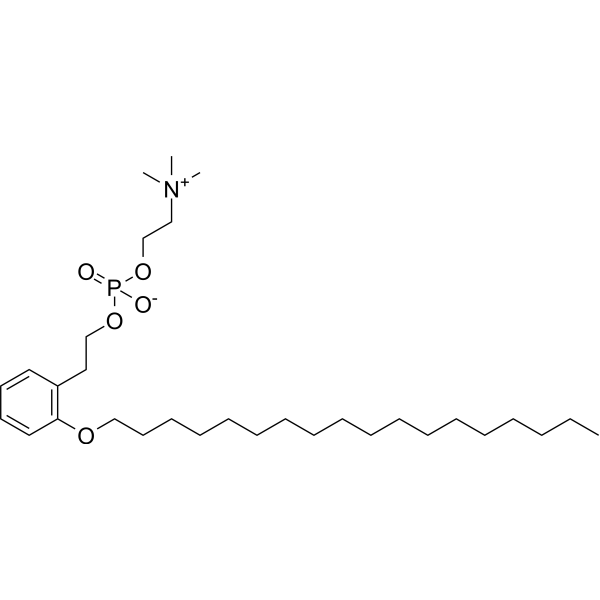 0 ImagesCat. No.: HY-163114CAS No.: 2170888-39-62-Stearoxyphenethyl phosphocholin (compound 1a) is a p38 MAPK inhibitor with anticancer activity. 2-Stearoxyphenethyl phosphocholin may bind to the p38 MAPK lipid-binding pocket and has broad-spectrum anti-tumor and lipid-modulating activities.
-
10-Methoxy-canthin-6-one
 0 ImagesSynonyms: Mtx-C10-Methoxy-canthin-6-one (Mtx-C) is analkaloid derivative. 10-Methoxy-canthin-6-one can induce DNA damage by intercalating into DNA. 10-Methoxy-canthin-6-one can inhibit cancer cells proliferation, cause G2/M phase arrest and induce myeloid differentiation. T10-Methoxy-canthin-6-one can upregulate the expression of myeloperoxidase, CD15, CD11b, and CD14, as well as activation of p38 MAPK. 10-Methoxy-canthin-6-one also exhibits anti-bacterial activity. 10-Methoxy-canthin-6-one can be used for the researches of cancer and infection, such as acute myeloid leukemias (AML).
-
DNH28
 0 ImagesCat. No.: HY-175037DNH28 is a potent NF-κB and MAPK inhibitor with an IC50 of 0.93 μM against HepG2 cells. DNH28 promotes apoptosis by down-regulating the expression of Bcl-2, up-regulating the expression of BAX and Cleaved-caspase-3. DNH28 blocks the cell cycle and inhibits migration. DNH28 can be used for the study of hepatocellular carcinoma (HCC).
-
Lansiumamide B
 0 ImagesCat. No.: HY-N20748CAS No.: 121817-37-6Lansiumamide B is a cinnamamide alkaloid, Antifungal agent and Insecticide. Lansiumamide B is isolated from the seeds of Clausena lansium. Lansiumamide B inhibits the phosphorylation of p38 MAPK, and decreases the protein and mRNA levels of TNF-α. Lansiumamide B induces abnormal mycelial growth, cell content leakage and cell wall degradation in Rhizoctonia solani. Lansiumamide B causes the death of early 4th-instar larvae of Aedes albopictus. Lansiumamide B exhibits anticonvulsant effects in epileptic rat models. Lansiumamide B can be used in studies related to plant fungal diseases.
-
JX401
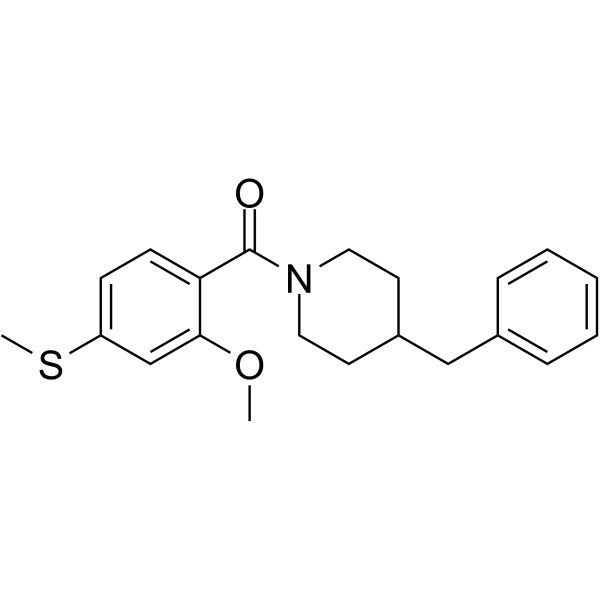 0 ImagesCat. No.: HY-108346CAS No.: 349087-34-9JX401 is a potent inhibitor of p38alpha, containing a 4-benzylpiperidine motif. p38alpha is hyperactive in inflammatory diseases, and various indications suggest that its inhibition would reverse inflammation. JX401 has the potential for the research of inflammation.
-
p38-α MAPK-IN-5
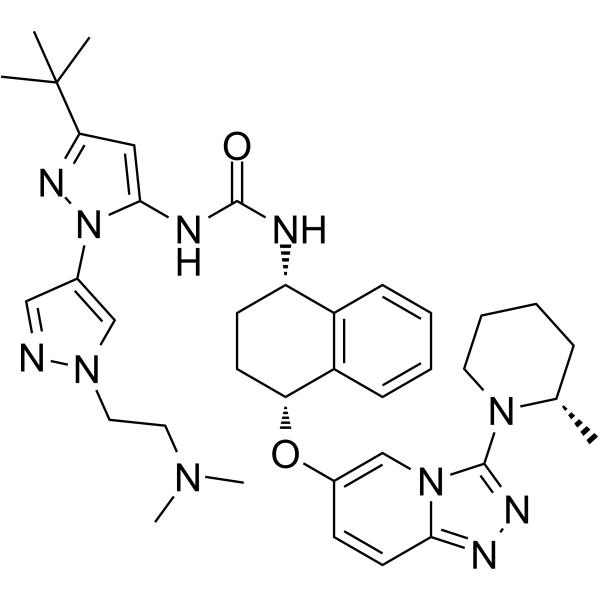 0 ImagesCat. No.: HY-147518CAS No.: 1443242-46-3
-
SB-T-101141
 0 ImagesCat. No.: HY-106159CAS No.: 186348-05-0SB-T-101141 is a novel taxane. SB-T-101141 effectively induces a noncanonical ferroptosis to overcome Paclitaxel (HY-B0015) resistance of breast cancer. SB-T-101141 facilitates the production of iron and ferrous ions and ROS. SB-T-101141 stably binds to KHSRP to inhibit the iron-dependent expression of CISD1 related to iron homeostasis. SB-T-101141 synergistically enhances the iron-dependent activation of JNK and PERK pathways via KHSRP. SB-T-101141 suppresses breast tumor growth in MCF-7(PR)/MDA-MB-231(PR) or KHSRP knock-down MCF-7 xenograft mice model.
-
Histamine phosphate (Standard)
 0 ImagesHistamine phosphate (Standard) is the analytical standard of Histamine phosphate (HY-A0129). This product is intended for research and analytical applications. Histamine phosphate is the agonist for histamine receptor and a vasodilator. Histamine phosphate is an organic nitrogen compound that participates in local immune responses, regulates intestinal physiological functions, and acts as a neurotransmitter. Histamine phosphate affects p38 MAPK/Akt signaling pathway, exhibits antitumor, antioxidant and anti-inflammatory activities. Histamine phosphate can be used in the research of acute myeloid leukemia, malignant melanoma, and renal cell carcinoma.
-
p38α-IN-14
 0 ImagesCat. No.: HY-184936p38α-IN-14 is a selective p38α inhibitor with an IC50 of 65 nM. p38α-IN-14 exhibits only weak inhibitory activity against hERG channels, with an IC50 > 30 μM. p38α-IN-14 can be used in the research of chronic inflammatory and autoimmune diseases, including rheumatoid arthritis, psoriasis and inflammatory bowel disease.
-
BIRB-1017
 0 ImagesCat. No.: HY-18861CAS No.: 294848-51-4BIRB-1017 is a potent inhibitor of p38 MAP kinase. BIRB-1017 can be used in inflammation research.
-
R-03201195
 0 ImagesCat. No.: HY-18794CAS No.: 249936-55-8R-03201195 is an efficient and selective p38 MAP kinase inhibitor with an IC50 for p38α of 0.7 nM. R-03201195 has inhibitory activity against TNF-α in THP-1 cells and against IL-1β in human whole blood, with IC50 values of 0.25 and 0.57 nM respectively. R-03201195 can be used for inflammatory diseases such as rheumatoid arthritis.
-
BS148
 0 ImagesCat. No.: HY-121033CAS No.: 2162116-09-6BS148 is a selective sigma-2 receptor (S2R) agonist with a Ki 20 nM. BS148 shows >80-fold selective for S2R than S1R. BS148 activates the endoplasmic reticulum stress response through the upregulation of protein kinase R-like ER kinase (PERK), activating transcription factor 4 (ATF4) genes, and C/EBP homologous protein (CHOP). BS148 induces apoptosis in melanoma cell. BS148 downregulates genes related to the cholesterol pathway and activates the MAPK signaling pathway. BS148 can be used for the study of melanoma.
-
Glucagon receptor antagonist-8
 0 ImagesCat. No.: HY-177156CAS No.: 208182-31-4Glucagon receptor antagonist-8 (Compound 1) is a human glucagon receptor and p38 mitogen-activated protein (MAP) kinase antagonist, with IC50s of 0.27 μM and 0.16 μM, respectively.




