



Wf-516
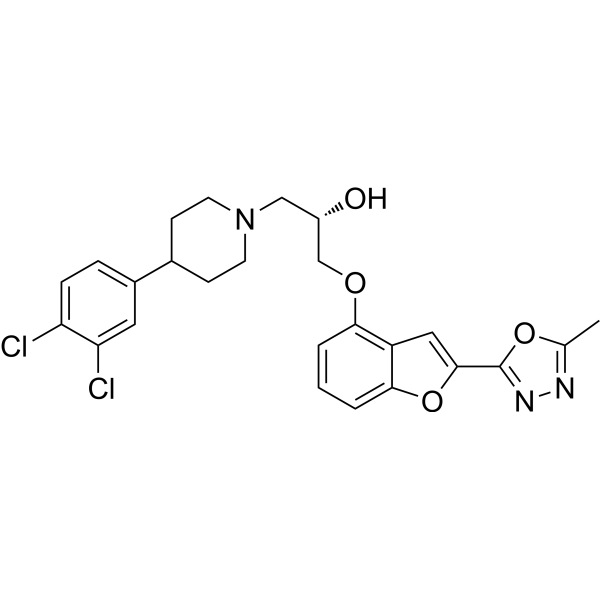
Wf-516 is an inhibitor of 5-HT reuptake, and an antagonist of 5-HT1A and 5-HT2A receptors, with Ki of 5 nM and 40 nM for 5-HT1A receptor and 5-HT2A receptor in humans, respectively, and has potent antidepressant activity.
For research use only. We do not sell to patients.
- CAS No.: 310392-94-0
- Formula: C25H25Cl2N3O4
- Molecular Weight:502.39
-
Storage:
Please store the product under the recommended conditions in the Certificate of Analysis.

To place orders, for customer services and technical support, please contact: MedChemExpress USA
Tel: 609-228-6898 E-mail: [email protected] [email protected]


-
 Biological Activity
-
Chemical Information
- Protocols
- Purity & Documentation
- References
-
 Help & FAQs


All 5-HT Receptor Isoforms
More

Biological Activity
Description
IC50 & Target
[1]|
5-HT1A Receptor |
5-HT2A Receptor |
5-HT1A Receptor 5 nM (Ki) |
5-HT2A Receptor 40 nM (Ki) |
In Vitro
Wf-516 shows high affinity for 5-HT1A receptors in the hippocampus and raphe nucleus of rats with Ki of 8.1 nM and 7.9 nM, respectively[2].
MedChemExpress (MCE) has not independently confirmed the accuracy of these methods. They are for reference only. Further protocols information, click here.
In Vivo
MedChemExpress (MCE) has not independently confirmed the accuracy of these methods. They are for reference only.


Chemical Information
-
CAS No. 310392-94-0
-
Molecular Weight 502.39
-
Formula C25H25Cl2N3O4
-
SMILES
O[C@H](COC1=C2C=C(C3=NN=C(C)O3)OC2=CC=C1)CN(CC4)CCC4C5=CC=C(Cl)C(Cl)=C5
-
Shipping
Room temperature in continental US; may vary elsewhere.
-
Storage
Please store the product under the recommended conditions in the Certificate of Analysis.

Protocols
-
Protocol for Tail Suspension Test (TST)
The Tail Suspension Test is a mouse behavioral assay in which an animal is suspended by the tail in an inescapable position, causing alternating escape-directed activity and immobility; the main readout is immobility time, and antidepressant-like treatments generally reduce immobility compared with vehicle controls. The assay detects behavioral response to acute inescapable stress rather than a molecular event; immobility is interpreted as passive stress-coping behavior, while reduced immobility is used as a predictive screen for antidepressant-like activity, with important limitations related to strain, locomotor activity, and tail-climbing behavior.
-
Protocol for Forced Swim Test (FST)
The Forced Swim Test is a rodent behavioral assay in which a mouse or rat is placed in an inescapable cylinder of water, and the main readout is the time spent immobile versus active escape-related behaviors such as swimming or climbing. Reduced immobility after treatment has historically been interpreted as antidepressant-like activity, but the assay should be interpreted as a behavioral response to acute inescapable stress rather than a complete model of human depression.


Purity & Documentation
References
[1]. El Mansari M, et al. In vivo electrophysiological assessment of the putative antidepressant Wf-516 in the rat raphe dorsalis, locus coeruleus and hippocampus. Naunyn Schmiedebergs Arch Pharmacol. 2008 Jan;376(5):351-61. Epub 2007 Nov 30. [Content Brief]
[2]. Saijo T, et al. Presynaptic selectivity of a ligand for serotonin 1A receptors revealed by in vivo PET assays of rat brain. PLoS One. 2012;7(8):e42589. [Content Brief]

Calculators
Concentration (start) × Volume (start) = Concentration (final) × Volume (final)


Wf-516 Related Classifications
HY-19417A Related Classifications
 Powered by Bioz