



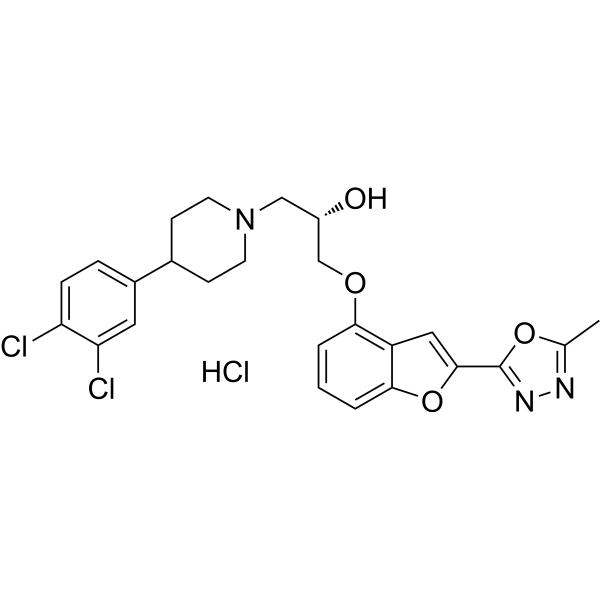
Wf-516 hydrochloride
Wf-516 hydrochloride is an inhibitor of 5-HT reuptake, and an antagonist of 5-HT1A and 5-HT2A receptors, with Ki of 5 nM and 40 nM for 5-HT1A receptor and 5-HT2A receptor in humans, respectively.Wf-516 hydrochloride has potent antidepressant activity.
For research use only. We do not sell to patients.
- CAS No.: 310392-93-9
- Formula: C25H26Cl3N3O4
- Molecular Weight:538.85
-
Storage:
Please store the product under the recommended conditions in the Certificate of Analysis.

To place orders, for customer services and technical support, please contact: MedChemExpress USA
Tel: 609-228-6898 E-mail: [email protected] [email protected]


-
 Biological Activity
-
Chemical Information
- Protocols
- Purity & Documentation
- References
-
 Help & FAQs


All 5-HT Receptor Isoforms
More

Biological Activity
Description
IC50 & Target
|
5-HT1A Receptor |
5-HT2A Receptor |


Chemical Information
-
CAS No. 310392-93-9
-
Molecular Weight 538.85
-
Formula C25H26Cl3N3O4
-
SMILES
O[C@H](COC1=C2C=C(C3=NN=C(C)O3)OC2=CC=C1)CN(CC4)CCC4C5=CC=C(Cl)C(Cl)=C5.Cl
-
Shipping
Room temperature in continental US; may vary elsewhere.
-
Storage
Please store the product under the recommended conditions in the Certificate of Analysis.

Protocols
-
Protocol for Tail Suspension Test (TST)
The Tail Suspension Test is a mouse behavioral assay in which an animal is suspended by the tail in an inescapable position, causing alternating escape-directed activity and immobility; the main readout is immobility time, and antidepressant-like treatments generally reduce immobility compared with vehicle controls. The assay detects behavioral response to acute inescapable stress rather than a molecular event; immobility is interpreted as passive stress-coping behavior, while reduced immobility is used as a predictive screen for antidepressant-like activity, with important limitations related to strain, locomotor activity, and tail-climbing behavior.
-
Protocol for Forced Swim Test (FST)
The Forced Swim Test is a rodent behavioral assay in which a mouse or rat is placed in an inescapable cylinder of water, and the main readout is the time spent immobile versus active escape-related behaviors such as swimming or climbing. Reduced immobility after treatment has historically been interpreted as antidepressant-like activity, but the assay should be interpreted as a behavioral response to acute inescapable stress rather than a complete model of human depression.


Purity & Documentation
References
[1]. El Mansari M, et al. In vivo electrophysiological assessment of the putative antidepressant Wf-516 in the rat raphe dorsalis, locus coeruleus and hippocampus. Naunyn Schmiedebergs Arch Pharmacol. 2008 Jan;376(5):351-61. Epub 2007 Nov 30. [Content Brief]
[2]. Saijo T, et al. Presynaptic selectivity of a ligand for serotonin 1A receptors revealed by in vivo PET assays of rat brain. PLoS One. 2012;7(8):e42589. [Content Brief]

Calculators
Concentration (start) × Volume (start) = Concentration (final) × Volume (final)


Wf-516 hydrochloride Related Classifications
HY-19417 Related Classifications
 Powered by Bioz