



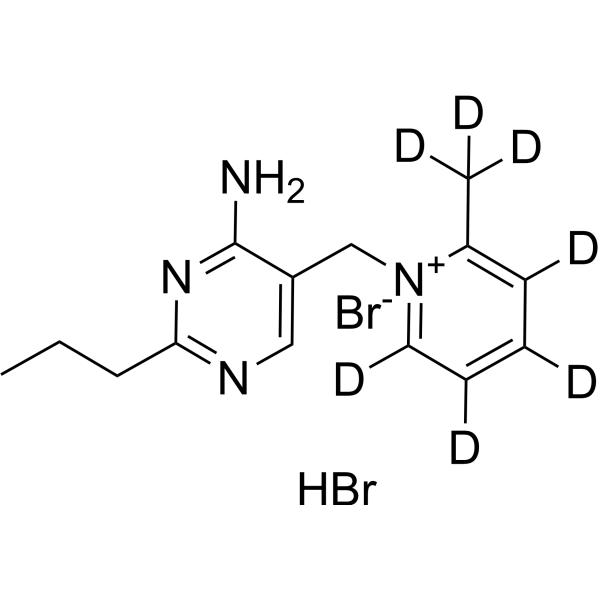
Amprolium-d7 bromide hydrobromide
Amprolium-d7 (bromide hydrobromide) is the deuterated-labeled Amprolium (HY-B0937). Amprolium is a thiamine transporter inhibitor and antiparasitic agent with oral activity and blood-brain barrier penetration. Amprolium blocks thiamine transport at the blood-brain barrier and intestine, and competitively inhibits thiamine pyrophosphokinase, inducing thiamine pyrophosphate deficiency and impairing carbohydrate synthesis. Amprolium induces oxidative stress, alters antioxidant enzyme activity, and inhibits acetylcholinesterase (AchE) activity. Amprolium disrupts reproductive organs and gametogenesis, and causes histopathological and ultrastructural damage to multiple organs. Amprolium induces thiamine deficiency, reduces body weight gain in mice, and causes psychomotor behavioral changes and nephropathy. Amprolium exhibits molluscicidal activity against the terrestrial snail Eobania vermiculata, and reduces the shedding of Eimeria meleagrimitis oocysts in feces and litter. Amprolium can be used for research on thiamine deficiency and coccidiosis.
商品は「研究用試薬」です。人や動物の医療用・臨床診断用・食品用の製品ではありません。
研究用途以外に使用した場合、当社は一切の責任を負いかねます。
- 分子式: C14H13D7Br2N4
- 分子量:411.19
-
保管条件:
Please store the product under the recommended conditions in the Certificate of Analysis.

To place orders, for customer services and technical support, please contact: MedChemExpress USA
Tel: 609-228-6898 E-mail: [email protected] [email protected]


-
 生物活性
生物活性
-
化学情報
- プロトコル
- 純度とドキュメンテーション
- 参考文献
-
 Help & FAQs


Parasite アイソフォーム固有の製品をすべて表示
More

生物活性
製品説明
IC50 & Target
[1]|
Coccidia |
AChE |
アプリケーション
1. This compound can be used as a tracer
2. This compound can be used as an internal standard for quantitative analysis by NMR, GC-MS, or LC-MS.


化学情報
-
非標識Cas 121-25-5
-
分子量 411.19
-
分子式 C14H13D7Br2N4
-
SMILES
CCCC1=NC=C(C(N)=N1)C[N+]2=C(C([2H])=C(C([2H])=C2C([2H])([2H])[2H])[2H])[2H].Br.[Br-]
-
輸送条件
Room temperature in continental US; may vary elsewhere.
-
保管条件
Please store the product under the recommended conditions in the Certificate of Analysis.


純度とドキュメンテーション
参考文献

Calculators
濃度 (開始) × 体積 (開始) = 濃度 (終了) × 体積 (終了)


Amprolium-d7 bromide hydrobromide 関連分類
HY-B0937S 関連分類
 Powered by Bioz
Keywords
- Amprolium-d7 bromide
- Isotope-Labeled Compounds
- Parasite
- Cholinesterase (ChE)
- thiamine pyrophosphate deficiency
- oxidative stress
- acetylcholinesterase activity
- coccidiosis
- synthetic anticoccidial
- Eimeria meleagrimitis
- Eobania vermiculata
- blood-brain barrier penetration
- thiamine pyrophosphokinase
- thiamine transporter inhibitor
- Inhibitor
- inhibitor
- inhibit