



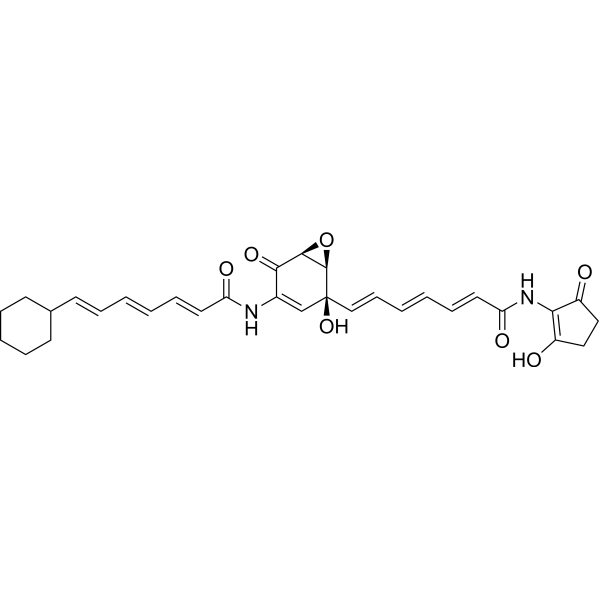
Asukamycin

Based on 1 Customer Validation
Asukamycin, a manumycin-type metabolite, could be isolated from Streptomyces nodosus subsp. asukaensis. Asukamycin is an antibiotic and has antimicrobial activity. Asukamycin inhibits growth of various tumor cell lines.
Nos produits utilisent uniquement pour la recherche. Nous ne vendons pas aux patients.
- Pureté : 95.0%
- CAS No.: 61116-33-4
- Formule: C31H34N2O7
- Masse moléculaire:546.61
-
Stockage:Powder -20°C, 3 years ; In solvent -80°C, 6 months , -20°C, 1 month

To place orders, for customer services and technical support, please contact: MedChemExpress USA
Tel: 609-228-6898 E-mail: [email protected] [email protected]


-
 Activité biologique
-
Chemical Information
- Protocole
- Pureté et documentation
- Références
-
 Help & FAQs


Voir tous les produits spécifiques à Isoform Antibiotic
More

Activité biologique
Description
Cellular Effect
|
Cell Line

|
Type | Value | Description | References |
|---|---|---|---|---|
| HCC38 | EC50 |
4.5 μM
Compound: Asukamycin
|
Antiproliferative activity against human HCC38 cells assessed as reduction in cell viability incubated for 48 hrs by SRB assay
Antiproliferative activity against human HCC38 cells assessed as reduction in cell viability incubated for 48 hrs by SRB assay
|
[PMID: 37984298] |
| MDA-MB-231 | EC50 |
13.8 μM
Compound: Asukamycin
|
Antiproliferative activity against human MDA-MB-231 cells assessed as reduction in cell viability incubated for 48 hrs by SRB assay
Antiproliferative activity against human MDA-MB-231 cells assessed as reduction in cell viability incubated for 48 hrs by SRB assay
|
[PMID: 37984298] |
In Vitro
Asukamycin (1-50 μM; 24 h) in a concentration-dependent manner reduces viability of five different human cell lines with IC50 of 1-5 μM[1].
Asukamycin (50 μM; 24 and 72 h; THP-1 cells) causes a significant increase in intracellular caspase 8 and caspase 3 activity[1].
Asukamycin (0-100 mcg/mL; bacteria, 18 h; fungus, 72 h) has antimicrobial activity. Asukamycin inhibits the growth of Gram-positive bacteria within a concentration range of 0.78-12.5 mcg/mL and inhibits the growth of Trichophyton mentagrophytes at a concentration of 25 mcg/ mL[2].
MedChemExpress (MCE) has not independently confirmed the accuracy of these methods. They are for reference only.
-
Cell Line:Human myeloid THP-1, HL-60, U-118 MG, U-87 MG and U-937 cells
-
Concentration:1-50 μM
-
Incubation Time:24 hours
-
Result:Reduced viability of five different cell lines in a concentration-dependent manner.
In Vivo
MedChemExpress (MCE) has not independently confirmed the accuracy of these methods. They are for reference only.
-
Animal Model:Mice[2]
-
Dosage:0-450 mg/kg
-
Administration:Intraperitoneal injection
-
Result:Had no effect on mice when administered by 450 mg/kg and the acute toxicity (LD50) was 48.5 mg/kg by intraperitoneal injection.


Chemical Information
-
CAS No. 61116-33-4
-
Appearance Solid
-
Masse moléculaire 546.61
-
Formule C31H34N2O7
-
Color Light yellow to yellow
-
SMILES
O=C1[C@@H]2[C@H]([C@@](O)(C=C1NC(/C=C/C=C/C=C/C3CCCCC3)=O)/C=C/C=C/C=C/C(NC4=C(CCC4=O)O)=O)O2
-
Structure Classification
-
Initial Source
Streptomyces nodosus subsp. asukaensis.
-
Livraison
Room temperature in continental US; may vary elsewhere.
-
Stockage
Powder -20°C 3 years In solvent -80°C 6 months -20°C 1 month


Pureté et documentation
-
Fiche technique (268 KB)
-
SDS (251 KB)
- English - EN (251 KB)
- Français - FR (251 KB)
- Deutsch - DE (251 KB)
- Norwegian - NO (251 KB)
- Español - ES (251 KB)
- Swedish - SV (251 KB)
- Italian - IT (251 KB)
- Korean - KR (251 KB)
- Portuguese - PT (251 KB)
-
Instruction de manipulation (2659 KB)
Références
[1]. Shipley PR, et, al. Antitumor activity of asukamycin, a secondary metabolite from the actinomycete bacterium Streptomyces nodosus subspecies asukaensis. Int J Mol Med. 2009 Nov;24(5):711-5. [Content Brief]
[2]. Omura S, et, al. A new antibiotic,, asukamycin, produced by Streptomyces. J Antibiot (Tokyo). 1976 Sep;29(9):876-81. [Content Brief]

Calculators
Concentration (start) × Volume (start) = Concentration (final) × Volume (final)


Asukamycin Related Classifications
HY-118893 Related Classifications
 Powered by Bioz