



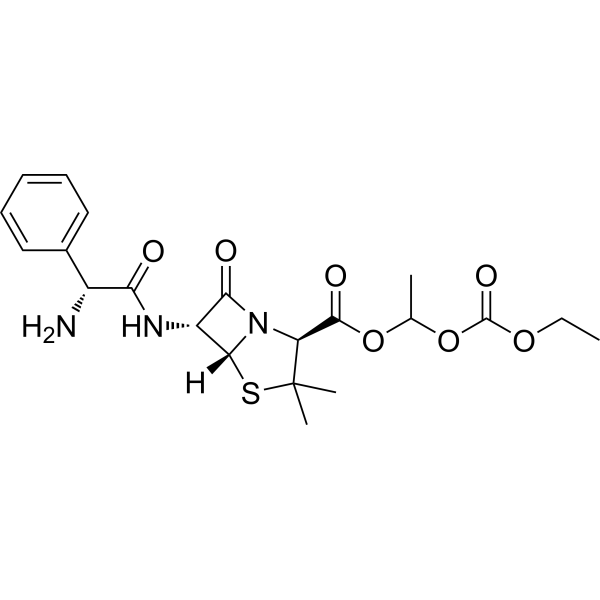
Bacampicillin
Bacampicillin is an orally active semi-synthetic aminopenicillin derivative, prodrug and bactericide that is readily inactivated by β-lactamases. Bacampicillin is hydrolyzed by carboxylester hydrolases and non-specific esterases in the gastrointestinal wall and plasma to form Ampicillin (HY-B0522), and produces higher levels of Ampicillin in rodents in vivo. Bacampicillin exhibits bactericidal activity against Gram-positive and Gram-negative bacteria. Bacampicillin can be used in studies related to bacterial infections.
For research use only. We do not sell to patients.
- CAS No.: 50972-17-3
- Formula: C21H27N3O7S
- Molecular Weight:465.52
-
Storage:
Please store the product under the recommended conditions in the Certificate of Analysis.

To place orders, for customer services and technical support, please contact: MedChemExpress USA
Tel: 609-228-6898 E-mail: [email protected] [email protected]


-
 Biological Activity
-
Chemical Information
- Protocols
- Purity & Documentation
- References
-
 Help & FAQs


All Antibiotic Isoforms
More

Biological Activity
Description
In Vitro
Bacampicillin (10-20 μg/mL; 30 min) is stable in synthetic gastric juice (pH 1.2) and phosphate buffer (pH 7.4), but undergoes extensive hydrolysis to Ampicillin (HY-B0522) in the presence of 10% human or rat serum after 30 min incubation at 37°C, with rat serum driving more complete hydrolysis than human serum[1].
Bacampicillin (100 μg/mL; up to 30 min) undergoes rapid first-order hydrolysis to Ampicillin in heparinized human blood, human plasma, and canine plasma at 37°C, with the fastest hydrolysis observed in human blood[1].
MedChemExpress (MCE) has not independently confirmed the accuracy of these methods. They are for reference only.
In Vivo
Bacampicillin (135 mg/kg; p.o.; single dose) produces significantly higher and longer-lasting interstitial fluid Ampicillin levels in female SPF-grade Sprague-Dawley rats with subcutaneous tissue cages compared to equimolar doses of Ampicillin[1].
Bacampicillin (135 mg/kg; p.o.; single dose) produces ampicillin concentrations in the kidney and liver tissues of female SPF-grade Sprague-Dawley rats that are 3 to 4 times those of equimolar ampicillin[1].
Bacampicillin (20 mg/kg; p.o.; single dose) exhibits 3-fold higher bioavailability than equimolar ampicillin in female beagle dogs[1].
Bacampicillin (p.o.; single dose) exhibits potent activity against a variety of bacterial infections in female NMRI mice, with better efficacy than Ampicillin[1].
MedChemExpress (MCE) has not independently confirmed the accuracy of these methods. They are for reference only.


Chemical Information
-
CAS No. 50972-17-3
-
Molecular Weight 465.52
-
Formula C21H27N3O7S
-
SMILES
O=C([C@@H](C(C)(C)S[C@]1([H])[C@@H]2NC([C@H](N)C3=CC=CC=C3)=O)N1C2=O)OC(OC(OCC)=O)C
-
Shipping
Room temperature in continental US; may vary elsewhere.
-
Storage
Please store the product under the recommended conditions in the Certificate of Analysis.


Purity & Documentation
References

Calculators
Concentration (start) × Volume (start) = Concentration (final) × Volume (final)


Bacampicillin Related Classifications
HY-B1149 Related Classifications
 Powered by Bioz
Keywords
- Bacampicillin
- 50972-17-3
- Drug Derivative
- Bacterial
- Antibiotic
- gram-negative bacteria
- upper respiratory tract infections
- urinary tract infections
- uncomplicated gonorrhea
- carboxylester hydrolase
- skin and soft tissue infections
- bacterial infections
- gram-positive bacteria
- lower respiratory tract infections
- beta-lactamase
- Inhibitor
- inhibitor
- inhibit