



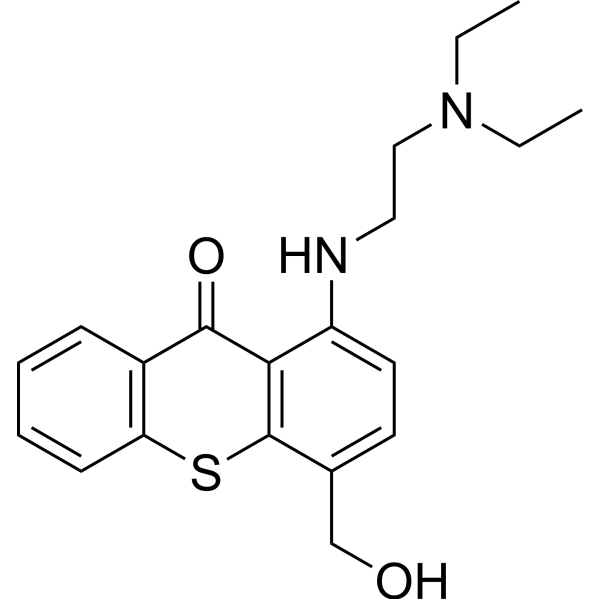
Hycanthone
Based on 2 publication(s) in Google Scholar
Hycanthone is an apurinic/apyrimidinic endonuclease 1 (APE1) inhibitor, DNA intercalator and Antischistosomal agent, with an IC50 of 80 nM against APE1. Hycanthone irreversibly inhibits thymidine incorporation into DNA in adult sensitive *Schistosoma mansoni*, while exerts weak inhibitory effects on uridine and leucine incorporation. Hycanthone reduces influenza virus-induced interferon production. Hycanthone exhibits mutagenic effects in various organisms, shows teratogenicity in mice and rabbits, and induces neoplastic liver lesions in partially hepatectomized mice. Hycanthone can be used in research related to schistosomiasis and cancer.
For research use only. We do not sell to patients.
- Purity : 99.81%
- CAS No.: 3105-97-3
- Formula: C20H24N2O2S
- Molecular Weight:356.48
-
Storage:Powder -20°C, 3 years , 4°C, 2 years ; In solvent -80°C, 2 years , -20°C, 1 year

To place orders, for customer services and technical support, please contact: MedChemExpress USA
Tel: 609-228-6898 E-mail: [email protected] [email protected]


-
 Biological Activity
-
Chemical Information
-
Solvent & Solubility
- Protocols
- Purity & Documentation
- References
-
 Help & FAQs


Publications Citing Use of MedChemExpress (MCE) Hycanthone
MoreAll DNA/RNA Synthesis Isoforms
MoreAll Parasite Isoforms
More

Biological Activity
Description
Cellular Effect
|
Cell Line

|
Type | Value | Description | References |
|---|---|---|---|---|
| P388 | IC50 |
28 μM
Compound: 1
|
In vitro cytotoxicity measured by quantifying clonogenic survival in soft agar following a 1-hour transient exposure of p388 mouse leukemia cells.
In vitro cytotoxicity measured by quantifying clonogenic survival in soft agar following a 1-hour transient exposure of p388 mouse leukemia cells.
|
[PMID: 9733489] |
In Vitro
Hycanthone potently inhibits the endonuclease activity of APE1, with an IC50 of 80 nM[1].
Hycanthone (1.0-50.0 μg/mL; 24 h) reduces the viability of LLC-MK2 cells in a concentration-dependent manner, with a cell survival rate of 43.1% at 50.0 μg/mL, 78.8% at 20.0 μg/mL, and only extremely weak effects at concentrations ≤10.0 μg/mL[3].
Hycanthone (0.1-10.0 μg/mL; 24 h) potently inhibits influenza virus-induced interferon production in LLC-MK2 cells in vitro in a concentration-dependent manner, reducing interferon yield by 73.5% at a concentration of 10.0 μg/mL[3].
Hycanthone (24 h) does not alter interferon-mediated antiviral cellular resistance in clone 1-5c-4 cells[3].
Hycanthone (10.0 μg/mL) ethanesulfonate prevents IA-4 N-oxide from blocking its inhibitory effect on influenza virus-induced interferon production, reducing interferon yield by 78.0%[3].
MedChemExpress (MCE) has not independently confirmed the accuracy of these methods. They are for reference only.
-
Cell Line:LLC-MK2
-
Concentration:1.0 μg/mL; 5.0 μg/mL; 10.0 μg/mL; 20.0 μg/mL; 50.0 μg/mL
-
Incubation Time:24 h
-
Result:Maintains 100.7% surviving cells at 1.0 μg/mL relative to untreated controls.
Maintains 95.4% surviving cells at 5.0 μg/mL relative to untreated controls.
Maintains 91.7% surviving cells at 10.0 μg/mL relative to untreated controls.
Reduces surviving cells to 78.8% at 20.0 μg/mL relative to untreated controls.
Reduces surviving cells to 43.1% at 50.0 μg/mL relative to untreated controls.
In Vivo
MedChemExpress (MCE) has not independently confirmed the accuracy of these methods. They are for reference only.
-
Animal Model:outbred Swiss albino mice (female, 18-20 g at infection, infected with Schistosoma mansoni hycanthone-resistant strain, treated at 8th week post-infection)[2]
-
Dosage:80 mg/kg
-
Administration:i.m.; single dose
-
Result:Showed no inhibition of tritiated thymidine, tritiated/14C-labeled uridine, or tritiated leucine incorporation at any time tested.
Showed ribosomal RNA levels identical to those of untreated controls seven days after treatment.


Chemical Information
-
CAS No. 3105-97-3
-
Appearance Solid
-
Molecular Weight 356.48
-
Formula C20H24N2O2S
-
Color Yellow to orange
-
SMILES
O=C1C2=C(SC3=C1C=CC=C3)C(CO)=CC=C2NCCN(CC)CC
-
Shipping
Room temperature in continental US; may vary elsewhere.
-
Storage
Powder -20°C 3 years 4°C 2 years In solvent -80°C 2 years -20°C 1 year


Publications (2)
-
Journal Impact Factor
-
Most Recent
-
Anal Chem
Metal-Enhanced Aggregation-Induced Emission Strategy for the HIV-I RNA-Binding Ligand Assay. [Abstract]2022 Mar 22;94(11):4695-4702. PMID: 35258935 -
Biomol Ther (Seoul)
Hycanthone Inhibits Inflammasome Activation and Neuroinflammation-Induced Depression-Like Behaviors in Mice. [Abstract]2023 Mar 1;31(2):161-167. PMID: 36203404


Solvent & Solubility
In Vitro:
DMSO : 12.5 mg/mL (35.07 mM; Need ultrasonic; Hygroscopic DMSO has a significant impact on the solubility of product, please use newly opened DMSO)
Please refer to the solubility information to select the appropriate solvent. Once prepared, please aliquot and store the solution to prevent product inactivation from repeated freeze-thaw cycles.
Storage method and period of stock solution: -80°C, 2 years; -20°C, 1 year. When stored at -80°C, please use it within 2 years. When stored at -20°C, please use it within 1 year.
Please refer to the solubility information to select the appropriate solvent. Once prepared, please aliquot and store the solution to prevent product inactivation from repeated freeze-thaw cycles.
Storage method and period of stock solution: -80°C, 2 years; -20°C, 1 year. When stored at -80°C, please use it within 2 years. When stored at -20°C, please use it within 1 year.
Concentration (start) × Volume (start) = Concentration (final) × Volume (final)
In Vivo:
Select the appropriate dissolution method based on your experimental animal and administration route.
- For the following dissolution methods, please ensure to first prepare a clear stock solution using an In Vitro approach and then sequentially add co-solvents:
- To ensure reliable experimental results, the clarified stock solution can be appropriately stored based on storage conditions. As for the working solution for In Vivo experiments, it is recommended to prepare freshly and use it on the same day.
- The percentages shown for the solvents indicate their volumetric ratio in the final prepared solution. If precipitation or phase separation occurs during preparation, heat and/or sonication can be used to aid dissolution.
Add each solvent one by one: 10% DMSO 40% PEG300 5% Tween-80 45% Saline
Solubility: ≥ 1.25 mg/mL (3.51 mM); Clear solution
This protocol yields a clear solution of ≥ 1.25 mg/mL (saturation unknown).
Taking 1 mL working solution as an example, add 100 μL DMSO stock solution (12.5 mg/mL) to 400 μL PEG300, and mix evenly; then add 50 μL Tween-80 and mix evenly; then add 450 μL Saline to adjust the volume to 1 mL.
Preparation of Saline: Dissolve 0.9 g sodium chloride in ddH₂O and dilute to 100 mL to obtain a clear Saline solution.
Add each solvent one by one: 10% DMSO 90% (20% SBE-β-CD in Saline)
Solubility: 1.25 mg/mL (3.51 mM); Suspended solution; Need ultrasonic
This protocol yields a suspended solution of 1.25 mg/mL. Suspended solution can be used for oral and intraperitoneal injection.
Taking 1 mL working solution as an example, add 100 μL DMSO stock solution (12.5 mg/mL) to 900 μL 20% SBE-β-CD in Saline, and mix evenly.
Preparation of 20% SBE-β-CD in Saline (4°C, storage for one week): 2 g SBE-β-CD powder is dissolved in 10 mL Saline, completely dissolve until clear.
In Vivo Dissolution Calculator
Please enter the basic information of animal experiments:
-
-
-
-
Recommended: Prepare an additional quantity of animals to account for potential losses during experiments.
Please enter your animal formula composition:
-
%DMSO +
Recommended: Keep the proportion of DMSO in working solution below 2% if your animal is weak.
-
%+
-
+%Tween-80 + +
-
%Saline +
The co-solvents required include: DMSO, . All of co-solvents are available by MedChemExpress (MCE). , Tween 80. All of co-solvents are available by MedChemExpress (MCE).
Working solution concentration: 0.22 mg/mL
Method for preparing stock solution: mg drug dissolved in μL DMSO. Stock solution concentration: mg/mL.
1. Take μL DMSO stock solution;
2. Add μL .
μL , mix evenly;
3. Then add μL Tween 80, mix evenly;
4. Then add μL
Please ensure that the stock solution in the first step is dissolved to a clear state, and add co-solvents in sequence. You can use ultrasonic heating (ultrasonic cleaner, recommended frequency 20-40 kHz), vortexing, etc. to assist dissolution.


Purity & Documentation
-
Data Sheet (290 KB)
-
SDS (393 KB)
- English - EN (393 KB)
- Français - FR (393 KB)
- Deutsch - DE (393 KB)
- Norwegian - NO (393 KB)
- Español - ES (393 KB)
- Swedish - SV (393 KB)
- Italian - IT (393 KB)
- Korean - KR (393 KB)
- Portuguese - PT (393 KB)
-
Handling Instructions (2659 KB)
References
[1]. Naidu MD, et al. Lucanthone and its derivative hycanthone inhibit apurinic endonuclease-1 (APE1) by direct protein binding. PloS one. 2011;6(9):e23679. [Content Brief]
[2]. Pica Mattoccia L, et al. Effect of hycanthone administered in vivo upon the incorporation of radioactive precursors into macromolecules of Schistosoma mansoni. Molecular and biochemical parasitology. 1983 Jun;8(2):99-107. [Content Brief]
[3]. Hahon N, et al. Action of antischistosomal drugs, hycanthone and its analog 1A-4 N-oxide, on viral interferon induction. J Toxicol Environ Health. 1980 Jul;6(4):705-12. [Content Brief]


Complete Stock Solution Preparation Table
Please refer to the solubility information to select the appropriate solvent. Once prepared, please aliquot and store the solution to prevent product inactivation from repeated freeze-thaw cycles.
Storage method and period of stock solution: -80°C, 2 years; -20°C, 1 year. When stored at -80°C, please use it within 2 years. When stored at -20°C, please use it within 1 year.
| Optional Solvent | Concentration Solvent Mass | 1 mg | 5 mg | 10 mg | 25 mg |
|---|---|---|---|---|---|
| DMSO | 1 mM | 2.8052 mL | 14.0260 mL | 28.0521 mL | 70.1302 mL |
| 5 mM | 0.5610 mL | 2.8052 mL | 5.6104 mL | 14.0260 mL | |
| 10 mM | 0.2805 mL | 1.4026 mL | 2.8052 mL | 7.0130 mL | |
| 15 mM | 0.1870 mL | 0.9351 mL | 1.8701 mL | 4.6753 mL | |
| 20 mM | 0.1403 mL | 0.7013 mL | 1.4026 mL | 3.5065 mL | |
| 25 mM | 0.1122 mL | 0.5610 mL | 1.1221 mL | 2.8052 mL | |
| 30 mM | 0.0935 mL | 0.4675 mL | 0.9351 mL | 2.3377 mL |


Hycanthone Related Classifications
HY-B1099 Related Classifications
 Powered by Bioz