



Besifloxacin Hydrochloride

Based on 1 Customer Validation
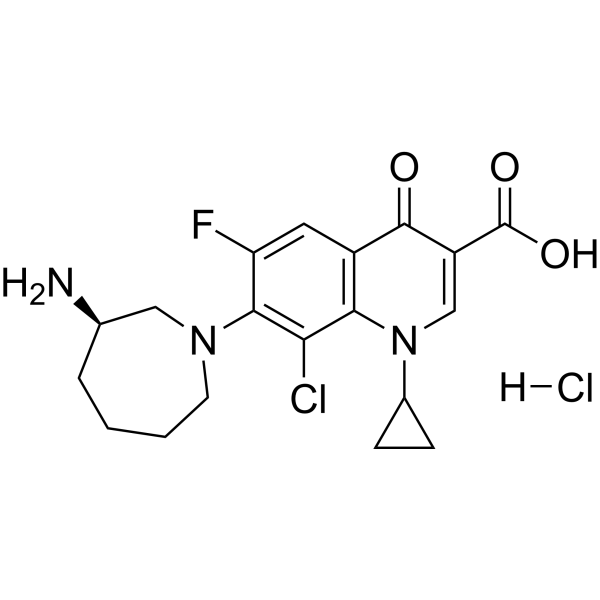
Besifloxacin Hydrochloride is a fourth generation fluoroquinolone antibiotic. Besifloxacin Hydrochloride is a DNA gyrase and topoisomerase IV inhibitor. Besifloxacin Hydrochloride has broad-spectrum antibacterial activity, it is effective against Gram-negative and Gram-positive aerobic and anaerobic strains and reduces the incidence of drug resistance. Besifloxacin Hydrochloride has anti-inflammatory activity. Besifloxacin Hydrochloride can be used in bacterial conjunctivitis research.
For research use only. We do not sell to patients.
- Purity : 98.49%
- CAS No.: 405165-61-9
- Formula: C19H22Cl2FN3O3
- Molecular Weight:430.30
-
Storage:
4°C, sealed storage, away from moisture
* In solvent : -80°C, 6 months; -20°C, 1 month (sealed storage, away from moisture)

To place orders, for customer services and technical support, please contact: MedChemExpress USA
Tel: 609-228-6898 E-mail: [email protected] [email protected]


-
 Biological Activity
-
Chemical Information
-
Solvent & Solubility
- Purity & Documentation
- References
-
 Help & FAQs




Biological Activity
Description
IC50 & Target
|
Quinolone |
In Vitro
Besifloxacin Hydrochloride (0.1-30 μg/mL, 18 h) inhibits the expression of IL-1α, G-CSF, IL-1ra, IL-6, GM-CSF, IL-12p40, IL-1β, IL-8, IP-10, MCP-1, and MIP-1α cytokines in THP-1 monocytes in a dose-dependent manner[1].
Besifloxacin Hydrochloride exhibits low cumulative minimum inhibitory concentration (MIC) values against S. aureus isolates, with only minimal increases in MIC observed as isolate resistance levels rise (0.015–8 μg/mL)[2].
Besifloxacin Hydrochloride shows only slight MIC elevation in response to increasing numbers of quinolone resistance-determining region (QRDR) mutations in DNA gyrase and topoisomerase IV of S. aureus isolates[2].
MedChemExpress (MCE) has not independently confirmed the accuracy of these methods. They are for reference only.
In Vivo
MedChemExpress (MCE) has not independently confirmed the accuracy of these methods. They are for reference only.
-
Animal Model:Rabbit MRSA infection model (New Zealand white rabbits, 2-3 kg and of either sex)[4]
-
Dosage:One drop (6 mg/mL) was placed on each eye
-
Administration:Topical administration, 19 total doses over 8 h
-
Result:Reduced corneal ulcers and edema in rabbit eyes.
Reduced colony-forming unit (CFU) recovered in the cornea.
Compared with gatifloxacin and moxifloxacin, the MIC was minimal (1 μg/mL).


Chemical Information
-
CAS No. 405165-61-9
-
Appearance Solid
-
Molecular Weight 430.30
-
Formula C19H22Cl2FN3O3
-
Color White to off-white
-
SMILES
O=C(C1=CN(C2CC2)C3=C(C=C(F)C(N4C[C@H](N)CCCC4)=C3Cl)C1=O)O.[H]Cl
-
Shipping
Room temperature in continental US; may vary elsewhere.
-
Storage
4°C, sealed storage, away from moisture
* In solvent : -80°C, 6 months; -20°C, 1 month (sealed storage, away from moisture)


Solvent & Solubility
In Vitro:
Ethanol : < 1 mg/mL (insoluble)


Purity & Documentation
-
Data Sheet (275 KB)
-
SDS (393 KB)
- English - EN (393 KB)
- Français - FR (393 KB)
- Deutsch - DE (393 KB)
- Norwegian - NO (393 KB)
- Español - ES (393 KB)
- Swedish - SV (393 KB)
- Italian - IT (393 KB)
- Korean - KR (393 KB)
- Portuguese - PT (393 KB)
-
Handling Instructions (2659 KB)
References
[1]. Zhang JZ, et al. Besifloxacin, a novel fluoroquinolone antimicrobial agent, exhibits potent inhibition of pro-inflammatory cytokines in human THP-1 monocytes. J Antimicrob Chemother. 2008 Jan;61(1):111-6. [Content Brief]
[2]. Sanfilippo CM, et al. Topoisomerase mutations that are associated with high-level resistance to earlier fluoroquinolones in Staphylococcus aureus have less effect on the antibacterial activity of besifloxacin. Chemotherapy. 2011;57(5):363-71. [Content Brief]
[3]. Haas W, et al. Besifloxacin, a novel fluoroquinolone, has broad-spectrum in vitro activity against aerobic and anaerobic bacteria. Antimicrob Agents Chemother. 2009 Aug;53(8):3552-60. [Content Brief]
[4]. Sanders ME, et al. Efficacy of besifloxacin in an early treatment model of methicillin-resistant Staphylococcus aureus keratitis. J Ocul Pharmacol Ther. 2010 Apr;26(2):193-8. [Content Brief]

Calculators
Concentration (start) × Volume (start) = Concentration (final) × Volume (final)


Besifloxacin Hydrochloride Related Classifications
HY-17028 Related Classifications
 Powered by Bioz