



Carcinine
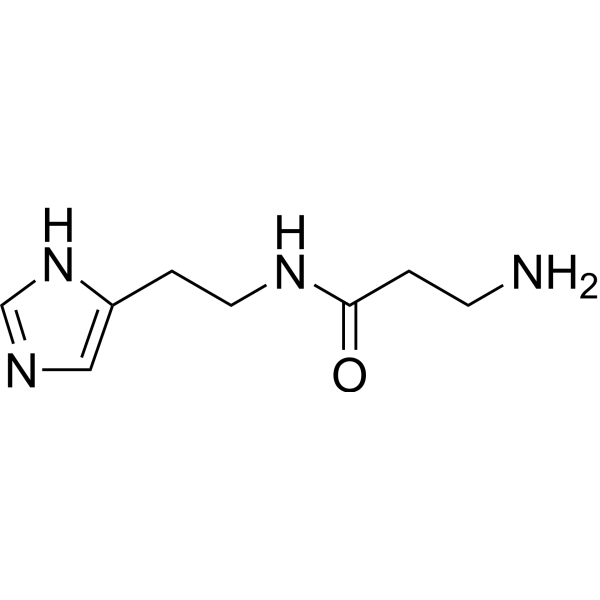
Carcinine (β-Alanylhistamine) is a selective and orally active histamine H3 receptor antagonist with a Ki of 0.2939 μM. Carcinine can reduce histamine content. Carcinine exhibits anti-oxidant activity and neuroprotective effects. Carcinine shows positive inotropic effect and can reduce blood sugar and blood lipid levels. Carcinine can be used for the researches of inflammation, neurological, cardiovascular and metabolic disease, such as retinal damage, seizure and diabetes.
For research use only. We do not sell to patients.
- CAS No.: 56897-53-1
- Formula: C8H14N4O
- Molecular Weight:182.22
-
Storage:
Please store the product under the recommended conditions in the Certificate of Analysis.

To place orders, for customer services and technical support, please contact: MedChemExpress USA
Tel: 609-228-6898 E-mail: [email protected] [email protected]


-
 Biological Activity
-
Chemical Information
- Protocols
- Purity & Documentation
- References
-
 Help & FAQs


All Histamine Receptor Isoforms
More

Biological Activity
Description
IC50 & Target
[1]|
H3 receptor 0.2939 μM (Ki) |
H2 Receptor 365.3 μM (Ki) |
H1 Receptor 3621.2 μM (Ki) |
In Vitro
Carcinine (0.5 mM, 16 h) forms a stable adduct with 4-HNE (HY-113466) a retention time of 17.5 mins[1].
Carcinine (1 μg-2 mg, 90 mins) inhibits 4-HNE-induced modification of mouse retinal proteins with an IC50 of 33.2 μg/μL[1].
Carcinine (1 mg, 0-72 h) reverses pre-formed 4-HNE-retinal protein adducts[1].
Carcinine (5 mM, 4-8 h) rescues the protein level of retinol dehydrogenase 12 in mouse retinal explants treated with 4-HNE[1].
Carcinine shows high affinity for histamine H3 receptor (Ki = 0.2939 μM) and extremely low affinity for H1 (Ki = 3621.2 μM) and H2 (Ki = 365.3 μM) receptors[2].
Carcinine (2-50 μM, 22.5 mins) increases K+-induced endogenous 5-HT release but shows no effect on dopamine release in mouse forebrain slices[2].
Carcinine (10 mM) scavenges hydroxyl radicals and inhibits deoxyribose damage[3].
Carcinine (10-25 mM, 60 mins) reduces linoleic acid 13-monohydroperoxide (LOOH) and phosphatidylcholine hydroperoxide (PCOOH) in PC liposomes to hydroxy products (LOH)[3].
MedChemExpress (MCE) has not independently confirmed the accuracy of these methods. They are for reference only. Further protocols information, click here.
In Vivo
Carcinine (0.2-20 mg/mouse, i.g., daily for 5 days) protects the retina in BALB/c mice with bright light exposure[1].
Carcinine (5-50 mg/kg, i.p.) decreases cortical and midbrain histamine content in ICR mice[2].
Carcinine (2-20 mg/kg, i.p., before PTZ) significantly reduces the seizure stage induced by pentylenetetrazole (PTZ) in ICR mice[2].
Carcinine (10-20 mg/kg, i.p., 30 mins before scopolamine) significantly ameliorates Scopolamine (HY-N0296)-induced learning deficit in ICR mice[2].
Carcinine (10-50 mg/kg, i.p.) increases the total ambulation distance in ICR mice[2].
Carcinine (10-100 μg, heart injection via perfusate cannula) shows positive inotropic effect in guinea pigs[4].
MedChemExpress (MCE) has not independently confirmed the accuracy of these methods. They are for reference only.
-
Animal Model:BALB/c mice with bright light exposure[1]
-
Dosage:0.2, 2 and 20 mg/mouse
-
Administration:Orally gavage, daily for 5 days
-
Result:Showed that the rod a-wave amplitude increases from 84 μV to 257 μV, and the b-wave increaseed from 183 μV to 606 μV.
Decreased the loss rate of photoreceptor nuclei.
Prevented light-induced reduction of RDH12 protein level.
-
Animal Model:Pentylenetetrazole (PTZ)-induced kindling mice models[2]
-
Dosage:2, 10 and 20 mg/kg
-
Administration:Intraperitoneally injection, before PTZ
-
Result:Reduced the seizure stage.
Prolonged the latency to myoclonic jerks and latency to generalized clonic seizures.


Chemical Information
-
CAS No. 56897-53-1
-
Molecular Weight 182.22
-
Formula C8H14N4O
-
SMILES
NCCC(NCCC1=CN=CN1)=O
-
Synonyms
β-Alanylhistamine
-
Shipping
Room temperature in continental US; may vary elsewhere.
-
Storage
Please store the product under the recommended conditions in the Certificate of Analysis.

Protocols
-
Research Protocol for Inflammation-related Diseases
The NLRP3 inflammasome is a cytosolic innate immune signaling platform that integrates priming signals and danger-signal activation to promote caspase-1 activation, maturation of IL-1β and IL-18, and gasdermin D-mediated pyroptotic cell death. The core experimental logic is to determine whether inflammatory disease phenotypes are driven by increased NLRP3 expression, ASC-containing inflammasome assembly, caspase-1 cleavage, GSDMD cleavage, and extracellular release of IL-1β/IL-18 rather than by nonspecific cell injury alone. The pathway is strongly linked to inflammation-related disease phenotypes because monosodium urate crystals activate NALP3/NLRP3 inflammasome signaling in gout-like crystal inflammation, cholesterol crystals activate NLRP3 inflammasomes in atherogenesis models, and DSS-induced intestinal inflammation has been reported to involve NLRP3 inflammasome activity. However, experimental colitis studies also show context-dependent protective effects of NLRP3 inflammasome co
-
Research Protocol for Metabolic Diseases
AMP-activated protein kinase, AMPK, is a conserved cellular energy sensor that responds to reduced cellular energy status and coordinates metabolism by increasing ATP-generating catabolic pathways while suppressing ATP-consuming anabolic processes. In metabolic disease research, the AMPK pathway is experimentally relevant because it regulates hepatic lipid synthesis, fatty acid oxidation, glucose production, skeletal-muscle glucose disposal, mTORC1-linked biosynthesis, autophagy, mitochondrial homeostasis, and whole-body energy balance. The central pathway logic is that energy stress, metformin, exercise-like stimulation, or direct AMPK activators increase AMPKα Thr172 phosphorylation and downstream substrate phosphorylation, including ACC and RAPTOR. Phosphorylation of ACC suppresses lipogenesis and supports fatty acid oxidation, whereas phosphorylation of RAPTOR suppresses mTORC1 signaling and links cellular energy status to growth and protein synthesis control. The pathway is linked


Purity & Documentation
References
[1]. Marchette LD, et al. Carcinine has 4-hydroxynonenal scavenging property and neuroprotective effect in mouse retina. Invest Ophthalmol Vis Sci. 2012 Jun 20;53(7):3572-83. [Content Brief]
[2]. Chen Z, et al. Pharmacological effects of carcinine on histaminergic neurons in the brain. Br J Pharmacol. 2004 Nov;143(5):573-80. [Content Brief]
[3]. Babizhayev MA, et al. L-carnosine (beta-alanyl-L-histidine) and carcinine (beta-alanylhistamine) act as natural antioxidants with hydroxyl-radical-scavenging and lipid-peroxidase activities. Biochem J. 1994 Dec 1;304 ( Pt 2)(Pt 2):509-16. [Content Brief]
[4]. Brotman DN, et al. Positive inotropic effect of carcinine in the isolated perfused guinea pig heart. Crit Care Med. 1990 Mar;18(3):317-21. [Content Brief]
[5]. Palmieri B, et al. The role of Carcinine treatment on glico-lipidic imbalance of patients with altered blood glucose pattern. Clin Ter. 2023 Mar-Apr;174(2):195-202. [Content Brief]

Calculators
Concentration (start) × Volume (start) = Concentration (final) × Volume (final)


Carcinine Related Classifications
HY-107567 Related Classifications
 Powered by Bioz