



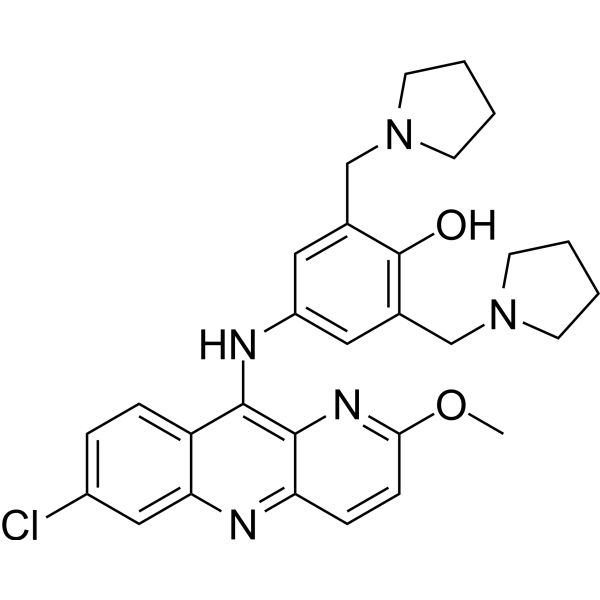
Pyronaridine
Based on 1 publication(s) in Google Scholar
Pyronaridine is an orally active Mannich base anti-malarial agent. Pyronaridine is active against P. falciparum and Echinococcus granulosus infection.
For research use only. We do not sell to patients.
- CAS No.: 74847-35-1
- Formula: C29H32ClN5O2
- Molecular Weight:518.05
-
Storage:
Please store the product under the recommended conditions in the Certificate of Analysis.

To place orders, for customer services and technical support, please contact: MedChemExpress USA
Tel: 609-228-6898 E-mail: [email protected] [email protected]


-
 Biological Activity
-
Chemical Information
- Protocols
- Purity & Documentation
- References
-
 Help & FAQs


Publications Citing Use of MedChemExpress (MCE) Pyronaridine
MoreAll Parasite Isoforms
More

Biological Activity
Description
Cellular Effect
|
Cell Line

|
Type | Value | Description | References |
|---|---|---|---|---|
| HEK293 | CC50 |
3549.5 nM
Compound: Pyronaridine
|
Cytotoxicity against HEK293 cells after 72 hrs by resazurin dye based assay
Cytotoxicity against HEK293 cells after 72 hrs by resazurin dye based assay
|
[PMID: 30537832] |
| HEK293 | IC50 |
0.00179 μM
Compound: Pyronaridine
|
Cytotoxicity against HEK293 cells assessed as cell viability after 72 hrs by resazurin-based plate reader analysis
Cytotoxicity against HEK293 cells assessed as cell viability after 72 hrs by resazurin-based plate reader analysis
|
[PMID: 26651537] |
| HEK293 | IC50 |
1.8 μM
Compound: Pyronaridine
|
Growth inhibition of HEK293 cells after 72 hrs by PrestoBlue staining based fluorescence assay
Growth inhibition of HEK293 cells after 72 hrs by PrestoBlue staining based fluorescence assay
|
[PMID: 28001067] |
| HEK293 | IC50 |
1.8 μM
Compound: Pyronaridine
|
Cytotoxicity against HEK293 cells
Cytotoxicity against HEK293 cells
|
[PMID: 32067457] |
| HEK293 | IC50 |
1.99 μM
Compound: Pyronaridine
|
Cytotoxicity against HEK293 cells after 72 hrs by resazurin dye-based fluorescence assay
Cytotoxicity against HEK293 cells after 72 hrs by resazurin dye-based fluorescence assay
|
[PMID: 30865443] |
| HEK293 | IC50 |
2.9 μM
Compound: Pyronaridine
|
Cytotoxicity against HEK293 cells after 72 hrs by resazurin dye based assay
Cytotoxicity against HEK293 cells after 72 hrs by resazurin dye based assay
|
[PMID: 29236492] |
| HEK293 | IC50 |
5.2 μM
Compound: Pyronaridine
|
Cytotoxicity against human HEK293 cells after 72 hrs by resazurin dye based fluorescence assay
Cytotoxicity against human HEK293 cells after 72 hrs by resazurin dye based fluorescence assay
|
[PMID: 29969262] |
| HEK293 | IC50 |
5.22 μM
Compound: Pyronaridine
|
Growth inhibition of HEK293 cells
Growth inhibition of HEK293 cells
|
[PMID: 28400231] |
| HeLa | IC50 |
0.82 μM
Compound: Pyronaridine
|
Antiviral activity against Ebolavirus infected in human HeLa cells assessed as reduction in viral replication incubated for 48 hrs by luminescence based assay
Antiviral activity against Ebolavirus infected in human HeLa cells assessed as reduction in viral replication incubated for 48 hrs by luminescence based assay
|
[PMID: 32832035] |
| HeLa | IC50 |
3.1 μM
Compound: Pyronaridine
|
Cytotoxicity against human HeLa cells assessed as reduction in cell viability incubated for 48 hrs by CellTiter Glo assay
Cytotoxicity against human HeLa cells assessed as reduction in cell viability incubated for 48 hrs by CellTiter Glo assay
|
[PMID: 36208544] |
| HepG2 | IC50 |
<1 μM
Compound: Pyronaridine
|
Antimalarial activity against sporozoite stage of Plasmodium yoelii assessed as invasion of human HepG2 cells expressing CD81 incubated for 2 hrs prior to inoculation measured after 1 hr by immunofluorescence assay in presence of penicillin/streptomycin
Antimalarial activity against sporozoite stage of Plasmodium yoelii assessed as invasion of human HepG2 cells expressing CD81 incubated for 2 hrs prior to inoculation measured after 1 hr by immunofluorescence assay in presence of penicillin/streptomycin
|
[PMID: 23927658] |
| HT-1080 | IC50 |
4.23 μM
Compound: Pyronaridine
|
Anticancer activity against human HT-1080 cells assessed as reduction in cell viability incubated for 48 hrs by resazurin dye based fluorescence assay
Anticancer activity against human HT-1080 cells assessed as reduction in cell viability incubated for 48 hrs by resazurin dye based fluorescence assay
|
[PMID: 36208544] |
| Jurkat | IC50 |
4 μM
Compound: (4) Pyronaridine
|
Concentration required to reduce growth of human jurkat leukemia cells to 50% of control cultures, determined using a 72 hr continuous exposure
Concentration required to reduce growth of human jurkat leukemia cells to 50% of control cultures, determined using a 72 hr continuous exposure
|
[PMID: 8182707] |
| SH-SY5Y | IC50 |
1.7 μM
Compound: Pyronaridine
|
Anticancer activity against human SH-SY5Y cells assessed as reduction in cell viability incubated for 48 hrs by resazurin dye based fluorescence assay
Anticancer activity against human SH-SY5Y cells assessed as reduction in cell viability incubated for 48 hrs by resazurin dye based fluorescence assay
|
[PMID: 36208544] |
| SK-N-AS | IC50 |
3.45 μM
Compound: Pyronaridine
|
Anticancer activity against human SK-N-AS cells assessed as reduction in cell viability incubated for 48 hrs by resazurin dye based fluorescence assay
Anticancer activity against human SK-N-AS cells assessed as reduction in cell viability incubated for 48 hrs by resazurin dye based fluorescence assay
|
[PMID: 36208544] |
| Vero 76 | IC50 |
1.3 μM
Compound: Pyronaridine
|
Cytotoxicity against African green monkey Vero 76 cells assessed as reduction in cell viability
Cytotoxicity against African green monkey Vero 76 cells assessed as reduction in cell viability
|
[PMID: 36208544] |
In Vitro
Pyronaridine (24 h) shows anti-P. falciparum activity with an IC50 value of 1.53-3.94 nM[1].
MedChemExpress (MCE) has not independently confirmed the accuracy of these methods. They are for reference only. Further protocols information, click here.
In Vivo
Pyronaridine (57 mg/kg, intraperitoneal injection, q.d. for 3 days) reduces the parasitic burden in secondarily infected (cysts) mice[2].
Pyronaridine (57 mg/kg, intraperitoneal injection, for a single dose) exhibits a higher exposure in the liver than in the plasma in male ICR mice[2].
MedChemExpress (MCE) has not independently confirmed the accuracy of these methods. They are for reference only.
-
Animal Model:Echinococcus granulosus-infected mice model[2]
-
Dosage:57 mg/kg
-
Administration:Oral administration, q.d. for 30 days
-
Result:Reduced 42.4% of parasite wet weight and killed 90.7% of secondary infection (cysts) of E. granulosus ss.
Clinical Trial
| NCT Number | Sponsor | Condition | Start Date |
Phase
|
|---|---|---|---|---|
| NCT01329991 | Plexxikon| | 2011-05 | PHASE1 |


Chemical Information
-
CAS No. 74847-35-1
-
Molecular Weight 518.05
-
Formula C29H32ClN5O2
-
SMILES
OC1=C(CN2CCCC2)C=C(NC3=C4N=C(OC)C=CC4=NC5=CC(Cl)=CC=C53)C=C1CN6CCCC6
-
Shipping
Room temperature in continental US; may vary elsewhere.
-
Storage
Please store the product under the recommended conditions in the Certificate of Analysis.


Publications (1)
-
Journal Impact Factor
-
Most Recent
-
mBio
Pyronaridine tetraphosphate is an efficacious antiviral and anti-inflammatory active against multiple highly pathogenic coronaviruses. [Abstract]2023 Oct 31;14(5):e0158723. PMID: 37581442

Protocols
-
Research Protocol for Infectious Diseases
Infectious-disease experiments test how pathogens interact with host barriers, innate immune receptors, inflammatory signaling, pathogen replication, and tissue injury; pattern-recognition receptors such as TLRs, RIG-I-like receptors, NOD-like receptors, and inflammasomes detect microbial molecules and activate NF-κB, interferon, and cytokine responses. The central hypothesis is that infection severity reflects the balance between pathogen burden and host response: protective inflammation restricts pathogen growth, whereas excessive or mislocalized inflammation contributes to tissue damage and disease phenotype. Unresolved questions include which host pathways are protective versus pathogenic, why some infection models fail to translate to human disease, and which combined readouts best predict clinically relevant infection outcomes.


Purity & Documentation
References
[1]. Vivas L, et al. Anti-malarial efficacy of pyronaridine and artesunate in combination in vitro and in vivo. Acta Trop. 2008 Mar;105(3):222-8. [Content Brief]
[2]. Jun Li, et al. Old drug repurposing for neglected disease: Pyronaridine as a promising candidate for the treatment of Echinococcus granulosus infections. EBioMedicine. 2020 Apr;54:102711. [Content Brief]

Calculators
Concentration (start) × Volume (start) = Concentration (final) × Volume (final)


Pyronaridine Related Classifications
HY-14749 Related Classifications
 Powered by Bioz