



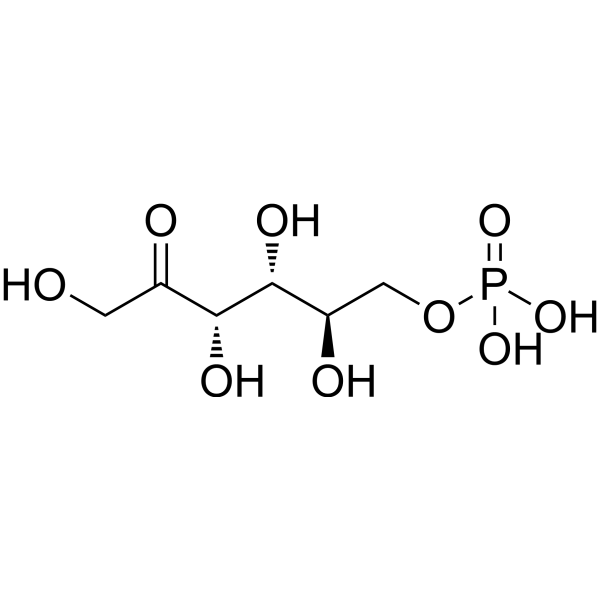
D-Fructose-6-phosphate
D-Fructose 6-phosphate is an endogenous metabolite. D-Fructose 6-phosphate can be obtained by hydrolysis of Fructose-1,6-bisphosphatase (FBPase). D-Fructose-6-phosphate is a sugar intermediate in the glycolysis pathway and the pentose phosphate pathway. D-Fructose-6-phosphate can be used to detect glucosamine-6-phosphate synthase and TAL activities. D-Fructose 6-phosphate can be used to study Lewy body dementia.
Nos produits utilisent uniquement pour la recherche. Nous ne vendons pas aux patients.
- CAS No.: 643-13-0
- Formule: C6H13O9P
- Masse moléculaire:260.14
-
Stockage:
4°C, sealed storage, away from moisture
* In solvent : -80°C, 6 months; -20°C, 1 month (sealed storage, away from moisture)

To place orders, for customer services and technical support, please contact: MedChemExpress USA
Tel: 609-228-6898 E-mail: [email protected] [email protected]


-
 Activité biologique
-
Chemical Information
- Pureté et documentation
- Références
-
 Help & FAQs


Voir tous les produits spécifiques à Isoform Endogenous Metabolite
More

Activité biologique
Description
In Vitro
D-Fructose-6-phosphate (3.2 mM; room temperature) can detect transaldolase TAL activity[3].
D-Fructose-6-phosphate (10 mM; incubation at 37°C for 60 min) can complete the detection of glucosamine-6-phosphate synthase activity[4].
MedChemExpress (MCE) has not independently confirmed the accuracy of these methods. They are for reference only.


Chemical Information
-
CAS No. 643-13-0
-
Appearance Solid
-
Masse moléculaire 260.14
-
Formule C6H13O9P
-
Color White to off-white
-
SMILES
OCC([C@H]([C@@H]([C@@H](COP(O)(O)=O)O)O)O)=O
-
Initial Source
-
Livraison
Room temperature in continental US; may vary elsewhere.
-
Stockage
4°C, sealed storage, away from moisture
* In solvent : -80°C, 6 months; -20°C, 1 month (sealed storage, away from moisture)


Pureté et documentation
-
Fiche technique (267 KB)
-
SDS (252 KB)
- Français - FR (252 KB)
- Deutsch - DE (252 KB)
- Norwegian - NO (252 KB)
- Español - ES (252 KB)
- Swedish - SV (252 KB)
- Italian - IT (252 KB)
- Korean - KR (252 KB)
- Portuguese - PT (252 KB)
-
Instruction de manipulation (2659 KB)
Références
[1]. Lee JH, et al. Crystal structure of rabbit phosphoglucose isomerase complexed with its substrate D-fructose 6-phosphate. Biochemistry. 2001 Jul 3;40(26):7799-805. [Content Brief]
[2]. Hardie DG, et al. AMPK: a nutrient and energy sensor that maintains energy homeostasis. Nat Rev Mol Cell Biol. 2012 Mar 22;13(4):251-62. [Content Brief]
[3]. Puskas F, et al. Stimulation of the pentose phosphate pathway and glutathione levels by dehydroascorbate, the oxidized form of vitamin C. FASEB J. 2000 Jul;14(10):1352-61. [Content Brief]
[4]. Hiramatsu M, et al. Suppression by thyroid hormones of glucosamine-6-phosphate synthetase activity in rat sublingual glands. Arch Oral Biol. 1984;29(10):849-51. [Content Brief]

Calculators
Concentration (start) × Volume (start) = Concentration (final) × Volume (final)


D-Fructose-6-phosphate Related Classifications
HY-113407 Related Classifications
 Powered by Bioz