



Apomorphine
Based on 5 publication(s) in Google Scholar
Apomorphine ((-)-Apomorphine) is a potent dopamine receptor agonist. Apomorphine also inhibit MAO-A and MAO-B. Apomorphine exerts neuroprotective effect and can relax rat corpus cavernosum. Apomorphine can inhibit ROS production, DNA fragmentation and inibit JNK and ERK1/2 phosphorylation. Apomorphine can enhance degradation of intracellular Aβ40 and Aβ42, reduces tau protein levels and inhibit MMP-9 expression. Apomorphine is a highly potent radical scavenger and iron chelator. Apomorphine can be used for the researches of dementia, parkinson's disease, alzheimer disease, breast carcinoma, and erectile dysfunction.
Nos produits utilisent uniquement pour la recherche. Nous ne vendons pas aux patients.
- Pureté: 99.19%
- CAS No.: 58-00-4
- Formule: C17H17NO2
- Masse moléculaire:267.32
-
Stockage:
-20°C, sealed storage, away from moisture
* In solvent : -80°C, 6 months; -20°C, 1 month (sealed storage, away from moisture)


To place orders, for customer services and technical support, please contact: MedChemExpress USA
Tel: 609-228-6898 E-mail: [email protected] [email protected]


-
 Activité biologique
-
Chemical Information
-
Solvant et solubilité
- Pureté et documentation
- Références
-
 Help & FAQs


Publications Citing Use of MedChemExpress (MCE) Apomorphine
More Customer Validation & Images

-
In Vivo Efficacy Study
Voir tous les produits spécifiques à Isoform Dopamine Receptor
More

Activité biologique
|
MAO-A |
MAO-B |
ERK1 |
ERK2 |
MMP-9 |
|
Cell Line

|
Type | Value | Description | References |
|---|---|---|---|---|
| Astrocyte | EC50 |
10.19 μM
Compound: 6
|
Antiproliferative activity against mouse astrocyte cells by MTT assay
Antiproliferative activity against mouse astrocyte cells by MTT assay
|
[PMID: 17417631] |
| CHO | EC50 |
4 nM
Compound: 19, apomorphine
|
Agonist activity at human dopamine D2 receptor expressed in CHO cells assessed as inhibition of forskolin-stimulated cAMP production
Agonist activity at human dopamine D2 receptor expressed in CHO cells assessed as inhibition of forskolin-stimulated cAMP production
|
[PMID: 18313303] |
| CHO | EC50 |
52 nM
Compound: 19, apomorphine
|
Agonist activity at human recombinant dopamine D1 receptor expressed in CHO cells assessed as stimulation of cAMP production
Agonist activity at human recombinant dopamine D1 receptor expressed in CHO cells assessed as stimulation of cAMP production
|
[PMID: 18313303] |
| CHO | EC50 |
7 nM
Compound: apomorphine
|
Agonist activity at human recombinant dopamine D3 receptor expressed in CHO cells assessed as inhibition of forskolin-stimulated cAMP accumulation
Agonist activity at human recombinant dopamine D3 receptor expressed in CHO cells assessed as inhibition of forskolin-stimulated cAMP accumulation
|
[PMID: 17976986] |
| CHO-K1 | EC50 |
30 nM
Compound: 1
|
Agonist activity at rat D2 dopamine receptor expressed in CHOK1 cells assessed as [35S]GTPgammaS binding after 90 mins by liquid scintillation counter
Agonist activity at rat D2 dopamine receptor expressed in CHOK1 cells assessed as [35S]GTPgammaS binding after 90 mins by liquid scintillation counter
|
[PMID: 21550699] |
| CHO-K1 | EC50 |
53 nM
Compound: 1
|
Agonist activity at rat dopamine D2short receptor expressed in CHO-K1 cells assessed as stimulation of [35S]GTPgammaS binding by liquid scintillation counting
Agonist activity at rat dopamine D2short receptor expressed in CHO-K1 cells assessed as stimulation of [35S]GTPgammaS binding by liquid scintillation counting
|
[PMID: 19454369] |
| CHO-K1 | IC50 |
4.2 nM
Compound: Apomorphine
|
Agonist activity at human dopamine D2 receptor expressed in CHOK1 cells assessed as calcium mobilization by radiometric and luminescence plate counting method
Agonist activity at human dopamine D2 receptor expressed in CHOK1 cells assessed as calcium mobilization by radiometric and luminescence plate counting method
|
[PMID: 25557493] |
| COS-7 | IC50 |
118 nM
Compound: Apomorphine
|
Displacement of [3H]nemonapride from Rattus norvegicus (rat) wild type dopamine D2 receptor transfected in african green monkey COS7 cells after 1 hr by beta scintillation counting
Displacement of [3H]nemonapride from Rattus norvegicus (rat) wild type dopamine D2 receptor transfected in african green monkey COS7 cells after 1 hr by beta scintillation counting
|
10.1007/s00044-004-0006-x |
| COS-7 | IC50 |
135 nM
Compound: Apomorphine
|
Displacement of [3H]nemonapride from Rattus norvegicus (rat) chimeric dopamine D2 trunk/D2 tail receptor transfected in african green monkey COS7 cells after 1 hr by beta scintillation counting
Displacement of [3H]nemonapride from Rattus norvegicus (rat) chimeric dopamine D2 trunk/D2 tail receptor transfected in african green monkey COS7 cells after 1 hr by beta scintillation counting
|
10.1007/s00044-004-0006-x |
| COS-7 | IC50 |
24.3 nM
Compound: Apomorphine
|
Displacement of [3H]nemonapride from Rattus norvegicus (rat) chimeric dopamine D3 trunk/D2 tail receptor transfected in african green monkey COS7 cells after 1 hr by beta scintillation counting
Displacement of [3H]nemonapride from Rattus norvegicus (rat) chimeric dopamine D3 trunk/D2 tail receptor transfected in african green monkey COS7 cells after 1 hr by beta scintillation counting
|
10.1007/s00044-004-0006-x |
| COS-7 | IC50 |
27.2 nM
Compound: Apomorphine
|
Displacement of [3H]nemonapride from Rattus norvegicus (rat) chimeric dopamine D3 trunk/D3 tail receptor transfected in african green monkey COS7 cells after 1 hr by beta scintillation counting
Displacement of [3H]nemonapride from Rattus norvegicus (rat) chimeric dopamine D3 trunk/D3 tail receptor transfected in african green monkey COS7 cells after 1 hr by beta scintillation counting
|
10.1007/s00044-004-0006-x |
| COS-7 | IC50 |
29.4 nM
Compound: Apomorphine
|
Displacement of [3H]nemonapride from Rattus norvegicus (rat) wild type dopamine D3 receptor transfected in african green monkey COS7 cells after 1 hr by beta scintillation counting
Displacement of [3H]nemonapride from Rattus norvegicus (rat) wild type dopamine D3 receptor transfected in african green monkey COS7 cells after 1 hr by beta scintillation counting
|
10.1007/s00044-004-0006-x |
| COS-7 | IC50 |
69.5 nM
Compound: Apomorphine
|
Displacement of [3H]nemonapride from Rattus norvegicus (rat) chimeric dopamine D2 trunk/D3 tail receptor transfected in african green monkey COS7 cells after 1 hr by beta scintillation counting
Displacement of [3H]nemonapride from Rattus norvegicus (rat) chimeric dopamine D2 trunk/D3 tail receptor transfected in african green monkey COS7 cells after 1 hr by beta scintillation counting
|
10.1007/s00044-004-0006-x |
| HEK293 | EC50 |
0.4 nM
Compound: Apomorphine
|
In vitro effective concentration tested on HEK293 cells co-transfected with rat Dopamine receptor D2 using FLIPR assay
In vitro effective concentration tested on HEK293 cells co-transfected with rat Dopamine receptor D2 using FLIPR assay
|
[PMID: 15239663] |
| HEK293 | EC50 |
0.4 nM
Compound: Apomorphine
|
Agonist activity at rat D2 receptor in HEK293 cells coexpressing G-alpha-qo5 by FLIPR
Agonist activity at rat D2 receptor in HEK293 cells coexpressing G-alpha-qo5 by FLIPR
|
[PMID: 17149874] |
| HEK293 | EC50 |
1.5 nM
Compound: Apomorphine
|
In vitro effective concentration tested on HEK293 cells co-transfected with ferret Dopamine receptor D4 using FLIPR assay
In vitro effective concentration tested on HEK293 cells co-transfected with ferret Dopamine receptor D4 using FLIPR assay
|
[PMID: 15239663] |
| HEK293 | EC50 |
1.5 nM
Compound: Apomorphine
|
Agonist activity at ferret D4 receptor in HEK293 cells coexpressing G-alpha-qo5 by FLIPR
Agonist activity at ferret D4 receptor in HEK293 cells coexpressing G-alpha-qo5 by FLIPR
|
[PMID: 17149874] |
| HEK293 | EC50 |
1.8 nM
Compound: Apomorphine
|
In vitro effective concentration tested on HEK293 cells co-transfected with ferret Dopamine receptor D2 using FLIPR assay
In vitro effective concentration tested on HEK293 cells co-transfected with ferret Dopamine receptor D2 using FLIPR assay
|
[PMID: 15239663] |
| HEK293 | EC50 |
1.8 nM
Compound: Apomorphine
|
Agonist activity at ferret D2 receptor in HEK293 cells coexpressing Galphaqo5 by FLIPR
Agonist activity at ferret D2 receptor in HEK293 cells coexpressing Galphaqo5 by FLIPR
|
[PMID: 17149874] |
| HEK293 | EC50 |
25.7 nM
Compound: 1
|
Agonist activity at human dopamine D1 receptor expressed in HEK293 cells assessed as cAMP accumulation after 15 mins
Agonist activity at human dopamine D1 receptor expressed in HEK293 cells assessed as cAMP accumulation after 15 mins
|
[PMID: 23727194] |
| HEK293 | EC50 |
4 nM
Compound: 1
|
Agonist activity at human dopamine D2L receptor expressed in HEK293 cells assessed as forskolin-stimulated cAMP accumulation after 15 mins
Agonist activity at human dopamine D2L receptor expressed in HEK293 cells assessed as forskolin-stimulated cAMP accumulation after 15 mins
|
[PMID: 23727194] |
| HEK293 | EC50 |
4.3 nM
Compound: Apomorphine
|
In vitro effective concentration tested on HEK293 cells co-transfected with human Dopamine receptor D4 using FLIPR assay
In vitro effective concentration tested on HEK293 cells co-transfected with human Dopamine receptor D4 using FLIPR assay
|
[PMID: 15239663] |
| HEK293 | EC50 |
4.3 nM
Compound: Apomorphine
|
Agonist activity at human D4.4 receptor in HEK293 cells coexpressing G-alpha-qo5 by FLIPR
Agonist activity at human D4.4 receptor in HEK293 cells coexpressing G-alpha-qo5 by FLIPR
|
[PMID: 17149874] |
| HEK293 | EC50 |
5.5 nM
Compound: Apomorphine
|
In vitro effective concentration tested on HEK293 cells co-transfected with rat Dopamine receptor D4 using FLIPR assay
In vitro effective concentration tested on HEK293 cells co-transfected with rat Dopamine receptor D4 using FLIPR assay
|
[PMID: 15239663] |
| HEK293 | EC50 |
5.5 nM
Compound: Apomorphine
|
Agonist activity at rat D4 receptor in HEK293 cells coexpressing G-alpha-qo5 by FLIPR
Agonist activity at rat D4 receptor in HEK293 cells coexpressing G-alpha-qo5 by FLIPR
|
[PMID: 17149874] |
| HEK293 | EC50 |
5.8 nM
Compound: Apomorphine
|
In vitro effective concentration tested on HEK293 cells co-transfected with human Dopamine receptor D2 using FLIPR assay
In vitro effective concentration tested on HEK293 cells co-transfected with human Dopamine receptor D2 using FLIPR assay
|
[PMID: 15239663] |
| HEK293 | EC50 |
5.8 nM
Compound: Apomorphine
|
Agonist activity at human D2 receptor in HEK293 cells coexpressing G-alpha-qo5 by FLIPR
Agonist activity at human D2 receptor in HEK293 cells coexpressing G-alpha-qo5 by FLIPR
|
[PMID: 17149874] |
| HEK293 | IC50 |
20.8 μM
Compound: apomorphine
|
Inhibition of 4-(4-(dimethylamino)styryl)-N-methylpyridinium uptake at human OCT1 expressed in HEK293 cells by confocal microscopy
Inhibition of 4-(4-(dimethylamino)styryl)-N-methylpyridinium uptake at human OCT1 expressed in HEK293 cells by confocal microscopy
|
[PMID: 18788725] |
| Medulloblastoma cell | EC50 |
0.168 μM
Compound: 6
|
Antiproliferative activity against mouse medulloblastoma cells harboring heterozygous ptch1 gene by MTT assay
Antiproliferative activity against mouse medulloblastoma cells harboring heterozygous ptch1 gene by MTT assay
|
[PMID: 17417631] |
| Pituitary gland cell | EC50 |
20 nM
Compound: apomorphine
|
Agonist activity at human recombinant dopamine D2 receptor expressed in rat pituitary cells assessed as inhibition of forskolin-stimulated cAMP accumulation
Agonist activity at human recombinant dopamine D2 receptor expressed in rat pituitary cells assessed as inhibition of forskolin-stimulated cAMP accumulation
|
[PMID: 17976986] |
Apomorphine (0-250 μM; 30 min) inhibits striatal MAO-A and MAO-B activities from C57BL mice with IC50 values of 93 μM and 241 μM, respectively[2].
Apomorphine is a highly potent radical scavenger and iron chelator with an IC50 of 0.2-0.5 μM[2].
Apomorphine (7.5-15 μM; 24 h) protects SH-SY5Y cells against 6-OHDA (HY-B1081)-induced cell death, ROS production and DNA fragmentation[3].
Apomorphine (15 μM; 8-24 h) attenuates 6-OHDA-induced JNK phosphorylation in SH-SY5Y cells[3].
Apomorphine (7.5-30 μM; 24 h) does not induce intracellular glutathione synthesis in SH-SY5Y cells[3].
Apomorphine (10 μM; 2 h pre-incubation) significantly enhances degradation of intracellular Aβ40 and Aβ42 in SH-SY5Y cells, reversing MG132 (HY-13259)-mediated inhibition of Aβ breakdown[4].
Apomorphine (2-10 μM) significantly increases intracellular 20S proteasome and IDE activity in SH-SY5Y cells, and partially reverses MG132-induced proteasome inhibition[4].
Apomorphine (5-20 μM; 24 h) significantly protects SH-SY5Y cells from H2O2-induced cell death and reduces H2O2-mediated p53 protein elevation[4].
Apomorphine (10-100 μM; 24 h) exhibits minimal cytotoxicity in MCF-7 human breast carcinoma cells at concentrations ≤25 μM, with a 25% reduction in cell viability observed at 50 μM[5].
Apomorphine (10-40 μM; 24 h) potently inhibits TNF-α- and PMA (HY-18739)-induced MMP-9 secretion in MCF-7 human breast carcinoma cells without altering MMP-2 levels[5].
Apomorphine (40 μM; 24 h) inhibits TNF-α-induced invasion by MCF-7 human breast carcinoma cells by 80%[5].
Apomorphine (20-40 μM; 18 h) suppresses TNF-α-induced MMP-9 mRNA expression in MCF-7 human breast carcinoma cells[5].
Apomorphine (10-40 μM; 6 h) suppresses TNF-α-induced nuclear translocation of the AP-1 subunit c-Jun in MCF-7 human breast carcinoma cells without altering NF-κB subunit p65 nuclear translocation[5].
Apomorphine (10-40 μM; 15-30 min) and (40 μM; 15, 30 min) inhibits TNF-α-induced phosphorylation of ERK1/2 in MCF-7 human breast carcinoma cells without altering phosphorylation of JNK, p38, or Akt[5].
Apomorphine (10−9-10−4 M) produces concentration-dependent relaxation of rat corpus cavernosum[6].
Apomorphine (100 μM; 4 min) does not alter tissue cGMP or cAMP levels in Phenylephrine (HY-B0769)-precontracted isolated rat corpus cavernosum strips[6].
Apomorphine (0-600 μM) induces C6 cells (EC50 = 200 μM) and rat neuron death[7].
MedChemExpress (MCE) has not independently confirmed the accuracy of these methods. They are for reference only.
-
Cell Line:human neuroblastoma SH-SY5Y cells
-
Concentration:5, 10 and 20 μM
-
Incubation Time:24 h
-
Result:Protected cells from H2O2-induced toxicity, with 10 μM being the most effective concentration.
Attenuated the H2O2-induced elevation of p53 protein levels.
-
Cell Line:MCF-7 human breast carcinoma cells
-
Concentration:10, 20, 40 μM
-
Incubation Time:18 h
-
Result:Decreased TNF-α-induced MMP-9 mRNA expression at 20 and 40 μM.
Showed no effect on TNF-α-induced MMP-9 mRNA expression at 10 μM.
-
Cell Line:MCF-7 human breast carcinoma cells
-
Concentration:10, 20, 40 μM
-
Incubation Time:15, 30 min, 6 h
-
Result:Suppressed TNF-α-induced nuclear translocation of the AP-1 subunit c-Jun.
Left NF-κB subunit p65 nuclear translocation unaffected.
Inhibited TNF-α-induced phosphorylation of ERK1/2 for 15 min.
Reduced TNF-α-induced ERK1/2 phosphorylation at 15 and 30 min.
Apomorphine (5-10 mg/kg; s.c.; daily; 5 days) protects against MPTP MPTP (HY-W114750)-induced dopaminergic neurotoxicity in male C57BL mice, with 10 mg/kg almost completely preventing striatal dopamine loss and maintaining tyrosine hydroxylase content at 66.1% of control[2].
Apomorphine (5-10 mg/kg; s.c.; once weekly; 1 month) significantly improves short-term memory function and reduces intraneuronal Aβ, p-tau, p53, and HO-1 levels in 3xTg-AD mice[4].
Apomorphine (10-1000 nmol; s.c.; single dose) produces erectile responses in awake rats[6].
MedChemExpress (MCE) has not independently confirmed the accuracy of these methods. They are for reference only.
-
Animal Model:Albino Wistar (male, 180-200g, scopolamine-induced)[1]
-
Dosage:1.0 mg/kg
-
Administration:Injection; daily; 6 days
-
Result:Reduced latency to locate the platform for learning acquisition, memory consolidation, and memory retention, and reversed memory impairment.
Increased number of cage crossings and reduced AChE activity.
-
Animal Model:3xTg-AD (hemizygous; homozygous; 6-month-old); non-Tg (same genetic background; 6-month-old)[4]
-
Dosage:5 mg/kg; 10 mg/kg
-
Administration:S.c.; once a week; 1 month
-
Result:Reduced latency to reach the platform in Morris water maze and decreased latency to the platform location in MWM probe trials.
Increased crossing counts of the platform location and increased percentage of time spent in the target quadrant.
Eliminated intraneuronal Aβ immunoreactivity in hemizygous 3xTg-AD at 5 mg/kg.
Decreased hyperphosphorylated tau (p-tau) levels, p53 and heme oxygenase-1 (HO-1) protein levels.
Caused no significant memory function alteration in non-Tg mice at 5 mg/kg.


Chemical Information
-
CAS No. 58-00-4
-
Appearance Solid
-
Masse moléculaire 267.32
-
Formule C17H17NO2
-
Color Blue to blue-green
-
SMILES
OC1=CC=C2C(C3=C4C(CCN(C)[C@]4([H])C2)=CC=C3)=C1O
-
Synonyms
(-)-Apomorphine
-
Livraison
Room temperature in continental US; may vary elsewhere.
-
Stockage
-20°C, sealed storage, away from moisture
* In solvent : -80°C, 6 months; -20°C, 1 month (sealed storage, away from moisture)


Publications (5)
-
Journal Impact Factor
-
Most Recent
-
NPJ Parkinsons Dis
GDNF signaling modulation by Akkermansia muciniphila ameliorates constipation-depression comorbidity in Parkinson's disease. [Abstract]2025 Nov 28;11(1):342. PMID: 41315295
Apomorphine purchased from MedChemExpress. Usage Cited in: NPJ Parkinsons Dis. 2025 Nov 28;11(1):342. [Abstract]
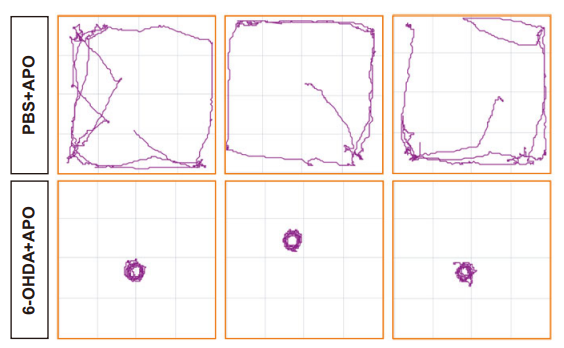
Movement track of PBS + Apomorphine (1 mg/kg, ip, single dose) and 6-OHDA + Apomorphine groups in the Apomorphine-induced mouse rotation test.
-
Biomater Adv
Metabolic reprogramming by microvesicle restores glycolysis and rescues nerve injury-induced erectile dysfunction via endogenous S1P-mediated MEK/ERK signaling. [Abstract]2026 Oct:187:214950. PMID: 42184709 -
Front Biosci (Landmark Ed)
Icariin Attenuates Neuroinflammation and Dopaminergic Degeneration in a Rodent Model of Parkinson's Disease by Promoting the Expansion of Regulatory T Cells. [Abstract]2026 Jun 26;31(6):47325. PMID: 42411473 -
Funct Integr Genomics
Tet1-mediated activation of the Ampk signaling by Trpv1 DNA hydroxymethylation exerts neuroprotective effects in a rat model of Parkinson's disease. [Abstract]2024 Sep 17;24(5):161. PMID: 39285026 -
Genes
Transcriptomic Analysis of Diabetic Erectile Dysfunction Rats After Red Blood Cell Exosome Treatment. [Abstract]2025 Jun 29;16(7):768. PMID: 40725424


Solvant et solubilité
DMSO : 50 mg/mL (187.04 mM; Need ultrasonic; Hygroscopic DMSO has a significant impact on the solubility of product, please use newly opened DMSO)
Please refer to the solubility information to select the appropriate solvent. Once prepared, please aliquot and store the solution to prevent product inactivation from repeated freeze-thaw cycles.
Storage method and period of stock solution: -80°C, 6 months; -20°C, 1 month (sealed storage, away from moisture). When stored at -80°C, please use it within 6 months. When stored at -20°C, please use it within 1 month.
Please refer to the solubility information to select the appropriate solvent. Once prepared, please aliquot and store the solution to prevent product inactivation from repeated freeze-thaw cycles.
Storage method and period of stock solution: -80°C, 6 months; -20°C, 1 month (sealed storage, away from moisture). When stored at -80°C, please use it within 6 months. When stored at -20°C, please use it within 1 month.
Concentration (start) × Volume (start) = Concentration (final) × Volume (final)
Select the appropriate dissolution method based on your experimental animal and administration route.
- For the following dissolution methods, please ensure to first prepare a clear stock solution using an In Vitro approach and then sequentially add co-solvents:
- To ensure reliable experimental results, the clarified stock solution can be appropriately stored based on storage conditions. As for the working solution for In Vivo experiments, it is recommended to prepare freshly and use it on the same day.
- The percentages shown for the solvents indicate their volumetric ratio in the final prepared solution. If precipitation or phase separation occurs during preparation, heat and/or sonication can be used to aid dissolution.
Add each solvent one by one: 10% DMSO 40% PEG300 5% Tween-80 45% Saline
Solubility: ≥ 2.5 mg/mL (9.35 mM); Clear solution
This protocol yields a clear solution of ≥ 2.5 mg/mL (saturation unknown).
Taking 1 mL working solution as an example, add 100 μL DMSO stock solution (25.0 mg/mL) to 400 μL PEG300, and mix evenly; then add 50 μL Tween-80 and mix evenly; then add 450 μL Saline to adjust the volume to 1 mL.
Preparation of Saline: Dissolve 0.9 g sodium chloride in ddH₂O and dilute to 100 mL to obtain a clear Saline solution.
Add each solvent one by one: 10% DMSO 90% (20% SBE-β-CD in Saline)
Solubility: 2.5 mg/mL (9.35 mM); Suspended solution; Need ultrasonic
This protocol yields a suspended solution of 2.5 mg/mL. Suspended solution can be used for oral and intraperitoneal injection.
Taking 1 mL working solution as an example, add 100 μL DMSO stock solution (25.0 mg/mL) to 900 μL 20% SBE-β-CD in Saline, and mix evenly.
Preparation of 20% SBE-β-CD in Saline (4°C, storage for one week): 2 g SBE-β-CD powder is dissolved in 10 mL Saline, completely dissolve until clear.
Please enter the basic information of animal experiments:
-
-
-
-
Recommended: Prepare an additional quantity of animals to account for potential losses during experiments.
Please enter your animal formula composition:
-
%DMSO +
Recommended: Keep the proportion of DMSO in working solution below 2% if your animal is weak.
-
%+
-
+%Tween-80 + +
-
%Saline +
The co-solvents required include: DMSO, . All of co-solvents are available by MedChemExpress (MCE). , Tween 80. All of co-solvents are available by MedChemExpress (MCE).
Working solution concentration: 0.22 mg/mL
Method for preparing stock solution: mg drug dissolved in μL DMSO. Stock solution concentration: mg/mL. * In solvent : -80°C, 6 months; -20°C, 1 month (sealed storage, away from moisture)
1. Take μL DMSO stock solution;
2. Add μL .
μL , mix evenly;
3. Then add μL Tween 80, mix evenly;
4. Then add μL
Please ensure that the stock solution in the first step is dissolved to a clear state, and add co-solvents in sequence. You can use ultrasonic heating (ultrasonic cleaner, recommended frequency 20-40 kHz), vortexing, etc. to assist dissolution.


Pureté et documentation
-
Fiche technique (289 KB)
-
SDS (393 KB)
- English - EN (393 KB)
- Français - FR (393 KB)
- Deutsch - DE (393 KB)
- Norwegian - NO (393 KB)
- Español - ES (393 KB)
- Swedish - SV (393 KB)
- Italian - IT (393 KB)
- Korean - KR (393 KB)
- Portuguese - PT (393 KB)
-
Instruction de manipulation (2659 KB)
Références
[1]. Ikram H, et al. Memory enhancing and neuroprotective effects of apomorphine in a rat model of dementia. Metab Brain Dis. 2024;39(6):1051-1063. [Content Brief]
[2]. Grünblatt E, et al. Apomorphine protects against MPTP-induced neurotoxicity in mice. Mov Disord. 1999;14(4):612-618. [Content Brief]
[3]. Hara H, et al. Apomorphine attenuates 6-hydroxydopamine-induced apoptotic cell death in SH-SY5Y cells. Redox Rep. 2003;8(4):193-197. [Content Brief]
[4]. Himeno E, et al. Apomorphine treatment in Alzheimer mice promoting amyloid-β degradation. Ann Neurol. 2011;69(2):248-256. [Content Brief]
[5]. Jung YS, et al. Apomorphine suppresses TNF-α-induced MMP-9 expression and cell invasion through inhibition of ERK/AP-1 signaling pathway in MCF-7 cells. Biochem Biophys Res Commun. 2017;487(4):903-909. [Content Brief]
[6]. Matsumoto K, et al. Effects in vitro and in vivo by apomorphine in the rat corpus cavernosum. Br J Pharmacol. 2005;146(2):259-267. [Content Brief]
[7]. dos Santos El-Bachá R, et al. Toxic effects of apomorphine on rat cultured neurons and glial C6 cells, and protection with antioxidants. Biochem Pharmacol. 2001;61(1):73-85. [Content Brief]


Complete Stock Solution Preparation Table
Please refer to the solubility information to select the appropriate solvent. Once prepared, please aliquot and store the solution to prevent product inactivation from repeated freeze-thaw cycles.
Storage method and period of stock solution: -80°C, 6 months; -20°C, 1 month (sealed storage, away from moisture). When stored at -80°C, please use it within 6 months. When stored at -20°C, please use it within 1 month.
| Optional Solvent | Concentration Solvent Mass | 1 mg | 5 mg | 10 mg | 25 mg |
|---|---|---|---|---|---|
| DMSO | 1 mM | 3.7408 mL | 18.7042 mL | 37.4083 mL | 93.5209 mL |
| 5 mM | 0.7482 mL | 3.7408 mL | 7.4817 mL | 18.7042 mL | |
| 10 mM | 0.3741 mL | 1.8704 mL | 3.7408 mL | 9.3521 mL | |
| 15 mM | 0.2494 mL | 1.2469 mL | 2.4939 mL | 6.2347 mL | |
| 20 mM | 0.1870 mL | 0.9352 mL | 1.8704 mL | 4.6760 mL | |
| 25 mM | 0.1496 mL | 0.7482 mL | 1.4963 mL | 3.7408 mL | |
| 30 mM | 0.1247 mL | 0.6235 mL | 1.2469 mL | 3.1174 mL | |
| 40 mM | 0.0935 mL | 0.4676 mL | 0.9352 mL | 2.3380 mL | |
| 50 mM | 0.0748 mL | 0.3741 mL | 0.7482 mL | 1.8704 mL | |
| 60 mM | 0.0623 mL | 0.3117 mL | 0.6235 mL | 1.5587 mL | |
| 80 mM | 0.0468 mL | 0.2338 mL | 0.4676 mL | 1.1690 mL | |
| 100 mM | 0.0374 mL | 0.1870 mL | 0.3741 mL | 0.9352 mL |


Apomorphine Related Classifications
HY-12723 Related Classifications
 Powered by Bioz