



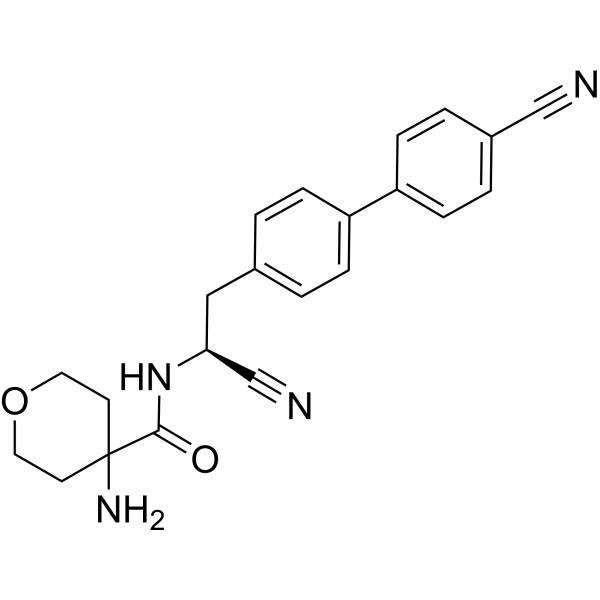
AZD5248

Based on 1 Customer Validation
AZD5248 is an orally active, selective dipeptidyl peptidase 1 (cathepsin C) inhibitor, with IC50 values of 1 nM and 17 nM against human CatC, 44 nM against human DPP1, and 67 nM against rat DPP1. It exhibits low clearance and high bioavailability in animal models. AZD5248 forms an irreversible covalent bond with the catalytic Cys234 residue of CatC, exerts reversible inhibition via its nitrile moiety, blocks CatC-dependent amyloid formation, and reduces the activation levels of neutrophil serine proteases in bone marrow and blood. AZD5248 reacts with aortic elastin aldehydes to form stable 4-imidazolinones, induces ultrastructural changes in aortic tissue, and has an α-amino acid-based backbone. AZD5248 reduces the severity of acute pancreatitis in mouse models. AZD5248 can be used in research on chronic obstructive pulmonary disease, acute pancreatitis, neurodegenerative diseases, lysosomal storage disorders, acute lung injury, cystic fibrosis, and neutrophil-mediated inflammatory diseases.
Nos produits utilisent uniquement pour la recherche. Nous ne vendons pas aux patients.
- Pureté : 98.9%
- CAS No.: 1254318-44-9
- Formule: C22H22N4O2
- Masse moléculaire:374.44
-
Stockage:Powder -20°C, 3 years ; In solvent -80°C, 6 months , -20°C, 1 month

To place orders, for customer services and technical support, please contact: MedChemExpress USA
Tel: 609-228-6898 E-mail: [email protected] [email protected]


-
 Activité biologique
-
Chemical Information
- Protocole
- Pureté et documentation
- Références
-
 Help & FAQs


Voir tous les produits spécifiques à Isoform Cathepsin
More

Activité biologique
Description
In Vitro
AZD5248 (1-10 μM) potently inhibits recombinant human Cathepsin C with an enzyme IC50 of 1 nM[1].
AZD5248 exhibits fast reactivity in an in vitro propionaldehyde assay, with 15% remaining after 1 h incubation and a half-life of 0.36 h, indicating aortic binding liability[1].
AZD5248 (Serial dilutions; 3 hours) potently inhibits recombinant human Cathepsin C with an IC50 of 2.9 nM[2].
AZD5248 binds to the active site of human Cathepsin C, as evidenced by its co-crystal structure with the protein, and shares overlapping binding space with compound 54 in the enzyme's active site[3].
AZD5248 (50-100 μM; 18 h) shows high reactivity with model aldehydes in pH 7.4 phosphate buffer at 37 °C, with a half-life of 39 min for reaction with 5 mM propionaldehyde[4].
AZD5248 (100 μM; overnight preincubation, 2 h incubation) competitively inhibits 14C]AZD5248 binding to Han Wistar rat aortic homogenate, showing strong activity in this in vitro covalent binding assay[4].
AZD5248 potently inhibits DPP1, with supporting data indicating high selectivity for the target[5].
MedChemExpress (MCE) has not independently confirmed the accuracy of these methods. They are for reference only.
In Vivo
AZD5248 (20 mg/kg; p.o.; single dose) shows persistent, high-affinity binding to rat aortic tissue, with radioactivity retained in the aorta for at least 21 days after a single oral 20 mg/kg dose[4].
AZD5248 (20-200 mg/kg/day; p.o.; daily; 14-28 days) causes ultrastructural changes to rat aortic endothelium and smooth muscle cells, including reduced attachment to elastic laminae and increased intercellular substance[4].
AZD5248 (10 mg/kg; p.o.; twice daily; 8 days) reduces bone marrow neutrophil serine protease activity by 64-90% in rats[5].
MedChemExpress (MCE) has not independently confirmed the accuracy of these methods. They are for reference only.
-
Animal Model:C57BL/6 (6-8 weeks old, gender and weight matched, 20-25 g, caerulein-induced acute pancreatitis)[2]
-
Dosage:20 mg/kg
-
Administration:p.o.; twice daily; 6 days
-
Result:Reduced pancreatic CatC activity to ~70% of sham levels, with p < 0.05 versus caerulein+vehicle group.
Reduced pancreatic tissue damage compared to the caerulein+vehicle group.
-
Animal Model:Lister hooded rats (male)[4]
-
Dosage:20 mg/kg
-
Administration:p.o.; single dose
-
Result:Reached peak concentrations in most tissues 1 hour post-dosing.
Eliminated most tissue radioactivity by 21 days, except for residual radioactivity retained in the aortic wall, outer ear, intervertebral ligament, eye, renal outer medulla, liver, and spleen.
Showed high affinity for elastic tissues, particularly the aorta, with strong retention visible on autoradiograms even at 21 days post-administration.
-
Animal Model:Wistar Hannover rats (male, female)[4]
-
Dosage:20 mg/kg/day; 60 mg/kg/day; 200 mg/kg/day
-
Administration:p.o.; daily; 28 days (20, 60 mg/kg/day); p.o.; daily; ~14 days (200 mg/kg/day, females); p.o.; daily; 28 days (200 mg/kg/day, males)
-
Result:Caused endothelial cells to show reduced association to elastic laminae, morphological changes, and loss of flattened structure.
Induced smooth muscle cells to lose organized contact.
Increased intercellular substance in aortic samples compared to controls.
-
Animal Model:Sprague Dawley (male, 200-400 g)[5]
-
Dosage:10 mg·kg-1
-
Administration:p.o.; twice daily; 8 days
-
Result:Achieved a 90% reduction in bone marrow neutrophil elastase (NE) activity, a 64% reduction in bone marrow proteinase 3 (PR3) activity, and an 88% reduction in bone marrow cathepsin G (CatG) activity compared to vehicle-treated controls after 8 days of treatment.
Recovered bone marrow NE activity to 20% below baseline, PR3 activity to 21% below baseline, and CatG activity to 8% below baseline by day 9 post-treatment.
Reached bone marrow NE activity 10% above baseline, PR3 activity 6% above baseline, and CatG activity 4% above baseline by day 18 post-treatment.
Estimated a k_out (first-order rate constant for loss of response) of 0.0102 h-1, corresponding to a rat neutrophil turnover time of 4 days via an indirect response model fitted to the data.
- Phagocytosis Functional Assay
- Fibrosis/Collagen Morphometry
- Collagen: Sirius Red Staining
- Connective Tissue: Masson's Trichrome/Collagen Trichrome Staining
- Protocol for Pharmacokinetic Study
- Fibers: Elastic Fiber Staining
- Lysosome and acidic-vesicle live-cell staining
- Inhalation Toxicity Study
- Amyloid: Congo Red Amyloid Staining


Chemical Information
-
CAS No. 1254318-44-9
-
Appearance Solid
-
Masse moléculaire 374.44
-
Formule C22H22N4O2
-
Color White to off-white
-
SMILES
N#CC1=CC=C(C2=CC=C(C[C@H](NC(C3(N)CCOCC3)=O)C#N)C=C2)C=C1
-
Livraison
Room temperature in continental US; may vary elsewhere.
-
Stockage
Powder -20°C 3 years In solvent -80°C 6 months -20°C 1 month


Pureté et documentation
-
Fiche technique (292 KB)
-
SDS (419 KB)
- English - EN (419 KB)
- Français - FR (419 KB)
- Deutsch - DE (419 KB)
- Norwegian - NO (419 KB)
- Español - ES (419 KB)
- Swedish - SV (419 KB)
- Italian - IT (419 KB)
- Korean - KR (419 KB)
- Portuguese - PT (419 KB)
-
Instruction de manipulation (2659 KB)
Références
[1]. Banerjee A, et al. Development of potent and selective Cathepsin C inhibitors free of aortic binding liability by application of a conformational restriction strategy. Bioorg Med Chem Lett. 2021;47:128202. [Content Brief]
[2]. Hou W, et al. Identification and Optimization of Novel Cathepsin C Inhibitors Derived from EGFR Inhibitors. J Med Chem. 2019;62(12):5901-5919. [Content Brief]
[3]. Chen X, et al. Discovery and In Vivo Anti-inflammatory Activity Evaluation of a Novel Non-peptidyl Non-covalent Cathepsin C Inhibitor. J Med Chem. 2021;64(16):11857-11885. [Content Brief]
[4]. Bragg RA, et al. Aortic Binding of AZD5248: Mechanistic Insight and Reactivity Assays To Support Lead Optimzation. Chem Res Toxicol. 2015;28(10):1991-1999. [Content Brief]
[5]. Chalmers JD, Kettritz R, Korkmaz B. Dipeptidyl peptidase 1 inhibition as a potential therapeutic approach in neutrophil-mediated inflammatory disease. Frontiers in immunology. 2023 Dec 14;14:1239151. [Content Brief]

Calculators
Concentration (start) × Volume (start) = Concentration (final) × Volume (final)


AZD5248 Related Classifications
HY-12733 Related Classifications
 Powered by Bioz
Keywords
- AZD5248
- 1254318-44-9
- AZD 5248
- AZD-5248
- Dipeptidyl Peptidase
- Cathepsin
- acute pancreatitis
- Han Wistar rat
- caerulein-induced acute pancreatitis mouse model
- neurodegenerative diseases
- neutrophil serine protease
- Cys234
- dipeptidyl peptidase 1
- chronic obstructive pulmonary disease
- cathepsin C
- THP1 cells
- Inhibitor
- inhibitor
- inhibit