



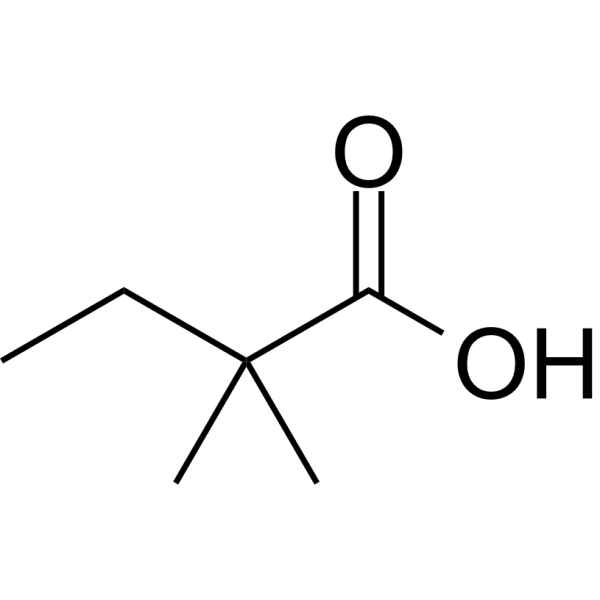
Dimebutic acid

Based on 1 Customer Validation
Dimebutic acid is an orally active short-chain fatty acid. Dimebutic acid stimulates fetal globin production and alters the balance of Bcl family proteins. Dimebutic acid prolongs red blood cell survival. Dimebutic acid exhibits toxicity in rats. Dimebutic acid can be used in the study of β-thalassemia and sickle cell disease.
Nos produits utilisent uniquement pour la recherche. Nous ne vendons pas aux patients.
- Pureté : 99.85%
- CAS No.: 595-37-9
- Formule: C6H12O2
- Masse moléculaire:116.16
-
Stockage:Pure form -20°C, 3 years , 4°C, 2 years ; In solvent -80°C, 6 months , -20°C, 1 month

To place orders, for customer services and technical support, please contact: MedChemExpress USA
Tel: 609-228-6898 E-mail: [email protected] [email protected]


-
 Activité biologique
-
Chemical Information
-
Solvant et solubilité
- Protocole
- Pureté et documentation
- Références
-
 Help & FAQs




Activité biologique
Description
Cellular Effect
|
Cell Line

|
Type | Value | Description | References |
|---|---|---|---|---|
| Hepatocyte | EC50 |
0.8 μM
Compound: 10; HST5040A
|
Reduction of 2-Methylcitric acid in human hepatocytes derived from methylmalonic acidemia patient pretreated for 30 mins followed by 13C-isoleucine addition and measured after 1 hr by MS/MS analysis
Reduction of 2-Methylcitric acid in human hepatocytes derived from methylmalonic acidemia patient pretreated for 30 mins followed by 13C-isoleucine addition and measured after 1 hr by MS/MS analysis
|
[PMID: 33848153] |
| Hepatocyte | EC50 |
0.94 μM
Compound: 10; HST5040A
|
Reduction of propionyl-CoA in human hepatocytes derived from propionic acidemia patient pretreated for 30 mins followed by 13C-isoleucine addition and measured after 1 hr by MS/MS analysis
Reduction of propionyl-CoA in human hepatocytes derived from propionic acidemia patient pretreated for 30 mins followed by 13C-isoleucine addition and measured after 1 hr by MS/MS analysis
|
[PMID: 33848153] |
| Hepatocyte | EC50 |
1.1 μM
Compound: 10; HST5040A
|
Reduction of 2-Methylcitric acid in human hepatocytes derived from propionic acidemia patient pretreated for 30 mins followed by 13C-isoleucine addition and measured after 1 hr by MS/MS analysis
Reduction of 2-Methylcitric acid in human hepatocytes derived from propionic acidemia patient pretreated for 30 mins followed by 13C-isoleucine addition and measured after 1 hr by MS/MS analysis
|
[PMID: 33848153] |
| Hepatocyte | EC50 |
1.4 μM
Compound: 10; HST5040A
|
Reduction of propionyl carnitine in human hepatocytes derived from methylmalonic acidemia patient pretreated for 30 mins followed by 13C-isoleucine addition and measured after 1 hr by MS/MS analysis
Reduction of propionyl carnitine in human hepatocytes derived from methylmalonic acidemia patient pretreated for 30 mins followed by 13C-isoleucine addition and measured after 1 hr by MS/MS analysis
|
[PMID: 33848153] |
| Hepatocyte | EC50 |
11.6 μM
Compound: 10; HST5040A
|
Reduction of CoASH in human hepatocytes derived from propionic acidemia patient pretreated for 30 mins followed by 13C-isoleucine addition and measured after 1 hr by MS/MS analysis
Reduction of CoASH in human hepatocytes derived from propionic acidemia patient pretreated for 30 mins followed by 13C-isoleucine addition and measured after 1 hr by MS/MS analysis
|
[PMID: 33848153] |
| Hepatocyte | EC50 |
130 μM
Compound: 10; HST5040A
|
Drug metabolism in mouse hepatocytes assessed as formation of 2,2-dimethylbutanoic acid-CoA incubated for 1 hrs by MS/MS analysis
Drug metabolism in mouse hepatocytes assessed as formation of 2,2-dimethylbutanoic acid-CoA incubated for 1 hrs by MS/MS analysis
|
[PMID: 33848153] |
| Hepatocyte | EC50 |
14.1 μM
Compound: 10; HST5040A
|
Reduction of CoASH in human hepatocytes derived from methylmalonic acidemia patient pretreated for 30 mins followed by 13C-isoleucine addition and measured after 1 hr by MS/MS analysis
Reduction of CoASH in human hepatocytes derived from methylmalonic acidemia patient pretreated for 30 mins followed by 13C-isoleucine addition and measured after 1 hr by MS/MS analysis
|
[PMID: 33848153] |
| Hepatocyte | EC50 |
2 μM
Compound: 10; HST5040A
|
Reduction of methylmalonyl-CoA in human hepatocytes derived from methylmalonic acidemia pretreated for 30 mins followed by 13C-isoleucine addition and measured after 1 hr by MS/MS analysis
Reduction of methylmalonyl-CoA in human hepatocytes derived from methylmalonic acidemia pretreated for 30 mins followed by 13C-isoleucine addition and measured after 1 hr by MS/MS analysis
|
[PMID: 33848153] |
| Hepatocyte | EC50 |
2.1 μM
Compound: 10; HST5040A
|
Reduction of propionyl-CoA in human hepatocytes derived from methylmalonic acidemia pretreated for 30 mins followed by 13C-isoleucine addition and measured after 1 hr by MS/MS analysis
Reduction of propionyl-CoA in human hepatocytes derived from methylmalonic acidemia pretreated for 30 mins followed by 13C-isoleucine addition and measured after 1 hr by MS/MS analysis
|
[PMID: 33848153] |
| Hepatocyte | EC50 |
2.3 μM
Compound: 10; HST5040A
|
Reduction of acetyl-CoA in human hepatocytes derived from propionic acidemia patient pretreated for 30 mins followed by 13C-isoleucine addition and measured after 1 hr by MS/MS analysis
Reduction of acetyl-CoA in human hepatocytes derived from propionic acidemia patient pretreated for 30 mins followed by 13C-isoleucine addition and measured after 1 hr by MS/MS analysis
|
[PMID: 33848153] |
| Hepatocyte | EC50 |
2.6 μM
Compound: 10; HST5040A
|
Reduction of propionyl carnitine in human hepatocytes derived from propionic acidemia patient pretreated for 30 mins followed by 13C-isoleucine addition and measured after 1 hr by MS/MS analysis
Reduction of propionyl carnitine in human hepatocytes derived from propionic acidemia patient pretreated for 30 mins followed by 13C-isoleucine addition and measured after 1 hr by MS/MS analysis
|
[PMID: 33848153] |
| Hepatocyte | EC50 |
202 μM
Compound: 10; HST5040A
|
Drug metabolism in rat hepatocytes assessed as formation of 2,2-dimethylbutanoic acid-CoA incubated for 1 hrs by MS/MS analysis
Drug metabolism in rat hepatocytes assessed as formation of 2,2-dimethylbutanoic acid-CoA incubated for 1 hrs by MS/MS analysis
|
[PMID: 33848153] |
| Hepatocyte | EC50 |
3 μM
Compound: 10; HST5040A
|
Drug metabolism in human hepatocytes derived from propionic acidemia patient assessed as formation of 2,2-dimethylbutanoic acid-CoA pretreated for 30 mins followed by 13C-isoleucine addition and measured after 1 hr by MS/MS analysis relative to control
Drug metabolism in human hepatocytes derived from propionic acidemia patient assessed as formation of 2,2-dimethylbutanoic acid-CoA pretreated for 30 mins followed by 13C-isoleucine addition and measured after 1 hr by MS/MS analysis relative to control
|
[PMID: 33848153] |
| Hepatocyte | EC50 |
3.5 μM
Compound: 10; HST5040A
|
Drug metabolism in human hepatocytes derived from methylmalonic acidemia patient assessed as formation of 2,2-dimethylbutanoic acid-CoA pretreated for 30 mins followed by 13C-isoleucine addition and measured after 1 hr by MS/MS analysis relative to contro
Drug metabolism in human hepatocytes derived from methylmalonic acidemia patient assessed as formation of 2,2-dimethylbutanoic acid-CoA pretreated for 30 mins followed by 13C-isoleucine addition and measured after 1 hr by MS/MS analysis relative to contro
|
[PMID: 33848153] |
| Hepatocyte | EC50 |
4.3 μM
Compound: 10; HST5040A
|
Reduction of acetyl carnitine in human hepatocytes derived from methylmalonic acidemia patient pretreated for 30 mins followed by 13C-isoleucine addition and measured after 1 hr by MS/MS analysis
Reduction of acetyl carnitine in human hepatocytes derived from methylmalonic acidemia patient pretreated for 30 mins followed by 13C-isoleucine addition and measured after 1 hr by MS/MS analysis
|
[PMID: 33848153] |
| Hepatocyte | EC50 |
4.8 μM
Compound: 10; HST5040A
|
Reduction of acetyl carnitine in human hepatocytes derived from propionic acidemia patient pretreated for 30 mins followed by 13C-isoleucine addition and measured after 1 hr by MS/MS analysis
Reduction of acetyl carnitine in human hepatocytes derived from propionic acidemia patient pretreated for 30 mins followed by 13C-isoleucine addition and measured after 1 hr by MS/MS analysis
|
[PMID: 33848153] |
| Hepatocyte | EC50 |
46.2 μM
Compound: 10; HST5040A
|
Drug metabolism in cynomolgus monkey hepatocytes assessed as formation of 2,2-dimethylbutanoic acid-CoA incubated for 1 hrs by MS/MS analysis
Drug metabolism in cynomolgus monkey hepatocytes assessed as formation of 2,2-dimethylbutanoic acid-CoA incubated for 1 hrs by MS/MS analysis
|
[PMID: 33848153] |
| Hepatocyte | EC50 |
5.9 μM
Compound: 10; HST5040A
|
Drug metabolism in human hepatocytes assessed as formation of 2,2-dimethylbutanoic acid-CoA incubated for 1 hrs by MS/MS analysis
Drug metabolism in human hepatocytes assessed as formation of 2,2-dimethylbutanoic acid-CoA incubated for 1 hrs by MS/MS analysis
|
[PMID: 33848153] |
| Hepatocyte | EC50 |
60 μM
Compound: 10; HST5040A
|
Drug metabolism in Beagle dog hepatocytes assessed as formation of 2,2-dimethylbutanoic acid-CoA incubated for 1 hrs by MS/MS analysis
Drug metabolism in Beagle dog hepatocytes assessed as formation of 2,2-dimethylbutanoic acid-CoA incubated for 1 hrs by MS/MS analysis
|
[PMID: 33848153] |
| Hepatocyte | EC50 |
8.3 μM
Compound: 10; HST5040A
|
Drug metabolism in human hepatocytes assessed as formation of 2,2-dimethylbutanoic acid-CoA pretreated for 30 mins followed by 13C-isoleucine addition and measured after 1 hr by MS/MS analysis relative to control
Drug metabolism in human hepatocytes assessed as formation of 2,2-dimethylbutanoic acid-CoA pretreated for 30 mins followed by 13C-isoleucine addition and measured after 1 hr by MS/MS analysis relative to control
|
[PMID: 33848153] |
| Hepatocyte | EC50 |
8.3 μM
Compound: 10; HST5040A
|
Drug metabolism in mini-pig hepatocytes assessed as formation of 2,2-dimethylbutanoic acid-CoA incubated for 1 hrs by MS/MS analysis
Drug metabolism in mini-pig hepatocytes assessed as formation of 2,2-dimethylbutanoic acid-CoA incubated for 1 hrs by MS/MS analysis
|
[PMID: 33848153] |
In Vivo
MedChemExpress (MCE) has not independently confirmed the accuracy of these methods. They are for reference only.
-
Animal Model:Sprague-Dawley rats (male: 200-260 g, female: 160-220 g)[2]
-
Dosage:200 mg/kg, 600 mg/kg, 1000 mg/kg
-
Administration:Oral gavage, once a day, for 15 consecutive days, with a 14-day recovery period after the end of administration
-
Result:Did not cause mortality in any dose group.
Showed ataxia for females, had rough coat and thin appearance for males (at 1000 mg/kg).
Showed frequent functional observational battery (FOB) deficits in females, including decreased body tone, rectal temperature, etc.
Decreased RBC, HGB, HCT and increased reticulocytes at high doses.
Increased liver and kidney weights at 1000 mg/kg.


Chemical Information
-
CAS No. 595-37-9
-
Appearance Liquid (Density: 0.9449 g/cm3)
-
Masse moléculaire 116.16
-
Formule C6H12O2
-
Color Colorless to light yellow
-
SMILES
CCC(C)(C)C(O)=O
-
Synonyms
NSC-16045; NSC-741804
-
Livraison
Room temperature in continental US; may vary elsewhere.
-
Stockage
Pure form -20°C 3 years 4°C 2 years In solvent -80°C 6 months -20°C 1 month


Solvant et solubilité
In Vitro:
DMSO : ≥ 100 mg/mL (860.88 mM; Hygroscopic DMSO has a significant impact on the solubility of product, please use newly opened DMSO)
* "≥" means soluble, but saturation unknown.
Please refer to the solubility information to select the appropriate solvent. Once prepared, please aliquot and store the solution to prevent product inactivation from repeated freeze-thaw cycles.
Storage method and period of stock solution: -80°C, 6 months; -20°C, 1 month. When stored at -80°C, please use it within 6 months. When stored at -20°C, please use it within 1 month.
Please refer to the solubility information to select the appropriate solvent. Once prepared, please aliquot and store the solution to prevent product inactivation from repeated freeze-thaw cycles.
Storage method and period of stock solution: -80°C, 6 months; -20°C, 1 month. When stored at -80°C, please use it within 6 months. When stored at -20°C, please use it within 1 month.
Concentration (start) × Volume (start) = Concentration (final) × Volume (final)
In Vivo:
Select the appropriate dissolution method based on your experimental animal and administration route.
- For the following dissolution methods, please ensure to first prepare a clear stock solution using an In Vitro approach and then sequentially add co-solvents:
- To ensure reliable experimental results, the clarified stock solution can be appropriately stored based on storage conditions. As for the working solution for In Vivo experiments, it is recommended to prepare freshly and use it on the same day.
- The percentages shown for the solvents indicate their volumetric ratio in the final prepared solution. If precipitation or phase separation occurs during preparation, heat and/or sonication can be used to aid dissolution.
Add each solvent one by one: 10% DMSO 40% PEG300 5% Tween-80 45% Saline
Solubility: ≥ 2.08 mg/mL (17.91 mM); Clear solution
This protocol yields a clear solution of ≥ 2.08 mg/mL (saturation unknown).
Taking 1 mL working solution as an example, add 100 μL DMSO stock solution (20.8 mg/mL) to 400 μL PEG300, and mix evenly; then add 50 μL Tween-80 and mix evenly; then add 450 μL Saline to adjust the volume to 1 mL.
Preparation of Saline: Dissolve 0.9 g sodium chloride in ddH₂O and dilute to 100 mL to obtain a clear Saline solution.
Add each solvent one by one: 10% DMSO 90% (20% SBE-β-CD in Saline)
Solubility: ≥ 2.08 mg/mL (17.91 mM); Clear solution
This protocol yields a clear solution of ≥ 2.08 mg/mL (saturation unknown).
Taking 1 mL working solution as an example, add 100 μL DMSO stock solution (20.8 mg/mL) to 900 μL 20% SBE-β-CD in Saline, and mix evenly.
Preparation of 20% SBE-β-CD in Saline (4°C, storage for one week): 2 g SBE-β-CD powder is dissolved in 10 mL Saline, completely dissolve until clear.
In Vivo Dissolution Calculator
Please enter the basic information of animal experiments:
-
-
-
-
Recommended: Prepare an additional quantity of animals to account for potential losses during experiments.
Please enter your animal formula composition:
-
%DMSO +
Recommended: Keep the proportion of DMSO in working solution below 2% if your animal is weak.
-
%+
-
+%Tween-80 + +
-
%Saline +
The co-solvents required include: DMSO, . All of co-solvents are available by MedChemExpress (MCE). , Tween 80. All of co-solvents are available by MedChemExpress (MCE).
Working solution concentration: 0.22 mg/mL
Method for preparing stock solution: mg drug dissolved in μL DMSO. Stock solution concentration: mg/mL.
1. Take μL DMSO stock solution;
2. Add μL .
μL , mix evenly;
3. Then add μL Tween 80, mix evenly;
4. Then add μL
Please ensure that the stock solution in the first step is dissolved to a clear state, and add co-solvents in sequence. You can use ultrasonic heating (ultrasonic cleaner, recommended frequency 20-40 kHz), vortexing, etc. to assist dissolution.


Pureté et documentation
-
Fiche technique (273 KB)
-
SDS (393 KB)
- English - EN (393 KB)
- Français - FR (393 KB)
- Deutsch - DE (393 KB)
- Norwegian - NO (393 KB)
- Español - ES (393 KB)
- Swedish - SV (393 KB)
- Italian - IT (393 KB)
- Korean - KR (393 KB)
- Portuguese - PT (393 KB)
-
Instruction de manipulation (2659 KB)
Références
[1]. Parise RA, et al. Liquid chromatography-mass spectrometric assay for quantitation of the short-chain fatty acid, 2,2-dimethylbutyrate (NSC 741804), in rat plasma. J Chromatogr B Analyt Technol Biomed Life Sci. 2008 Feb 1;862(1-2):168-74. [Content Brief]
[2]. Terse PS, et al. Short-term toxicity study of ST-20 (NSC-741804) by oral gavage in Sprague-Dawley rats. Toxicol Pathol. 2011 Jun;39(4):614-22. [Content Brief]


Complete Stock Solution Preparation Table
Please refer to the solubility information to select the appropriate solvent. Once prepared, please aliquot and store the solution to prevent product inactivation from repeated freeze-thaw cycles.
Storage method and period of stock solution: -80°C, 6 months; -20°C, 1 month. When stored at -80°C, please use it within 6 months. When stored at -20°C, please use it within 1 month.
| Optional Solvent | Concentration Solvent Mass | 1 mg | 5 mg | 10 mg | 25 mg |
|---|---|---|---|---|---|
| DMSO | 1 mM | 8.6088 mL | 43.0441 mL | 86.0882 mL | 215.2204 mL |
| 5 mM | 1.7218 mL | 8.6088 mL | 17.2176 mL | 43.0441 mL | |
| 10 mM | 0.8609 mL | 4.3044 mL | 8.6088 mL | 21.5220 mL | |
| 15 mM | 0.5739 mL | 2.8696 mL | 5.7392 mL | 14.3480 mL | |
| 20 mM | 0.4304 mL | 2.1522 mL | 4.3044 mL | 10.7610 mL | |
| 25 mM | 0.3444 mL | 1.7218 mL | 3.4435 mL | 8.6088 mL | |
| 30 mM | 0.2870 mL | 1.4348 mL | 2.8696 mL | 7.1740 mL | |
| 40 mM | 0.2152 mL | 1.0761 mL | 2.1522 mL | 5.3805 mL | |
| 50 mM | 0.1722 mL | 0.8609 mL | 1.7218 mL | 4.3044 mL | |
| 60 mM | 0.1435 mL | 0.7174 mL | 1.4348 mL | 3.5870 mL | |
| 80 mM | 0.1076 mL | 0.5381 mL | 1.0761 mL | 2.6903 mL | |
| 100 mM | 0.0861 mL | 0.4304 mL | 0.8609 mL | 2.1522 mL |


Dimebutic acid Related Classifications
HY-W015881 Related Classifications
 Powered by Bioz